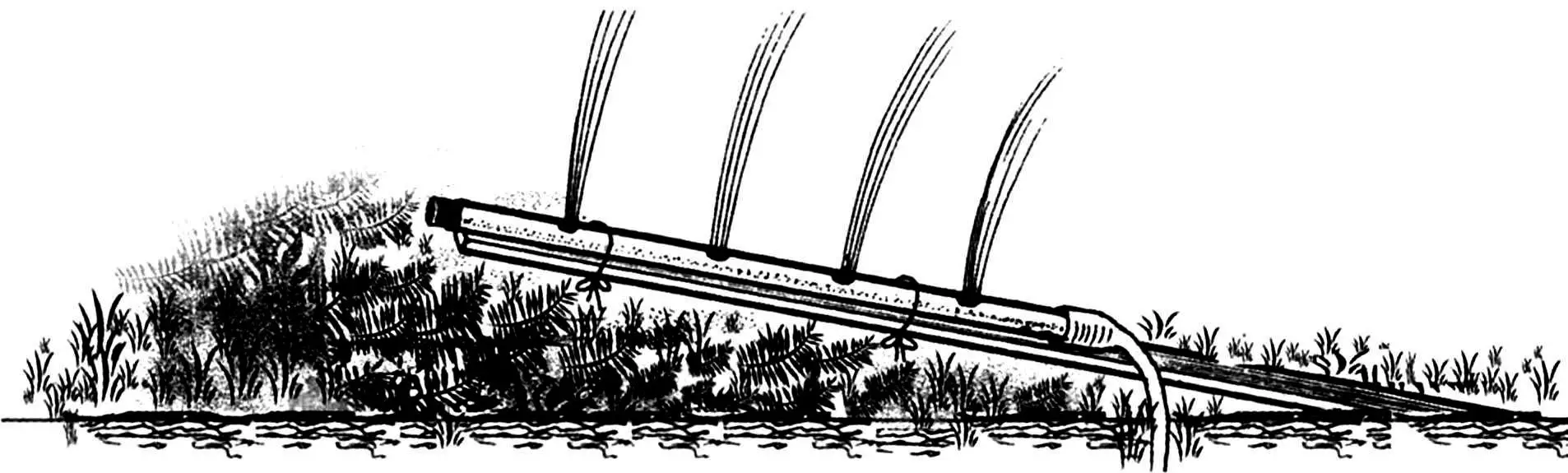
Whatever is planted on a garden plot—flowers, vegetables, shrubs, or fruit trees—every plant needs regular, and often heavy and prolonged watering.
A simple device, successfully tested by me and serving reliably for more than one season, makes this job much easier. It is a kind of mini-irrigation system consisting of a plastic portable water supply line and a series of small irrigation channels (aryks) between the plantings (Fig. 1). While building the aryks is straightforward (just shallow long furrows), supplying water to them required a special solution.
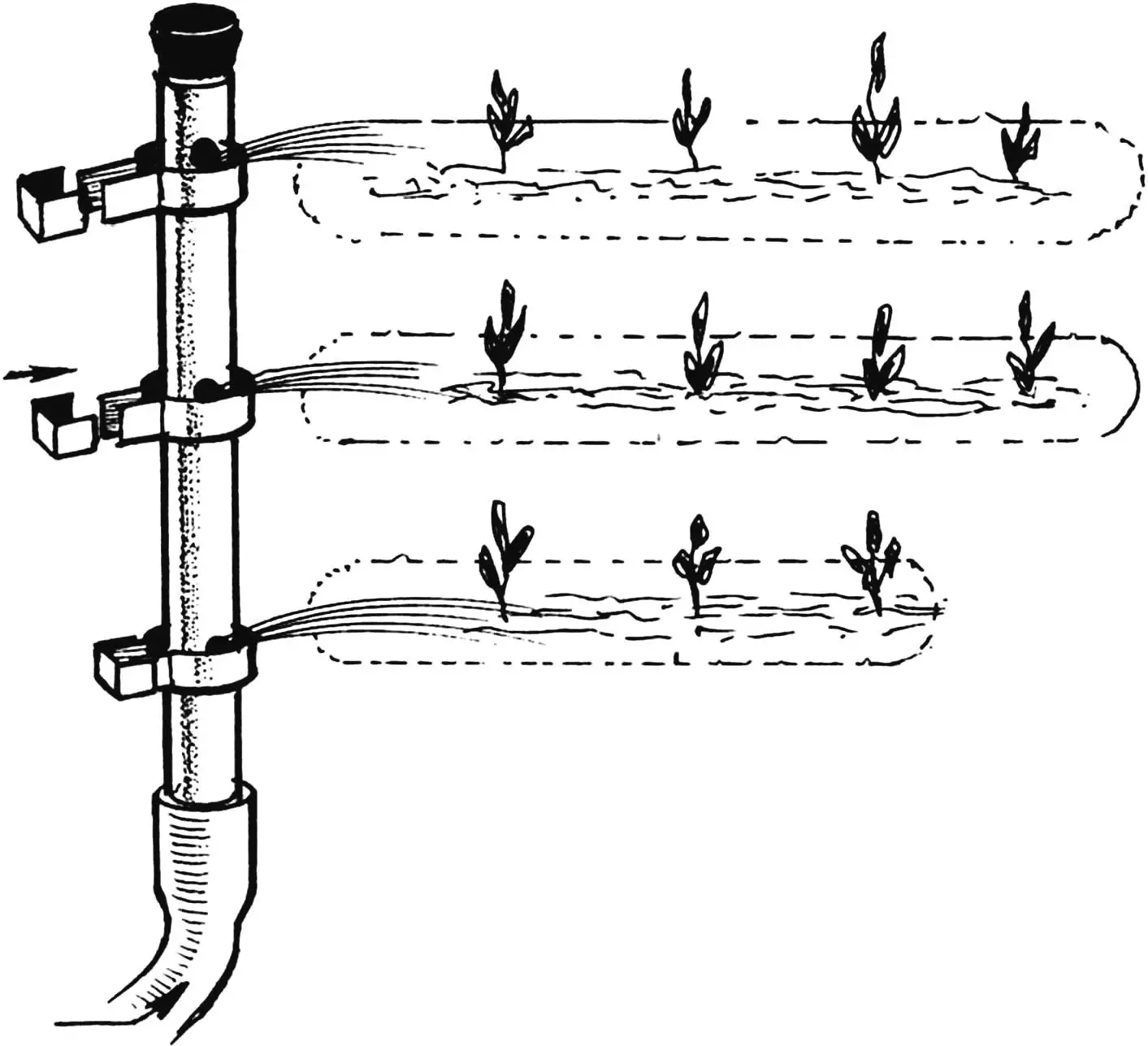
Of course, one could simply lay a length of perforated pipe, as is sometimes done. But in that case the jets are uneven, because water pressure depends on how far each hole is from the capped end of the pipe. Besides, each planting has its own moisture needs. So it is better to supply water selectively—that is, to have some kind of regulating or even shut-off devices on the distribution pipe.
I suggest an irrigation method that I consider the simplest and most accessible for any gardener. For the pipe (with holes near each aryk), split clamps are made from tin or plastic and slipped onto it (Fig. 2). By sliding a clamp over a hole, you can change the jet intensity or shut it off completely. If needed, extra tightening brackets can be made for the clamps to grip their tails; the clamps can also have a rubber or foam gasket.
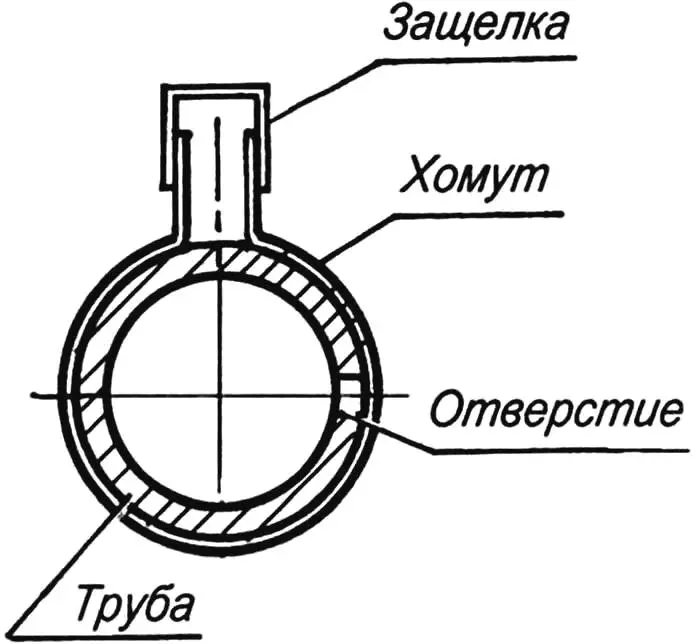
My clamps are made of sheet duralumin, with tails and auxiliary brackets (see Fig. 2). By gradually reducing how much each jet is covered from hole to hole toward the capped end of the pipe (the last one stays fully open), I get even watering. One such pipe serves five beds at once through the aryks.
When I arrive at the dacha, I open the tap, and within half an hour to an hour all the aryks are filled with water and soaking the soil, while I do other jobs that are hard to mechanize—weeding or harvesting, for example.
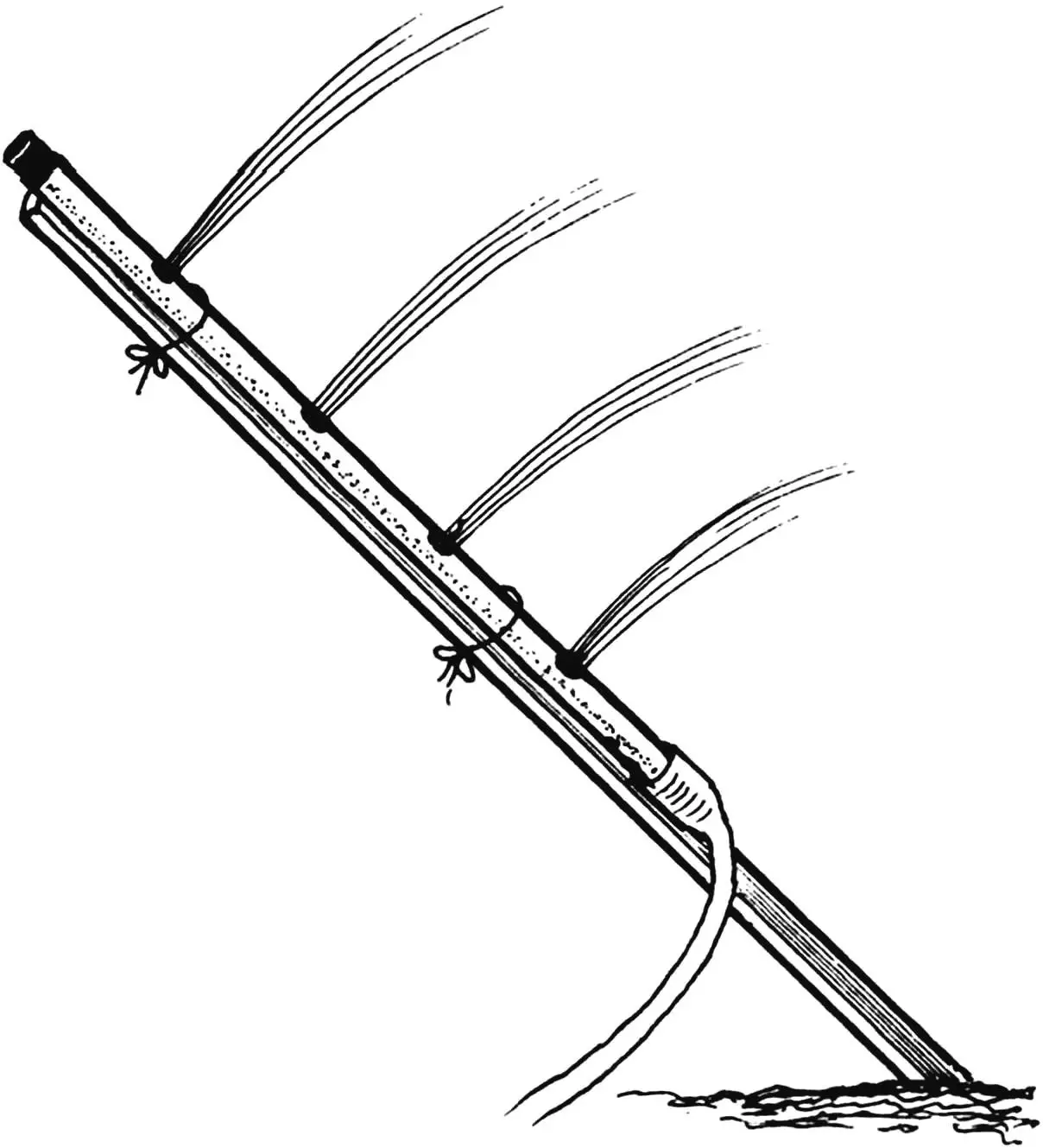
For watering a lawn or flower bed I use the pipe without clamps, setting it at an angle, sloping away from the lawn (Fig. 3)—then the jets disperse in the air (especially against the wind) and do not wash away the grass or soil.
«Modelist-Konstruktor» No. 3’2007, A. GONCHAR, Rudny, Kazakhstan
Recommend to read
 Bottle Flotilla — 3
We have already described the construction of a sailboat and a vessel powered by a rubber motor, using PET soda bottles (see “M-K” No. 5 and 8 for 2024). We suggest adding to the “bottle... Motorcycle in the trunk
Before starting to build the micromotorcycle, I spent a long time drawing various layout options, trying to anticipate on paper all possible errors and miscalculations that could arise...
