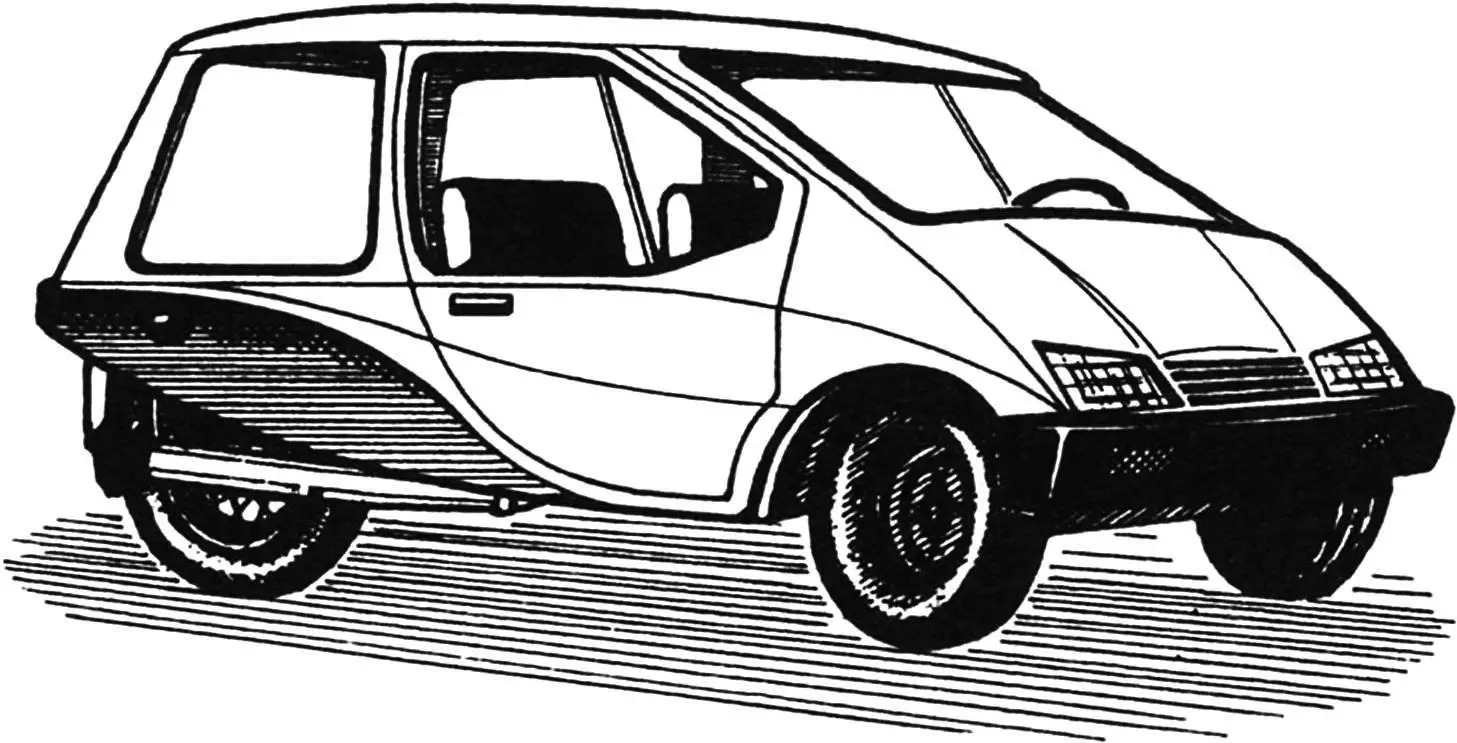
The proverb usually mentions a fifth wheel. However, some car designers use a formula reflected in the title of our article. They really do consider the fourth wheel on a car redundant. Judge for yourself: unlike a four-legged stool, a three-legged one does not rock even on uneven ground (remember from school: through three points you can draw a plane, and only one). Therefore, the frame of a “three-wheeler” will be stiffer, and the vehicle itself will be lighter and stronger (and thus cheaper).
Of course, “three-wheelers” are less stable in turns than traditional four-wheeled cars, but that is hardly a reason to reject such a layout. Then, following that principle, we should have long abandoned the three-wheeled motorcycle with a sidecar. Yet these machines are popular in every country and are not more accident-prone than “four-wheelers”.
It is worth saying that the advantages of three-wheelers have attracted designers since the birth of motoring. After all, Kulibin’s first pedal carriage, Cugnot’s first steam wagon, and Benz’s first gasoline car were three-wheeled. Three wheels were used by designers at world-famous firms such as BMW, Messerschmitt, Zündapp, Heinkel, and many others. In European cities you can see many light three-wheeled trucks, and in Asian cities even three-wheeled taxis. Today the famous Mercedes-Benz company has seriously taken up three-wheelers, developing and building an unusual car called the Mercedes F300 Life-Jet.
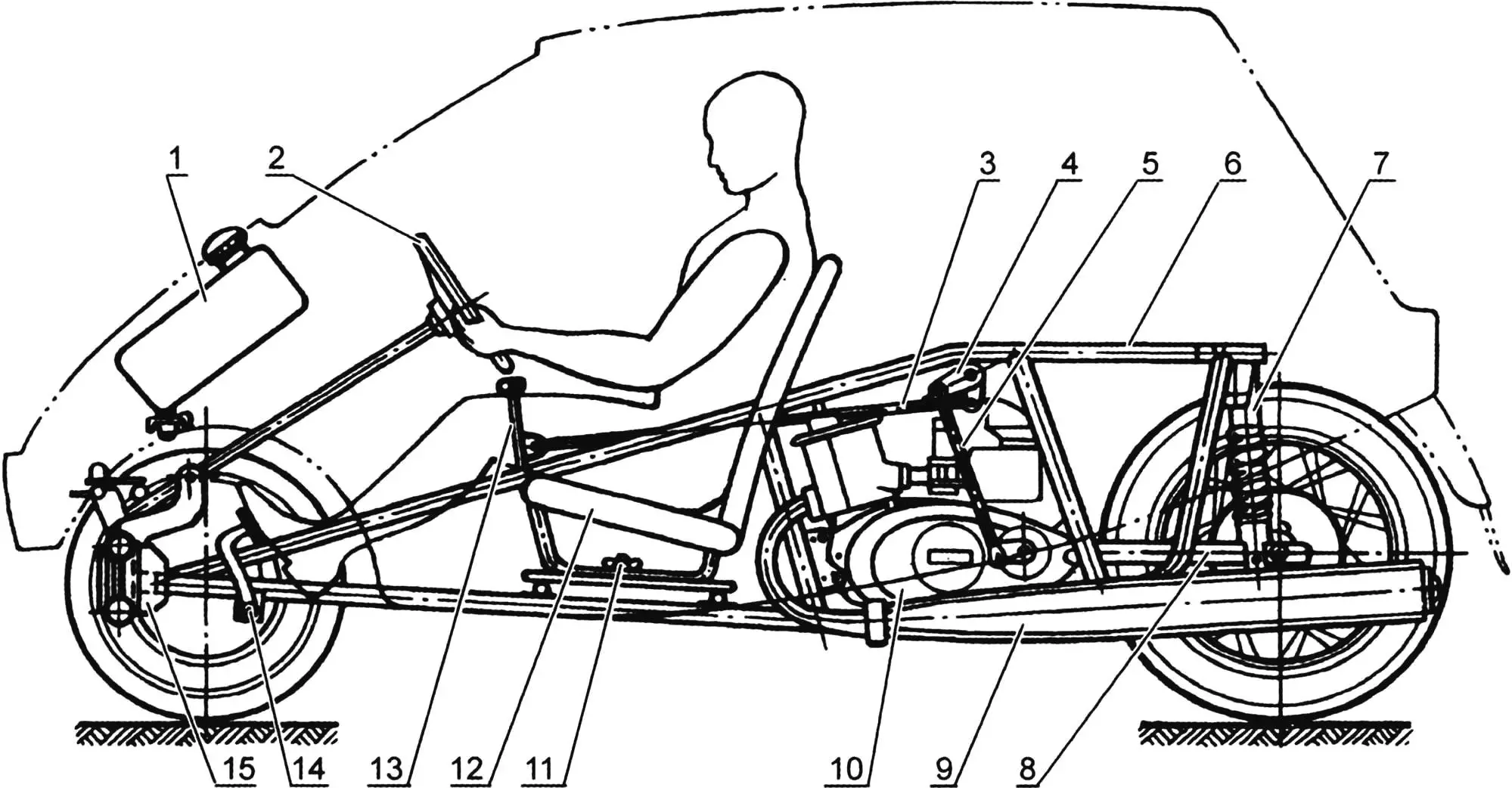
1 — fuel tank (10 L aluminum jerrycan); 2 — steering wheel with rack-and-pinion steering (from S3D); 3, 5 — gearbox control rods; 4 — two-arm lever; 6 — tubular three-wheeler frame; 7 — rear wheel suspension shock absorber; 8 — rear wheel suspension swingarm; 9 — muffler with exhaust pipe; 10 — IZH-Yu-5 engine with liquid cooling jacket; 11 — seat position adjustment clamp; 12 — seat; 13 — gearshift lever; 14 — three-wheeler pedal cluster (clutch–brake–throttle); 15 — front axle (from S3D)
The three-wheeled Mercedes is so unusual that it probably makes sense to tell more about this car. The main point is that its design, with increased stability in banked turns, can be an attractive example when developing home-built three-wheelers.
The main idea of this car is to give a person a sense of freedom and enjoyment of motion, as when riding a motorcycle. And at the same time to provide a level of comfort and safety typical of a car. Daimler-Benz representatives say that the decisive factor for organizing series production of the three-wheeler will be public reaction: if the public likes Life-Jet, full-scale production can be launched within a year or two.
Still, let us return to simpler three-wheelers — those built in our country by amateur car designers. Among them are V. Taranukha from Kharkiv, E. Rudyk from Kyiv, G. Malinovsky and E. Molchanov from Moscow, and many others. It should be said that both designers and testers of three-wheelers gave the most favorable reviews of such machines. Naturally, driving three-wheelers differed from driving conventional cars (though not more than riding a motorcycle with a sidecar).
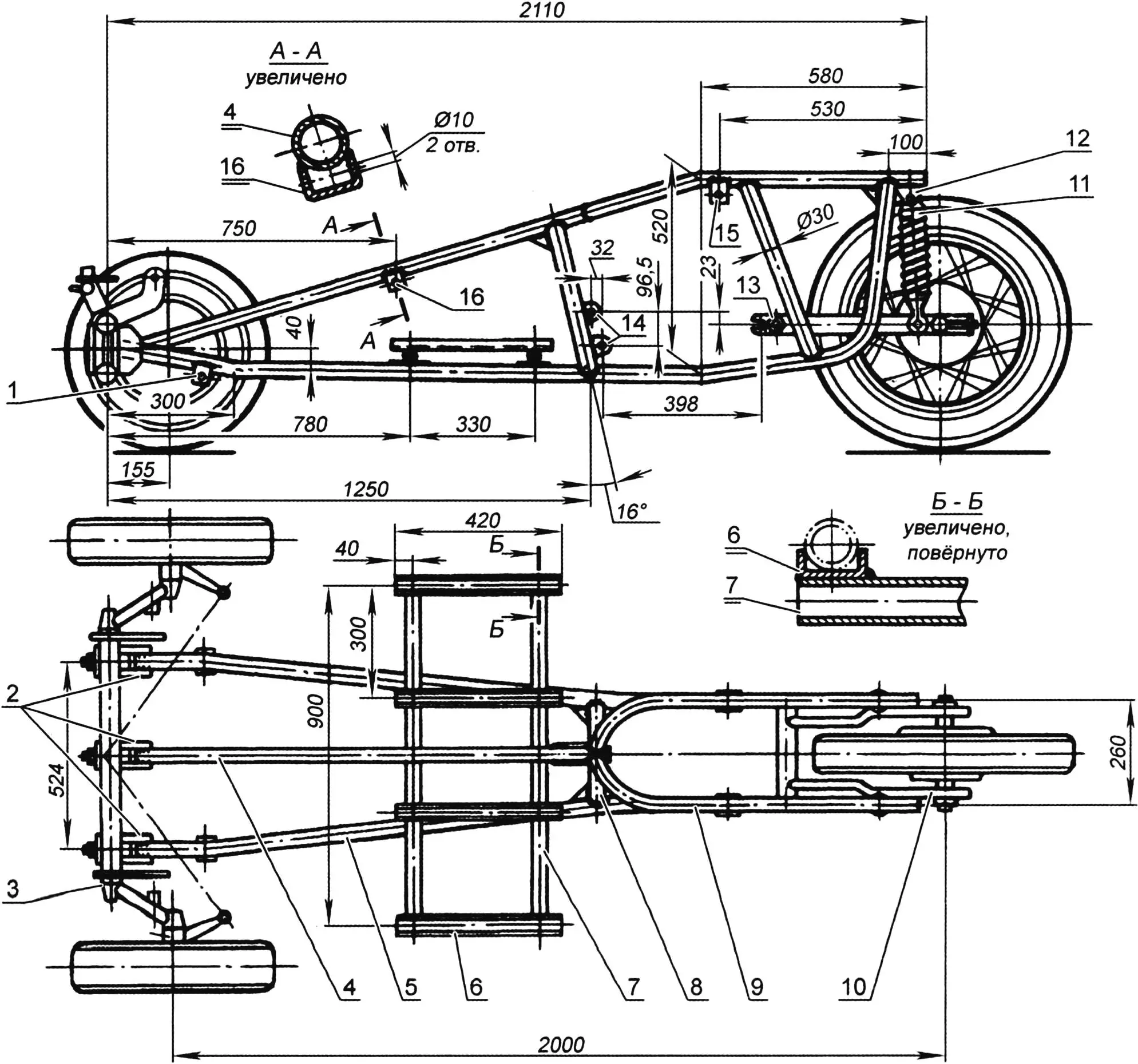
1 — pedal cluster shaft bracket (steel strip 40×3, 4 pcs.); 2 — frame-to-front-axle joint nodes; 3 — front axle (from S3D); 4 — frame brace (steel tube 30×2.5); 5 — frame side member (steel tube 36×2.5, 2 pcs.); 6 — seat rails (channel 25×10×2.5, 4 pcs.); 7 — seat supports (steel tube 20×2.5, 2 pcs.); 8 — cross member (steel tube 36×2.5); 9 — frame top tube (steel tube 30×2.5); 10 — rear suspension swingarm; 11 — rear suspension shock absorber (from IZH-Yu-5 motorcycle, 2 pcs.); 12 — shock absorber mounting lug (steel strip 40×3); 14 — front engine mounting nodes (steel strip 30×10); 15 — gearshift lever shaft bracket (steel strip 40×3, 4 pcs.); 16 — gearshift handle shaft bracket (steel strip 40×3, 4 pcs.)
We present another three-wheeled car named “Triada-350”. It is a two-seat, two-door three-wheeler with extra comfort, powered by a two-cylinder liquid-cooled IZH-Yu-5 engine of 350 cm³ displacement and about 23 hp.
The rear part of the chassis is similar to the IZH-Yu-5 motorcycle — with a swinging fork, standard Izhevsk spring-hydraulic shock absorbers, and chain drive from the engine to the rear wheel. The front axle is from the S3D motorcycle sidecar rig, with torsion suspension, hydraulic shock absorbers, and wheels. The rack-and-pinion steering with column and wheel comes from the same source.
The look of the front body is largely determined by the windshield shape. The “Triada” uses a VAZ-2108 rear window (alternatively Tavria or M-2141) together with part of the rear door. Side and rear windows are cut from 4 mm acrylic. With careful handling and regular care with car cosmetics, acrylic stays transparent for a long time.
The car frame was welded on a jig — a DSP sheet of suitable size painted white with water-emulsion paint. The frame plan projection was drawn on it and wooden blocks were nailed to fix the tubular frame members. In addition, simple clamps and screws and soft tying wire were used.
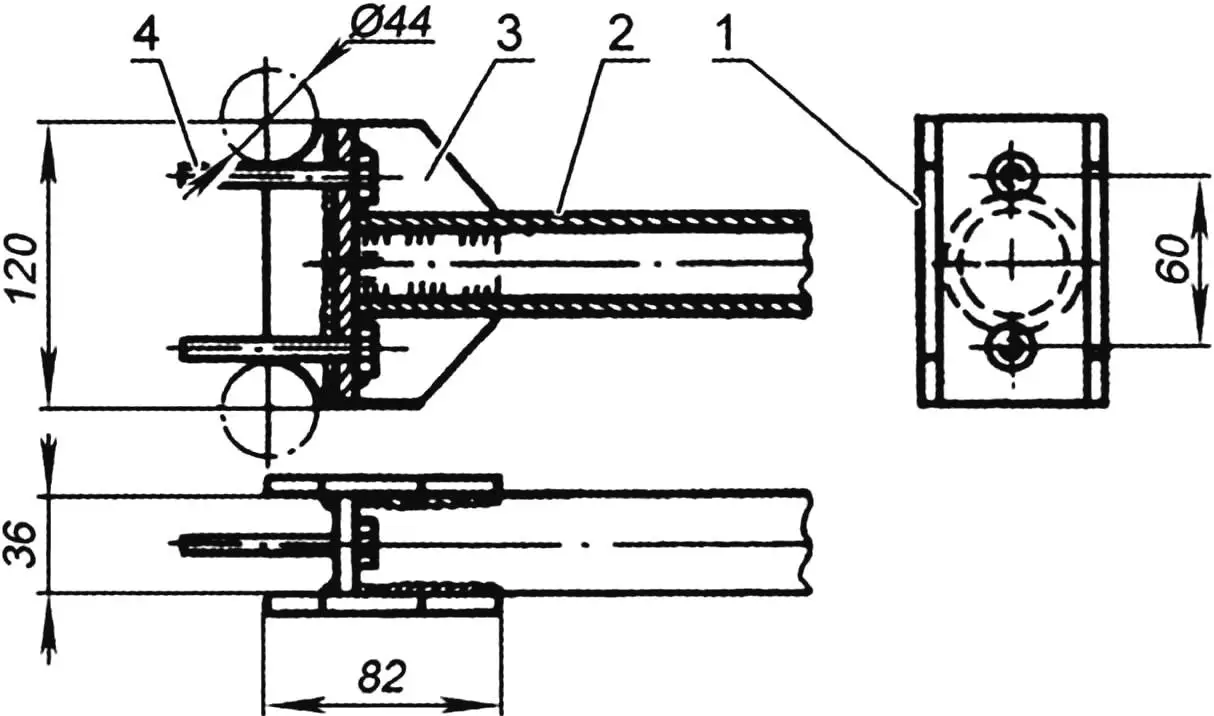
1 — partition (steel, sheet s4); 2 — side member (brace); 3 — cheek (steel, sheet s3); 4 — M10 bolt
Tubular frame members prepared for assembly were fitted to each other and temporarily joined; for this, technological holes were drilled and tying wire passed through. Tubes prepared this way were tacked with two or three weld spots; after careful symmetry checks the joints were welded fully. Symmetrical frame members were welded in short alternating sections — this avoided hard-to-fix thermal distortion.
In a home-built car, even the smallest one, the hardest part is the body, especially a load-bearing one. There are many ways to build this complex spatial assembly: fiberglass glued on a buck or in a mold, sheet metal, plywood or hardboard on a wood or metal frame, or fragments from production cars with home-made metal parts.
Nevertheless the “Triada-350” body stands apart — it has a light tubular frame with window frames attached. It was intended less for structural strength than for shaping. The shell was formed using light plywood frames mounted on the frame, with the space between them filled with sections of construction foam. The foam surface was then brought to 20 mm thickness, smoothed, and covered with two or three layers of fiberglass cloth in epoxy resin outside and one layer inside. The cabin was trimmed in artificial leather. As a result the tubular frame was almost “submerged” in foam and trim. A light, strong body was obtained.
Note that the doors, each with its own tubular frame, were formed integrally with the body and separated only after the surface was fiberglassed. Door glazing is acrylic; the vent window is sliding, sector-type.
The cabin floor is 10 mm plywood, coated with several layers of hot boiled linseed oil and painted with red lead.
The “Triada-350” body has a luggage compartment behind the driver, above the rear wheel.
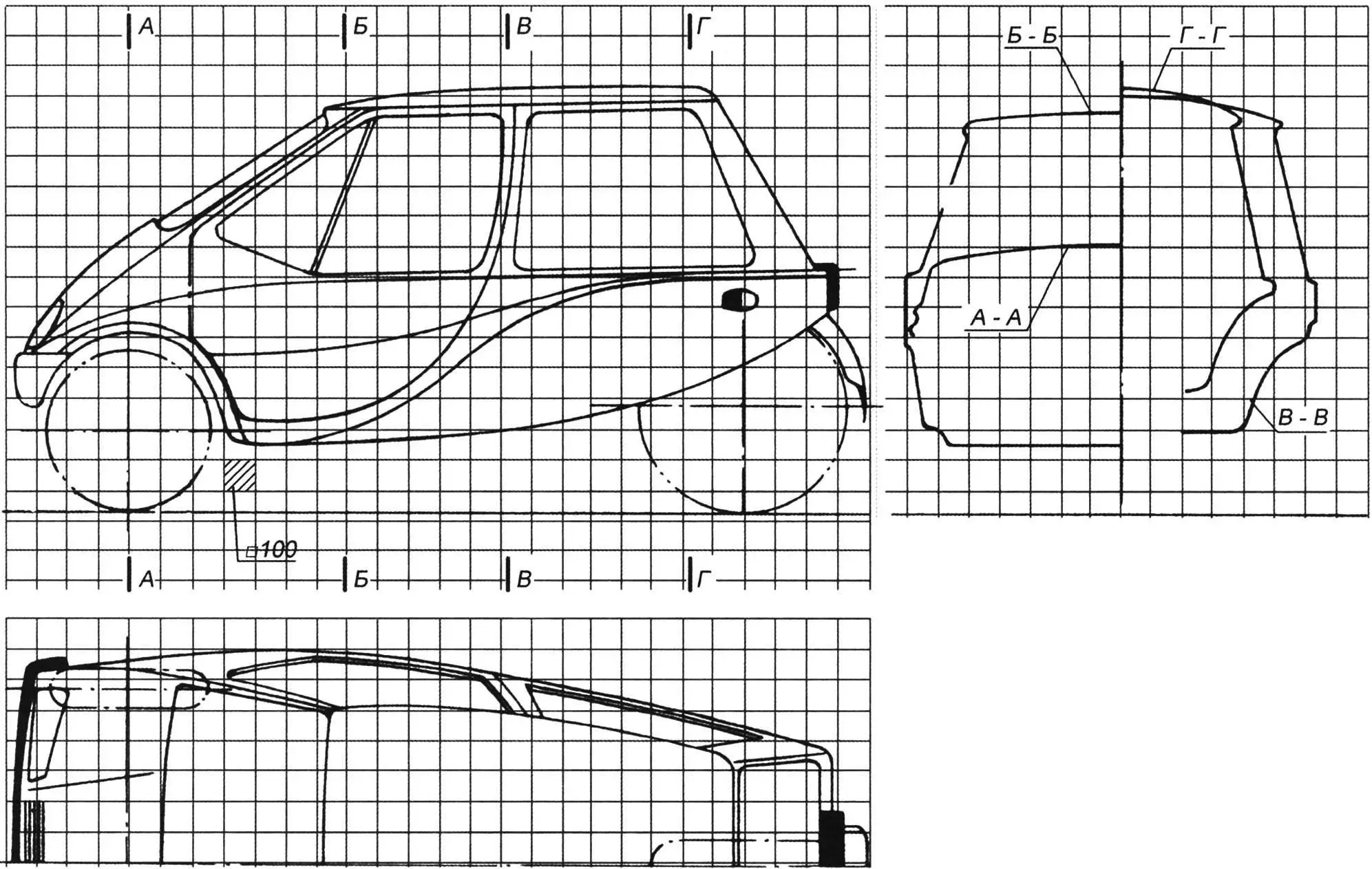
The body is hinged at the front of the frame and at the rear rests on a luggage bulkhead on the frame and is secured with a pair of wing nuts. This mounting gives convenient access to the engine for service — you only need to lift the rear of the body and prop it with a folding strut.
The car control pedals are mounted in the cabin on a shaft fixed in the frame side members. Clutch and carburetor throttle are cable-operated. Brakes are hydraulic. There were no difficulties with the front wheel brakes — they are based on the S3D sidecar rig’s standard brake system. The rear wheel brake shoes were converted from mechanical to hydraulic using wheel cylinders from the sidecar rig.
The gearshift lever is mounted to the right of the driver’s seat on the frame’s central brace. It is connected to the gearshift shaft lever by two rigid tubular rods via an intermediate two-arm lever. First gear is selected by moving the lever forward from neutral; second, third, and fourth by successive movements rearward from neutral.
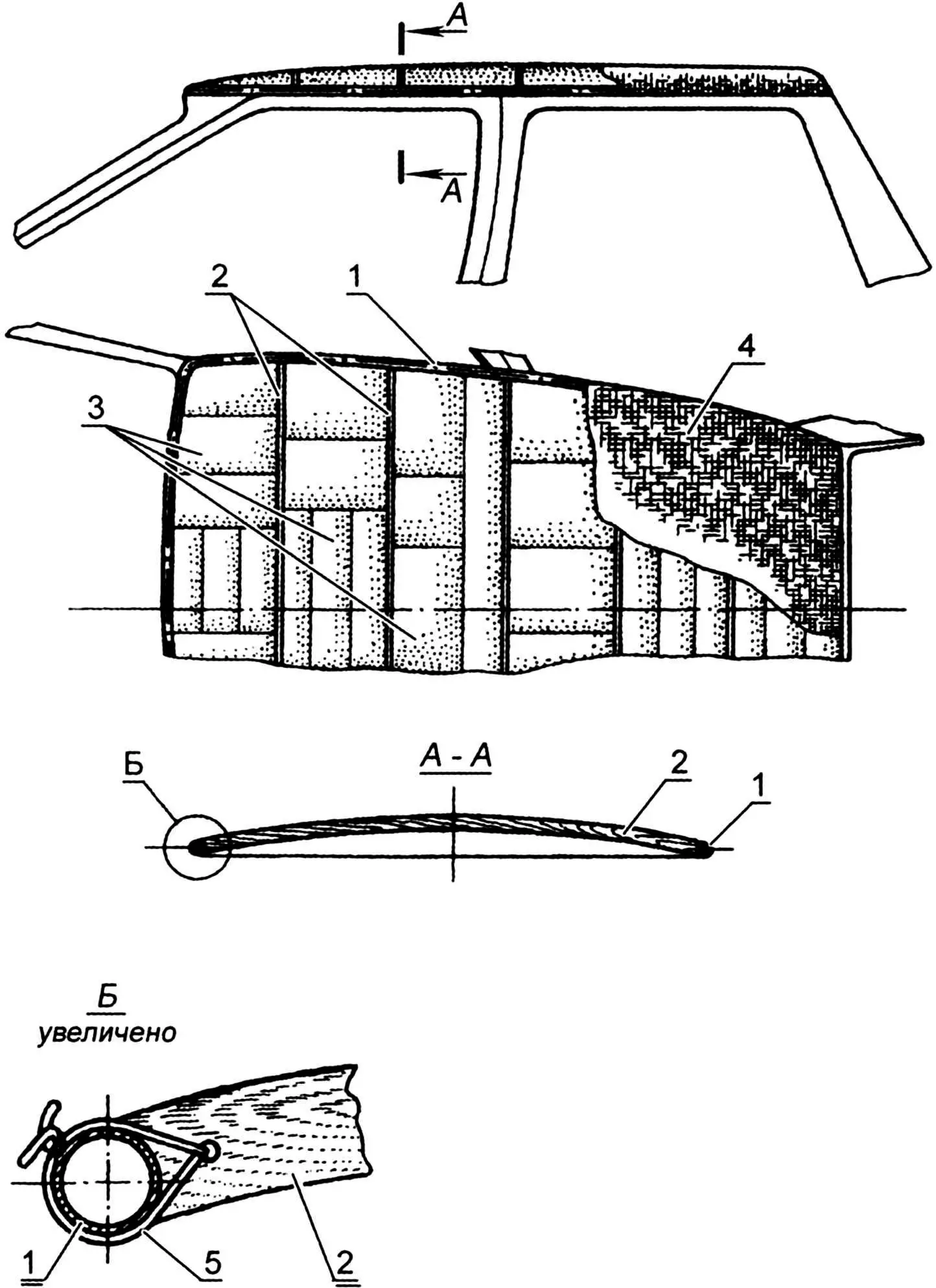
1 — frame (steel tube 12×2 or 16×2); 2 — frames (plywood s10 or s12); 3 — fill (foam); 4 — cover (fiberglass in epoxy resin); 5 — wire (removed after foam is glued in)
The “Triada-350” engine is started with a crank mounted under the instrument panel to the right of the driver, connected by a nylon rope to a drum on the engine’s kickstarter shaft instead of the kick lever. Three turns of rope are wound on the drum.
Steering is the same as on the S3D. The only change — the obsolete standard steering wheel was replaced with a so-called “sport” wheel of smaller diameter.
As already mentioned, the “Triada-350” has a motorcycle engine with liquid cooling. Such engines once gave new life to amateur car building, giving amateurs a powerful, reliable, and stable power unit. The engine cooling radiator is mounted at the front of the car in a tunnel riveted from aluminum sheet. There are also an electric fan (from a Zhiguli heater) and a flap deflector that can direct airflow into the cabin or outside, under the cabin floor.
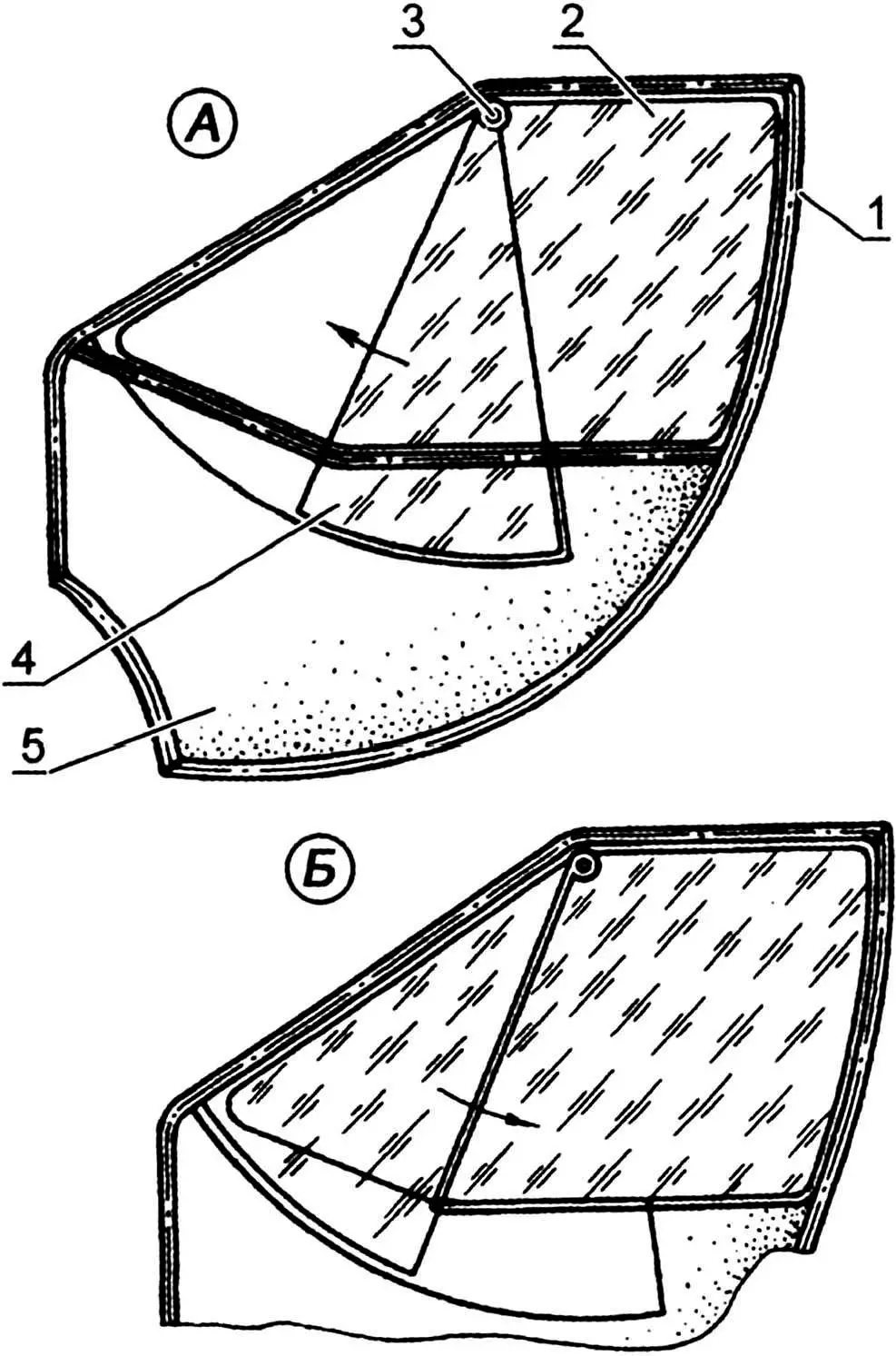
1 — frame (steel tube 12×2 or 16×2); 2 — fixed glass (acrylic s4); 3 — vent hinge; 4 — sliding vent (acrylic s4); 5 — fill (foam)
The three-wheeler’s fuel tank is made from a 10-liter aluminum jerrycan with a standard motorcycle fuel tap with sediment bowl. The tank is mounted at the front of the car. Fuel is fed from the tank by gravity.
Driving a three-wheeled vehicle is not especially difficult. The only thing to set once and for all is the optimum speed for corners. You can do this on a clear asphalt area. While turning, try to lift the front wheel and even ride on two wheels — one front and one rear (sidecar instructors teach this way). It is important to remember the feeling of the lifted wheel — it helps you judge speed in a given bend. Otherwise driving a three-wheeler is no different from a four-wheeler.
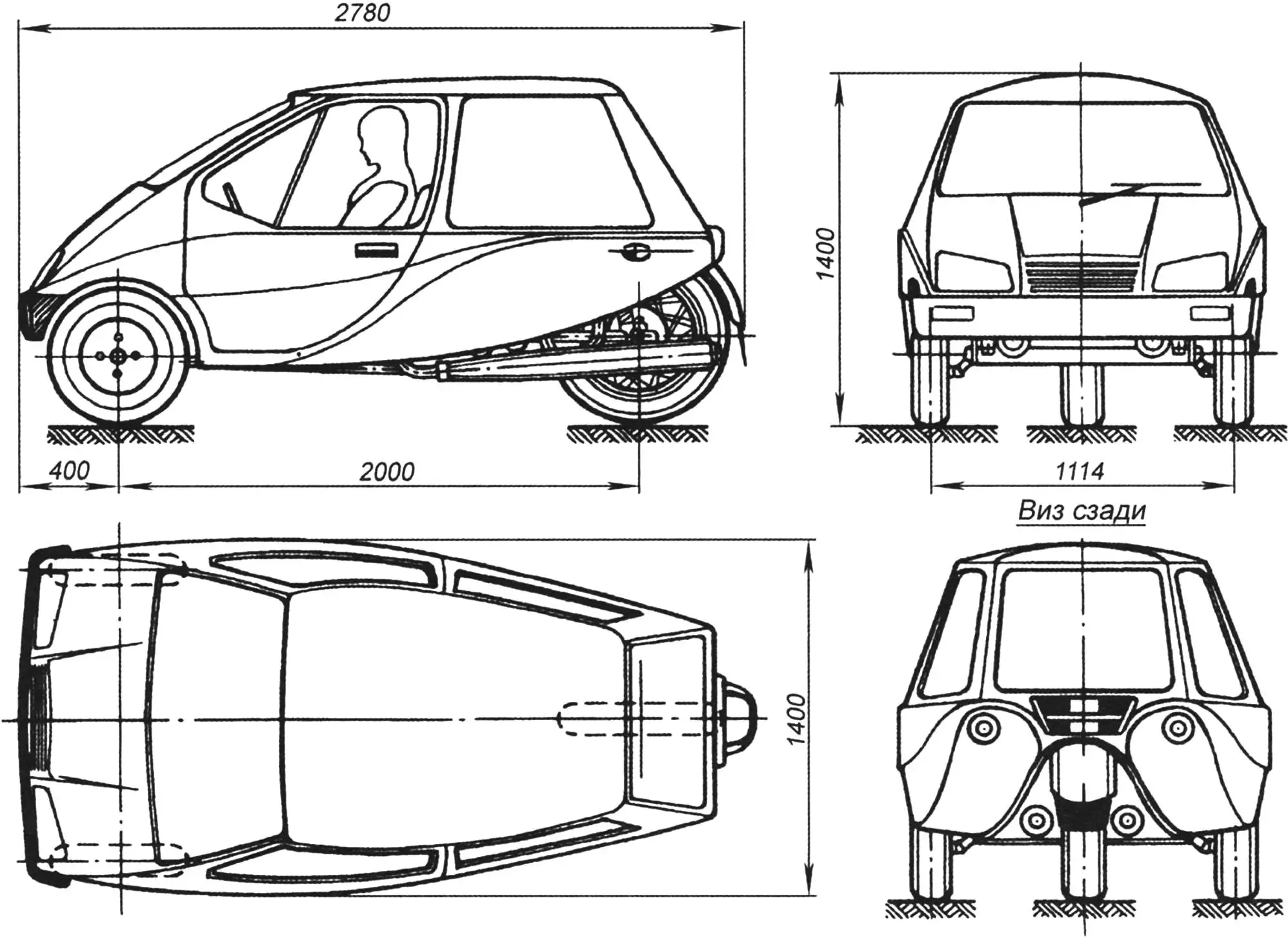
Triada-350 three-wheeler specifications
Wheelbase, mm … 2000
Track, mm … 1114
Ground clearance, mm … 180
Overall dimensions, mm:
length … 2780
width … 1400
height … 1400
Seats … 2
Engine, type … IZH-Yu-5
Engine power, hp … 23
Fuel consumption, L/100 km … 7.5
Tank capacity, L … 10
Maximum speed, km/h … 90
Modelist-Konstruktor No. 9’2014, I. YEVSTRATOV, engineer
Recommend to read
 FLYING IN THE SNOW
All-terrain vehicles are my long-standing and enduring passion. For over thirty years now, in my free time, I have been designing and building various all-terrain vehicles. But I have a... UNIVERSAL POWER SUPPLY
Every radio Amateur knows that without a source of constant and alternating stresses of different magnitudes in practical work is not enough. He needed to establish radiocontrole, repair...
