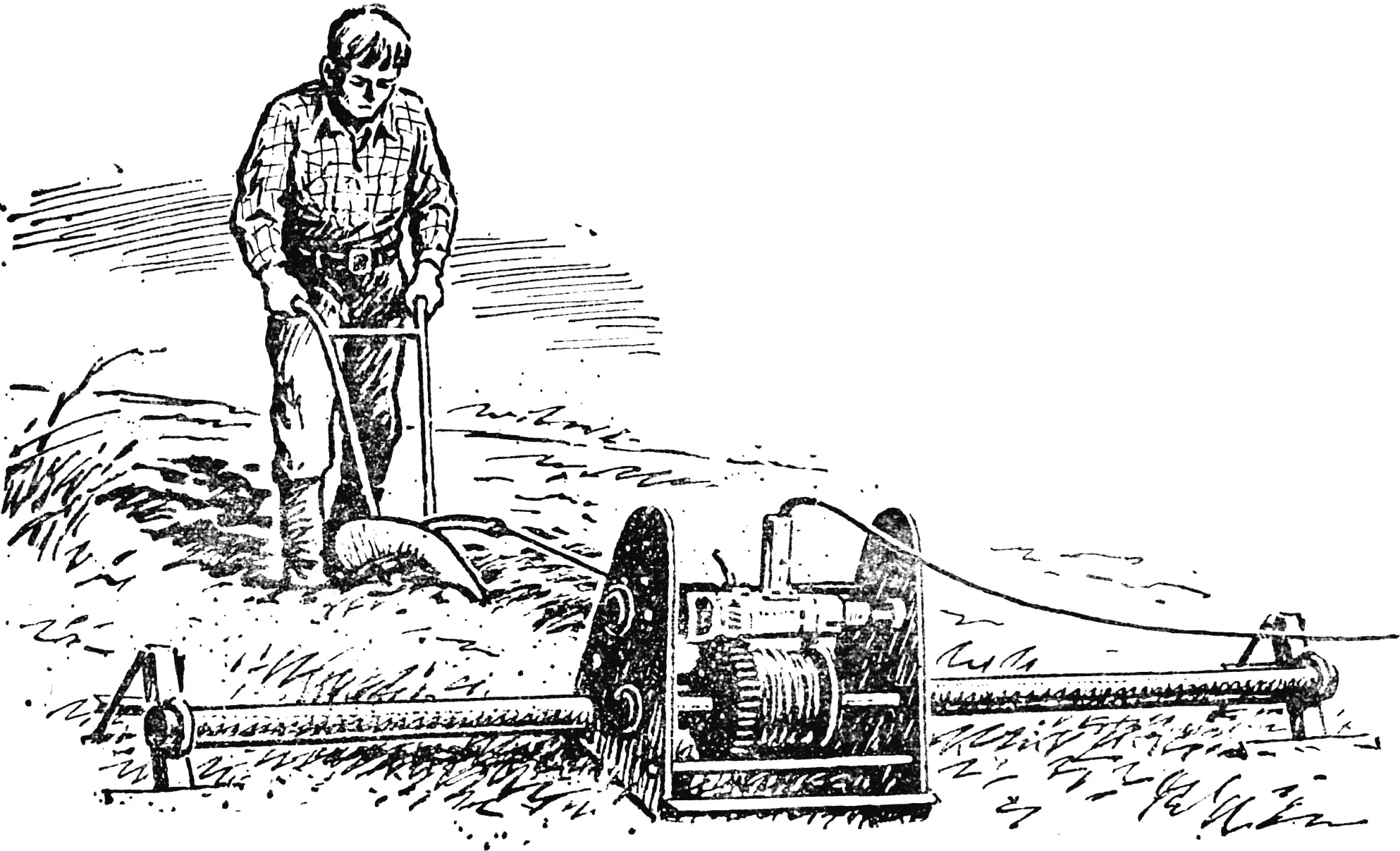
Blessed is the day and hour when a person first had the idea of fitting a chuck for mounting a tool onto the shaft of an electric motor. As a labor tool, the electric drill has become ubiquitous. What people do not do with a drill: they drill, cut, turn, polish, mix, mow, and now even… plow!
In fact, the idea of using electricity in agriculture was born as early as the end of 1920, when the VIII Congress of Soviets approved the plan for the electrification. Its implementation began in the fall of 1921, specifically on October 22. On that gloomy, cool day, the first Soviet electric plow was tested in the field.
Since then, much water has flowed through the turbines of hydroelectric power plants… Energy traveling along wires has become an inseparable attribute of our daily life. True, in the country’s fields machines equipped with powerful and mobile internal combustion engines are at work, but the idea of plowing with electricity is alive to this day. Proof of that is the successful experience of V. I. Morozov, a resident of the settlement of Pavlovo-on-the-Neva in the Kirovsky District of the Leningrad Region. He cultivates his household plot with a homemade electric plow.
Morozov’s plow is the most ordinary kind: a share, a moldboard, an adjustable hitch hook, and handles by which the plowman holds it in the furrow. But hitched to the plow is the winch shown in the drawing. Its design is simple. Between two steel plates of the housing, several horizontal shafts are mounted in bearings. At the rear on top is a single-phase electric drill rated at 600 W with 250 revolutions per minute. Its rear handle is secured on a G-shaped bracket, and the shaft is in the bearing of the drive shaft. The side handle of the drill points upward, and the cable from it runs to the power source.
Gears, brought out of the housing and covered by a casing, transmit torque from the drill to an intermediate shaft. On the latter, a key bushing with a gear is fastened with through bolts; it meshes with the gear of the rope drum. They can be disengaged and engaged again by a clutch lever located higher on a fixed shaft. If the lever is pushed to the side, the clutch dogs, pressing against a groove in the gear, will shift it along the key and take it out of mesh.
The gear with the rope drum is welded together and seated on the power shaft, which is mounted in heavy-duty bearings. To keep the rope from slipping off the drum during winch operation, “gates” are provided in front of it: two vertical pipe sections welded to a horizontal one secured between the housing plates.
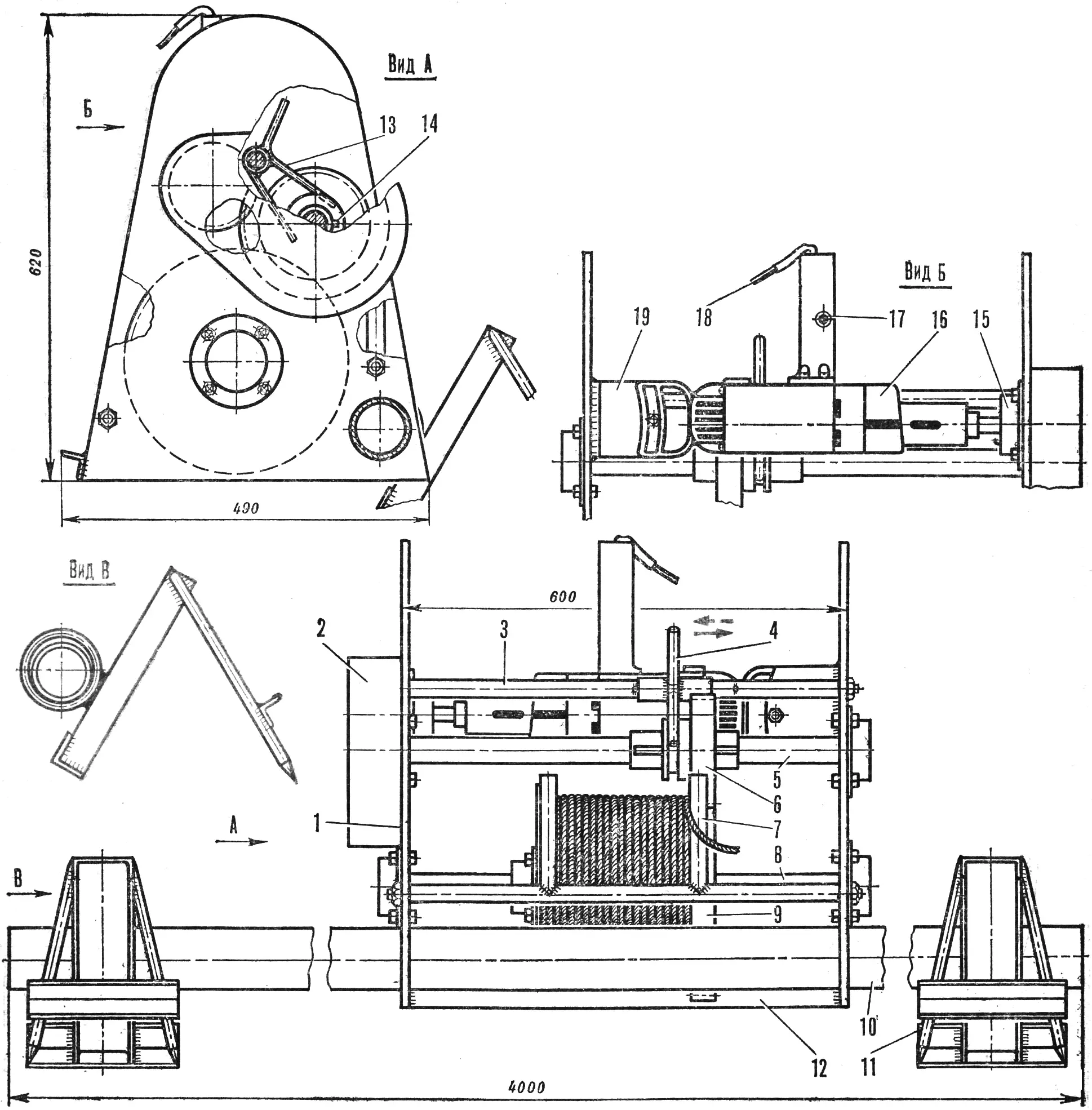
1 — housing, 2 — casing of the drive and intermediate shaft gears, 3 — clutch lever shaft, 4 — clutch lever, 5 — intermediate shaft, 6 — clutch gear, 7 — “gates”, 8 — power shaft, 9 — rope drum gear, 10 — support pipe, 11 — trestle, 12 — support angle, 13 — clutch dog, 14 — key, 15 — drive shaft bearing, 16 — electric drill, 17 — switch, 18 — cable, 19 — bracket.
The winch weighs quite a lot; moving it along the edge of the plot after each plowed furrow is not easy. Therefore the entire assembly is placed on a long pipe of large diameter resting on two trestles. The trestles are firmly secured with stakes and hold the pipe with the winch in place. Since it is positioned relatively high above the ground, the winch is tilted backward and rests on the soil with a support angle welded to the rear lower corners of the housing. In this position the taut rope barely touches the support pipe. But that is necessary, because the closer it is to the ground, the smaller the moment arm of the pulling force that could overturn the winch.
How does Morozov plow with his electric plow? Having set the winch at the end of the support pipe, he disengages the gears and carries the plow to the opposite end of the plot. The rope unwinds freely. Then one of the craftsman’s sons engages the gears with the clutch lever and switches on the electric motor. The drum begins to wind the rope, the plow starts moving, and the plowman only has to guide it along the furrow. When he reaches the edge of the field, the son switches off the drill, and everything starts over.
***
Undoubtedly, the “winch — plow” complex created by the rural craftsman is interesting. But before recommending it for replication, I would like to offer a proposal aimed at improving the design of this complex. The fact is that, as follows from the description, a plot can be plowed with the electric plow only by two people. Someone working alone cannot be at the plow and at the winch at the same time. Therefore he must ensure that control of the clutch and the drill is concentrated on the plow. For example, the clutch could be made electromagnetic.
However, experience shows that no matter how successfully a stationary source of traction works, an autonomous motorized plow is still better. It has more advantages: an obstacle can be bypassed, there is no need to drag it back idle, less effort is spent holding it in the furrow, and so on. In short, those who are fired up by the idea of building an electric plow should aim for an electric motor cultivator. But that does not mean Morozov’s experience should be forgotten. The point is that what he created is very valuable. Look closely: his design has everything that will be needed to create an electric motor cultivator! Only wheels are missing… The rope, support pipe, and trestles, of course, will no longer be used.
…One successful idea gives birth to another, more successful one. And there is no doubt that the day is not far off when electric motor cultivators will help rural workers grow rich harvests alongside their rattling gasoline brothers.
«M-K» 9’81, A. TIMCHENKO
Expert commentary
V. I. Morozov’s electric plow is one of the first designs submitted to the All-Union competition “Small Mechanization” announced by the Central Committee of the Komsomol. Its value lies in the fact that Morozov boldly used electric drive to move the plow. Despite the use of a low-power electric drill not intended for long operation under load, successful operation of the plow shows that the geometric parameters of the gear transmission and rope drum were chosen correctly.
It is unclear, however, whether the quality of soil treatment by Morozov’s electric plow fully meets agrotechnical requirements. After all, a plow must lift a layer of soil to a depth of up to 20 cm, turn it over, and break it into clods up to 5 cm, completely burying plant residues. To cope with this work, the working body must move at a speed of at least 1.25 m/s (4.5 km/h). Calculations show, however, that with transmitted power of 600 W and a resistance to movement of 100 kgf (even without accounting for the efficiency of the transmission mechanism), the speed of Morozov’s plow cannot exceed 0.5 m/s.
The question of electrical safety for the plowman is also unresolved, since the electric drill is intended for use only in a dry enclosed space.
Nevertheless, this in no way diminishes the merit of the rural designer. His experiments, as well as the experience of many other enthusiasts, give impetus to the development of electrified means of small-scale mechanization of agricultural work, which will find wide application in subsidiary farms of citizens of our country.
V. KOZUBOV, senior researcher
Recommend to read
 SCRABLED
Such a tool would work if in wood handle metal brushes to punch the metal plate. The tool will be indispensable in the preparation of surfaces for repainting plate conveniently scrape... FAN LAMP…
The principle of operation of my proposed homemade svetvincenat "Whelan" is forced Ventilation of the Lamp bulb and heat the bottom of the room with warm air by sending heat to the...
