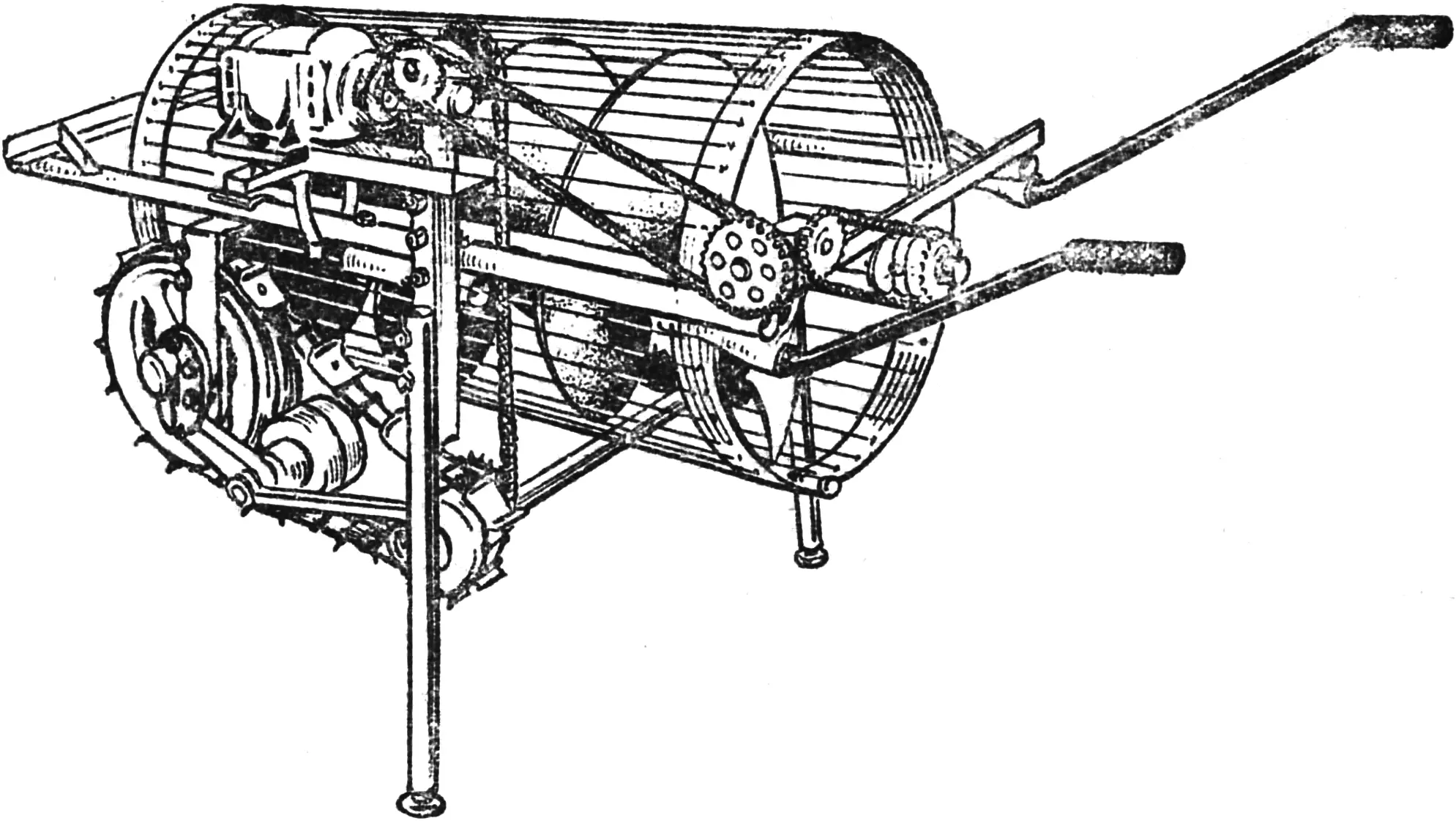
We named our potato digger a screw-drum digger after its two main working elements. It is intended for harvesting tubers on educational and experimental plots, as well as household plots and gardens. That is why an electric motor is used as the drive, although of course an internal combustion engine of suitable power can also be installed on the machine.
It should be noted right away that the potato digger became self-propelled not by itself, but thanks to mounting it on a self-propelled chassis that we, together with the boys, designed as a universal one, also suitable for use with other implements.
The main parts of the digger are a cutting knife (horizontal share), a screw (auger), and a grated drum; the self-propelled chassis consists of a frame, an electric motor, gearboxes, a chain drive, and a tracked undercarriage.
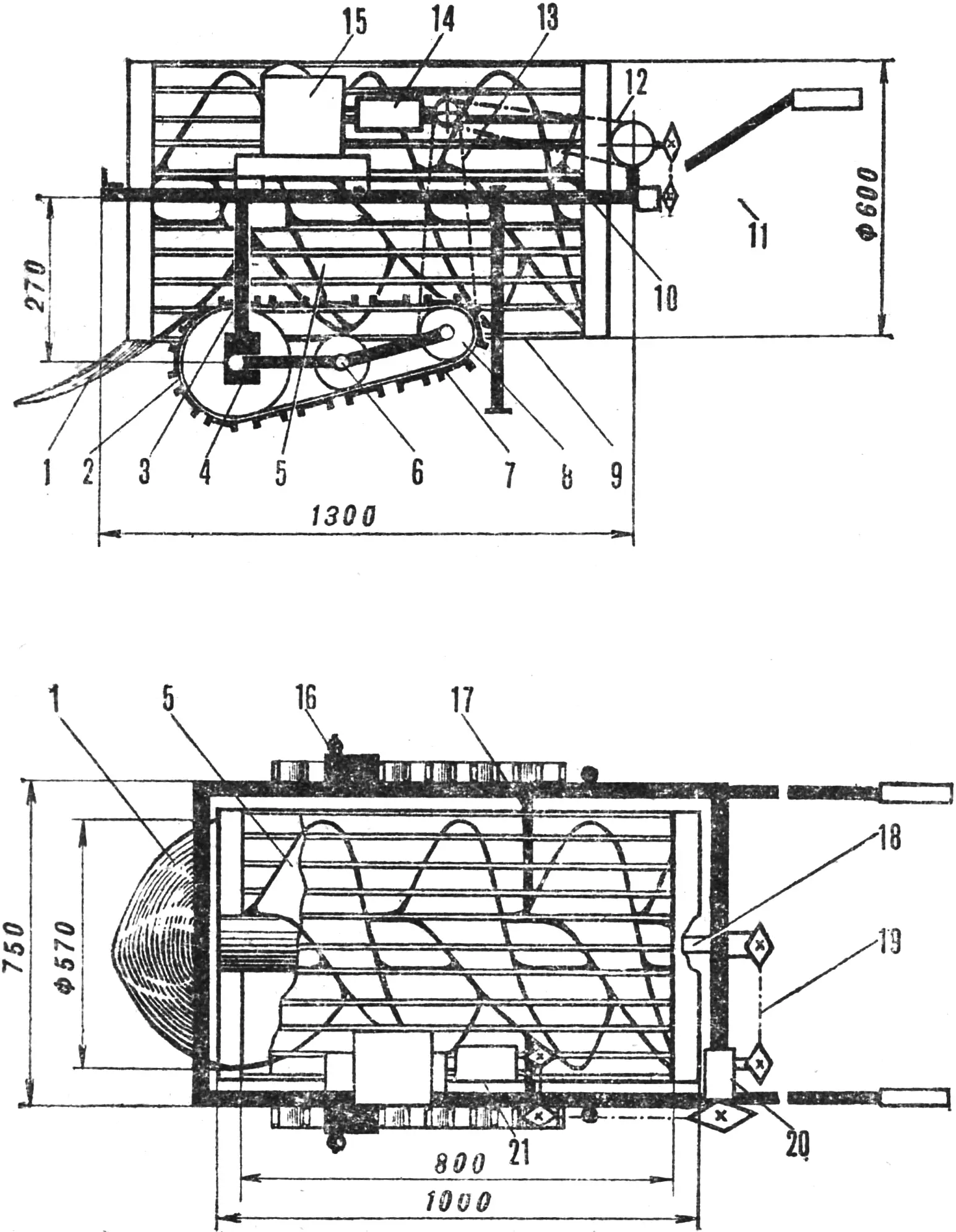
1 — knife (share), 2 — tracked undercarriage, 3 — upright, 4 — bearing housing, 5 — screw (auger), 6 — tension roller, 7 — track shoe, 8 — drive roller with sprocket, 9 — grated drum, 10 — frame, 11 — handle, 12 — intermediate chain drive, 13 — chain drive to the track, 14 — gearbox, 15 — electric motor, 16, 17 — axles, 18 — drum shaft, 19 — chain drive to the drum, 20 — gearbox, 21 — motor subframe.
Metal pipes and angles were used for the chassis frame. The main digger units, the electric motor, and the track uprights are mounted on it.
Aluminum rollers from a flax-puller of a flax combine were used to make the undercarriage. Tracks assembled from grain-loader chains and homemade metal track shoes are fitted over them; their shape prevents soil from sticking.
The potato digger is controlled by handles attached to the frame. Between them is a chain drive that rotates the digger’s screw (auger).
“M-K” 11’81, Oleg SIDELNIKOV, Yuri YELSIN
Recommend to read
 PIPE — HAMMER
There are cases when after oblique impact arm break in two next to the hammer, resulting in not only loss of the tool or of the workpiece, but also serious injury. To avoid this... CARGO FOR CARS
The need for a cargo trailer occurs periodically when it is necessary to carry does not fit the vehicle or soiling the cargo over long distances. Trucking services are very expensive,...
