
Imagine this: you’re standing on the shore of Ecuador’s Lake San Pablo, with a view of the dormant Imbabura volcano before you, and parked nearby is… no, not a luxurious camper with panoramic windows and a rooftop hot tub. Next to you stands an ordinary Chevrolet Super Carry—the same van you’ve seen a thousand times on the streets, delivering pizza or hauling construction materials. But for one brave girl traveling solo through South America, this isn’t just a vehicle. It’s her home. And not just a home, but a fully functional living space where she feels completely comfortable. Sounds incredible? Now imagine that this entire life fits into an area of just over two square meters. Yes, you heard right—two meters. That’s less than a standard king-size bed. That’s less than many of our bathrooms. That’s a space most of us would call, at best, a spacious closet. But it’s precisely this story that makes us reconsider all our notions of what comfort means, what a home is, and how much a person actually needs for a happy life. We’ve studied her video review of this amazing campervan and are ready to share with you five of the most striking lessons that can be learned from her experience. These lessons aren’t just about life on the road—they’re about life in general. Because when space is limited to a minimum, you begin to understand what’s truly important and what’s just unnecessary baggage we’ve been carrying around for years.
Comfort isn’t about square meters, it’s about how you use them
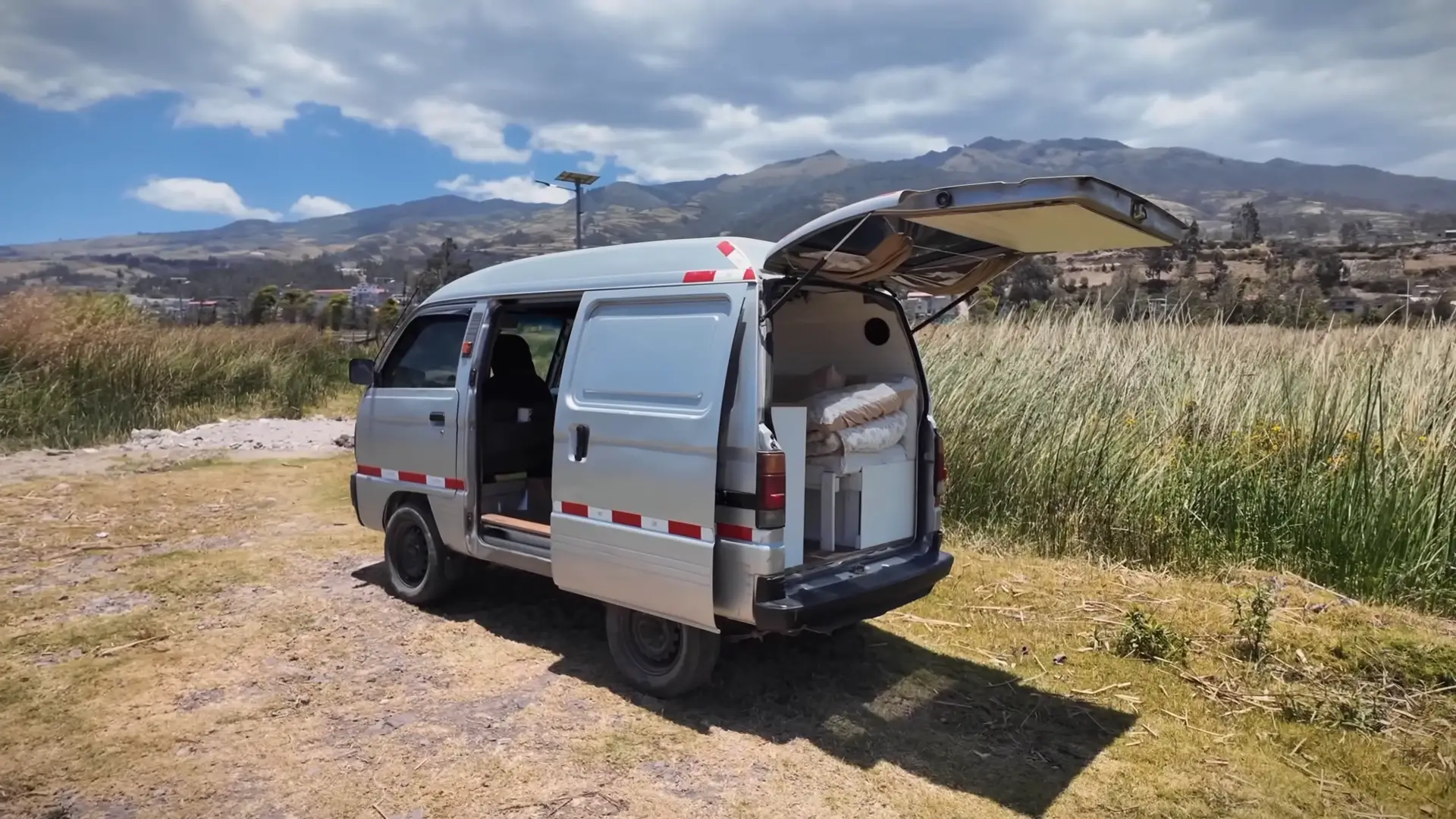
Let’s start with numbers that will blow your mind. The length of the living module in this Chevrolet Super Carry is just 1.80 meters. Width—1.20 meters. Height—1.40 meters. If you multiply length and width, you get 2.16 square meters. That’s less than the area of a standard double bed. That’s less than many of our walk-in closets. That’s a space where most of us couldn’t even turn around properly, let alone live there for months. But here’s what’s interesting: when we watch the video review of this campervan, we don’t see a cramped cubbyhole, but a cozy, well-thought-out space where every detail is in its place. And most importantly—we see a person who says: “I actually feel completely comfortable, and at this stage of my life, this is more than enough for me.” This isn’t showy bravado or an attempt to convince yourself that “it’ll do.” This is a sincere acknowledgment that comfort isn’t about size, but about how well the space meets your needs. Imagine: you live in a huge apartment, but half the rooms sit empty because you simply don’t know what to do with them. Now imagine these two square meters, where every centimeter works for you. Where there isn’t a single unnecessary item, because there simply isn’t room for unnecessary things. Where everything has its purpose and its place. Where you know exactly where everything is, because otherwise it’s simply impossible. That’s the difference. Comfort is created not by square meters, but by thoughtfulness, functionality, and how well the space matches what you truly need. It’s like the difference between a huge warehouse where you can’t find what you need and a small workshop where every tool hangs in its place and is always at hand. But this comfort didn’t appear on its own—it became the result of incredible ingenuity and a willingness to seek unconventional solutions where others would simply give up.
Genius lives in simplicity (and sometimes in ordinary tape)

When we think about homemade campervans, we usually imagine complex engineering solutions, expensive materials, and professional tools. But this project is a true ode to practical ingenuity, where function always trumps form, and simplicity defeats complexity. Take the sink, for example. Why buy a special camping sink for hundreds of dollars when you can take an ordinary metal bowl, cut a drain hole in it, and it will work exactly the same? Simple, cheap, and 100% functional. This isn’t saving for the sake of saving—it’s understanding that complexity doesn’t always mean better. But the most amazing story is about the electric water pump. Imagine: you have a USB pump that works like a faucet. Everything’s great until one day water gets on the control button, and the pump breaks down. What to do? Buy a new one? Look for a waterproof model? No. The solution came from a random viewer on the internet and turned out to be ridiculously simple: cover the button with ordinary tape. The problem was solved once and for all. It’s in moments like these—when advice from a stranger on the internet solves a real problem—that the magic of the road community lies. This is a reminder that sometimes the most brilliant solutions are the ones right on the surface, but we don’t see them because we’re looking for something complex. And there’s also the story of how initially there was a canister for “gray” water under the sink, taking up precious space. But why do you need it if you can simply make a hole in the floor and let the water drain straight outside? This solution freed up space and significantly simplified daily life. Because when you live in such a tiny space, every unnecessary item isn’t just a thing—it’s your enemy, stealing precious centimeters from you. And sometimes the best way to solve a problem isn’t to add something new, but to remove something unnecessary. This is the philosophy of minimalism in action, but not the minimalism from glossy magazines where everything must be perfect and expensive, but real minimalism where the main thing is functionality and simplicity.
The bed isn’t just a place to sleep, it’s the center of your universe
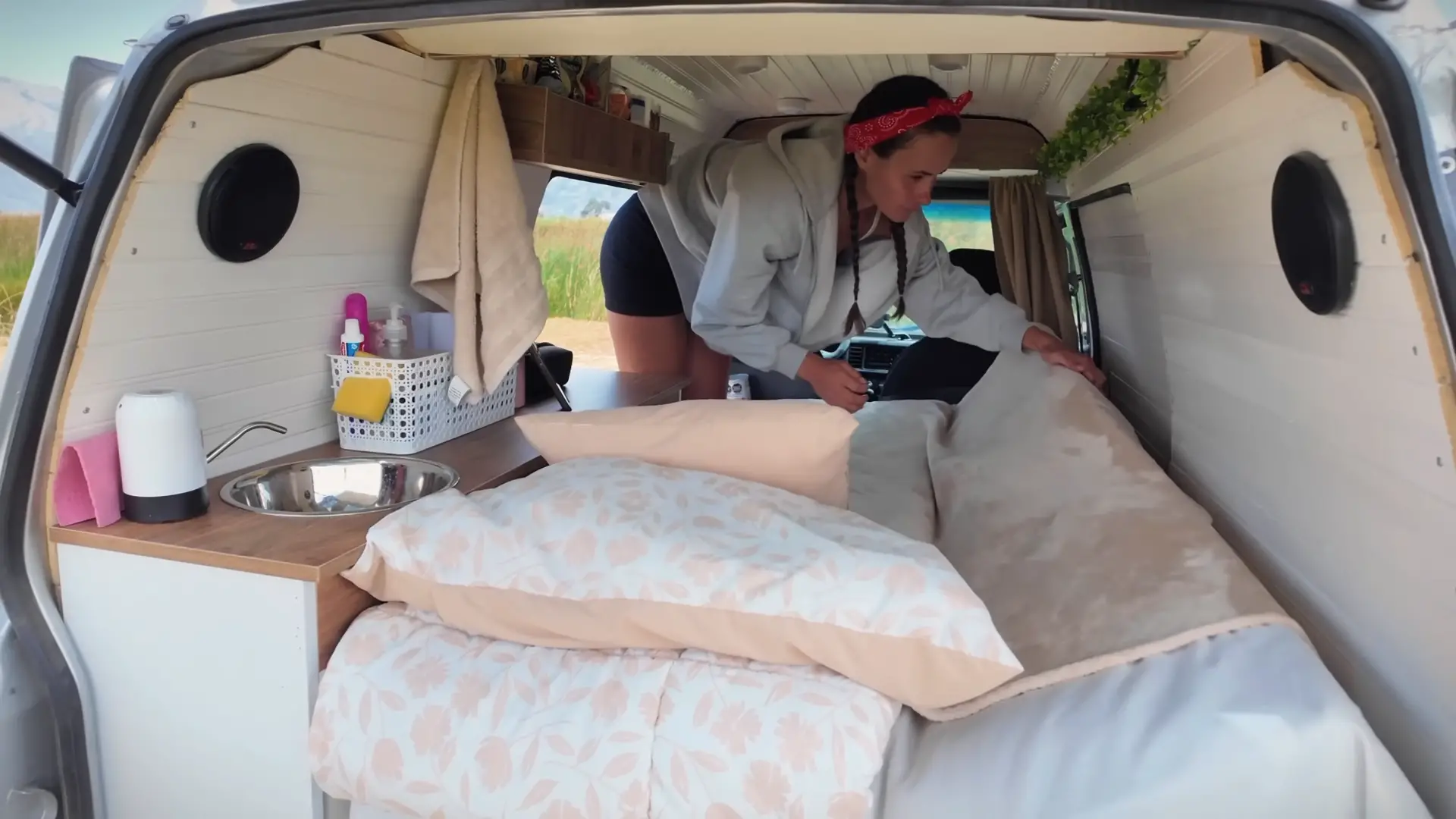
In an ordinary apartment, a bed is just a bed. You sleep on it at night, and that’s it. But when you only have two square meters, every large object must work for you 24 hours a day. And the bed in this campervan is a true masterpiece of multifunctionality. During the day, it’s a sofa 50-60 centimeters wide, comfortable for sitting, working on a laptop, reading a book, or simply looking out the window at that same Imbabura volcano. At night, the structure expands, turning into a full sleeping space 90 centimeters wide. The secret of the transformation lies in the mattress, which consists of two parts—one 50 centimeters, the other 40. During the day, the 40-centimeter section serves as the sofa back, and at night it lies next to the main part, creating a unified sleeping area. Sounds simple? It’s actually genius. But the most important detail that transforms this simple construction into truly comfortable was suggested by a local carpenter—”carpentero,” as they’re called in Ecuador. He not only helped choose paint for the walls but also added special protrusions that prevent the mattress parts from sliding apart at night. Imagine: you’re sleeping, you turn in your sleep, and the mattress parts start sliding apart in different directions. You wake up in the middle of the night in an uncomfortable position because a gap has formed beneath you. This might seem like a small thing, but when you live in constant motion, such small things become real problems. It’s precisely these seemingly unnoticeable details that separate a simple “place to sleep” from true comfort. It’s like the difference between a cheap mattress where you toss and turn all night and a quality one where you wake up rested. But here it’s not about price—it’s about attention to detail, understanding that comfort is made up of small things. And under the bed, by the way, hides another surprise—a huge storage space, which we’ll discuss further. Because in such a tiny space, even the air under the bed must work for you.
Storage is a game of three-level Tetris at expert level

Organizing storage in two square meters isn’t just a task—it’s a true art. It’s like playing Tetris, but at expert level, where you can’t afford a single mistake, because every incorrectly placed item steals precious space from you. But here it’s not just about the ability to cram in everything necessary—it’s a conscious discipline based on frequency of use. The storage system is divided into three logical levels, each with its own purpose. The first level is long-term storage. The huge space under the bed is used for things that aren’t needed every day but can’t be done without. To avoid clutter and protect everything from dust, all items are stored in transparent boxes with lids. Here lie tools for breakdowns, spare bedding, off-season shoes, craft supplies, and, of course, a first aid kit. This is your strategic reserve, which you access rarely, but which must always be at hand. The second level is daily access. Everything needed at hand every day is located on the countertop and in drawers beneath it. Separate drawers for food and clothing, so as not to mix products with belongings. On the shelves, dishes, tea, coffee, and bath accessories are neatly arranged. A box with hygiene products is securely attached to the countertop with double-sided tape—because on the road, everything must be secured, otherwise at the first turn everything will fly apart. The third level is strategic reserve, and here we’re talking about the most important thing in autonomous travel: water. The front part of the vehicle—the passenger seat and the space in front of it—is reserved for water. Two 12-liter canisters under the sink are for technical water from gas stations, used for washing. And in the cab, separate 5-liter bottles of drinking water are stored. The total reserve reaches 60 liters, providing confidence and independence from civilization. This isn’t paranoia—it’s understanding that on the road, water isn’t just a liquid, it’s your freedom. Because when you have a water supply, you can stop anywhere, without thinking about where to find the next gas station or store. This storage system teaches us that order isn’t about aesthetics, but about efficiency. When you know exactly where everything is, you don’t waste time searching. When everything is in its place, you don’t feel chaos, even if the space is tiny. This is discipline that liberates, not limits.
Accepting imperfection isn’t weakness, it’s wisdom
Perhaps the most important lesson this project teaches is a healthy attitude toward imperfection. This isn’t about doing everything sloppily and justifying it with “it’ll do.” It’s about understanding the difference between the ideal from glossy magazines and reality that works. Many of the solutions we’ve discussed—the sink made from a bowl, the pump with tape—work precisely because their creator gave up the pursuit of perfection typical of social media images. The walls and ceiling in this campervan aren’t expensive cedar paneling, but ordinary boards, painted and screwed directly to the body. The floor made of particleboard isn’t even secured—it just lies where it should. It works, and that’s enough. As insulation, double-sided reflective material was used. Does it help? The author honestly admits: “It’s there, even if it doesn’t help, so be it.” The main thing is to do what’s within your power and move forward. This isn’t laziness or indifference—it’s understanding that perfectionism often becomes the enemy of progress. Because while you’re searching for the perfect solution, you’re standing still. And while you’re using what works, you’re moving forward. Things get dirty quickly on the road—that’s a natural part of life in motion. The cutting board has blackened from the pan, the food container can’t be cleaned completely anymore. This isn’t a tragedy, it’s just life. The author searched for a long time for the perfect organizer box but found nothing suitable. Instead of continuing to search or ordering something special, she accepted the one she had, and it turned out to be very convenient. This is a reminder that sometimes “good enough” is exactly what you need. Because the ideal is an illusion, and a working solution is reality. And when you live in constant motion, reality is always more important than illusions. This lesson is especially important in our time, when social media makes us think everything must be perfect. But the ideal isn’t a goal—it’s a trap that prevents us from moving forward.
What’s truly important when space is limited
The story of this Chevrolet Super Carry isn’t just a DIY campervan assembly manual. It’s a manifesto that freedom isn’t measured in cubic meters of living space, but in the courage to make unconventional decisions and the willingness to give up the unnecessary for what’s truly important. This project shows us that for a comfortable, happy, and adventure-filled life, we need far fewer things than we’re used to thinking. The main thing isn’t the number of square meters, but the thoughtfulness of every centimeter. The main thing isn’t expensive materials, but ingenuity and a willingness to seek simple solutions. The main thing isn’t perfect aesthetics, but functionality and comfort. This campervan teaches us that limitations aren’t obstacles, but opportunities. When you don’t have room for the unnecessary, you begin to understand what’s truly needed and what can be done without. When every centimeter counts, you begin to value simplicity and functionality. When you can’t hide imperfection behind expensive materials, you learn to accept reality as it is. And most importantly—this project reminds us that home isn’t about walls and a roof, but about how you feel in that space. You can live in a palace and feel like you’re in prison. Or you can live in two square meters and feel free. And what in your life would turn out to be unnecessary if you had to fit it all into two square meters? This question makes you think not only about things, but about priorities, about what’s truly important and what’s just baggage we’ve been carrying around for years. And maybe the answer to this question will help you understand what you can change in your life today, without waiting for the moment when you’ll have to fit everything into two square meters.
Lesya (LESYAKA)
Recommend to read
 STAIRCASE WITH A MAGNET…
Any upholstery work carried out from ladders, is difficult because you have to constantly climb in pockets for supplies nails, and even down behind them. But the solution is simple:... VELOTANDEM “TWO PLUS TWO”
Among the participants of the traditional velometer in the city of šiauliai, this bike stood out primarily for its unusually large capacity. Still, relatively compact and lightweight...
