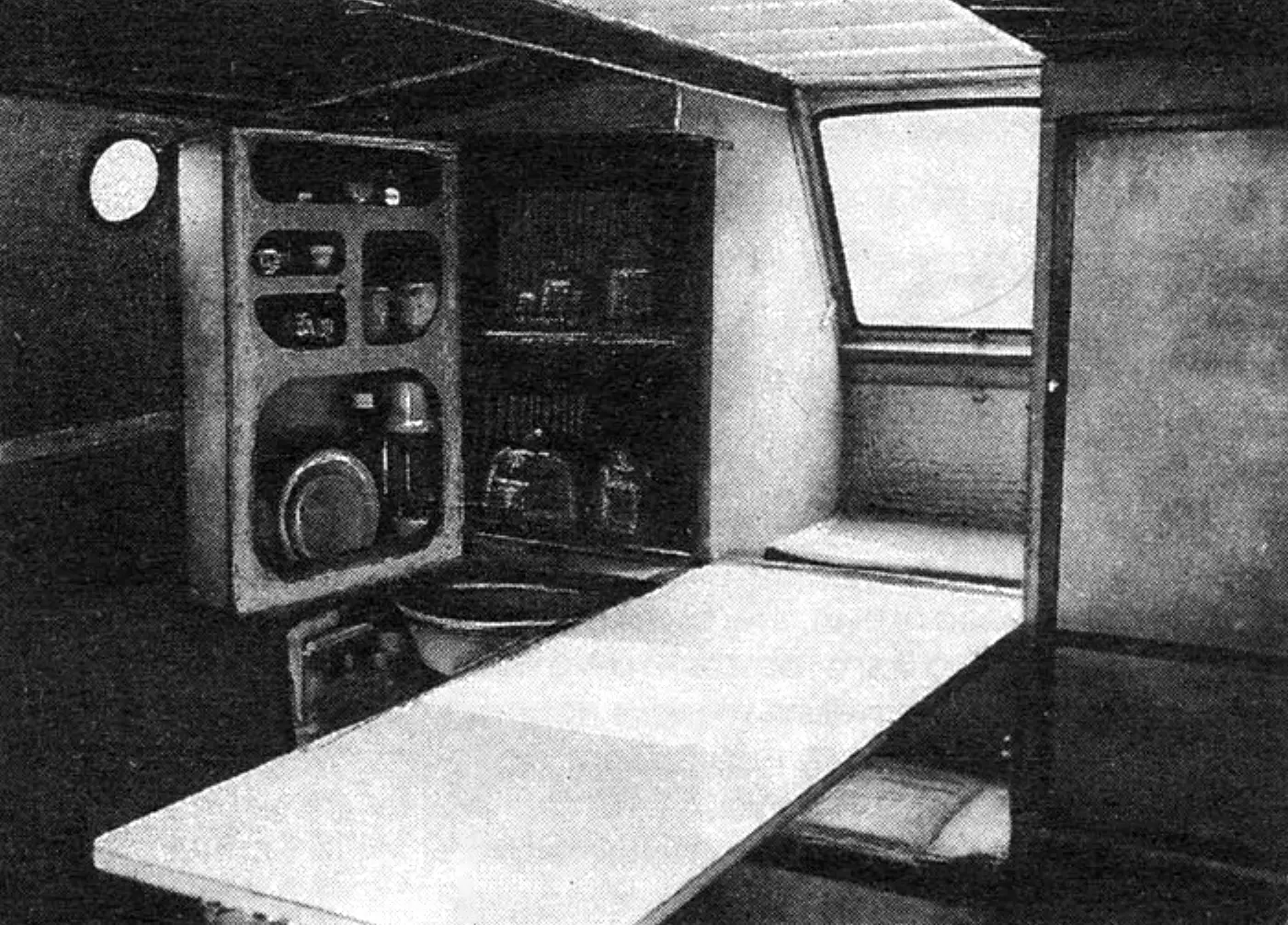
On small cabin boats and yachts, every square decimeter of space counts. Finding a dedicated place for a galley is a problem. So to cook meals you have to moor to shore each time, and the crew has to settle right on the grass and ants. On top of that, you have to carry dishes and supplies back and forth, forgetting things, getting annoyed and irritated. Especially if it’s raining or you’re late choosing a place to spend the night.
However, for owners of vessels close in size to 2×5 m, the galley situation is not hopeless if you can find a cozy corner in the cabin and work on it. An example is the experience of rationally using such a corner in the saloon of our planing amphibious craft “Triton” (“Modelist-Konstruktor” No. 5, 1996). In an area of just a few square decimeters we fitted what became a subject of keen interest and even white envy for the crews of many boats (especially their female members) that we met during years of water tourism. Namely — a mini-galley that gave the “Triton” crew complete independence from the whims of the weather. We were never bothered by choosing a mooring spot. You could poke the amphibian’s bow straight into sedge or reeds (as long as it wasn’t stormy) and drop anchor. Everything else needed for a proper lunch or dinner was on board.
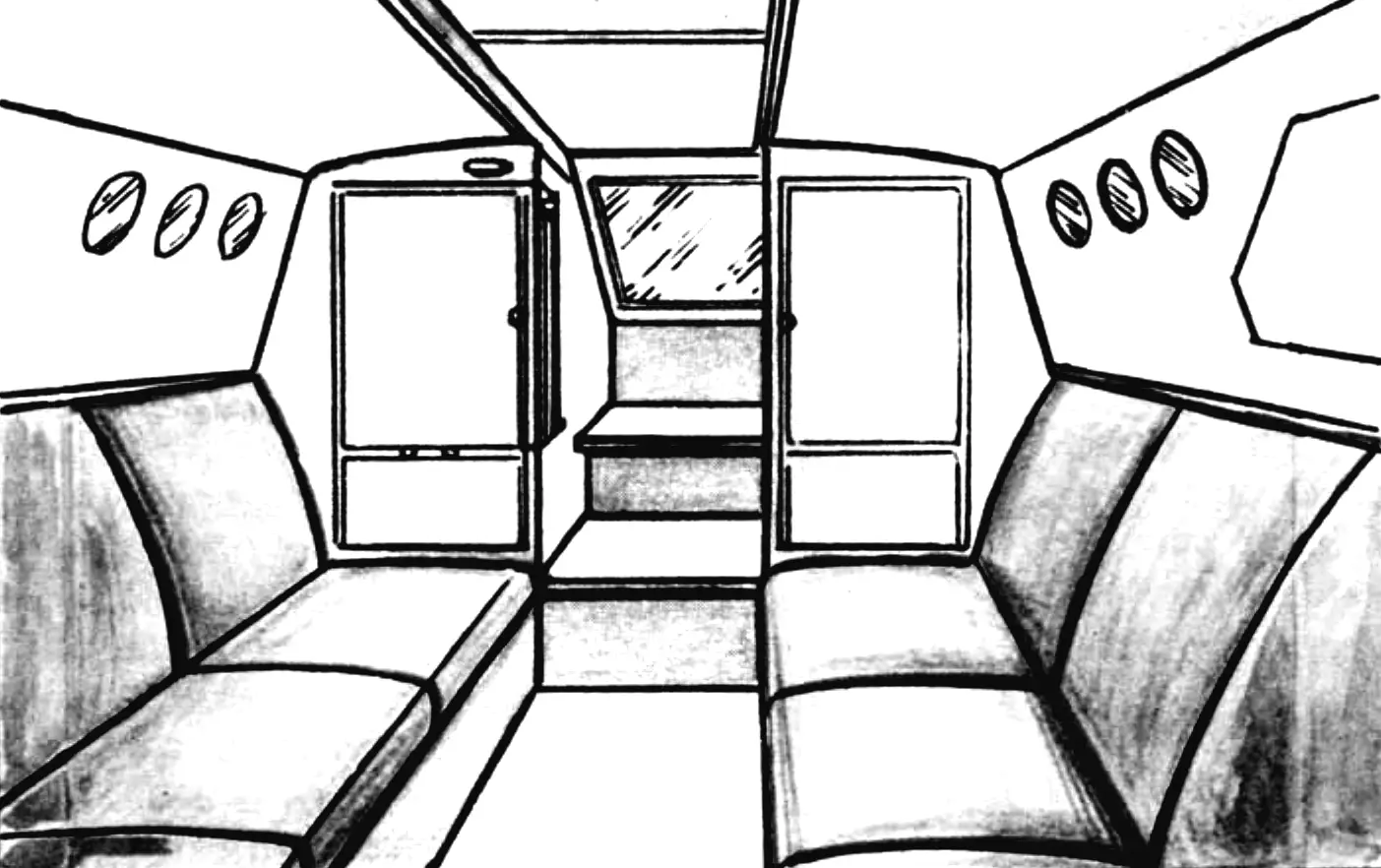
The main feature of the mini-galley is that it is absolutely invisible to an outsider’s eye, repeating in its folded and closed state the “architectural forms” of the wardrobe opposite. But it takes only a few seconds for shelves filled with food, a compartment with all kinds of kitchenware, a sink for washing hands and dishes, and a fairly large dining table to appear before an astonished guest as if from nowhere. You need only a few moves: pull out the guide rod and fix it in the wardrobe wall, open the volumetric galley door, raise the U-shaped retainer that holds the table panels vertical, and slide them out of the niche (dish compartment) along the guide tube and rod; then, raising the retainer higher, release the panels and unfold them while inserting the legs into sockets on the floorboards.
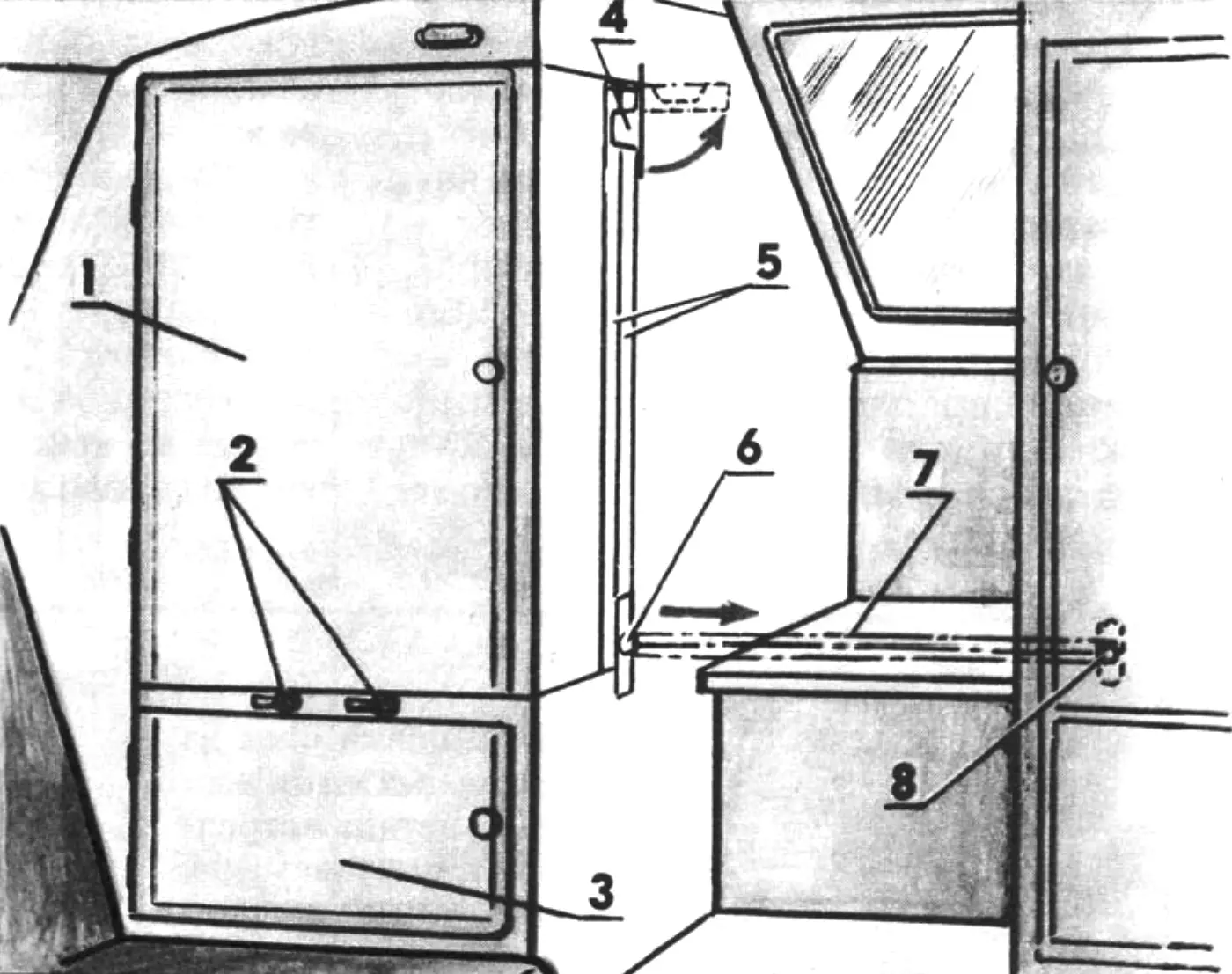
1 — volumetric door, 2 — water taps, 3 — sink door, 4 — table panel retainer, 5 — table panels folded and stowed, 6 — head of the sliding rod, 7 — rod extended, 8 — fixing socket on the wardrobe side wall.
If a full-size table is not needed, you can use only its first panel. In that case legs are unnecessary, since the second panel, slightly tilted and resting on the step of the inner ladder, serves as the table support.
On the shelves of the volumetric galley door go: two thermoses, small dishes, bags and jars of sugar, tea, coffee, spices and the like. Pots, a kettle and two “Shmel” camp stoves are hidden in the compartment deeper — behind the table panels.
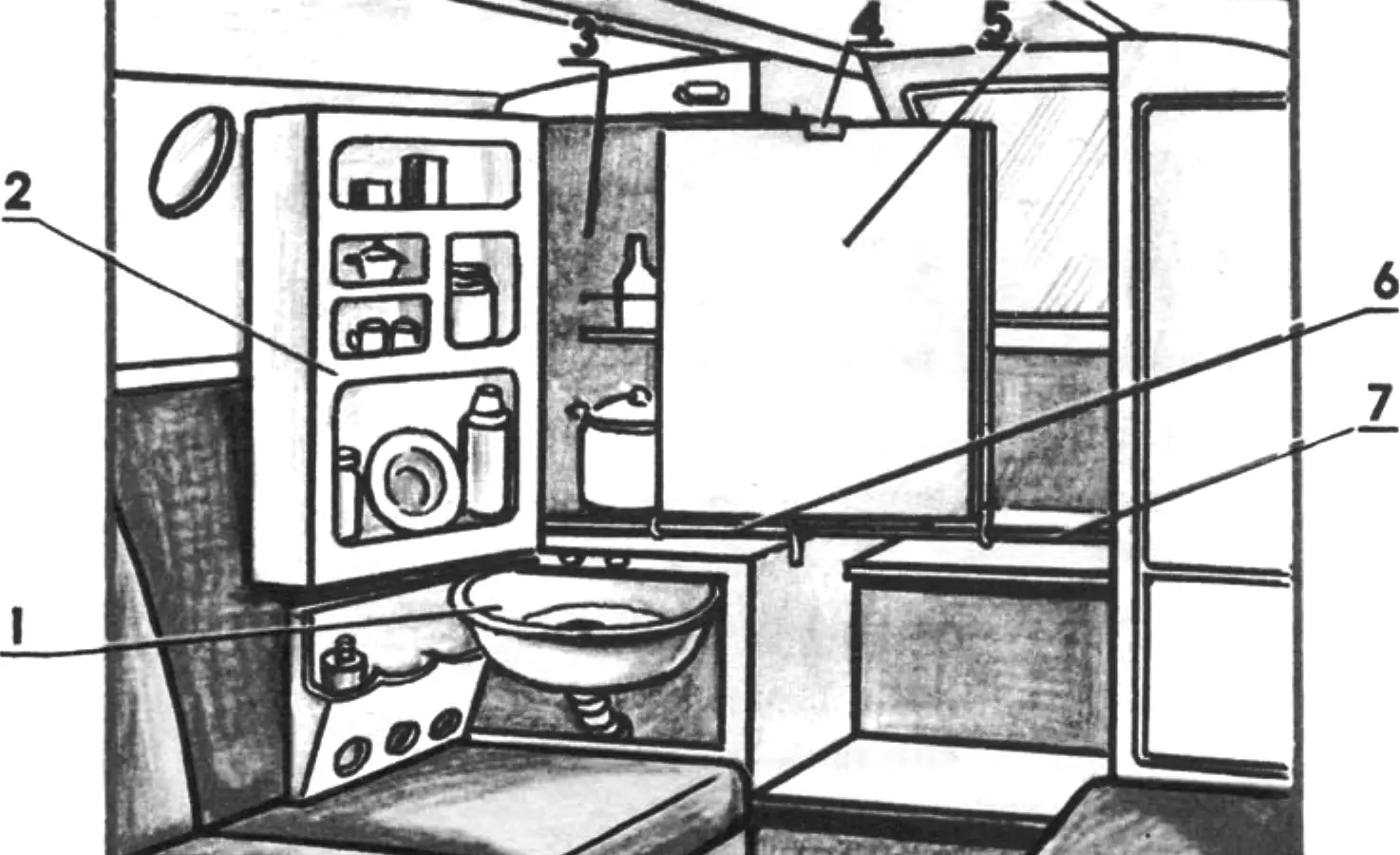
1 — sink, 2 — shelves of the volumetric door, 3 — dish compartment, 4 — table panel retainer, 5 — table panels, 6 — guide tube, 7 — sliding rod.
Drinking water flows by gravity from a canister secured behind the galley wall. The wash sink is a small polyethylene basin 400 mm in diameter, with a pipe attached to the bottom and a corrugated rubber tube from an old gas mask long enough for the sink to slide freely on runners out of its recess. Used water is drained outside through a hose. Under the sink is a vegetable bin, and in the door pockets — detergents and other household small items.
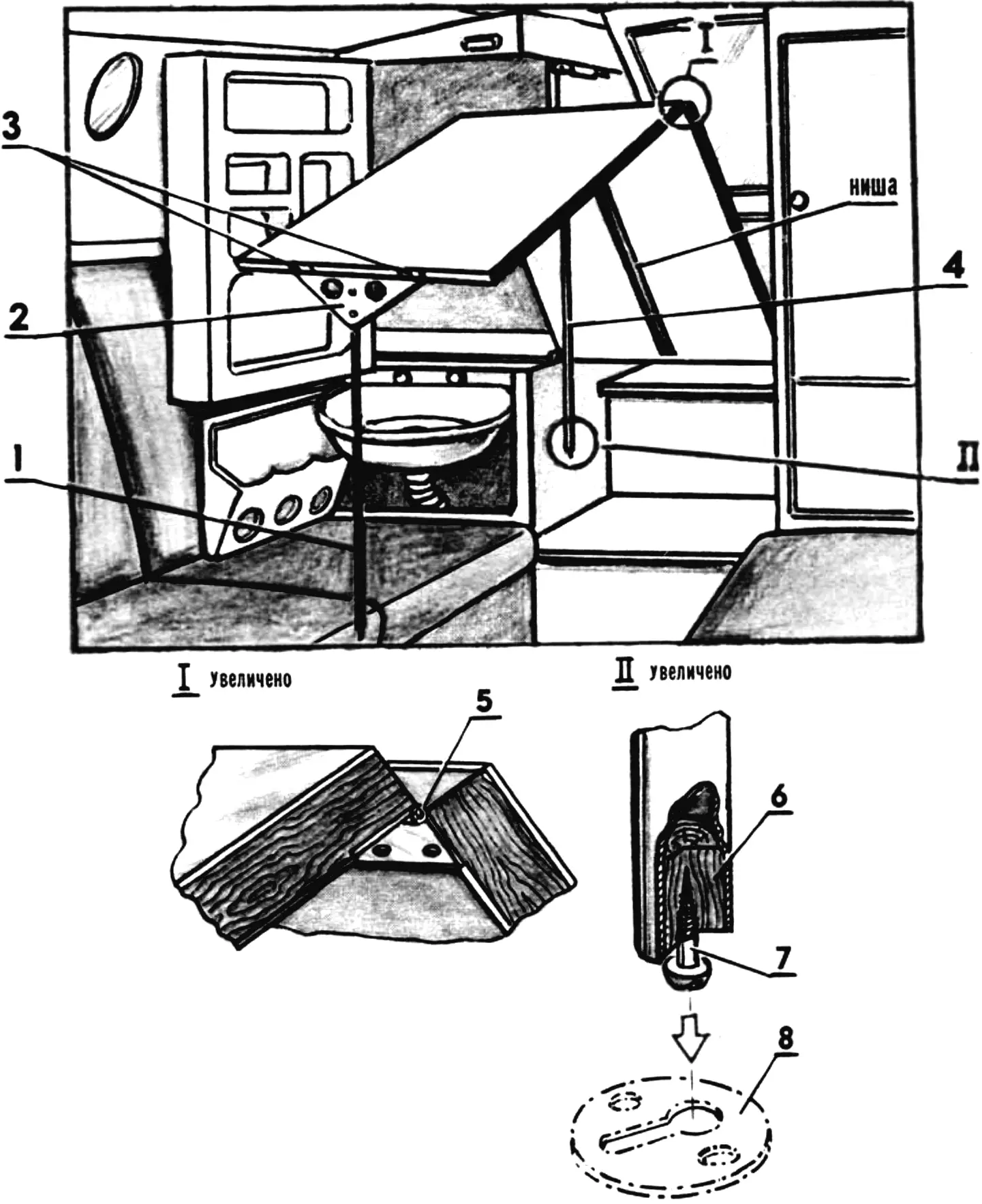
1,4 — front and rear legs (duralumin tube Ø 15), 2 — triangle (duralumin plate, s1), 3 — hinges, 5 — piano hinge, 6 — wooden plug, 7 — screw, 8 — socket on the floorboards fixing the leg.
The table panel frames are made of 15×15 mm strips and covered on top with light plastic, and on the bottom (for rigidity) with 2 mm aircraft plywood. Only epoxy adhesive was used. Panel sizes were chosen to fit the space (ours — 500×600 mm each). Their long side must be at least 30 mm greater than the desired table height, since the legs lie in specially provided grooves when folded. The panels are joined by a piano hinge and, when folded, slide into a slot behind the galley door on a telescopic guide that deserves careful construction.
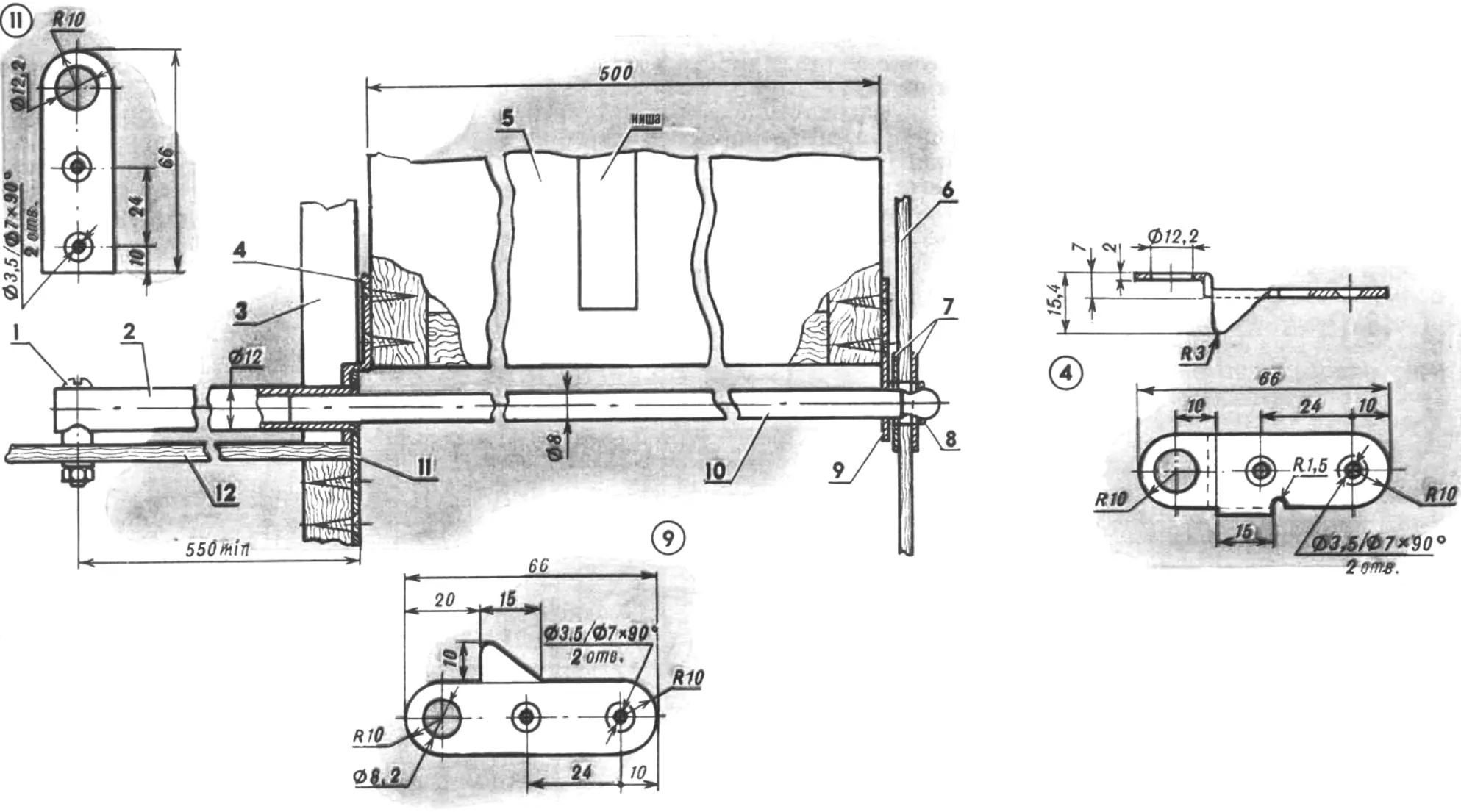
1 — M4 screw, 2 — tube, 3 — galley wall, 4 — inner hinge, 5 — table panel, 6 — wardrobe side wall, 7 — washers, 8 — spring latch of the fixing socket, 9 — outer hinge, 10 — sliding rod, 11 — bracket, 12 — dish compartment bottom.
The guide consists of a steel tube 12×2 mm and a steel rod 8 mm in diameter, connected telescopically. The tube is fixed immovably on the dish compartment shelf with an M4 screw and bracket. The rod extends until it touches the opposite wall and is locked in the spring latch by a ball-shaped head.
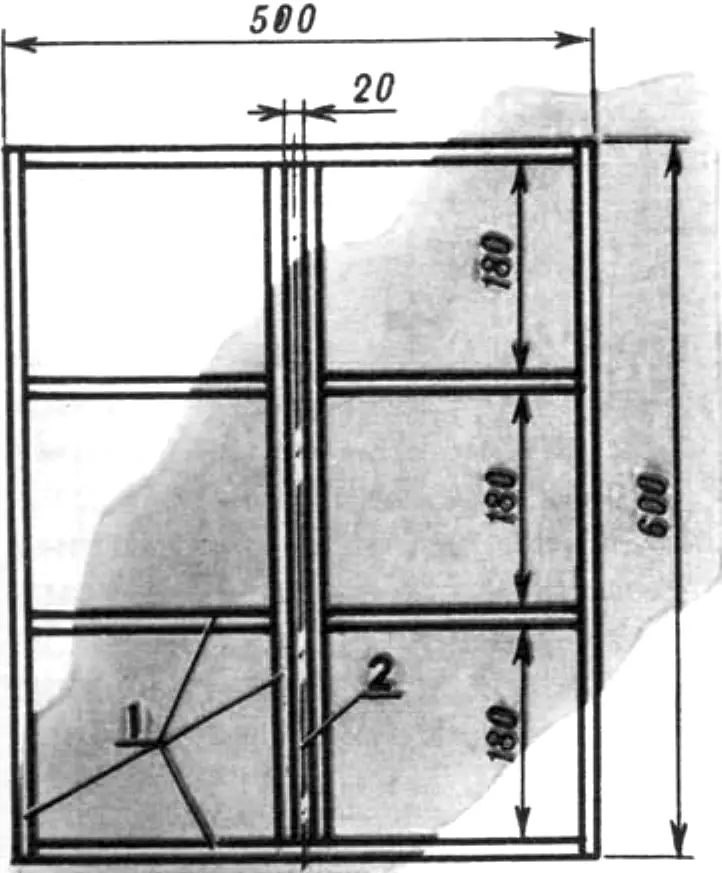
1 — strips (pine, 15×15 batten), 2 — niche for the leg.
Such a folding table is suitable not only in a boat or yacht cabin. It can equally well be installed in a living trailer, a compact summer kitchen, or any multifunctional transformable space. Five people can sit at it comfortably: two on each side seat and one on a folding stool at the end.
The design of the entire mini-galley is so variable and depends on the volume and layout of the cabin, for example, that it is not covered in detail here and is left to the imagination and capabilities of our followers.
“Modelist-Konstruktor” No. 3’97, D. KUDRYACHKOV
Recommend to read
 TREATMENT BATTERY TRANSCEIVER
Station IC-V8 has stopped working - not charging Nickel-cadmium (Ni-CD) battery. After dismantling his case it turned out that two elements of the line is faulty: you do not have... TRIMARAN… FOUR BOATS
Advantages of compact folding boats is obvious, disadvantages is also. In one of the old issues of the journal "modelist-Konstruktor" (on last page) photos and a brief description of...
