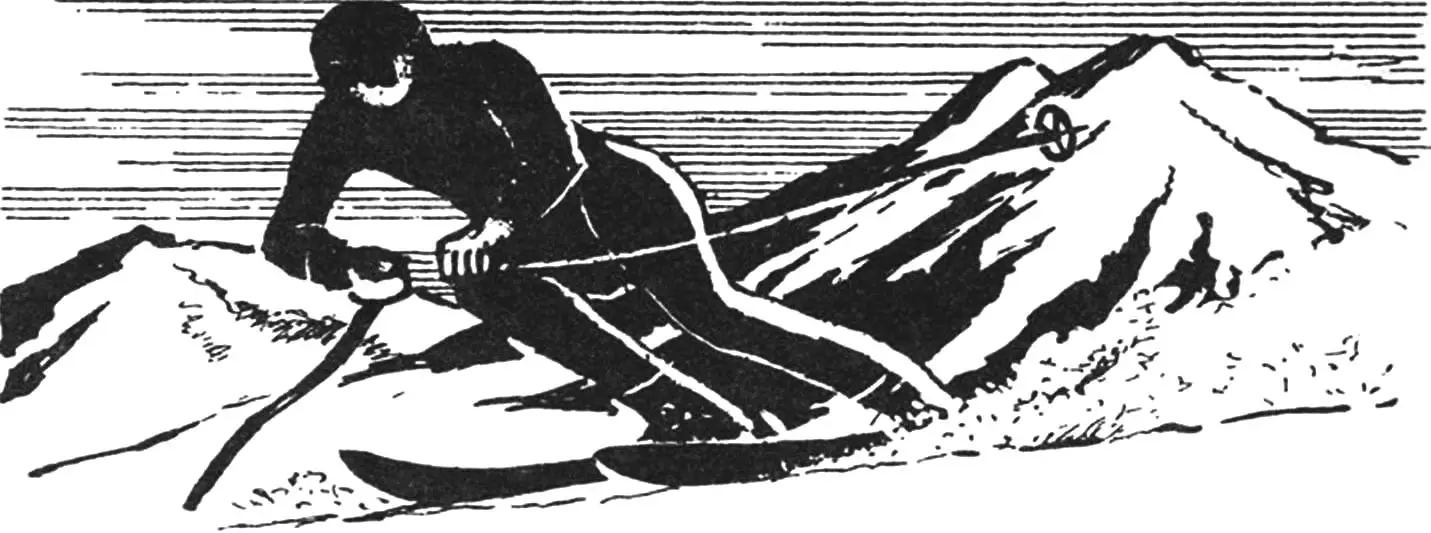
When descending on alpine skis, as soon as the transverse or longitudinal load exceeds the set value, the binding automatically releases, freeing the foot from the ski. The detached ski often rushes down the slope, which threatens many troubles: having accelerated, it can injure another skier, and when hitting an obstacle (stone, tree) it can break itself or, in the end, simply get lost, buried in the snow. Imagine the situation of a person on a high mountain without skis: with every step, they sink deep into the snow and even risk falling off the slope.
To prevent accidentally released skis from rolling far from their owner, they are equipped with a brake. One version of such brakes was described in the magazine “Modelist-Konstruktor” No. 1 for 1983. Another version is proposed, distinguished by simplicity, manufacturability and reliability in operation. The brake prevents the ski from rolling forward with the tip as well as with the heel and consists of only three parts: a spring, a pad and a snow grip.
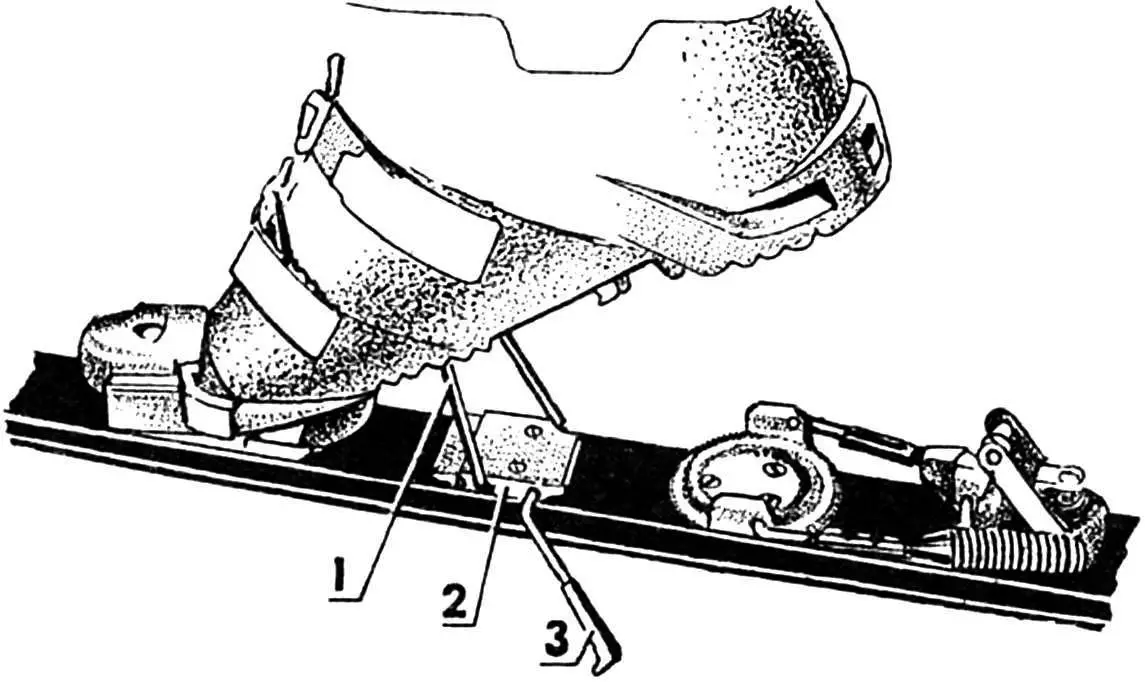
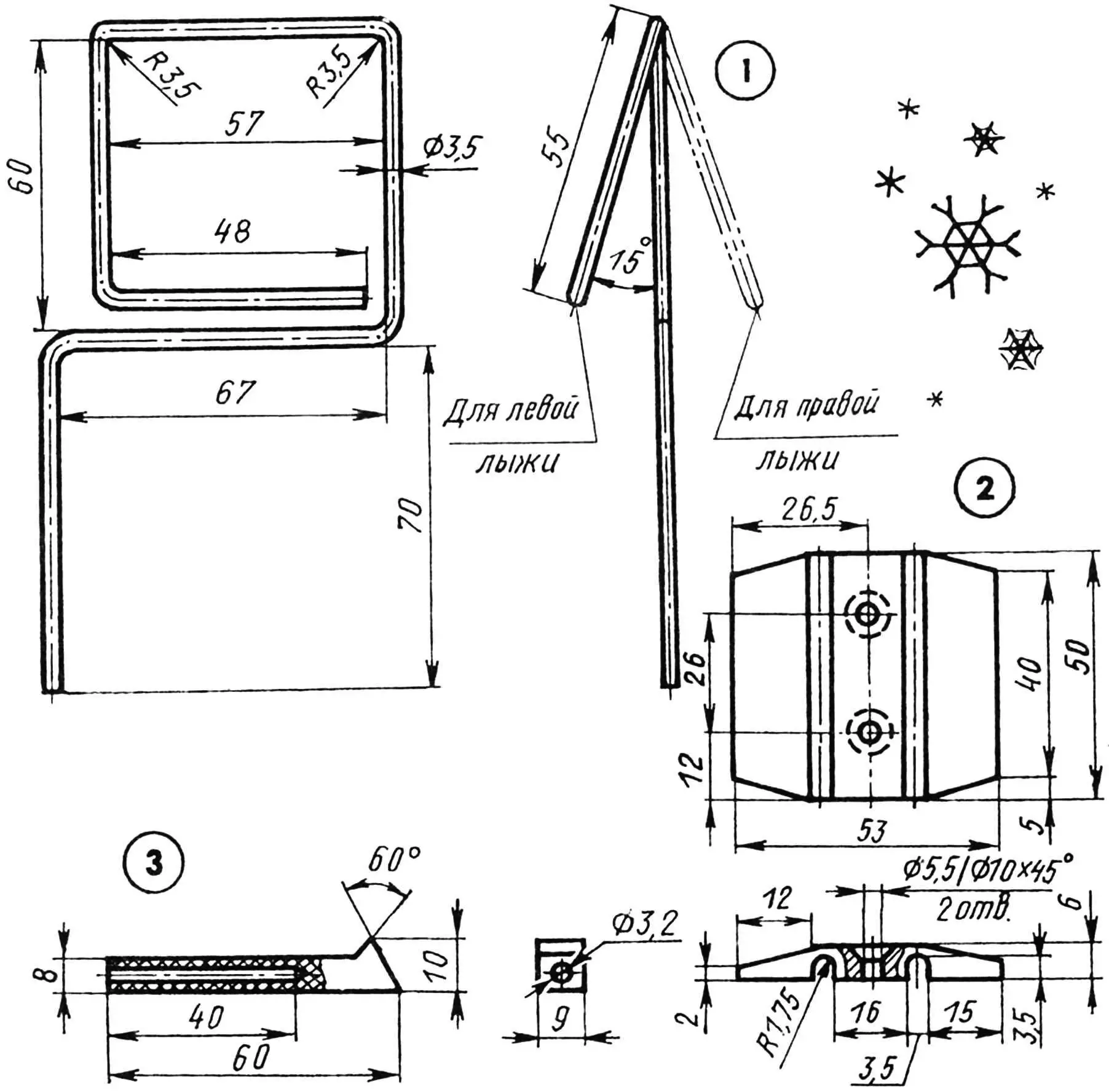
1 — spring (steel spring wire Ø3.5); 2 — pad (aluminum alloy or textolite); 3 — snow grip (hard rubber)
The spring is bent from steel spring wire. It must be taken into account that for the left and right ski, the leg of each spring is bent in different directions.
The pad can be made by hand from any strong but relatively easy-to-process material, for example, from an aluminum alloy or textolite.
The snow grip increases the contact area of the brake with the snow. In addition, it prevents the possibility of injury from the sharp end of the spring. The snow grip is made of hard rubber. A hockey puck will serve as a blank. First, the rubber plate is clamped in a vise and a hole 40 mm deep and 0.3-0.5 mm smaller in diameter than the spring wire diameter is drilled in the end of the plate. Then the snow grip is cut out with a sharp knife and processed with a file, after which it is fixed on the end of the spring using glue.
The brake is attached with two screws between the front and rear markers so that the spring leg with the snow grip extends to the outer part of the ski. When putting on the ski, the boot moves down and forward, compresses the spring and sets its leg to a horizontal position. Since the leg is on one side of the ski, after the brake is activated, the ski turns towards the leg and stands across the slope.
Several samples of the described brake have successfully passed tests.
A. LOGVIN, Lviv, Ukraine
Recommend to read
 FROM THE BARREL — STRETCHER
They can be made in just a few minutes. For this you need to saw off part of an old metal barrel and attach it with bolts to handles (e.g., spade handles). Yu MACHALA, 13 pet., Lviv, Ukraine AT THE DOOR BARKS… A TAPE RECORDER
In these troubled and difficult time when the crime situation every year more complicated, the important importance of watchdog and signaling device that protects property from...
