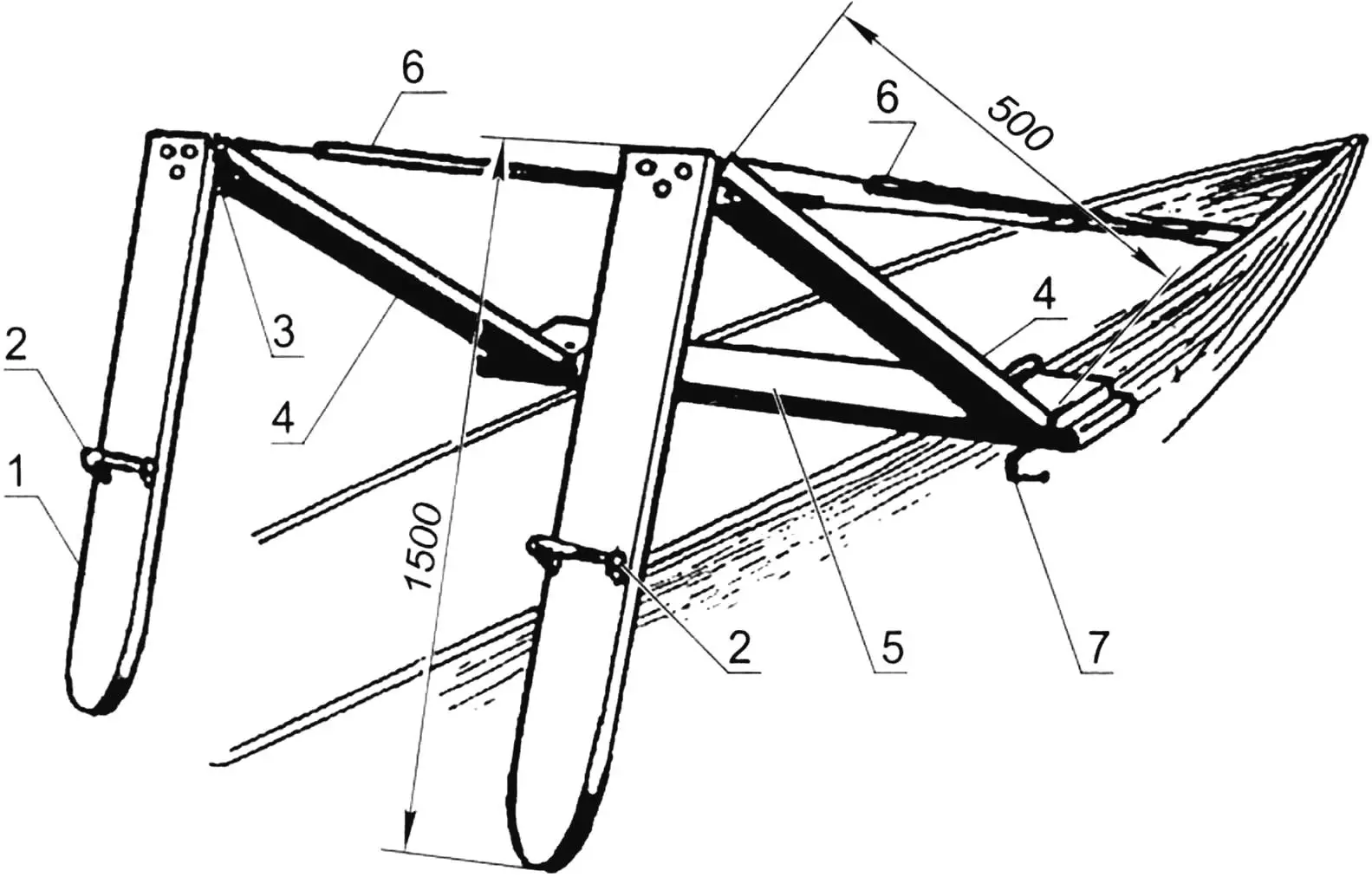
Rowing oars allow for powerful strokes, but where the boat is heading is not visible – the rower sits with their back against the direction of movement. The propulsion system of the proposed design lacks this drawback – it is a pair of vertical hinged devices installed along the sides of the vessel. Externally, they resemble grasshopper legs. In shallow water, the “legs” can push against the bottom like poles, and in overgrown water bodies, the vertical movements of the blades prevent algae from winding around them.
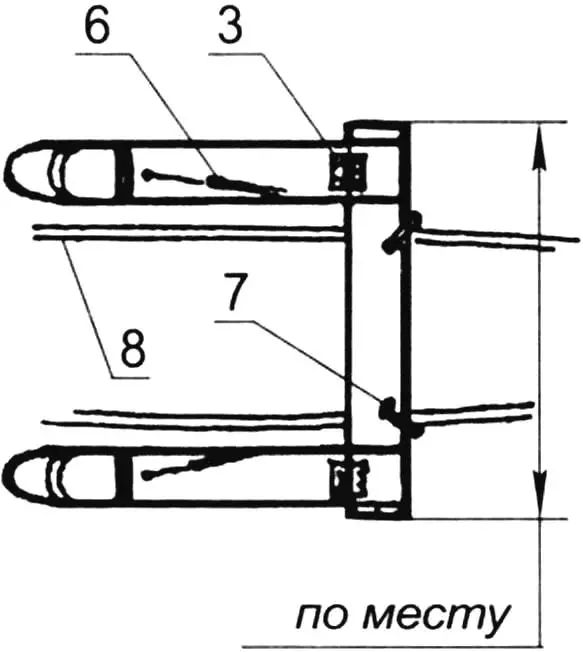
1 – blades; 2 – handles; 3 – hinges (card hinges); 4 – brackets; 5 – crossbar; 6 – elastic cords; 7 – clamps; 8 – boat sides. Before assembly, impregnate the parts with hot linseed oil and coat with varnish
Each oar consists of a blade and a bracket connected by a card hinge. The brackets are connected by a crossbar. A rubber elastic cord facilitates the rowing process, and a cord serves to support the bracket during the stroke. Holding the handle, the rower lifts the blade, pushes it forward, lowers it, and pulls it toward themselves, alternating each oar or both together.
Approximate dimensions: for brackets – 500x150x10 mm, for blades – 1500x150x10 mm.
Alexander BORISEVICH, Minsk
Recommend to read
 VELOSEZON
The proposed design is the winner of one of the contests of velomobiles in the Lithuanian city of šiauliai. My first recumbent I built in the 1980's, a few times it was altered... FIELD MACHINE
Dream-the idea of making a car, even simple, like buggy, appeared in his teenage years, when machines were in short supply. But for many UNDERSTANDABLE reasons (had neither the...
