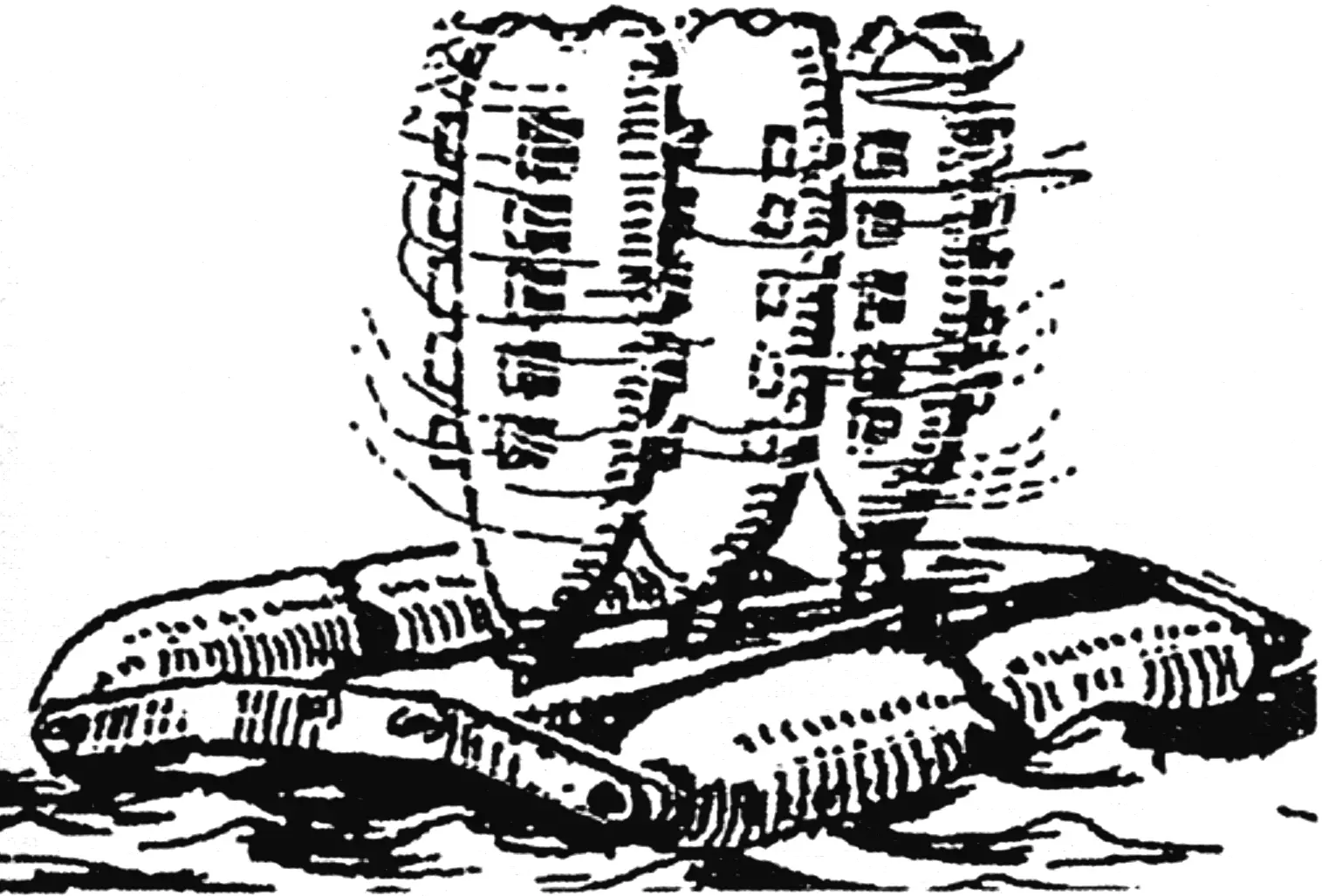
We have already described the construction of a sailboat and a vessel powered by a rubber motor, using PET soda bottles (see “M-K” No. 5 and 8 for 2024). We suggest adding to the “bottle fleet” a catamaran model with a rotor wind drive.
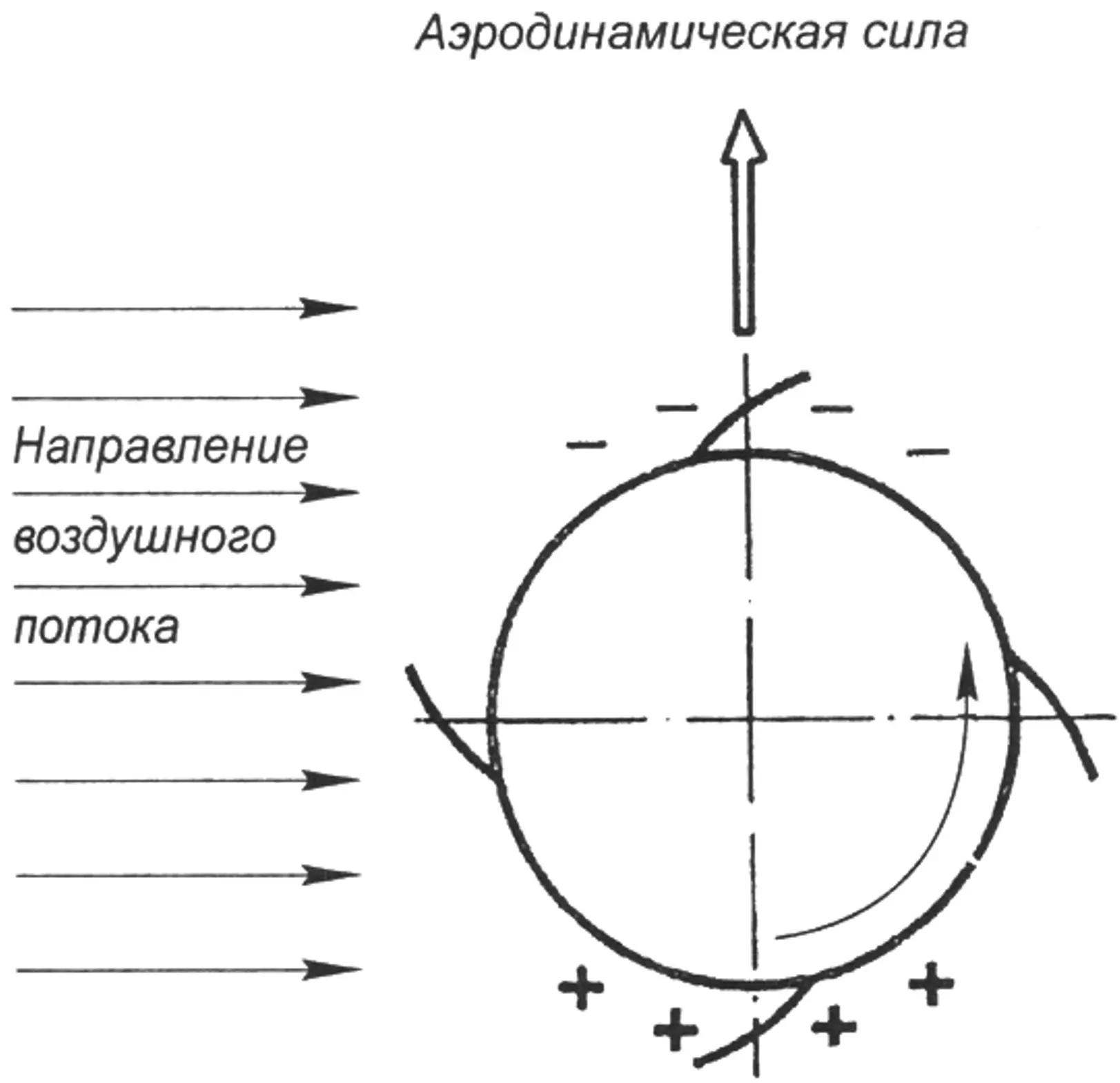
It has long been observed that if a rotating cylinder is placed in an airflow, a force acts on it perpendicular to the direction of the flow. The reason is that when the cylinder rotates, the direction of motion of one part of its surface coincides with the direction of the airflow, while the opposite part rotates against it. According to Bernoulli’s law, which establishes the relationship between the speed of airflow and the pressure in it, as the flow speed increases, the pressure decreases. When a rotating cylinder is blown by air, the pressure in the zone where the cylindrical surface and the flow move toward each other is lower than in the zone where the cylindrical surface and the air move in the same direction. The resulting pressure difference creates a force directed perpendicular to the motion of the airflow — from the zone of higher pressure to the zone of lower pressure.
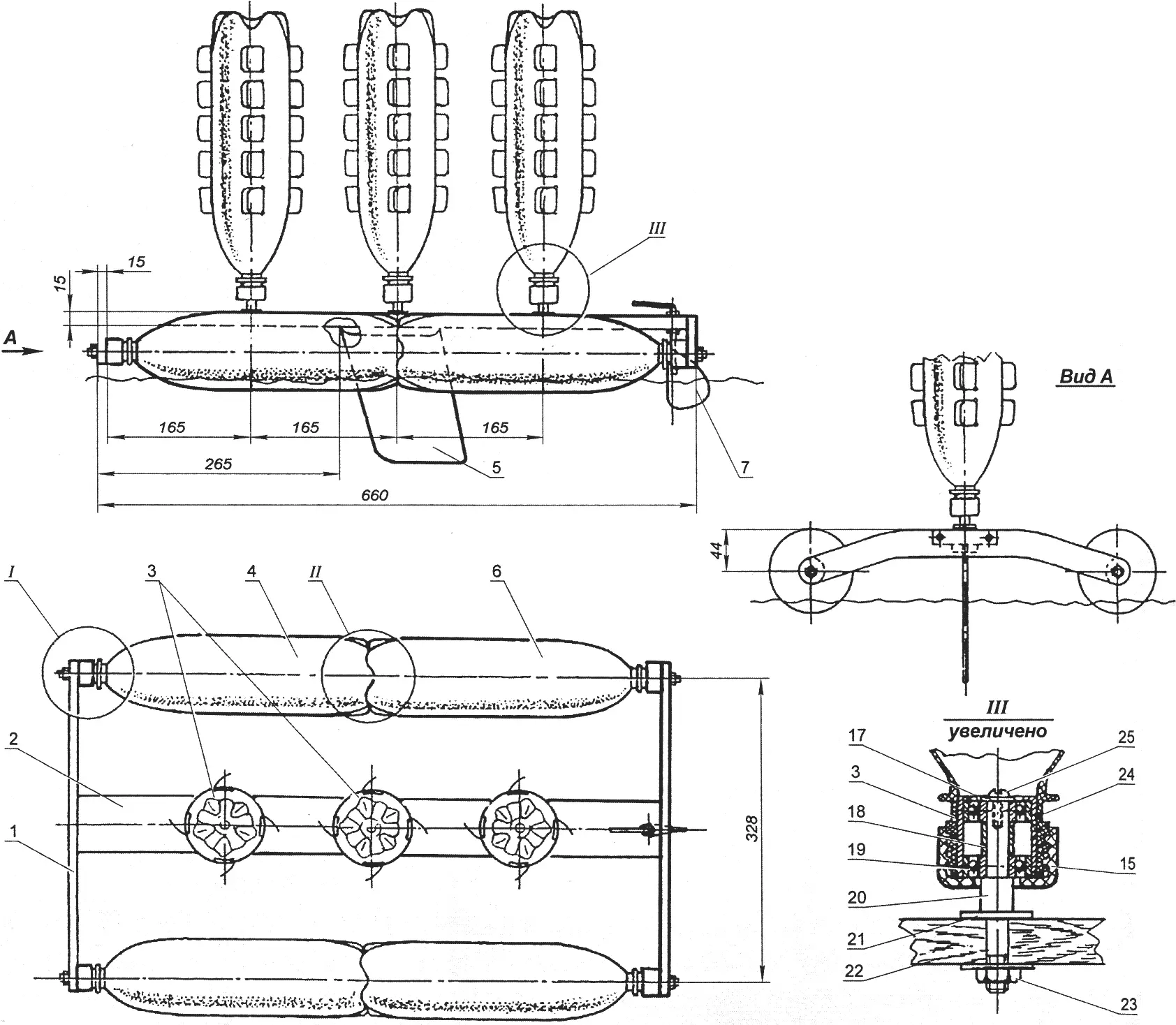
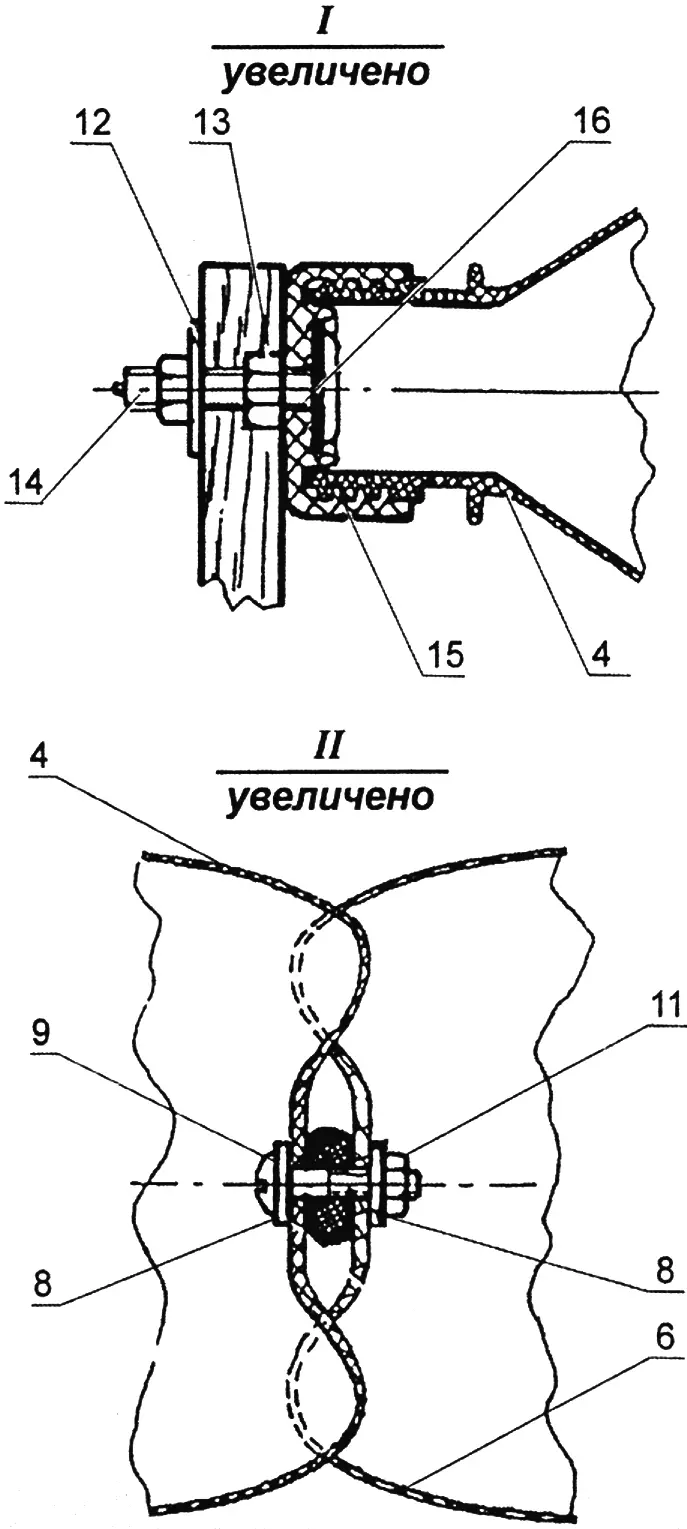
1 — crossbeam of the bridge deck (plywood s15 mm, 2 pcs.); 2 — platform (pine, strip 60×15 mm); 3 — rotor hulls; 4 — forward part of the model hull; 5 — keel; 6 — aft part of the model hull; 7 — steering gear; 8 — washers; 9 — M5 bolt; 10 — spacer washer (rubber); 11 — M5 nut; 12, 17, 21, 22 — wide washers (steel); 13 — valve nut (2 pcs.); 14 — valve with core (from a bicycle tube); 15 — threaded plug; 16 — sealing washer (rubber); 18 — spacer bushing (duralumin); 19 — bearing (2 pcs.); 20 — rotor shaft (steel); 23 — M6 nut; 24 — bearing housing (duralumin)
In the proposed model, the rotors are spun by the airflow. Each of them is a plastic bottle with many blades on its surface — when blown upon, it is mounted vertically on bearings and receives axial rotation.
Construction of the catamaran begins with the hulls — each requires two one-and-a-half- or two-liter bottles. The plastic containers are joined into a single hull at their bottoms and connected with an M5 bolt, a nut, and washers — two steel and one rubber. Special tools are needed for this joint: a screwdriver with an extended tip and a long socket wrench. Valves from bicycle tubes are inserted into the caps of all four bottles, through which excess pressure is created inside the hulls with a pump, substantially increasing their rigidity.
The prepared hulls are mounted into a single catamaran using a bridge deck consisting of a platform (a pine board 60×15 mm in cross-section) and two crossbeams (15 mm plywood). The bridge deck parts are joined with long 4 mm screws. Holes for the valves are drilled in the crossbeams. The finished bridge deck is sanded, painted, and coated with two or three layers of parquet varnish.
The catamaran keel is cut from 5 mm plywood; two birch blocks are glued to its upper part with epoxy resin. The forward part of the keel is rounded, the aft part is sanded to a wedge shape. The keel is sanded and coated with two layers of parquet varnish. A lead bulb can be hung on the end of the keel. The keel is attached to the bridge deck platform with four 4 mm screws.
The model’s steering gear consists of a plywood rudder blade and a tiller shaft. The latter is bent from 4 mm steel wire, and an M4 thread is cut on one end. The rudder blade has a symmetrical profile with a rounded leading edge and a sharp trailing edge. Finishing of the blade is standard: sanding, painting, and coating with parquet varnish. The connection of the blade to the tiller shaft is permanent, using epoxy glue.
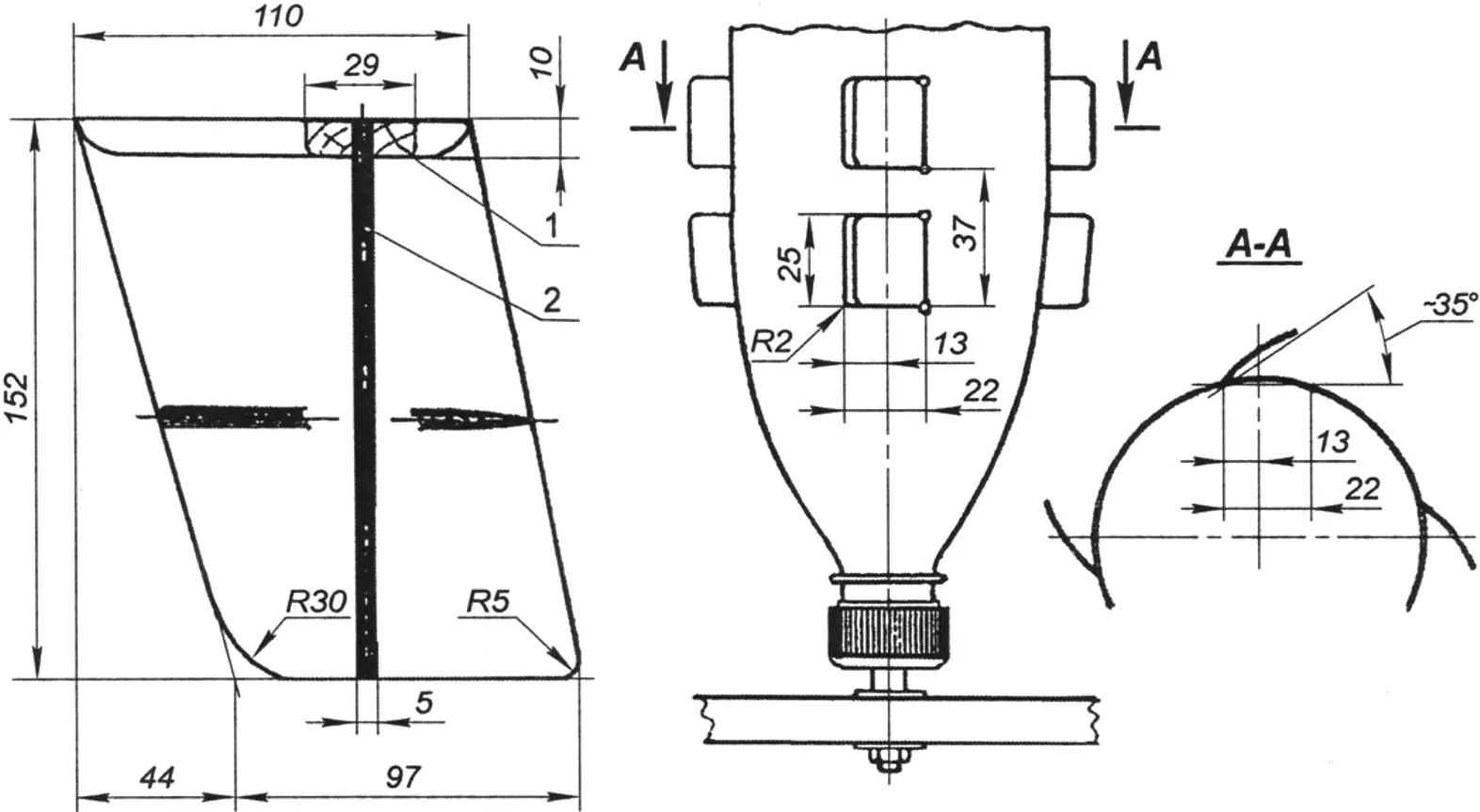
1 — overlay (birch, strip 12×10 mm, 2 pcs.); 2 — plate (plywood s5 mm)
Now we turn to making the rotor drive. Each rotor is a one-and-a-half- or two-liter plastic bottle hinged on the platform with many bent blades on its surface. When blown by an airflow, such a rotor begins to rotate. To make the blades uniform and neat, it is advisable to use an electric pyrograph or a homemade hot cutter to cut through the bottle wall.
The blade outlines on the surface should be marked using a template — a rigid plate with a window sized to the blade. Before cutting, a couple of holes should be melted in the window, and then cuts should be made along the blade outline. Attention: work with the hot cutter only in a well-ventilated room or by an open window! On the rotor prepared in this way, the blades are bent at approximately 35°.
The rotor hinge assemblies must ensure extremely easy rotation — literally from the slightest breeze. This can be achieved only with ball bearings. For two-liter bottles, bearings with an outer diameter of 18 mm, an inner diameter of 6 mm, and a width of 6 mm are suitable.
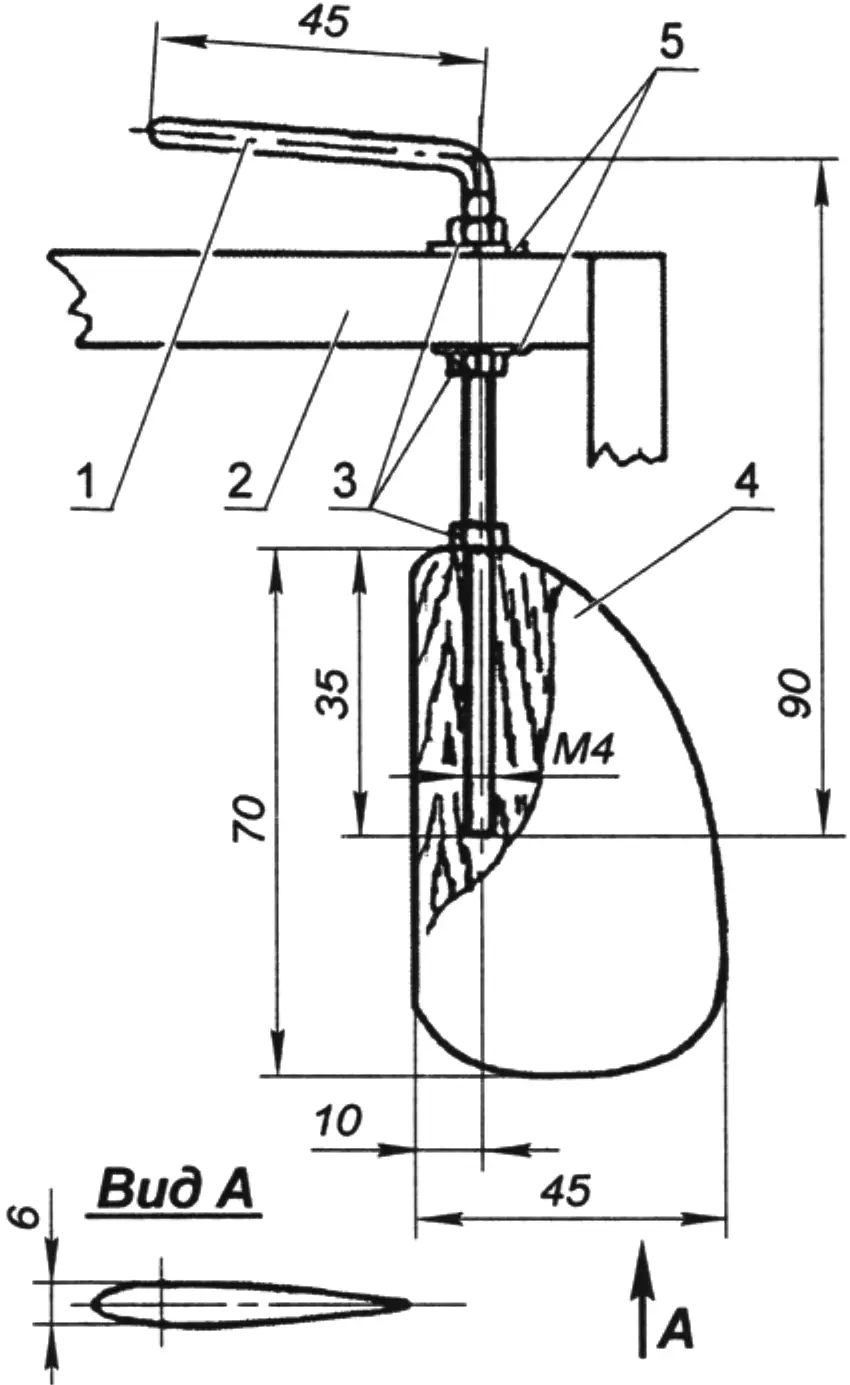
1 — tiller shaft (steel, wire Ø4 mm); 2 — bridge deck platform; 3 — M4 nuts; 4 — rudder blade (plywood s6 mm); 5 — washers
Duralumin housings are needed to mount the bearings. In the necks of the rotors they are fixed with standard bottle caps with 8 mm holes. The stepped shaft on which the bearings and, accordingly, the rotor rotate is steel; on the bridge deck platform it is secured with an M6 nut. Before installing the bearings in the housings, the grease should be removed from them (wash in kerosene) and sewing machine oil should be applied.
On a properly adjusted catamaran, the rotor drive spins up easily, and the vessel, oriented sideways to the wind, quickly gains speed while automatically maintaining its course relative to the wind direction. If the model yaws or heels, the center of lateral resistance must be shifted by moving the keel forward or aft.
It should be noted that a rotor catamaran can sail not only on a beam reach, when the wind blows directly from the side, but also on fuller or sharper courses. Although, of course, a catamaran with a classic sail can point closer to the wind.
“Modelist-Konstruktor” No. 8’2025, Igor TERKHOVSKY
Recommend to read
 STARTS… CARDBOARD
Going into the club "Technical modeling", we saw a lot of bench models made of paper and cardboard by One of our members suddenly suggested — and in fact the GAK you can build and... MICROBALANCE
Remote nodes of the tape I smeared with homemade butter. which made from plastic bottle pipette from-under eye drops and medical needle from a syringe. Bottle thoroughly washed and...
