My article on the so-called separate lubrication system for a two-stroke engine was published in “Modelist-Konstruktor” No. 7, 1991. However, I still receive letters from readers interested in additional information about the equipment for it. As the mail analysis showed, practically everyone experiences difficulties when manufacturing parts of the metering device—turned fittings, needle, etc. I can recommend a method developed and tested by me on my motorcycle.
Let’s recall: when adjusting the flow rate using a metering needle, the amount of oil entering the engine crankcase changes by changing the jet’s flow area. In principle, the same can be done without changing the jet’s flow area, but only by selecting the viscosity of the oil flowing through a channel of constant cross-section. This method is somewhat simpler and more reliable than the first one, since the adjusting needle can always unscrew, and all the oil from the tank will literally “go down the drain” after a couple of kilometers. And then—dry friction in the piston-cylinder pair and seizure…
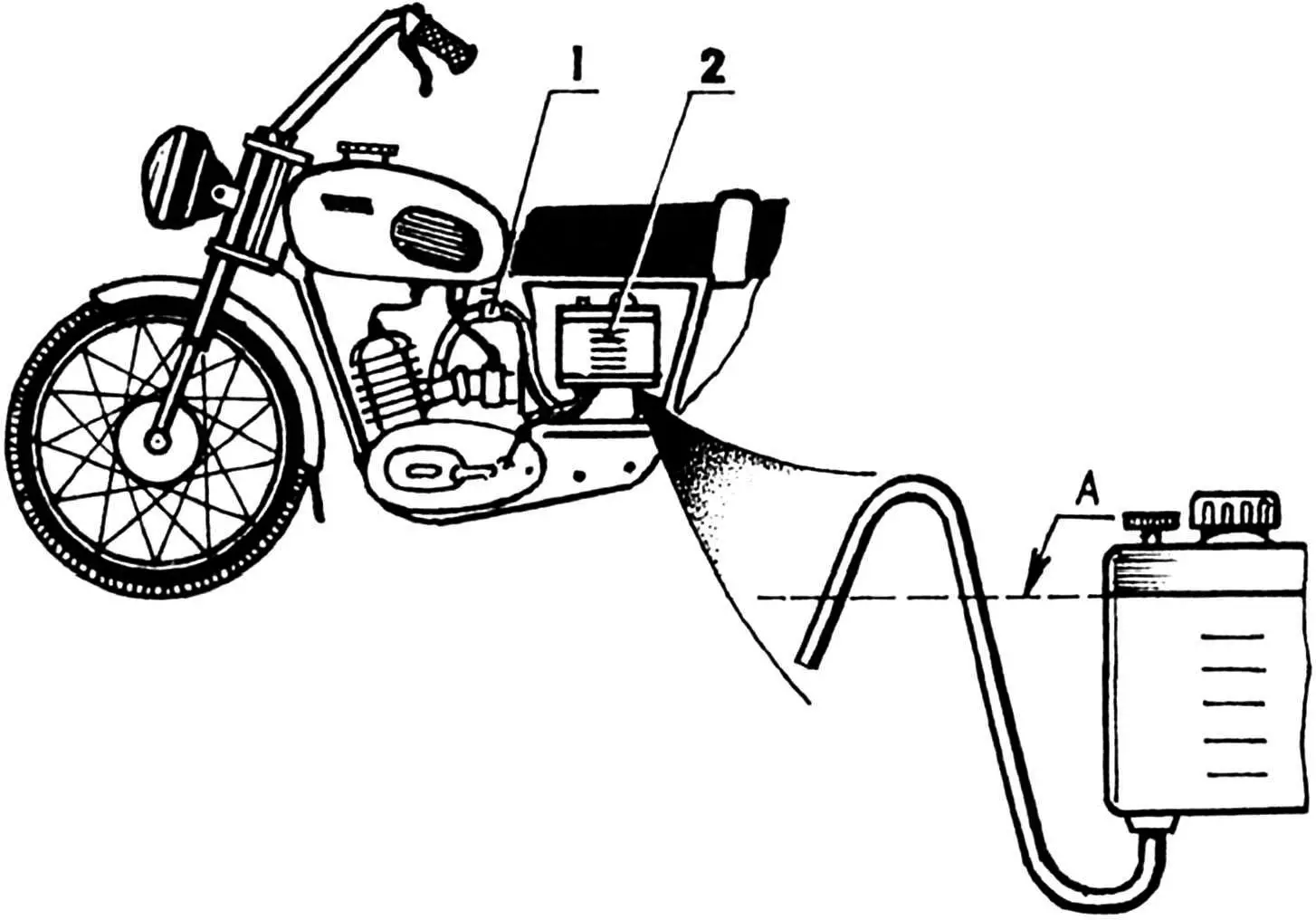
Diagram of oil line routing from tank to fitting on carburetor intake (A — maximum oil level in tank):
1 — oil line (polyvinyl tube with inner diameter 6—8 mm); 2 — tank (transparent container with volume of about 250 cm3)
The new metering device is a capillary channel—a tube with an inner diameter of 0.5—0.8 and length of 20—30 mm, soldered into the oil tank fitting. If a tube with such parameters is not found, you can use a thicker one, for example, with an inner diameter of 1 mm, and insert a wire 0.4—0.5 mm thick into it. To ensure a strict ratio of oil and gasoline in the fuel mixture, the oil viscosity is selected, for which it is thinned with gasoline. The approximate oil consumption should be 0.5—1 cm3 per kilometer at a speed of 50—60 km/h. If you carefully approach the experimental selection of oil viscosity and accurately record the quantitative ratios of gasoline and oil, then in the future for each brand of oil you can know the amount of gasoline needed to dilute it. After all, the viscosity must be optimal for a capillary of a given cross-section and length.
Taking this opportunity, I also want to supplement my previous article on the metering device with an adjusting needle. Many readers are interested in how to prevent oil from entering the engine crankcase when it is not running—when parked. So, I have no mechanical shutoff—valve or valve—provided. Simply, the oil line is routed so that the hose passes above the oil level in the tank, as shown in the figure.
Many of those who wrote to me ask to indicate the most important dimensions of the metering device—they are before you.
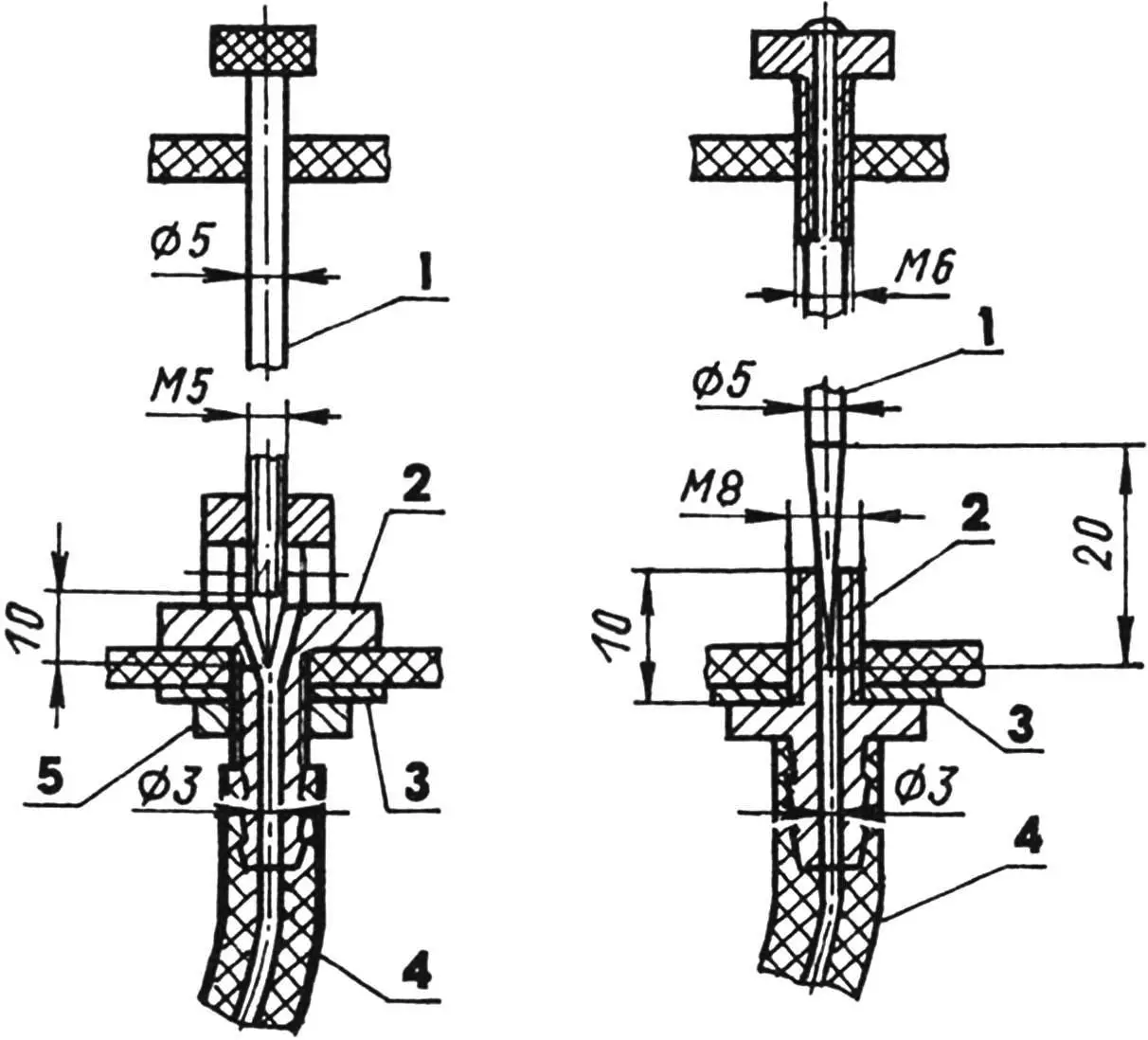
1 — metering needles; 2 — fittings; 3 — washers; 4 — oil lines (polyvinyl tube); 5 — nut
The quantitative ratios of oil and gasoline were also not entirely clear. The fact is that both in the fuel tank and in the oil tank, a mixture of gasoline and oil is used. In the fuel tank, the ratio of gasoline and oil is 100:1, but you can also use pure gasoline. In the oil tank, the ratio of gasoline and oil should be such that the viscosity of the mixture is approximately the same as that of transformer oil.
It’s good if the oil tank volume is about 250 cm3, which will be enough for 250—500 km. It is desirable that this container be semi-transparent (for example, made of plastic) and have clear marks indicating the liquid volumes—this makes it easier when setting up the metering system.
And finally. The metering device fitting and the fitting on the carburetor intake are connected by a polyvinyl tube with an inner diameter of 6—8 mm. On the carburetor intake, the fitting is located at the top, if possible next to the cylinder. A threaded hole M8 is drilled in the intake under it, the inner diameter of the hole in the fitting is 4 mm.
“Modelist-Konstruktor” No. 4’2001, V. KHVOSTIK, Tsaredarovka village, Kharkiv region
Recommend to read
 Technology of construction of country houses
How to build a reliable and durable house? What technologies are currently in use? To these and other questions will find answers in this article. Just note that the choice of technology... STEREO PHONES
In high quality stereorelease made on the basis of heads 0,25 GD-10-290 from small radios. Their advantages are a wide frequency range, small harmonic distortion comfortable ear cushions...
