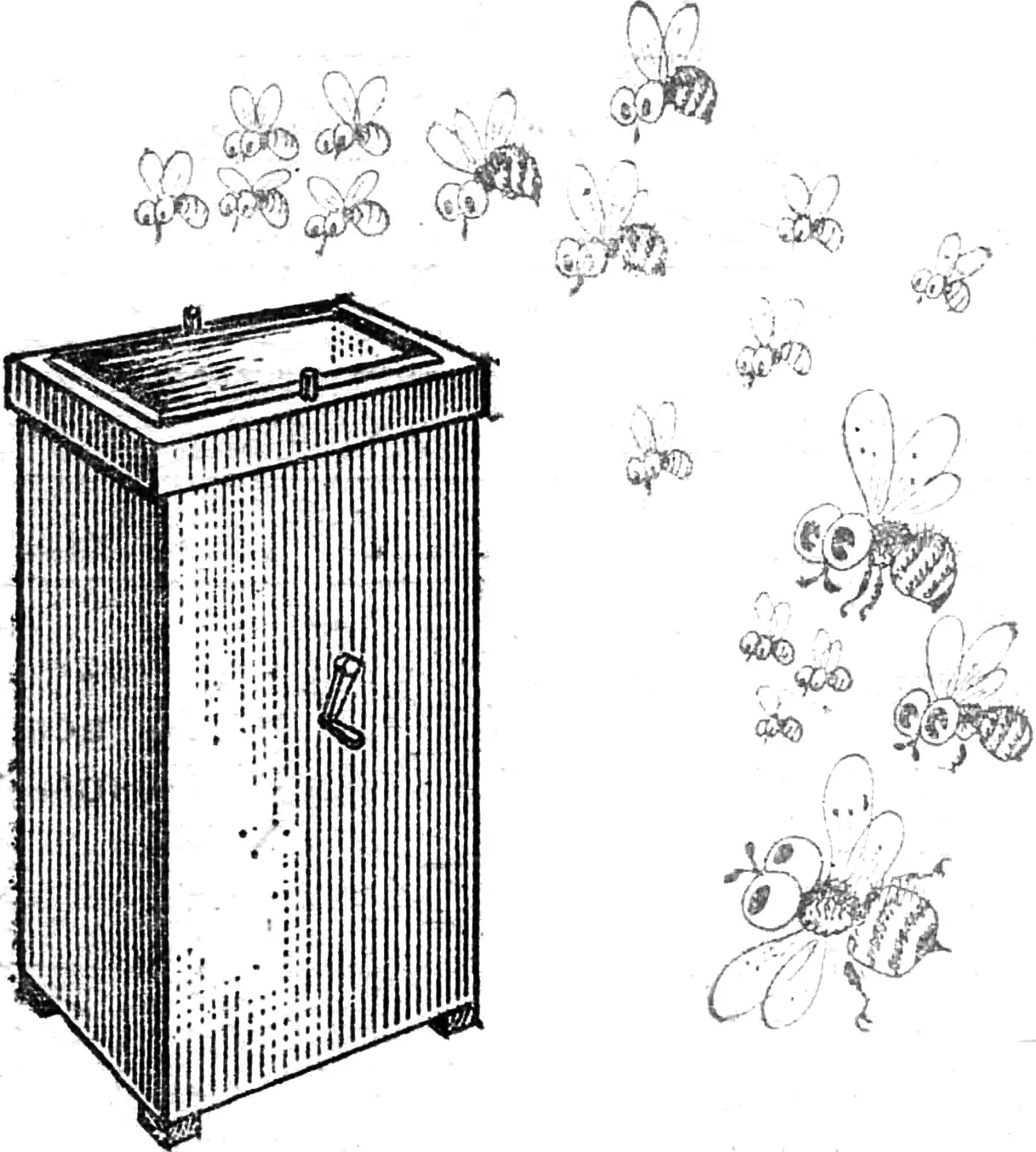
For almost twenty years, a design club for agricultural modeling has been operating at the Chernihiv regional Station of Young Technicians. Over the years, the students, under the guidance of their mentors, have developed and built many useful machines, mechanisms, and devices, many of which are of practical economic importance and bring real benefit to the collective farms of the region. One such device is a unit for thermal anti-mite treatment of bees.
…It so happened that a nearby collective-farm apiary was struck by varroatosis — a contagious bee disease. How could the hives be saved? The club members visited the apiary and, on the spot, became familiar with the requirements for the future unit. The main one: it had to ensure complete and harmless removal of mites from the bees.
At club sessions, several design options were discussed collectively, and the most successful one was chosen.
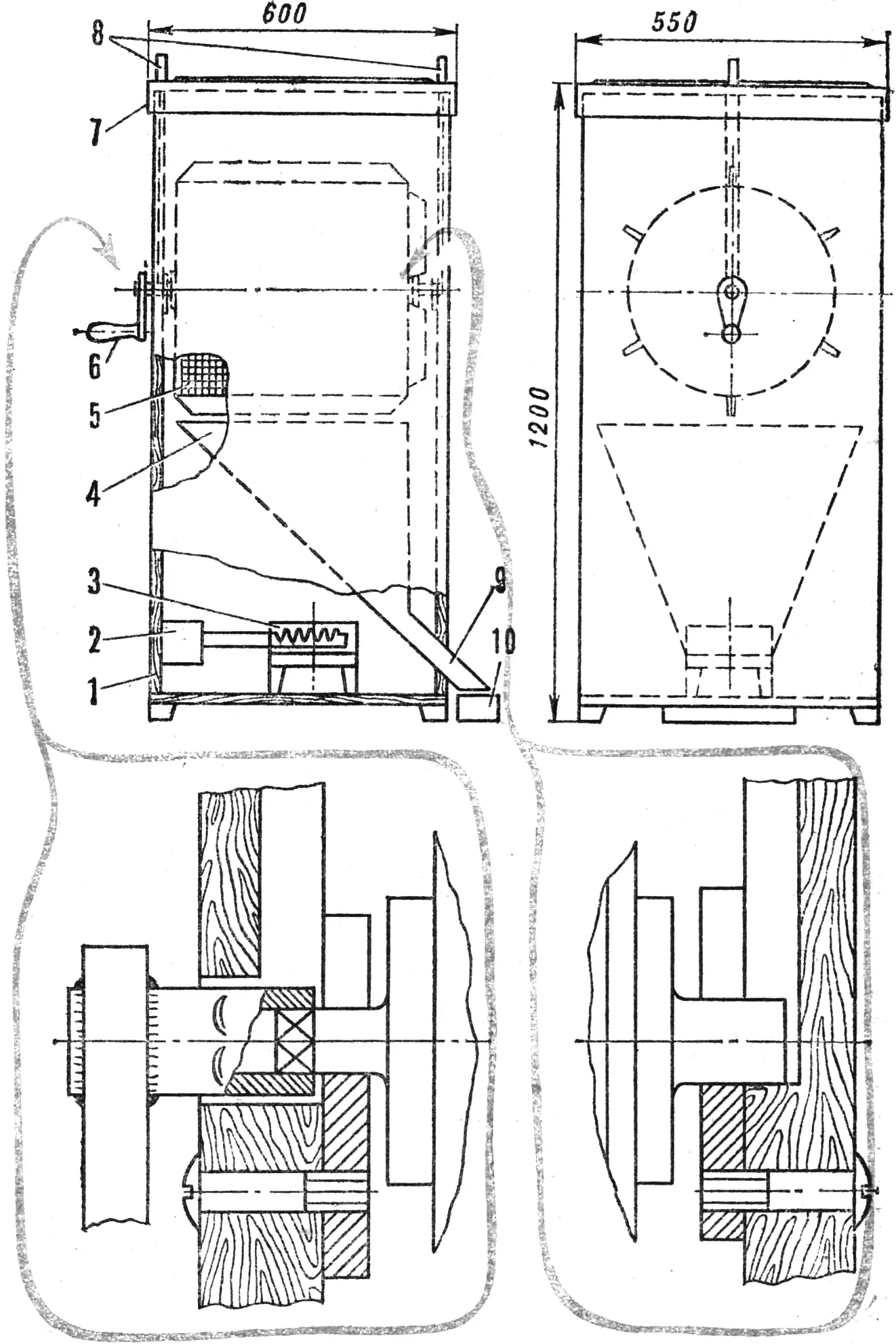
1 — housing, 2 — thermal relay, 3 — electric heating element, 4 — funnel, 5 — drum, 6 — drum rotation handle, 7 — housing cover, 8 — control thermometers, 9 — funnel mouth, 10 — special tray.
Here is how the bee sauna is arranged. The housing (Fig. 1) is a straight parallelepiped made of five-ply plywood. On top there is a cover with a seal; a large glazed observation window is mounted in it. Inside the housing, in the chamber, there is a cylindrical mesh drum with a removable end part. A bee colony is placed here during heat treatment. Below is a kind of funnel for collecting and discharging to the outside, into a special tray, the mites that fall off under the effect of elevated temperature. An electric heating element is installed on the bottom of the chamber to heat the air in it to +42°C; the mode is maintained automatically by a thermal relay. The progress of treatment is monitored visually by two thermometers mounted in the housing cover.
The main unit of the installation is the drum (Fig. 2), whose cylindrical part is covered with steel mesh with 4×4 mm cells. Six duralumin blades are distributed around the circumference on the mesh. On the removable end part — the drum cover, fastened to it with three bolts and wing nuts — there are also three radially arranged blades. When rotating, they create air circulation in the chamber. On the same cover and on the opposite end of the drum, journals are fixed that serve as the axis of rotation.
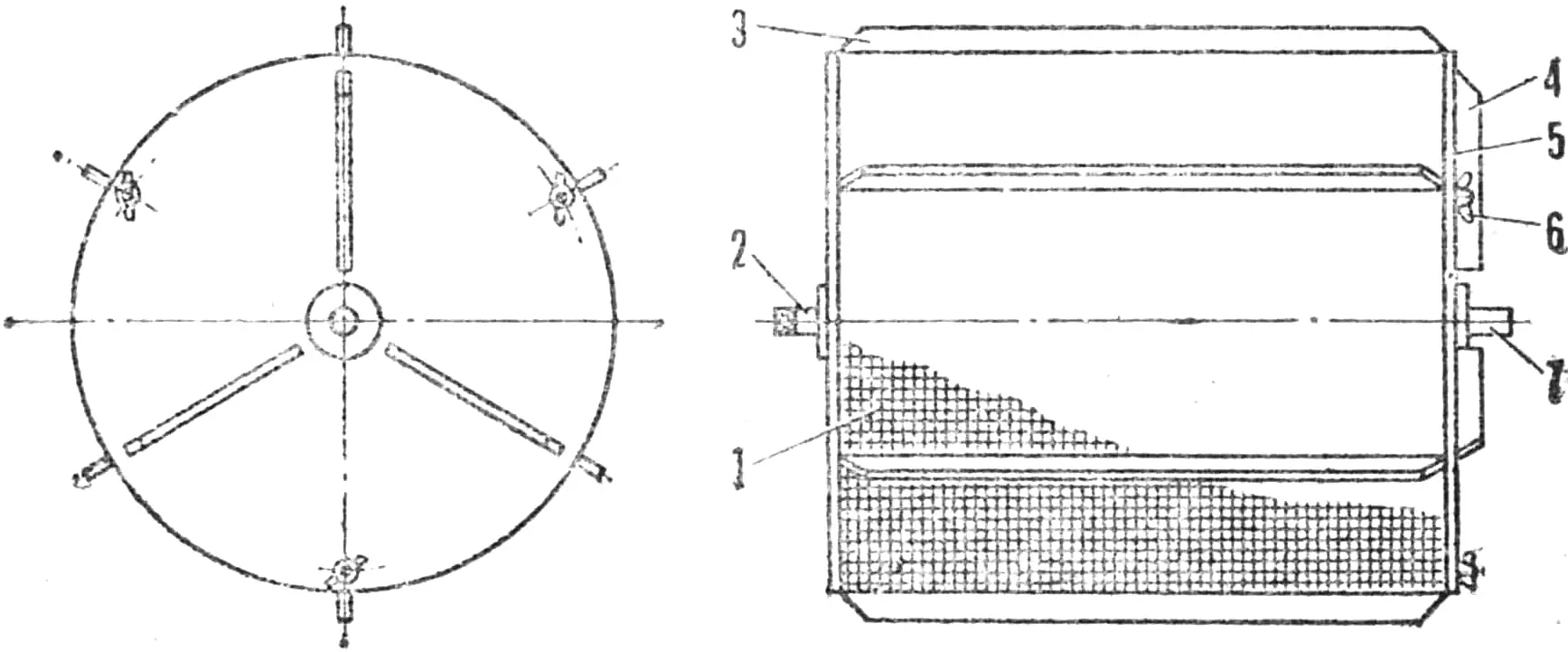
1 — mesh, 2 — journal with a square for the handle, 3 — drum blade, 4 — cover blade, 5 — cover, 6 — wing nut, 7 — cover journal.
How is the unit used? A bee colony affected by varroatosis is shaken from the comb frames into the open drum; the cover is closed and pressed tightly with wing nuts. The drum is lowered into the chamber so that the journals slide along vertical grooves milled in the housing walls. These grooves end above metal plates screwed to the housing walls. These are sliding bearings in which the drum is rotated by a handle inserted into a through hole in the housing opposite one of the journals. The end of the journal has a square cross-section; the handle is fitted onto it.
The cover with the observation window is put in place, and the heating element is switched on. As soon as the air temperature in the chamber rises, the drum is smoothly rotated at 45—50 rpm. This is done for six to seven minutes while watching the heat treatment through the observation window.
When the falling of heat-neutralized mites from the drum stops, the bee “treatment” process is finished. The drum is removed from the housing, the cover is taken off, and the now healthy bees are shaken out into their hive.
“M-K” 6’81, I. YEVDOKYMENKO
Recommend to read
 BOAT-QUASI CAR
The boat, called "Quasi," always caused a sensation on reservoirs. Initially, attention was drawn to its purely automotive appearance, emphasized by wheels painted on the sides. Upon... “PEGASUS” ON WHEELS
The Pegasus automobile studio, which builds cars of the same name, was founded in Yaroslavl in 2003 by Vadim Shustrov. At that time, he had just graduated from Yaroslavl Polytechnic...
