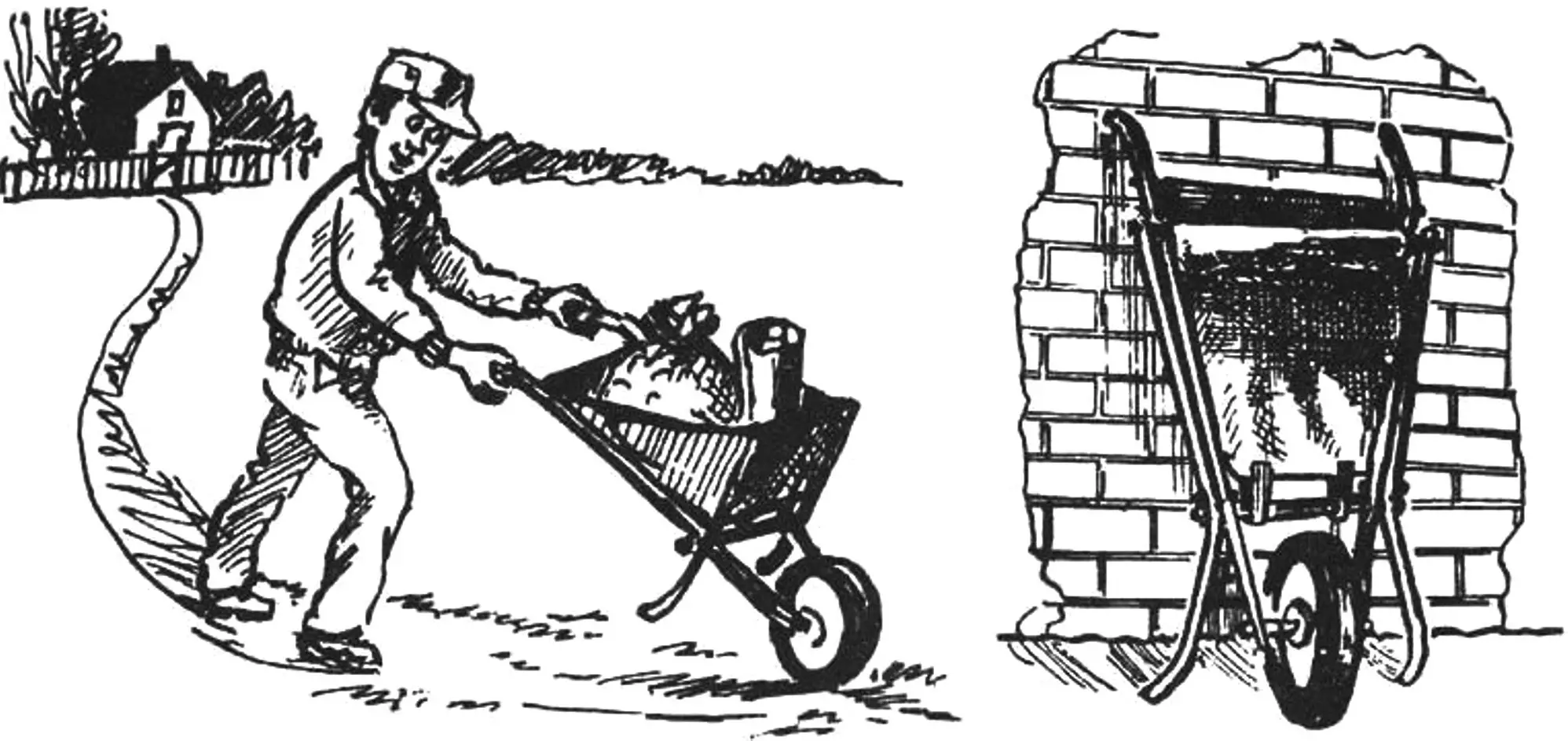
Any gardening tools used by gardeners and vegetable growers are operated mainly during the warm season, and the rest of the time they are simply stored, waiting for their turn. That is why the requirements placed on them are understandable: they should be convenient not only in use. It is no accident that among mechanization tools, compact, demountable, or folding ones have always been especially preferred. As, for example, the wheelbarrow-cart presented here, proposed by the Hungarian magazine “Ezermester”. Its principal difference from traditional designs of similar auxiliary equipment is the hinged body made of soft material and able, thanks to this, to fold into a flat pack, which makes it possible to store the cart without a special place.
The design under consideration can be made from light metal tubes, although, in principle, a wheelbarrow of this layout can also be made from wooden bars. Parts of an old folding bed can serve quite well as starting materials: its duralumin tubes have the necessary strength and low weight, and a soft pyramid-shaped body can be sewn from a canvas sheet. To make it easier to manufacture the main tubular parts, their shape is somewhat simplified on the diagram. The same applies to the body hinge and the wheel: the installation option will depend on what ready-made wheel the maker has available.
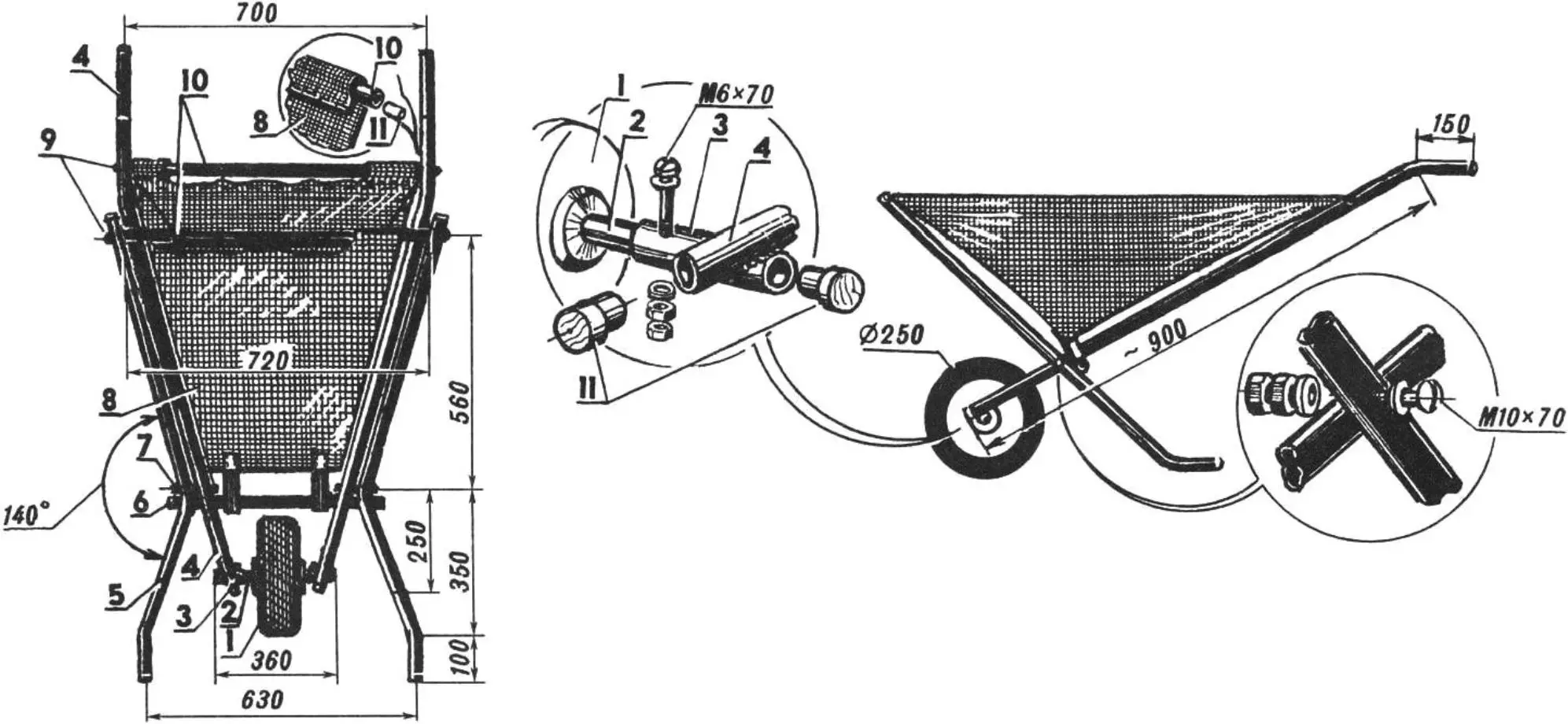
1 — wheel; 2 — wheel axle; 3 — axle bushing (2 pcs.); 4 — handle (2 pcs.); 5 — support (2 pcs.); 6 — stop-limiter; 7 — hinge (2 pcs); 8 — soft body (canvas); 9 — furniture screws (or bolts, 4 pcs.); 10 — crossbars (of handles and supports); 11 — wooden plugs
The basis of the tubular frame is two long handles, with the wheel mounted on one ends and rubber or plastic grips fitted on the opposite ends. Closer to them, the handles are joined by a tubular crossbar that gives the resulting frame the necessary rigidity. And slightly above the wheel there is a hinged joint linking the handles to the support part of the wheelbarrow, which consists of two bent tubes also joined at the top by a tubular crossbar.
Both of the mentioned crossbars have wooden plugs inserted tightly (if necessary — with epoxy glue) for fastening them with screws. If heavy loads are expected, it is better to use bolts as fasteners.
Near the hinge there is another crossbar, an overlay one and also tubular, which acts as a limiter when unfolding the wheelbarrow — the descending handles of the cart rest against it.
Sewing the soft body is not particularly difficult. The upper edges at the front and rear have patch pockets or slits by which the body is put onto the crossbars during assembly. And at the bottom two straps are sewn on, which are tightened on the limiting stop crossbar.
The design of the hinge and the mounting of the wheel also need no special comment, especially since they may have other solutions as well.
“Modelist-Konstruktor” No. 3’2002
Recommend to read
 FOR AEROBATICS
Meditating and finding equipment for the new sports season, we decided to stop on tested, proven for many years solutions. Sacrilega scheme is not too large wingspan; horizontal tail... “ELECTROMURES”
The name given to the original device, designed to replace manual labor when laying trunk cables with a diameter up to 60 mm. With their heavy lashes, as if boatmen twine could handle,...
