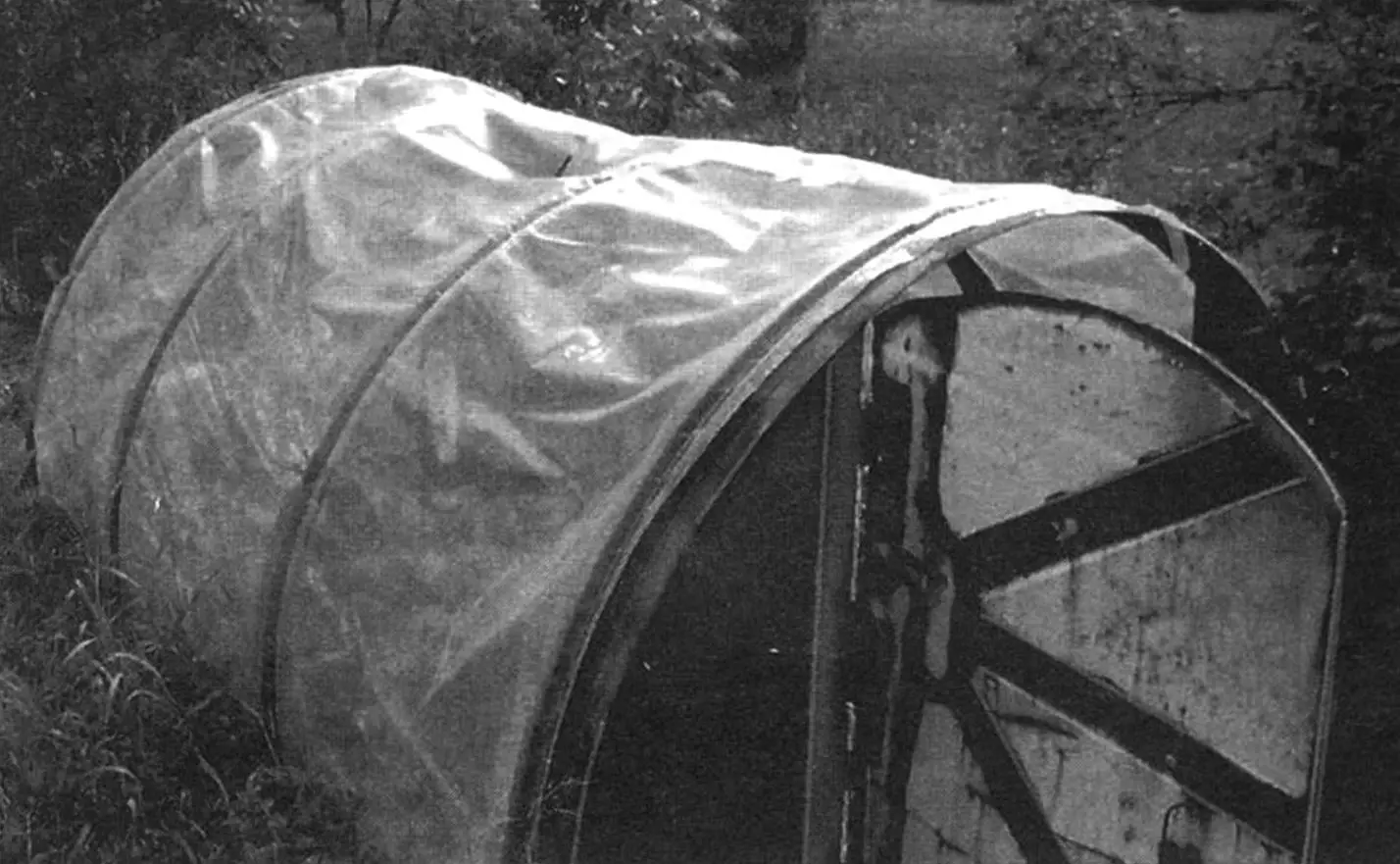
If you want to have early vegetables on your plot — then you need a greenhouse. Only in it can you create conditions for maintaining constantly high temperature and humidity of soil and air for plants both during the day and at night.
There are many designs of individual greenhouses and film-covered frames, and each has its own special feature, its own rational beginning. Those made in industrial conditions are, of course, more high-tech, but homemade greenhouses and film-covered frames are often cheaper and more practical.
It’s quite difficult to come up with something new. But I still want to propose my version — simple and accessible for replication. What should a film greenhouse be like? First of all, it needs good stability, which requires a more or less solid foundation, and tight, reliable fastening of the film to the frame. The latter often turns out to be weak: it doesn’t withstand strong winds or temperature fluctuations during the day and night. Secure fastening of the film is often achieved through permanent connections that don’t allow removing and putting the film on the frame without damaging it.
My design with an area of 4 — 5 m2 differs in the absence of a foundation, a minimal number of frame parts, and convenient film fastening on it, thanks to which the greenhouse is easily disassembled and assembled, it’s not difficult to move it to another location, which is important for owners of small garden plots. Instead of renewing the soil for a new crop, it’s enough to simply move the greenhouse; one person can handle this.
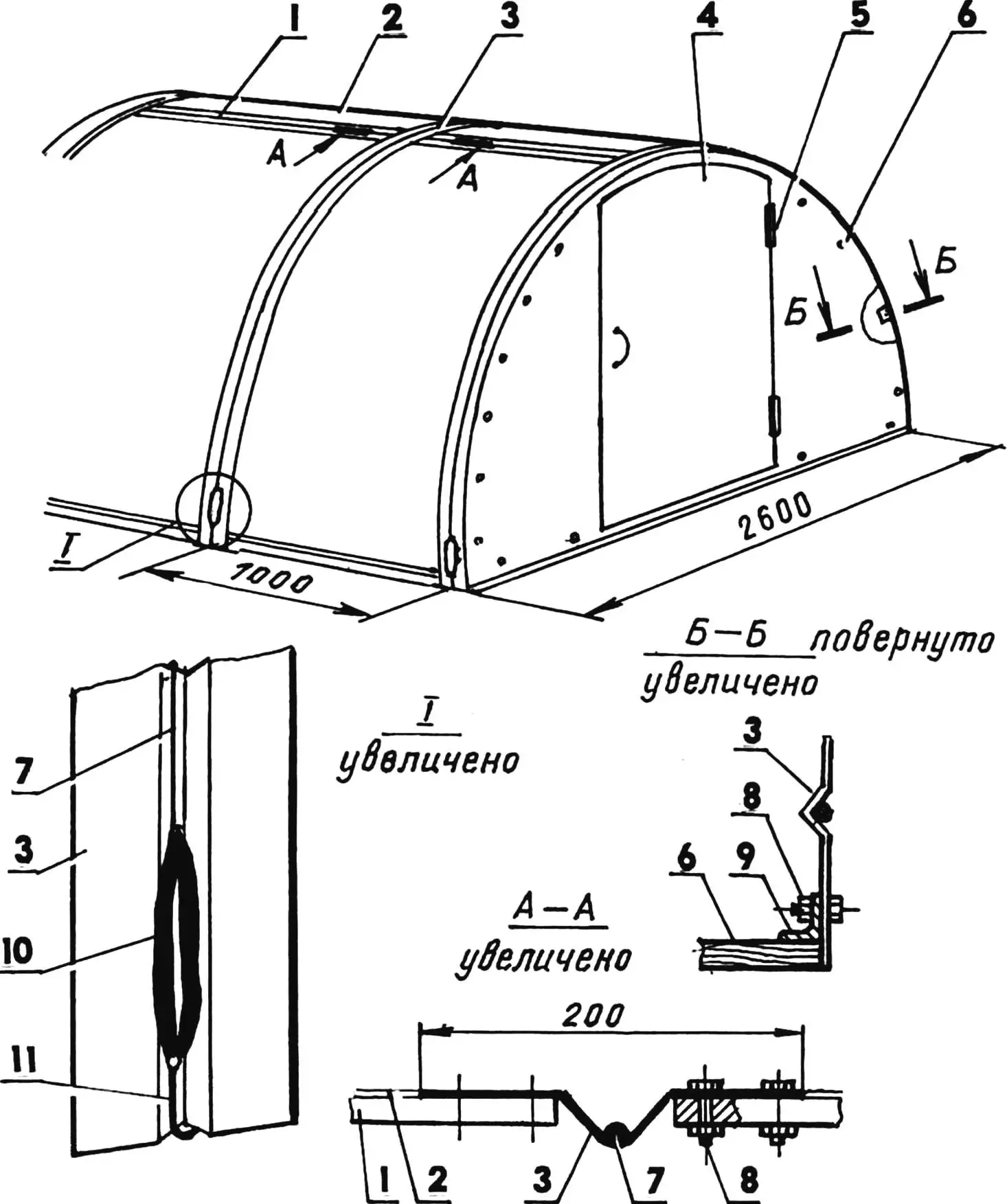
1 — connecting element (steel, rod or strip); 2 — film; 3 — arch (half of a wheel from a sprinkler system); 4 — door (plywood, plastic); 5 — hinge (2 pcs.); 6 — end panel (plywood, plastic); 7 — twine; 8 — bolt M5 or M6 (quantity — as needed); 9 — panel bracket (furniture angle or 25×25); 10 — loop (ring from an automobile inner tube); 11 — hook (steel rod Ø5 — 6)
Common methods of fastening film require either nailing it with battens to the frame, or making special loops on the film. I propose to tightly press the film to the frame with a “spring-loaded” twine. In this case, the film is not damaged. My method is ensured by the presence of grooves in the frame arches, into which twine is laid over the film, tensioned using rubber rings from worn automobile inner tubes. The ring width is 15 mm; fastening to the frame — using metal hooks made from rods with a diameter of 5 — 6 mm. Rubber tension (with a force of 4 — 5 kg) ensures soft and tight film fastening. Depending on weather conditions, removing or installing such a covering is a matter of minutes.
The greenhouse frame consists of strong metal arches, for which I used halves of wheels with a diameter of 260 cm from sprinkler systems (finding such is not difficult nowadays). They are very suitable for a greenhouse: on one hand, the arches are tall enough to walk under them slightly bent, on the other — the not too great height of the greenhouse ensures correspondingly low wind resistance and reduces heat loss. And, of course, the wheel profile itself — with a groove in the middle and smooth edges, which is convenient for mounting connecting elements.
The arches are installed at a distance of 100 cm from each other and connected to each other with wooden rods or metal strips using bolts. It’s better to rest the arch ends on bricks or boards: this prevents the structure from settling; no special foundation is required.
An end panel with a door is mounted in the end arch. They can be made of plywood or plastic. The panel is also fastened with bolts. There should be no sharp and protruding frame parts in the greenhouse that could tear the film. The greenhouse length can be easily increased by adding additional arches. The rear end of the greenhouse is simply closed with the remaining end of the film, the upper edge of which is also secured with twine, and the lower one is pressed down or covered with earth. For ventilation, it’s most convenient to open this end, as the film here easily folds back and is quickly put back in place. On a hot day, the door is also opened additionally.
Greenhouses under film of the described design have been used on my estate for seven seasons already. The film and twine last three to four years, rubber rings — about two years.
V. PEYCHEV
Recommend to read
 I ADJUST THE FRONT AXLE MYSELF
A car’s handling and tire wear, as is well known, depend primarily on the condition of the front suspension — the caster angles of the steering axes, as well as the camber and toe angles... “SPORTS EQUIPMENT” FROM NEW OSKOL
"The rocketeer" in Belgorod region more than five years are among the strongest in Russia. In the team competition they are equal "butt" on the leaders rakatomalala Moscow and...
