
In “Modelist-Konstruktor” magazine No. 4’2003, there was a good publication about interesting developments by members of the Tambov velomobile club: various models to suit any taste with comfortable soft seats, efficient muscle-powered drives, and stable three-wheeled chassis.
Among these original homemade vehicles, one model stands out as fundamentally new in the velomobile world, since it, like a regular bicycle, is two-wheeled! The design is not complicated, although it requires a special cantilever frame with a bottom bracket unit extended far forward. It differs from a bicycle in the comfortable seating position of the rider—like in a sports car—semi-reclining. I immediately built a prototype and tested it, since somehow I didn’t believe it was possible to ride a two-wheeled machine almost lying on your back. But it is possible, and quite well at that, with new and unusual sensations! However, since I assembled the frame from two standard ones, fastening them together in several places with bolts, the rigidity of such a structure turned out to be insufficient. Now I’m thinking about how to make a more reliable frame (I’m thinking of contacting colleagues from Tambov). Of course, this model requires careful alignment and fitting of dimensions so that the chain doesn’t rub against the seat and the front wheel, which should be small and not touch the cranks when turning. But these are, generally speaking, minor details, and in the near future I’m thinking of thoroughly mastering this new “steed.”
In the process of working on this model, I came up with, it seems to me, an interesting idea for a “reverse” bicycle, where the front wheel becomes the driving wheel and the rear wheel becomes the steering wheel (in a three-wheeled version, this is perhaps not new).
The essence of the idea. For example, the well-known “Salyut” bicycle with the so-called “ladies'” frame (without the top horizontal crossbar) is turned “back to front” and a seat is attached to the inclined tube in the frame opening with its back to the steering wheel (which will now be the rear one). To the fixed rear fork with the driving wheel (they will now be in front), a part of another frame with a bottom bracket unit (cut from an old bicycle frame) is firmly attached. The handlebar is installed under the seat and connected by a rigid link to the steering wheel at the rear.
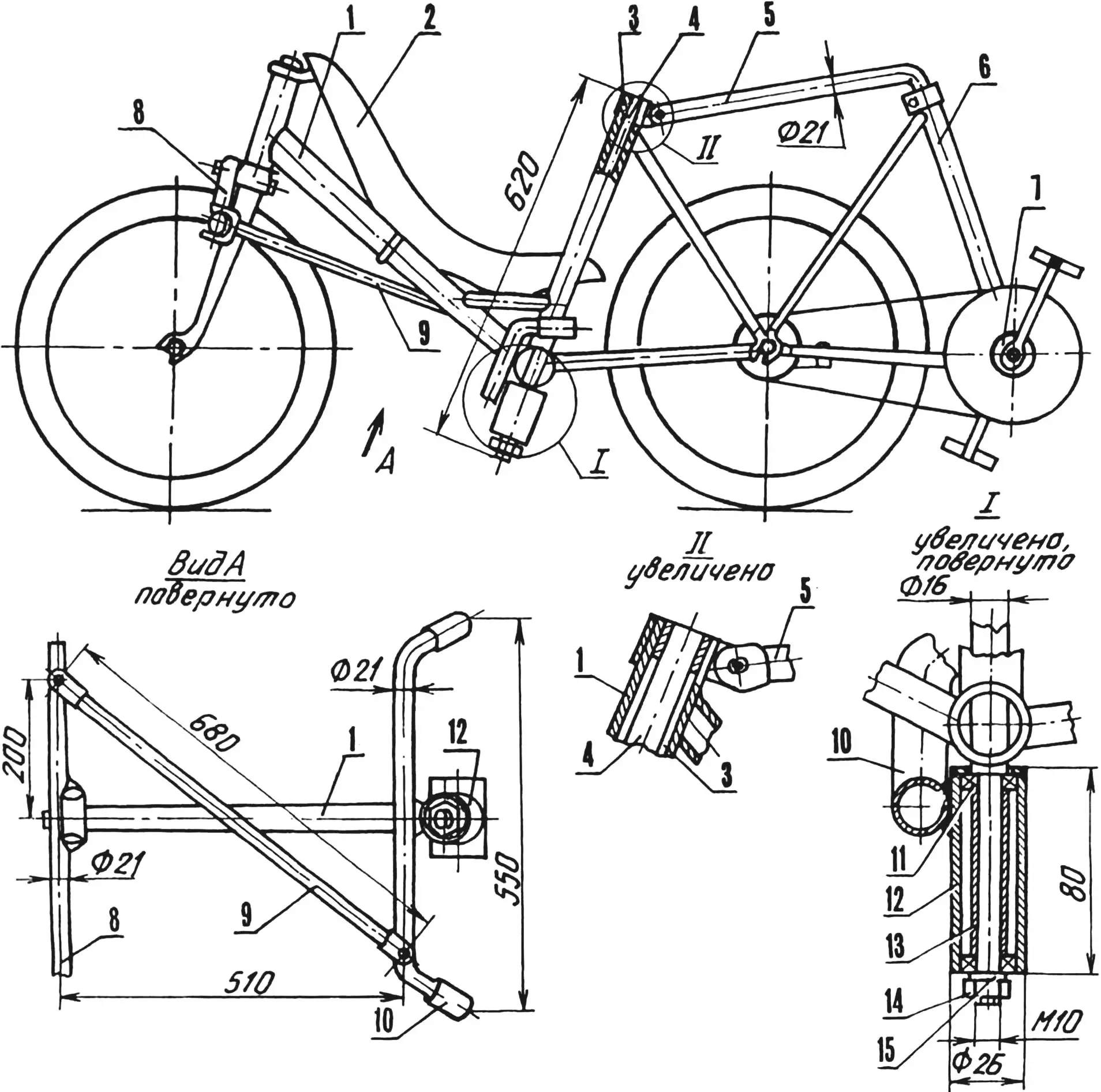
1 — frame (from “Salyut” bicycle); 2 — seat (tram seat); 3 — intermediate split ring (tube Ø20×2); 4 — rod (steel bar Ø16); 5 — crossbar (tube 1/2″); 6 — additional fork (from road bicycle); 7 — pedal drive (from road bicycle); 8 — cross member (tube 1/2″); 9 — link with fork (from cardan drive of agricultural machinery); 10 — handlebar (tube 1/2″); 11 — bearing series 1000900 (2 pcs.); 12 — cup (tube 3/4″ with welded top flange); 13 — spacer bushing (tube Ø16×3); 14 — nut M10; 15 — washer
So, more about the construction. In the bottom bracket shell (frame from “Salyut” bicycle), a hole 16 mm in diameter is made at the bottom, into which a rod made of steel bar of the same diameter and 620 mm long is inserted, passed inside the seat tube of the frame (instead of a rod, a tube of appropriate diameter with a welded tip can be used). The upper end of the bar is secured through an intermediate split ring with a standard clamp. On the lower end of the bar, a journal 10 mm in diameter with M10 thread at the end is pre-machined. Two ball bearings of series 1000900 are mounted on the journal through an intermediate bushing. A cup made from a 3/4″ tube with a welded flange and secured at the bottom with a nut is fitted onto the bearings. A handlebar is firmly welded to the cup wall (it can also be made yourself—from a half-inch tube). To the fixed rear fork of the frame using a half-inch tube—a crossbar—a similar fork with a bottom bracket unit and pedal drive is rigidly attached.
The driving wheel is rotated in the fork by 180°. Now the drive (driving sprocket—in the bottom bracket unit, driven—on the wheel hub and the chain connecting them) on the velomobile is located on the opposite side, not as in the standard version—on a bicycle.
The seat—comfortable and soft (a plastic one from a tram can be used)—is firmly secured to the frame using brackets.
The standard handlebar is removed, and a cross member is attached to the steering (now rear) fork, which is connected by a rigid link to the under-seat handlebar. The link is installed diagonally: from the left end of the handlebar to the right end of the cross member or vice versa. This connection of the handlebar to the steering wheel ensures convenient control. It is now the same as on traditional bicycles—the machine turns in the same direction as the handlebar is turned.
V. GAVRILOV
Recommend to read
 TREAT THE BIKE
Boys — people are desperate: the bike chase so that injuries are not only them, but also technology: the wheel rim is bent, the frame or the fork. If this happens, do not have to seek... FLYING BOAT L-31
29.09.2012 G. has a new plane the boat under the designation L-31 and "New Faith." Now the aircraft has been tested in acquitting all the calculations and hopes. Manufactured flying boat...
