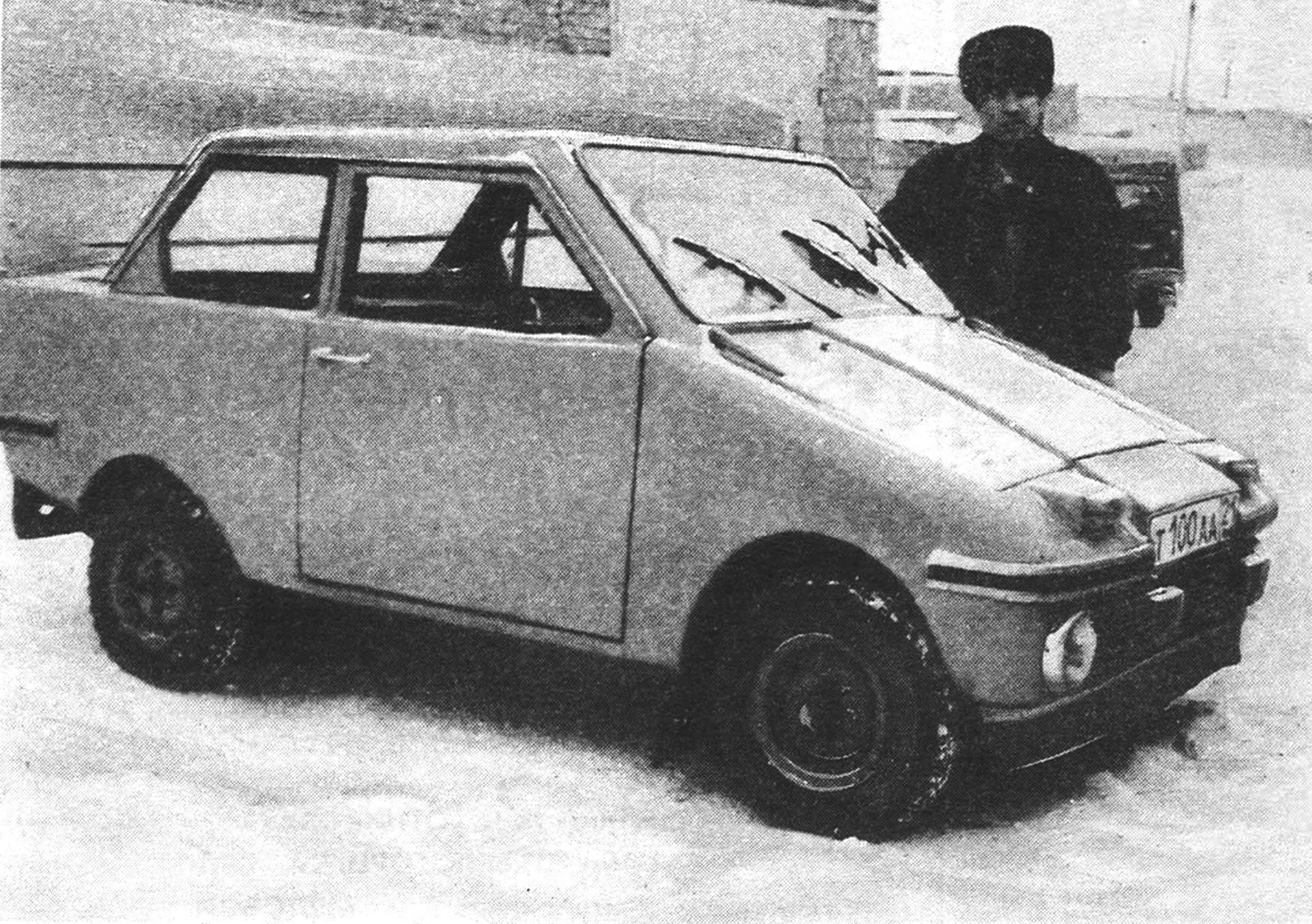
The two-seat car “Alezonnik-2” was built specifically for driving in urban conditions. Therefore, even before design work began, I formulated the main requirements the future vehicle had to meet: compact size, minimum curb weight, and high maneuverability combined with good road stability.
Drawing on experience gained while building an off-roader (“Modelist-Konstruktor” No. 10, 1996) to the design of Yerevan-based constructor S. Khopshanov, I decided to apply the same approach here.
The car body’s space frame made of rectangular steel tubes remained almost the same as on the jeep. Only the windshield rake changed (because a rear window from a RAF van was already available), the rear body section gained a separate luggage compartment, and the vehicle’s overall dimensions shrank somewhat.
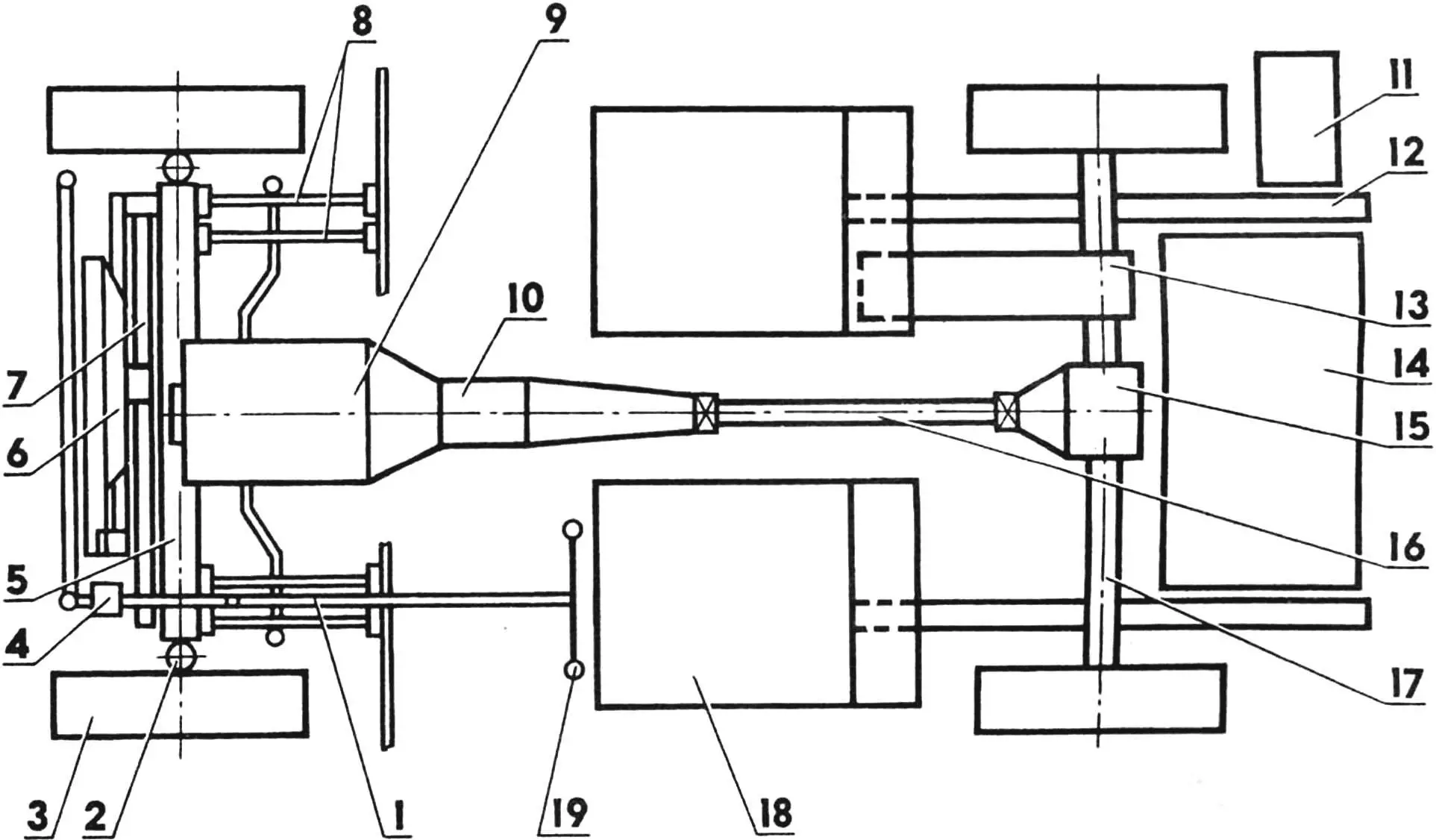
1 — steering column cardan shaft, 2 — ball joint (from “M-408”), 3 — wheel (from S3D microcar), 4 — steering gear (from ZAZ-968), 5 — front axle beam, 6 — radiator (from Audi), 7 — front leaf spring, 8 — longitudinal reaction rods, 9 — engine, 10 — gearbox, 11 — battery, 12 — rear suspension leaf spring, 13 — muffler (from “M-408”, shortened), 14 — fuel tank, 15 — final drive (from “M-412”), 16 — propeller shaft, 17 — rear axle, 18 — seat (from Latvia minibus), 19 — steering wheel (homemade).
Exterior and interior (cabin only) panels are made of 1.5…2 mm duralumin sheet; the floor is covered with 0.8 mm stainless sheet steel. The void between the skins is filled with foam plastic. The panels are attached to the frame with 4 mm screws and rivets. For amateur construction, this method offers an optimal balance of body strength and weight.
Door frames are also made of rectangular steel tubes (30×35 mm). The upper members have slots for vent windows and seals for the lift-up window glass. Window regulators and door locks are borrowed from the ZAZ-968 “Zaporozhets”. Exterior door skins are riveted to the frames.
Rear and side windows were cut to fit from stalenite taken from decommissioned trolleybuses.
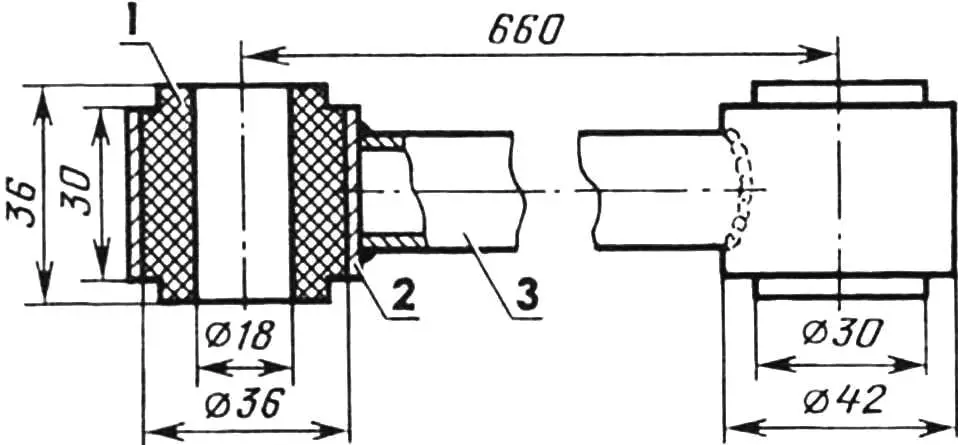
1 — silent block (from “M-408”), 2 — shell (steel 45), 3 — rod (steel tube 3/4″).
“Alezonnik-2” turned out quite attractive, small, and lively. The latter is ensured by the engine, a modified Moskvich-408 gearbox (GB), and a final drive from the “412”. The gearbox work consisted of making the gear cluster, primary shaft, and third-gear pinion so that, once S3D microcar wheels were fitted, the car would not lose out in speed. As a result, third gear became an overdrive, and the car easily reaches 120 km/h.
The structural solution for replacing the stock gearbox shift rods, first used on our off-roader, was applied here as well.
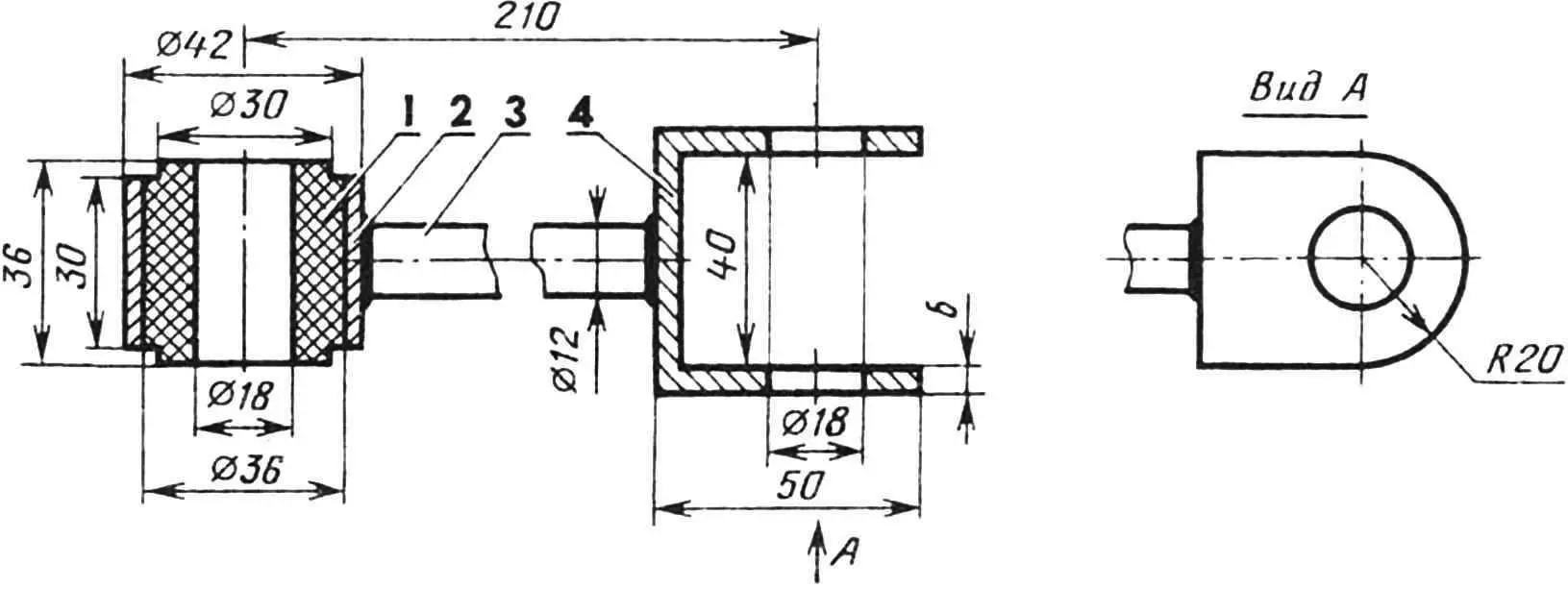
1 — silent block (from “M-408”), 2 — shell (steel 45), 3 — rod (steel 45, bar stock), 4 — lug (steel 45).
Because the new car’s wheelbase is shorter than the Moskvich-408’s and it runs 5×10″ wheels, the Moskvich propeller shaft and rear axle beam were shortened, and flanges for the smaller wheels were welded to the half-shafts.
The front axle suspension is of an original design. It is dependent but uses only one leaf spring mounted across the car. The beam is supported by five reaction rods. This greatly improves maneuverability and stability.
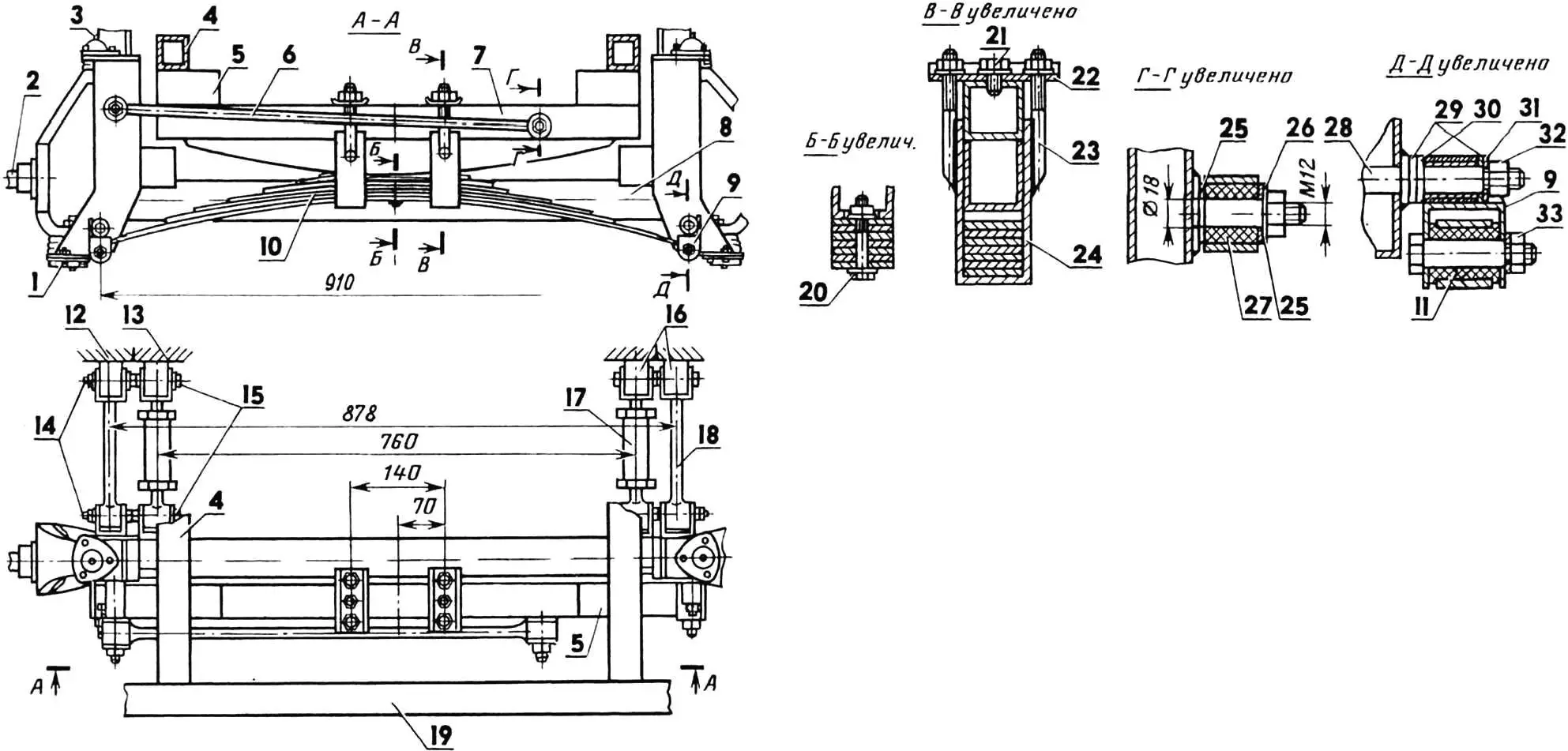
1 — lower ball joint (from “M-408”), 2 — steering knuckle (from “M-408”), 3 — upper ball joint, 4 — front frame side member (steel 45, 50×50×3 tube), 5 — spacer (steel 45, 50×50×3 tube), 6 — lateral reaction rod, 7 — frame cross member, 8 — front axle beam, 9 — shackle, 10 — leaf spring (7 leaves), 11 — bushing (buffer rubber), 12 — upper cross member of engine bay rear wall, 13 — lower cross member of engine bay rear wall, 14,15 — M18 bolts, 16 — longitudinal rod mounting assemblies with silent blocks (from “M-408”), 17 — lower adjustable longitudinal rod, 18 — upper longitudinal reaction rod, 19 — front frame cross member (steel 45, 50×50×3 tube), 20 — M8 clamp bolt, 21 — M10 locking bolt, 22 — rocker (steel 45, s6 sheet), 23 — stirrup tie rod (M12 stud, 4 pcs.), 24 — stirrup strap (steel 45, s4), 25, 29 — washers (bronze, s1 sheet), 26, 30, 31 — washers (St3, s2 sheet), 27 — silent block (from “M-408”), 28 — shackle mounting pin, 32, 33 — M12 nuts.
Camber is set during assembly by offsetting the ball joints relative to their mounting pads on the beam. Toe is adjusted with the tie rod (steering is from the ZAZ-968 “Zaporozhets”, except for the cardan, which is from the “Zhuk”), and the steering knuckle inclination in the longitudinal plane is set with the lower longitudinal rods.
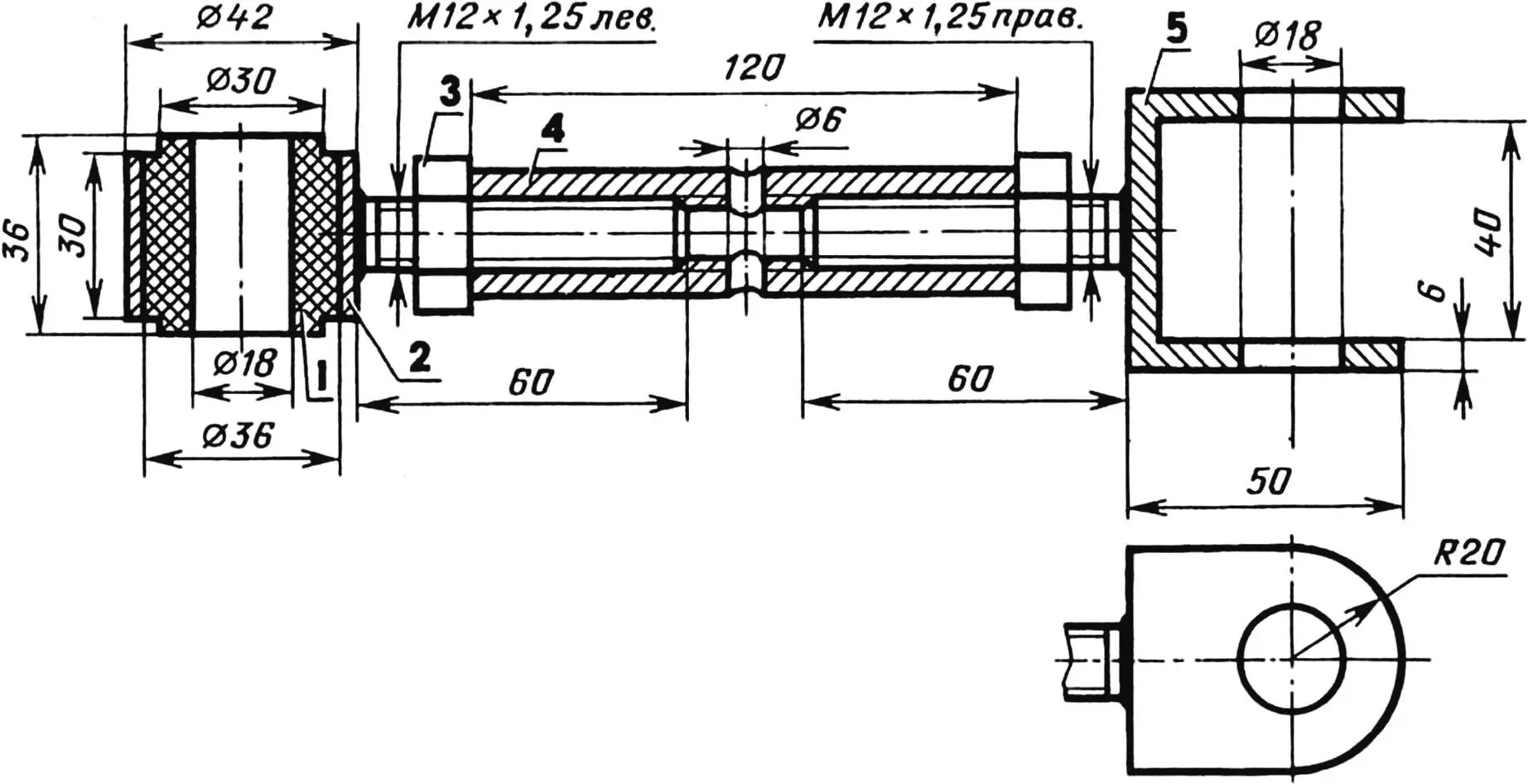
1 — silent block (from “M-408”), 2 — shell (steel 45), 3 — locknut, 4 — bushing (steel 45, Ø 22 bar), 5 — lug (steel 45).
The front beam consists of a thick-walled steel tube with box-section uprights welded to its ends. The uprights mount the upper and lower ball joints of the steering knuckles, the leaf spring, and the reaction rods (lateral, upper fixed, and lower adjustable). Longitudinal rods connect on one side to lugs welded to the front axle and on the other to mounting brackets on the engine bay rear wall. The lateral rod damps side sway of the car. One end attaches to the upper pin of the beam’s right upright, the other to a pin on a body frame cross member. Its length is chosen as long as possible, and its angle to the horizontal at full load is minimal.
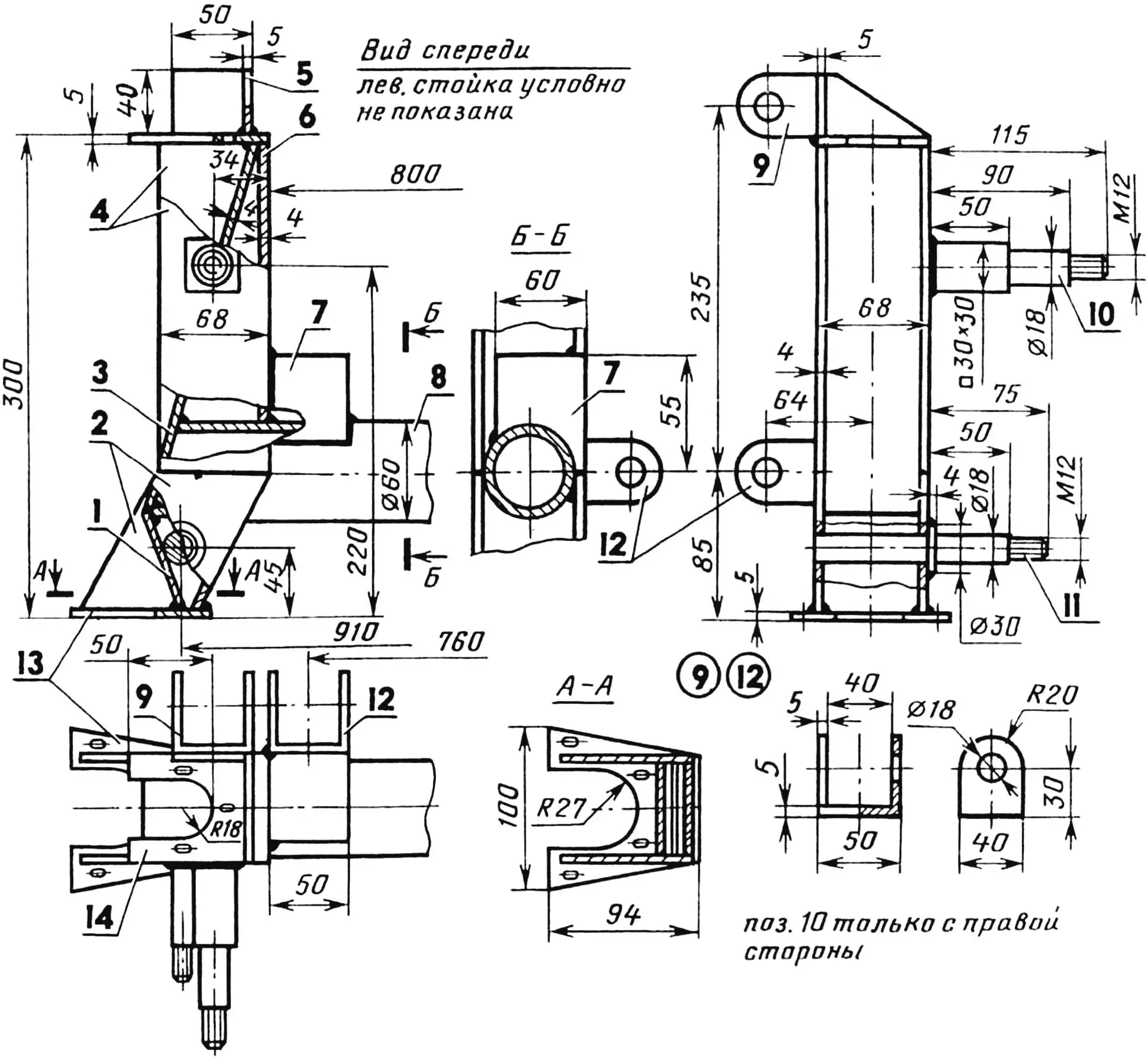
1 — lower intermediate wall (steel 45, s4 sheet), 2 — lower (front and rear) walls (steel 45), 3 — upper intermediate wall (steel 45), 4 — upper (front and rear) walls (steel 45), 5 — bracket (steel 45), 6 — side wall (steel 45), 7 — stop (steel 45, s4 sheet), 8 — beam (steel 45, 60×6 tube), 9, 12 — longitudinal rod mounting lugs (steel 45), 10 — lateral reaction rod mounting pin (steel 45, bar), 11 — leaf spring mounting pin (steel 45, Ø 30 bar), 13 — lower ball joint mounting pad (steel 45), 14 — upper ball joint mounting pad (steel 45).
The front axle leaf spring is from the Moskvich-408, shortened by 90 mm. To do this, the spring’s lower leaf ends were first stress-relieved, straightened, shortened, then bent again and hardened. Buffer-rubber bushings were pressed into the formed ends.
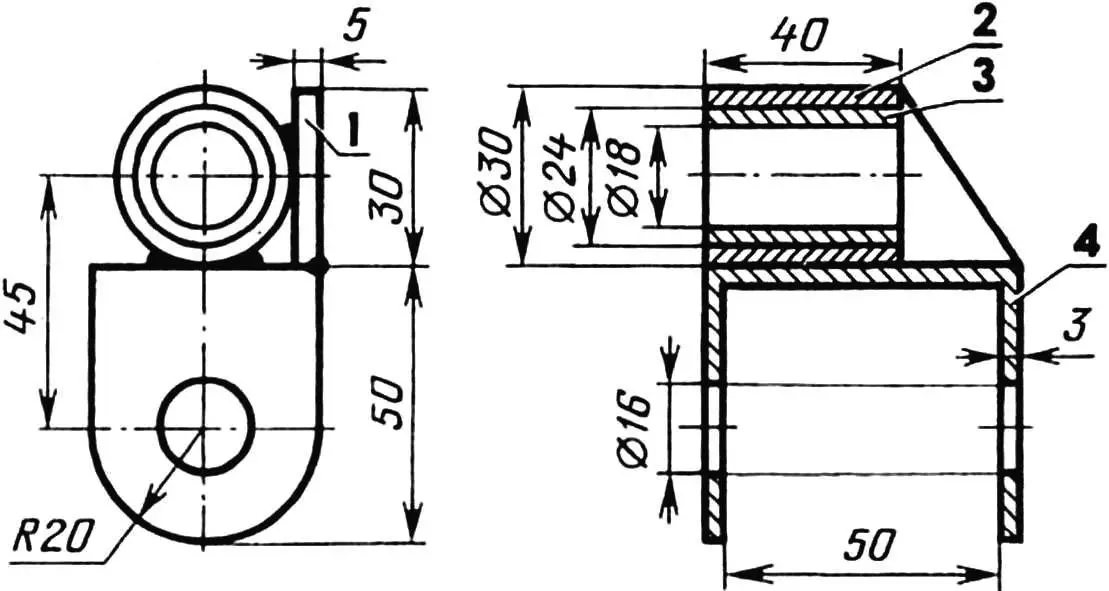
1 — gusset (steel 45), 2 — bushing housing (steel 45), 3 — bushing (bronze), 4 — lug (steel 45).
The spring is hung on the beam with two custom shackles on the lower pins of the front axle beam. It is securely attached to the body frame cross member with two stirrups.
Rear axle suspension is similar to the “M-408”.
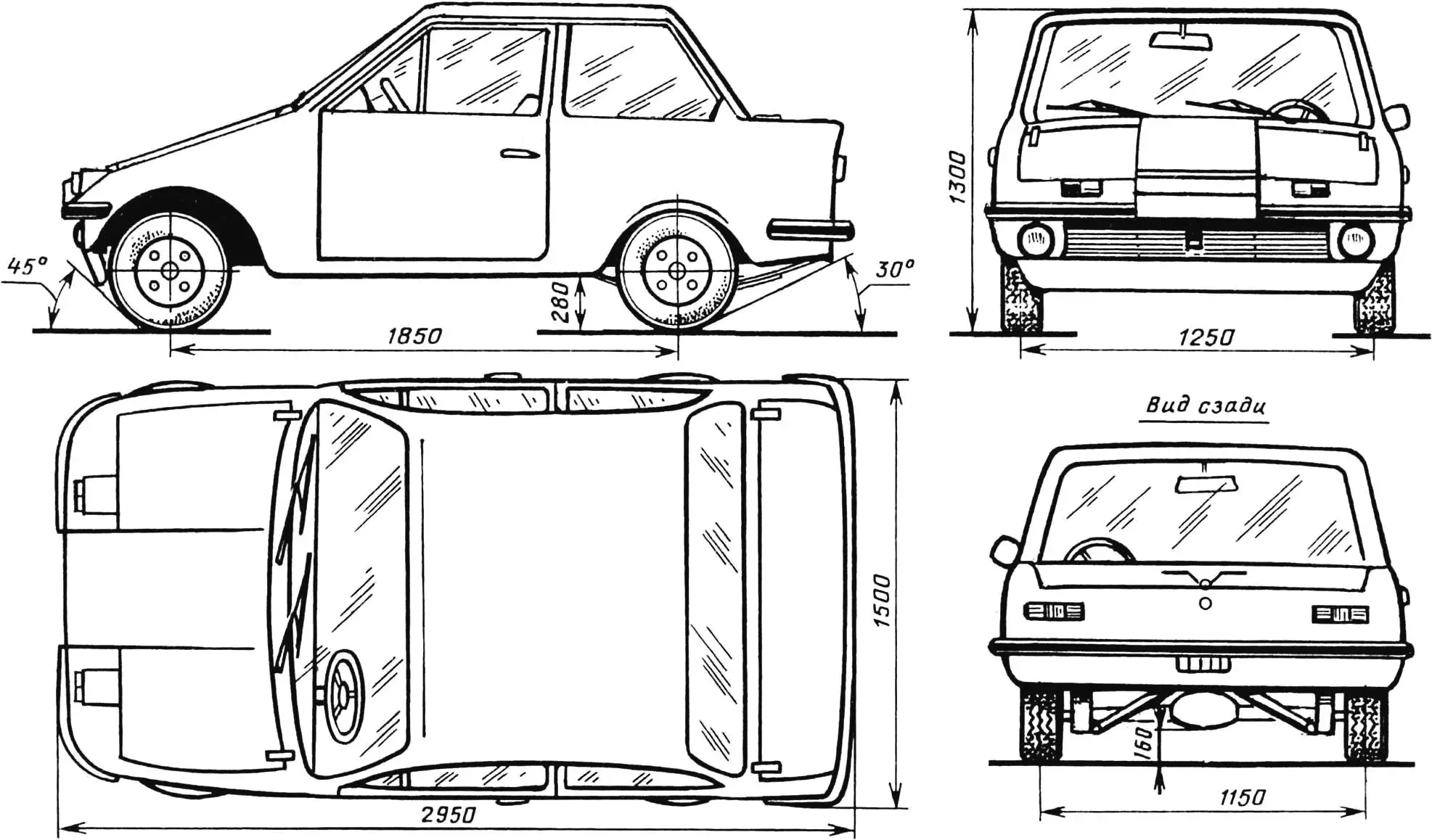
In use, “Alezonnik-2” proved convenient and reliable. After registration with the traffic police, it covered more than 10,000 km on our city’s roads, and over a year and a half not a single failure was found.
MAIN TECHNICAL SPECIFICATIONS:
Seating capacity … 2
Length, mm … 2950
Width, mm … 1500
Height, mm … 1300
Curb weight, kg … 700
Engine power, hp … 45
Maximum speed, km/h … 120
Minimum turning radius, mm … 3500
Brake system … ZAZ-968
Master brake cylinders … “M-408”
Cooling system drive … electric
Ignition system … electronic
Fuel tank capacity, L … 35
Fuel consumption per 100 km, L … 8
0–100 km/h acceleration time, s … 13
“Modelist-Konstruktor” No. 1’97, N. VASILYEV
Recommend to read
 Well trap
I have been subscribing to the magazine «Modelist-Konstruktor» since 1980, so I am a long-time reader. I have decided to write to the editorial office for the first time. Since school I... AN ASSISTANT ELECTRICIAN
The proposed instrument is an improved version of the previously published article "the Indicator of the electric field" [1]. An assistant electrician (NPE) is a relatively...
