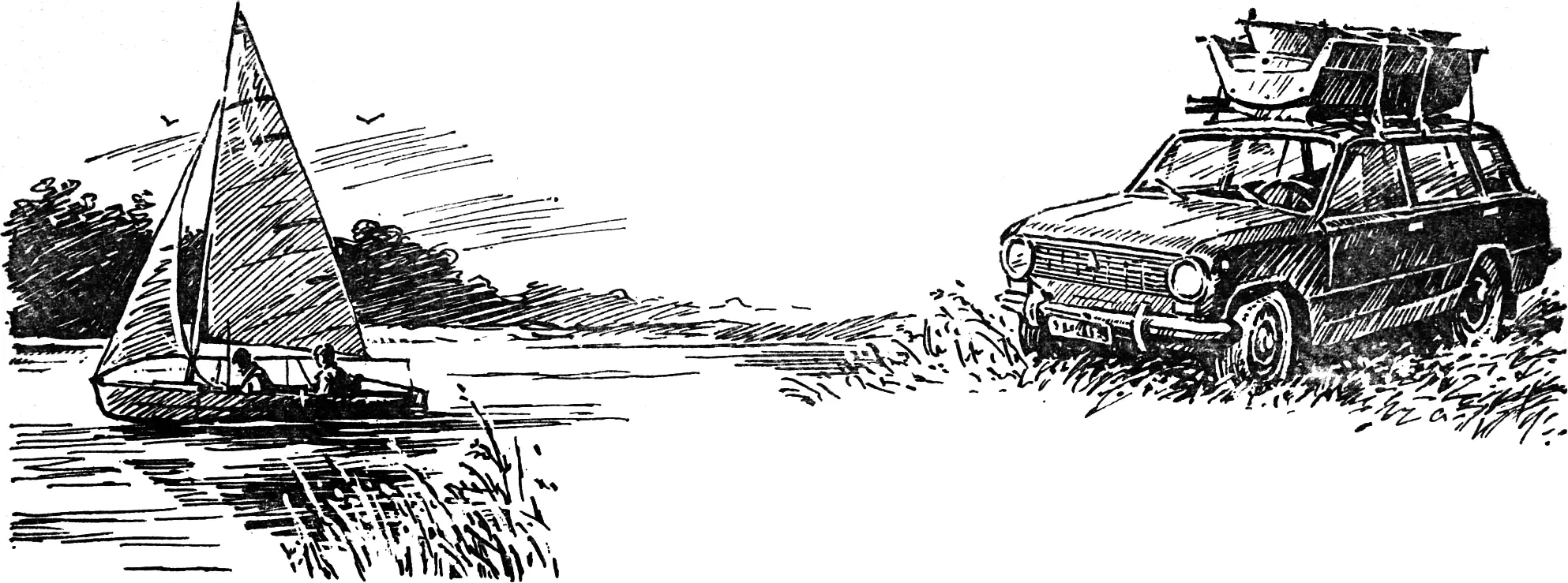
One timber beam and a canvas bag (a bag with a round bottom) measuring 550×1400×1450 and 250×1400 mm — that is what this svertboat turns into if you take it apart and pack it for transport. Compactness was achieved by making the hull three-section. Each section can nest inside another, like the familiar “matryoshka” dolls. This feature fundamentally simplifies transporting the boat and allows a city dweller to store it in an apartment or on a balcony, and even repair it right in a room. After all, the overall hull length is impressive — more than 4000 mm, and the beam is 1400 mm. On such a svertboat you can make weekend trips and go on tourist voyages, sail in shallow water, and thread through reeds. And although its lines are designed for light wind and sailing with a full load, the svertboat’s carrying capacity (about 300 kg) allows a crew of two or three; it handles waves about half a meter high well and wind gusts of force 4—5 on the Beaufort scale.
An important positive feature of the boat is the manufacturability of the hull: smooth lines make it much easier to build from fiberglass. Moreover, you can do without a plug during lay-up by making a mold with a smooth surface, for example from “glossy” hardboard.
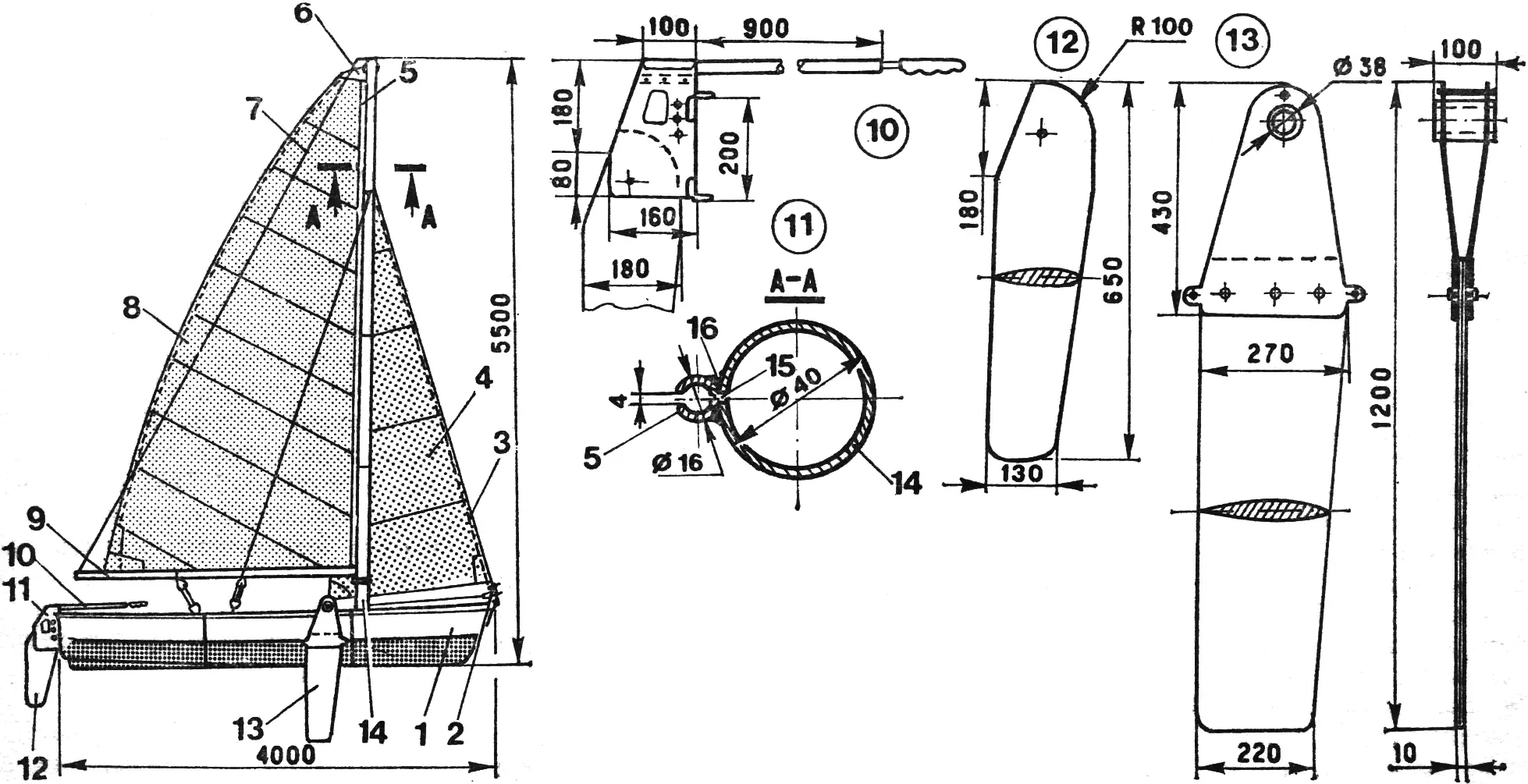
1 — hull, 2 — jib halyard, 3 — jib luff rope, 4 — jib, 5 — mast luff rope, 6 — mainsail tack board, 7 — boom topping lift, 8 — mainsail, 9 — boom, 10 — tiller, 11 — rudder box, 12 — rudder blade, 13 — centerboard, 14 — tube, 15 — mounting screw M4, 16 — epoxy seam.
You should start with frames — wooden structures repeating the profile of each of the theoretical frames. There are six of them: they are set on a level surface and joined by stringers, then sheathed with hardboard. Work will be easier if you first cut patterns from heavy paper or cardboard, refining their shape on site. Changes along the keel and buttocks are accounted for by varying the height of the transverse timbers of the frame bases. The bilges and all sharp edges are rounded with templates made of organic glass using ordinary putty or plasticine. Where section joints are required, partitions of 10 mm plywood are installed.
After assembling the mold, its “releasable” surface is coated with a parting layer: “Edelwachs” parquet paste or a wax solution in gasoline so that the fiberglass cloth does not stick to it during lay-up. The technology of making a fiberglass hull itself is no different from the usual one. Depending on the fabric thickness, molding is done in 4—7, even 9 layers so that the sides are 2.5—3 mm thick, the bottom 3.5 mm, and the bulkheads 4—4.5 mm. It is better to do a trial bonding on several fabric offcuts first — this will help determine the required number of layers more accurately.
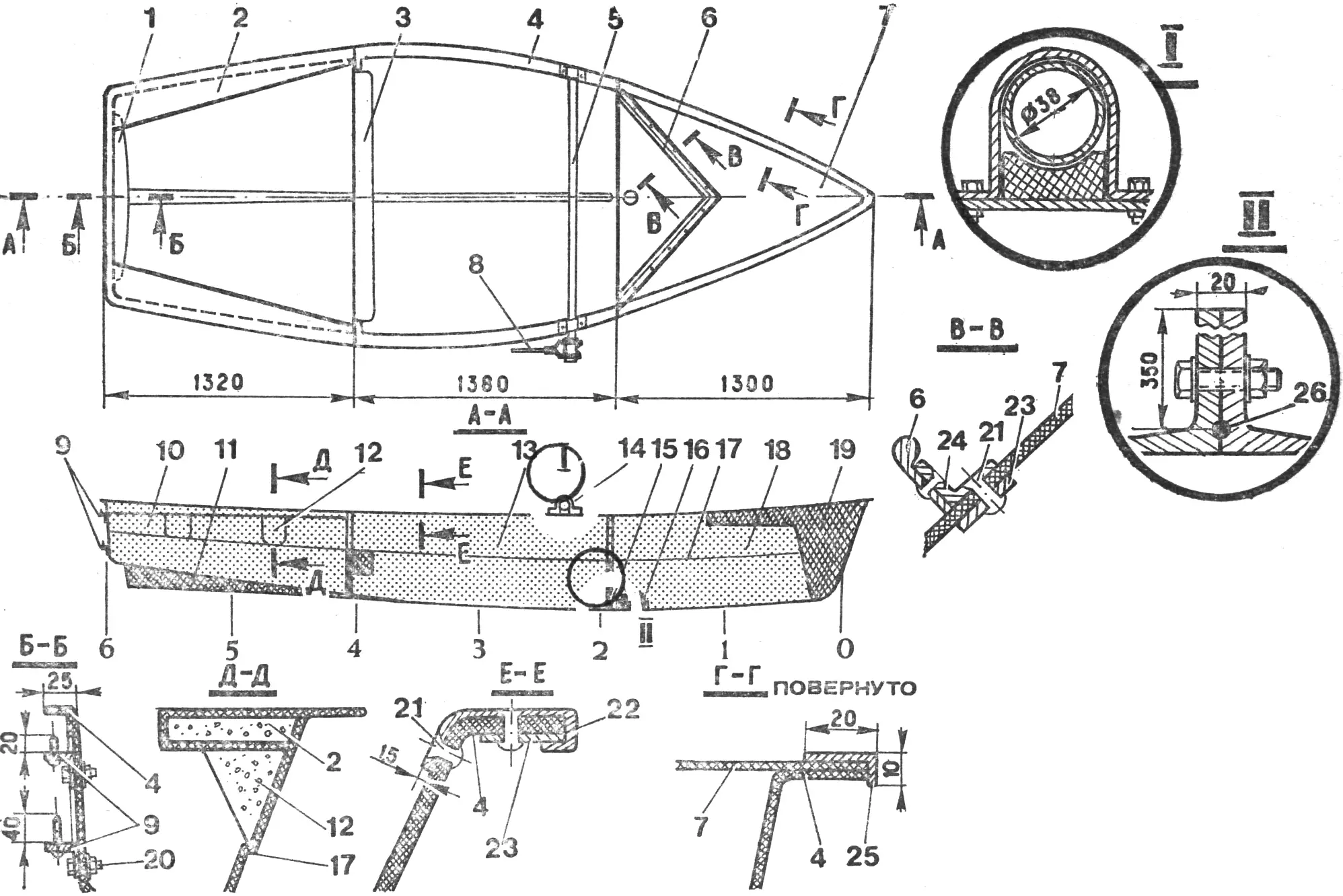
1 — transom, 2 — aft half-deck, foam plastic, 3 — thwart, 4 — inwale, 5 — centerboard beam, 6 — spray deflector, 7 — foredeck, 8 — centerboard, 9 — rudder hanging brackets, 10 — aft section, 11 — keel, 12 — knuckle, foam plastic, 13 — middle section, 14 — clamp, 15 — section bulkhead, 16 — mast step, 17 — hull chine (redan), 18 — bow section, 19 — under-deck insert, foam plastic, 20 — bolt M8, 21 — rivet Ø6 mm, 22 — inwale “cover,” duralumin, 23 — lining, 24 — spray-deflector angle, 25 — rubbing strake (duralumin, 10×20 mm angle), 26 — rubber gasket, cord. (Sections B-B, V-V, G-G, D-D, E-E — enlarged.)
Strength and rigidity are given to the svertboat hull by the keel, bulkheads, and chine along the side. In the stern, a narrow half-deck is reinforced with knuckles. In the middle part, an inwale is made along the side. The foredeck is solid; a low triangular coaming of the spray deflector is secured on it. The deck reliably protects gear stowed in the lazarette from rain and spray while sailing.
The inwale is covered with thin sheet duralumin. In addition, a metal angle is placed along the entire bow part: it serves as a rubbing strake. The knuckle is made of foam plastic with fiberglass sheathing. Under the deck at the stem, a reinforcing foam insert is laid in.
The sections are joined to each other with M8 or M10 bolts; for this, corresponding holes are drilled at the bottom in the bulkheads.
The role of a seat in the svertboat is performed by a narrow transverse thwart (material — foam plastic with fiberglass). In the middle of the hull on the inwale, thole pins for oars can be installed.
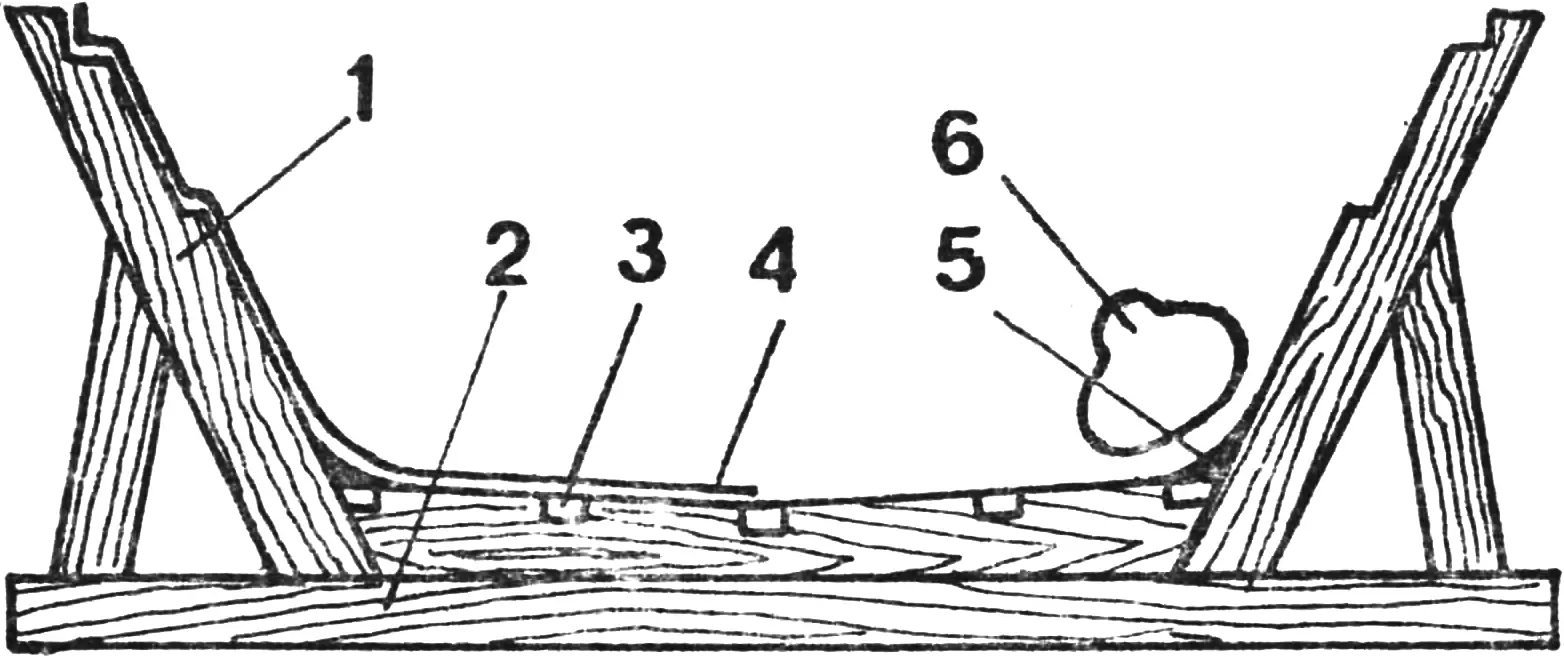
1 — upright, 2 — base, 3 — connecting stringers, 4 — hardboard, 5 — putty, 6 — template.
The svertboat’s rig is also dismountable, made of duralumin tubes. The mast, 5500 mm high, consists of four identical lengths of Ø40×2 mm tube joined with inserts. The mast luff rope of Ø16×1 mm tube is attached to it with countersunk-head M4 screws. The boom is made of three parts of Ø30×1 mm tube. It has no luff rope, and the lower corner of the mainsail is free: held only in the clew. The jib is set on the forestay with the luff of the forward corner and furled with the jib halyard. Sail material is dense lining fabric. Their total area is 8.5 m2.
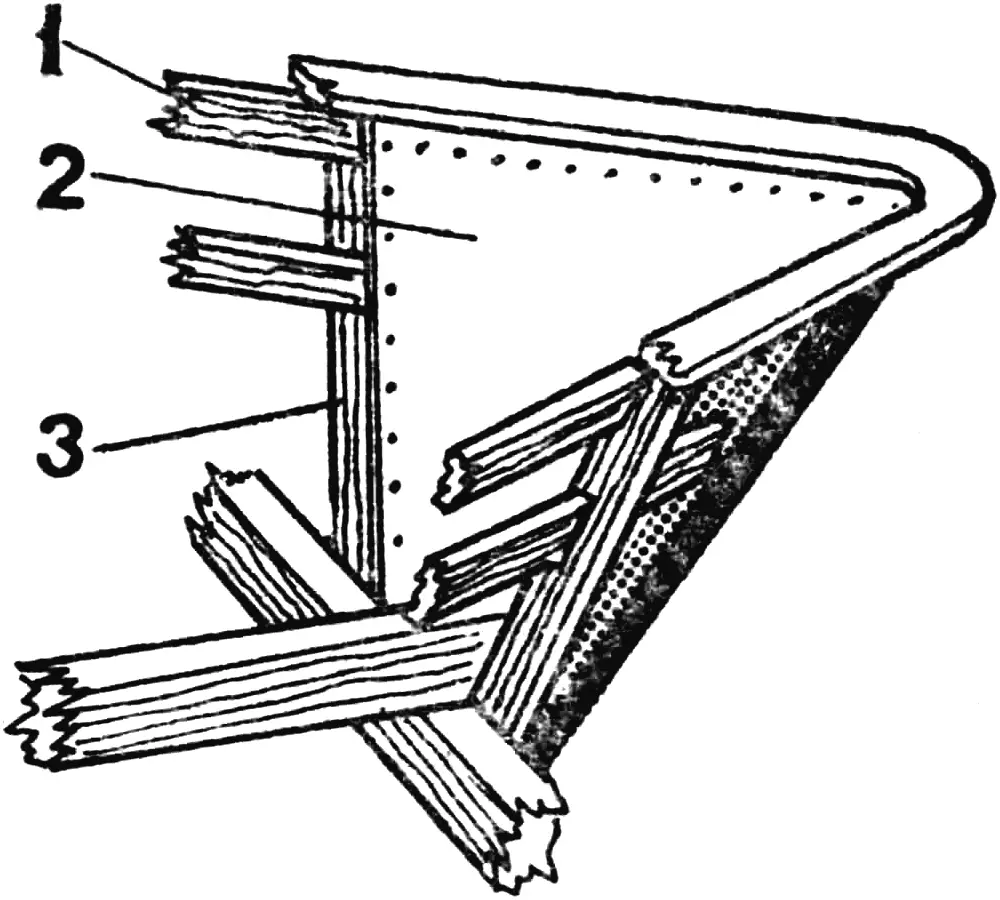
1 — stringer, 2 — mold stem (sheet metal, duralumin), 3 — strongback upright.
The mast is secured with a forestay and two shrouds running down from the mast cap, and the boom is supported by a topping lift from the masthead. Its step is located 1250 mm from the bow end of the first section.
The centerboard is side-mounted, of the kayak type: there is no need to make a centerboard trunk in the bottom — this simplifies construction and its mounting. It is installed on a bushing fitted into the centerboard beam (Ø38 mm tube), which in turn is held in clamps on both sides. The centerboard is of the dagger type, foiled, made of plywood. Its length is 1200 mm, maximum width at the waterline is 270 mm. The centerboard beam is located almost immediately aft of the mast.
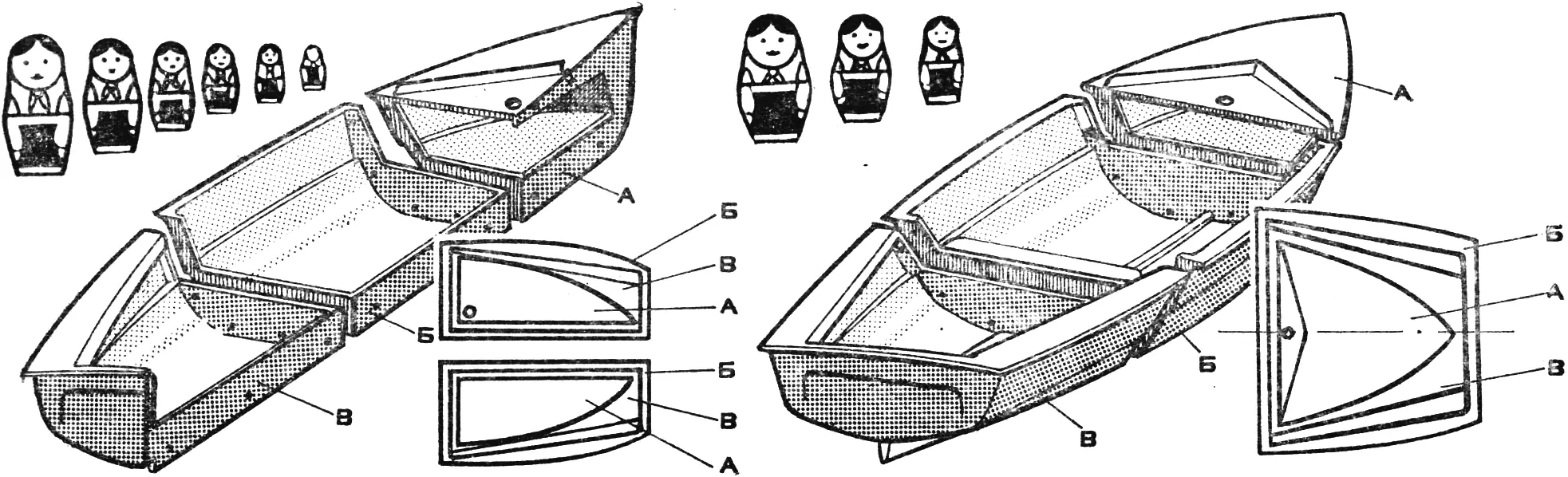
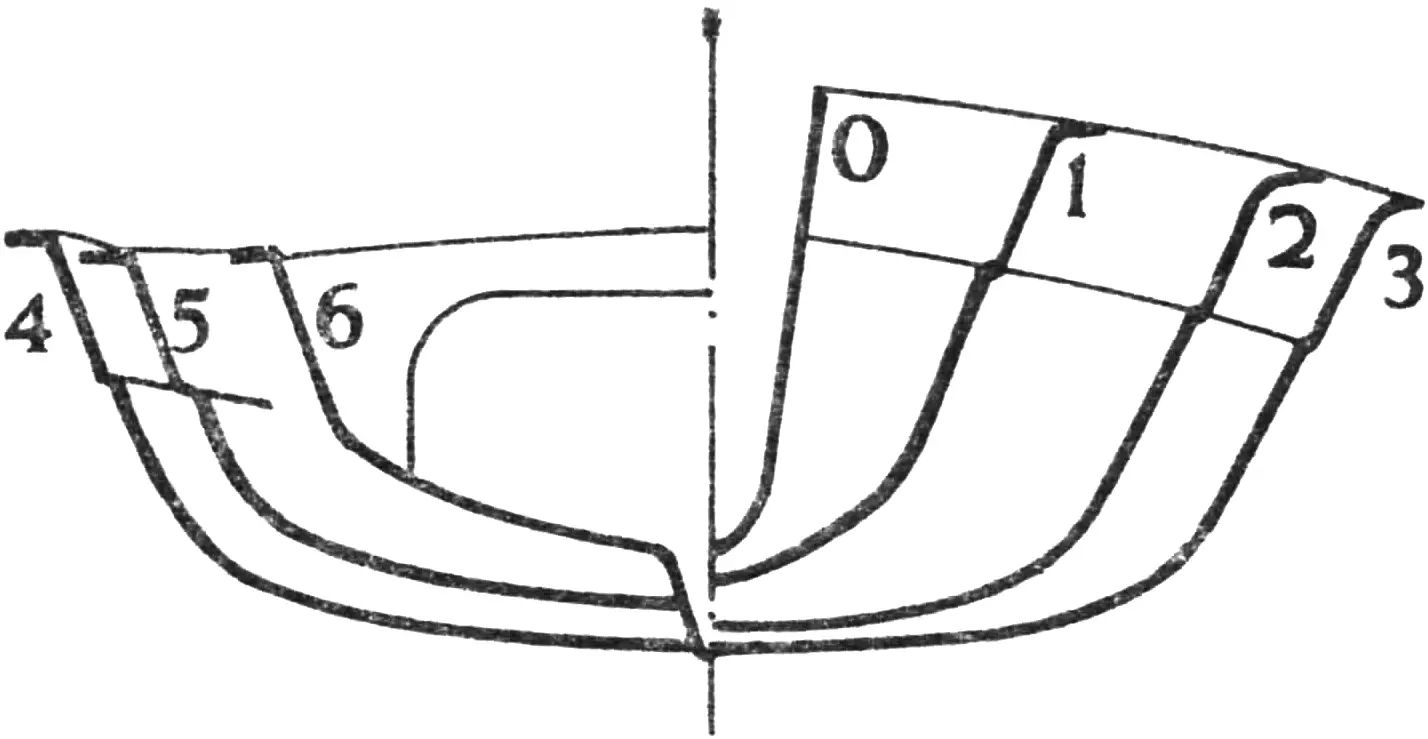
left — 6-section version, right — 3-section version. The diagrams show the order of nesting sections for transport.
The rudder blade is also foiled, plywood; its lower part is sheathed with fiberglass cloth. The blade length is about 650 mm, and the maximum width is 180 mm. Mounting is conventional: with a rudder box it is hung on brackets and pins to the transom. For easier steering, the tiller is made with an extension that slides out of the main tube.
A few words about the prospective design. The hull of the “Fox” svertboat consists of three sections, but an identical boat has already been built in six “matryoshka” sections. This makes transport even easier: the boat breaks down into two packages measuring 550×750×1450 mm. True, this required some increase in weight — due to additional bulkheads and fasteners.
«M-K» 7’84, V. RUMYANTSEV
Recommend to read
 “LOTUS-56V” – A CAR WITH A SHIP’S PIPE
Picking up the prototype for the model with open wheels (the trace of A class), we did not immediately notice the car "Lotus" with a modest architecture of the body and a relaxed... Dump shovel
It would seem that a shovel is such a simple tool that changing or improving its design is hardly possible. A handle and a blade—that’s the whole device. Nevertheless, there are many...
