Before introducing the material below, we’d like to recall a short note in issue No. 2 of our journal for 1979 — “Folding sleds.” The reason is that the author of both designs is the same — our reader from Kazan, E. Zakharov. His technical creativity was prompted by a little son who every morning had to be taken to kindergarten. Ordinary sleds, because of their bulk, were not very suitable for trips with transfers in transport, and E. Zakharov builds an original version — foldable, like the popular stroller-walking sticks. Folding sleds interested many of our readers who decided to make the same: convenient not only in use, but also for storage.
And the son meanwhile grew up — and the father designs new ones for him, now with an engine. In essence, these are the smallest motosleds we have published. Here is another pleasant confirmation of the unwritten law of technical creativity: whoever once touched it will remain its faithful and active follower.
Interesting: what will be the third design? What it will be — we’re now sure!
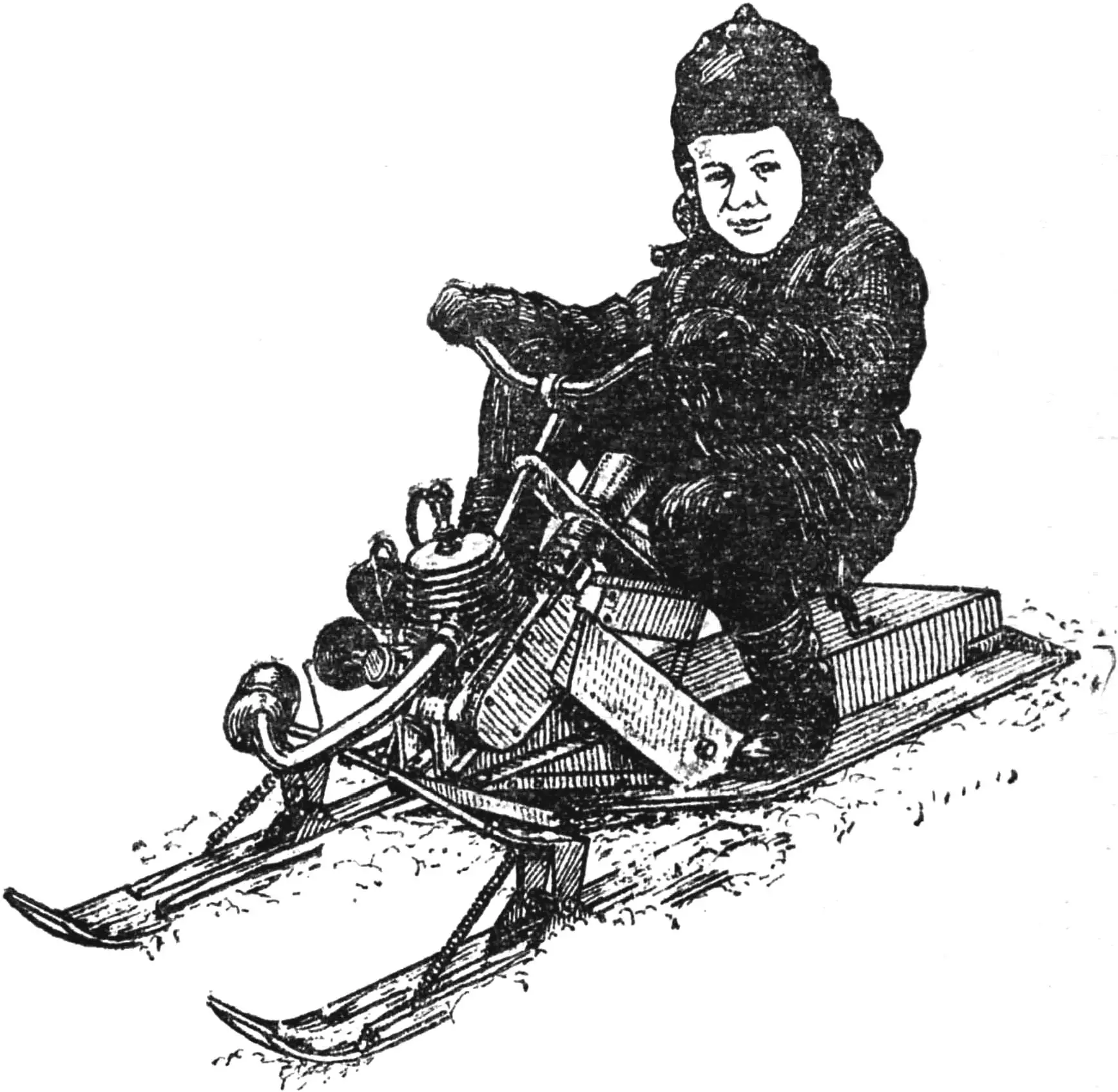
The design is made for the D-4 bicycle engine. It has demonstrated good running characteristics, is easy to control, climbs a 10—15° slope, and reaches a speed of 7—8 km/h. On packed snow, the motosleds can even carry an adult person.
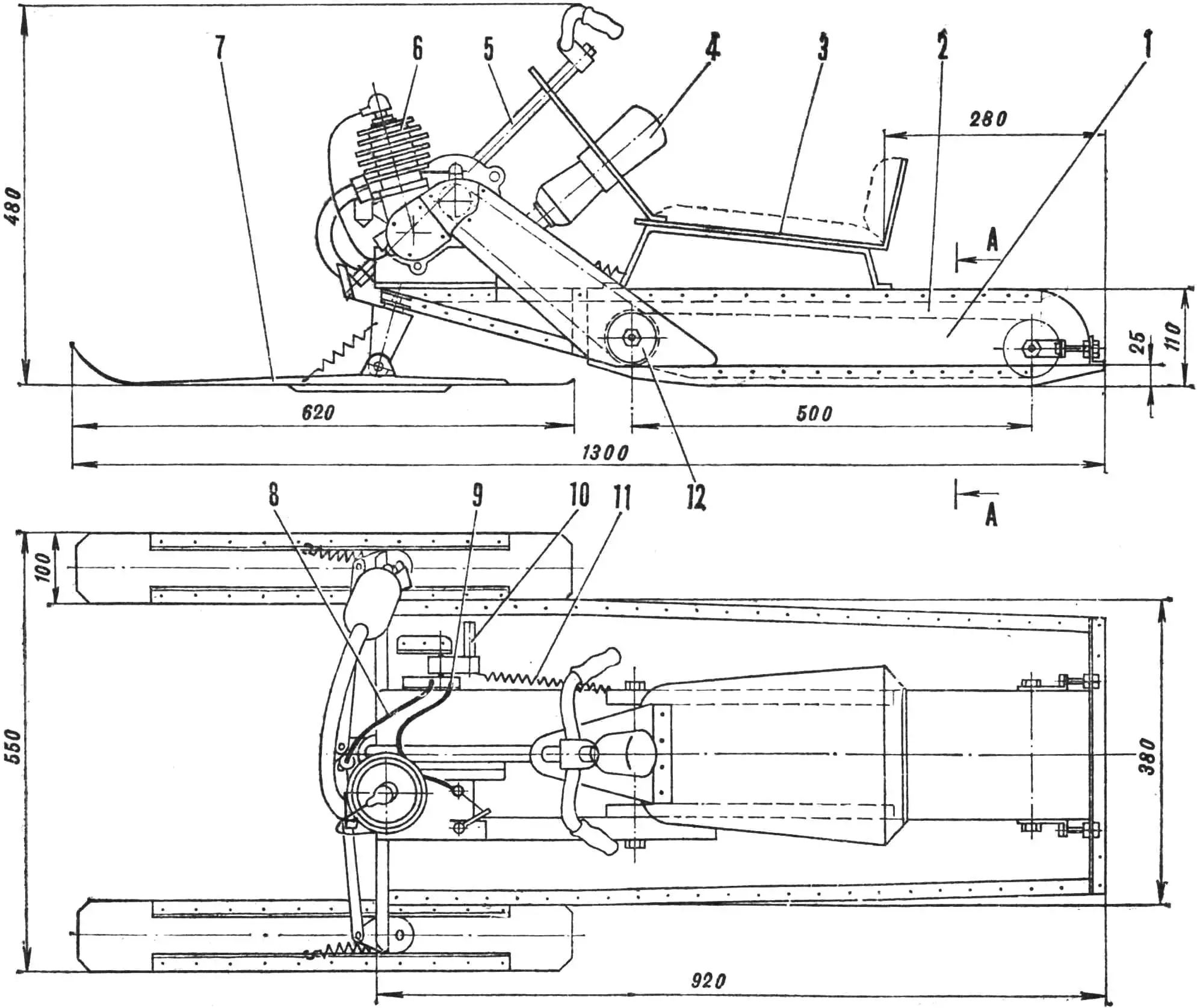
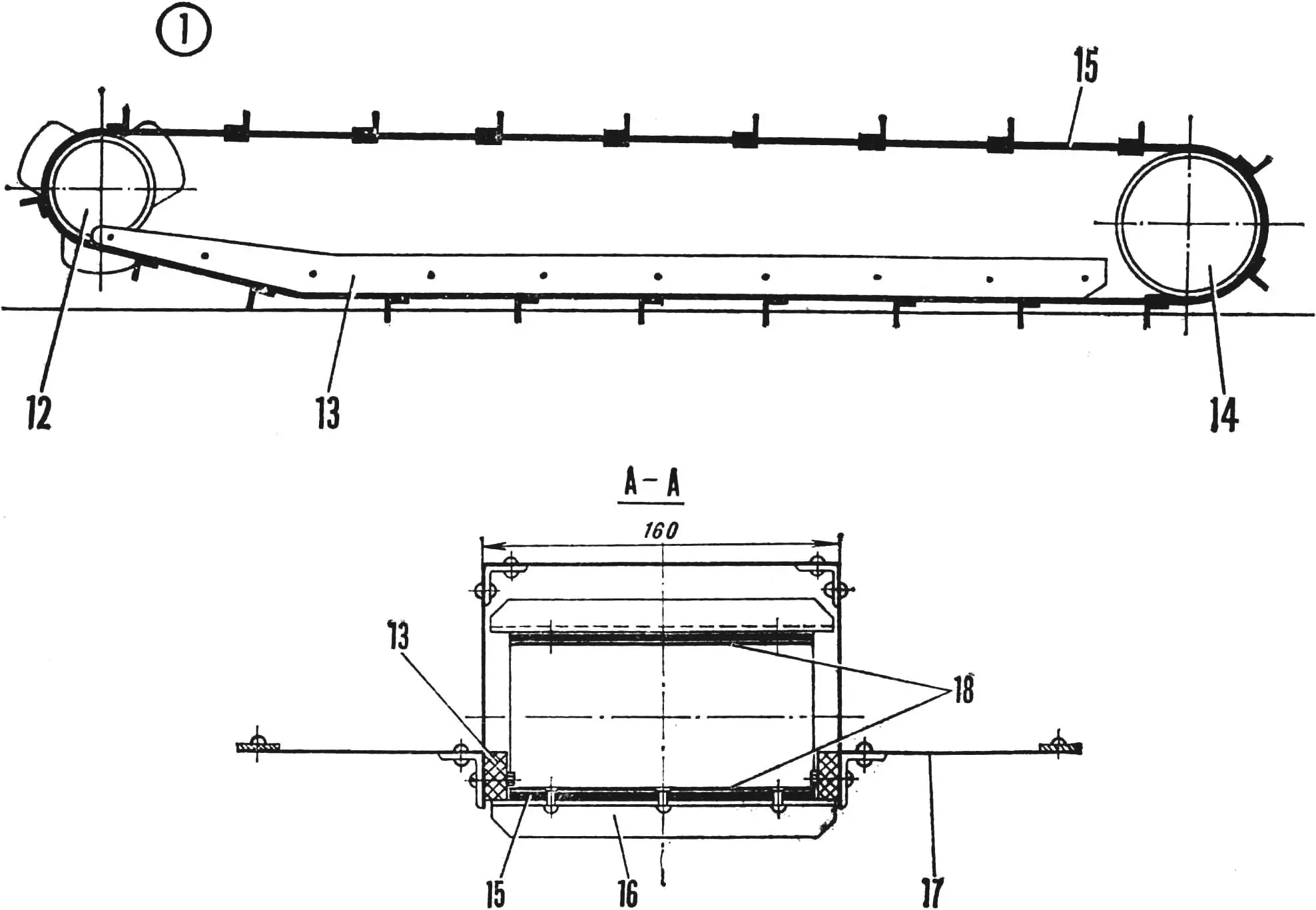
1 — drive unit, 2 — body, 3 — seat, 4 — tank, 5 — steering column, 6 — engine, 7 — ski, 8 — throttle cable, 9 — clutch cable, 10 — pedal, 11 — return spring, 12 — drive drum (sprocket Z 18 not shown), 13 — supporting runner, 14 — tension drum, 15 — track, 16 — ground-engagement angle bracket, 17 — foot platform, 18 — ground-engagement plate.
However, since they are still intended for a “driver” aged six to eight, running control is reduced to a single pedal, “throttle — clutch.” When the foot is removed, the return spring moves the pedal to its original position — it releases the throttle and disengages the clutch, which simplifies the control problem for a small driver. However, during engine start it is still possible to control the “throttle” independently of the clutch. The engine is started with a cord.
The motosleds, weighing 17—18 kg, consist of the following main units: body, skis, engine, drive unit, seat, and controls.
BODY is a riveted structure made of duraluminum angles and a duraluminum sheet 1 mm thick. The body is load-bearing: all other units are mounted on it.
SKIS are also riveted from a D16T sheet 1 mm thick and duraluminum angles. On the sole of each ski there are two notches.
ENGINE — the mentioned D-4, but with some modifications. A pulley is installed for starting with a cord; feet made from duraluminum angles are attached to fix it to the sled body and to allow movement when adjusting the chain tension.
DRIVE UNIT, evidently the most labor-intensive part of the work. It consists of a track, a front (driving) and a rear (tension) drum, and two supporting runners.
The track is a closed ring made of a rubber-fabric belt 3 mm thick and 135 mm wide. On it, ground-engagement elements made from D16T angle steel, sized 15×15×155 mm, are bolted with countersunk heads, together with matching 1 mm thick stainless steel plates (sized by width and length). The ground-engagement elements project 10 mm on both sides of the track.
The front drum is a duraluminum hollow rubberized cylinder Ø 56 mm, on which two steel three-tooth sprockets are mounted to engage with the projecting ends of the ground-engagement plates. On the left side of the drum there is also a sprocket with 18 teeth (from a bicycle’s rear wheel) for the driving chain from the engine.
The rear drum is also a duraluminum hollow rubberized cylinder Ø 75 mm. Both drums are mounted on bearing No. 200 and rotate on axles fixed in the body. The bearings on both sides are covered with oil seals.
The body’s supporting runners are made of textolite plates with a 10×25 mm cross-section and are located at the bottom of the vertical walls of the body. Along them slide the projecting ends of the ground-engagement elements.
SEAT — made from two plywood panels 4 mm thick connected with an angle bracket. It has two posts for mounting to the body. On the seat, a bracket for the steering column and a fuel tank is installed; a plastic bottle from shampoo is used as the latter. On its cap, a feeder tap is attached.
CONTROLS — a handlebar and a pedal. For the handlebar, an abbreviated bicycle handlebar from the “Orlenok” is used. It is inserted into a steering column made of stainless steel (tube 18×08), on whose lower end a steering arm is welded, connected by rods to the bell-cranks of the ski brackets.
The pedal is of a bell-crank type and consists of two levers. The first controls the throttle independently of the second. When the pedal is pressed further, the clutch is engaged. The return spring pulls the released pedal back to its initial position: the “throttle” is moved to “low,” and the clutch disengages.
The design proved to be quite manageable for a child and sufficiently safe.
“M-K” 3’81, E. ZAKHAROV
Recommend to read
 CAN AND CONE
The one who often have to use a vise knows that the most difficult thing is to hold them a wedge-shaped or cone detail: when processing it loosened and slips out. However, if you apply a... TRACTOR-TRUCK: A SMALL, BUT VALIANT
The first homemade motorized assistant appeared in our family almost 20 years ago. We made it V. Il'ichev development of the suburbs, published in the journal "modelist-Konstruktor"....
