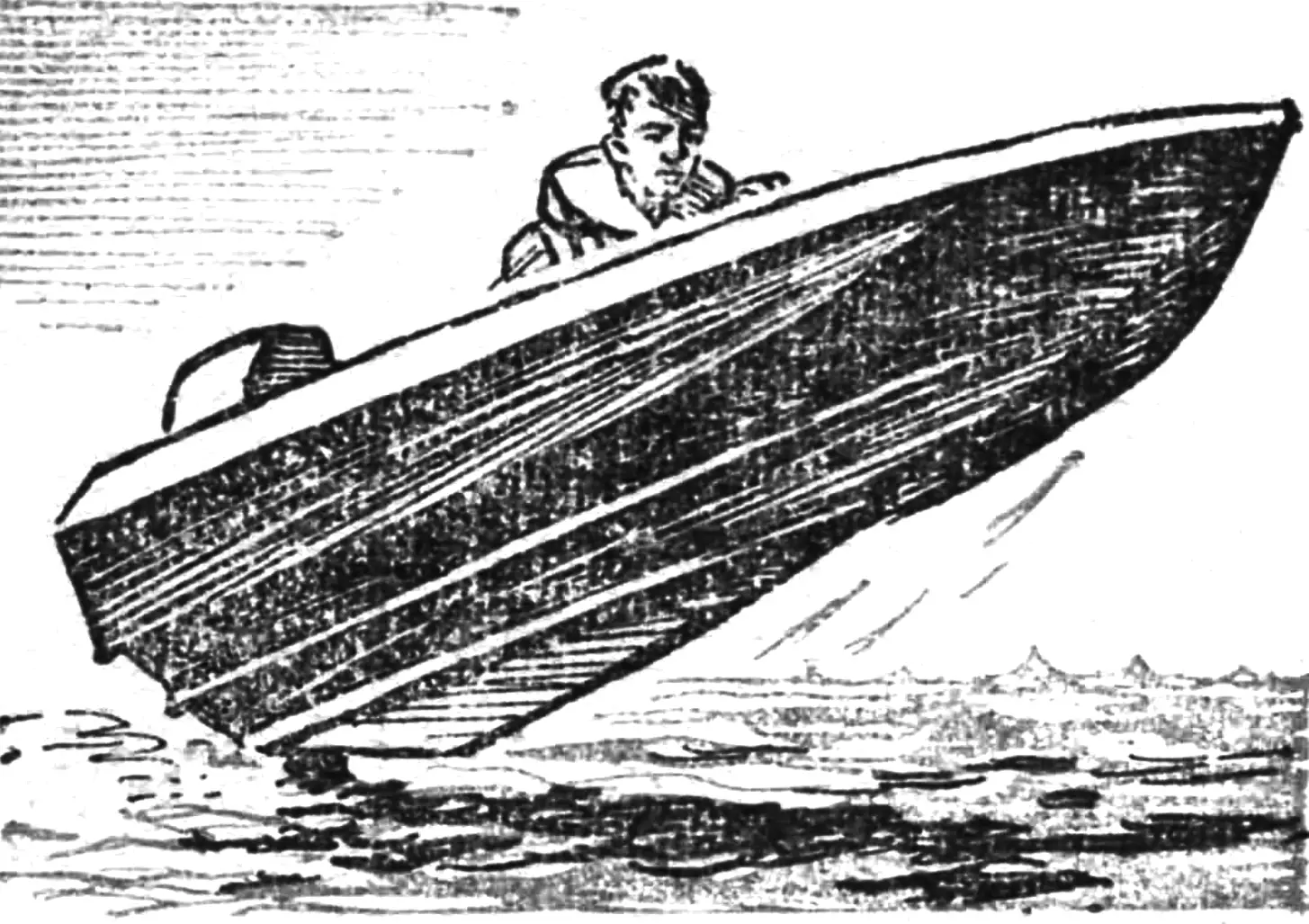
Thousands of motorboats and launches built by amateurs to designs from the MK design bureau ply the waters of rivers, lakes, and even seas across our vast homeland. These include the widely popular Moskichka, Volzhanka, Strelka, Rusalka, Taifun, and Ruslan. An experienced specialist will recognize them at once by their characteristic profile and attitude on the water, which allows them to run with almost no wake across nearly the entire speed range. But lately, “hybrids” of motorboats and launches born in the MK design bureau have been appearing more and more often. They are the result of creative amateur work: attempts to adapt various designs to local operating conditions, and the search for new materials and technologies that ensure a high-quality product.
One interesting new design is the Lada motorboat by our reader V. I. Kokorev from Kuybyshev. It is based on motorboats that have already been tested and proved themselves well, with a ski in the keel plane and lines of the “sea knife” type developed by American designer Peter Payne. As is known, Payne designed a high-speed craft with a greatly lengthened and sharply pointed bow (from which it received its name), capable of overcoming oncoming waves by cutting through them smoothly. Modern supersonic aircraft have approximately the same shape: a pointed nose makes it easier to break the sound barrier.
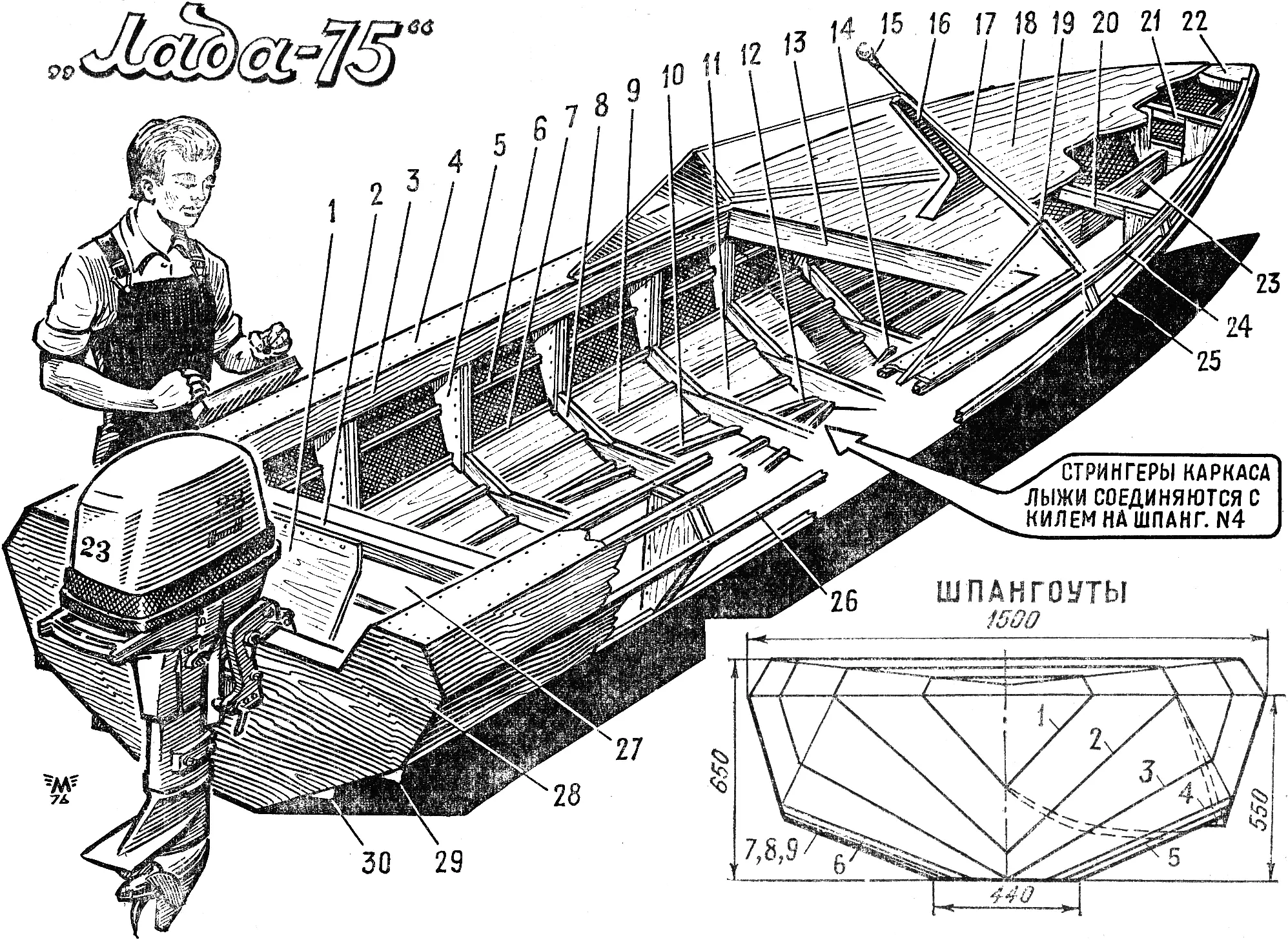
1 — motor well, 2 — beam of frame No. 8, 3 — gunwale, 4 — sheer strake, 5 — side gussets of frame No. 6, 6 — side stringer, 7 — chine stringer, 8 — floor timbers of frame No. 5, 9 — bottom stringer, 10 — ski frame stringer, 11 — bottom planking (4 mm plywood), 12 — keel connection to ski frame stringers, 13 — widened beam of frame No. 4, 14 — aft end of the stem “blade”, 15 — top light, 16 — central windshield post, 17 — windshield, 18 — deck (3 mm plywood), 19 — side windshield post, 20 — beam of frame No. 2, 21 — frame No. 1, 22 — bow bolster, 23 — stem “blade”, 24 — side stringer, 25 — chine stringer, 26 — corner side stringer, 27 — aft seat, 28 — transom planking (10 mm plywood), 29 — chine longitudinal spray rail, 30 — bottom longitudinal spray rail. The stem “blade” is not shown on the theoretical frame plan.
In the Lada motorboat design, a sharply pointed bow transitions into a wide keel ski (440 mm at the transom frame) and, together with the beveled side branches of the frame rings, forms a hull of quite modern shape capable of planing well under various loads and in different water-surface conditions. Thus, with minimum load (one driver), the Lada motorboat can plane on a single ski that is essentially a flat plate; as load increases, the beveled sections of the bottom come into play. At the same time, the hull’s planing qualities deteriorate much more slowly than in ordinary boats with “deep V” lines.
There is no doubt that V. I. Kokorev’s work has merits that any amateur in water-motor sports can appreciate.
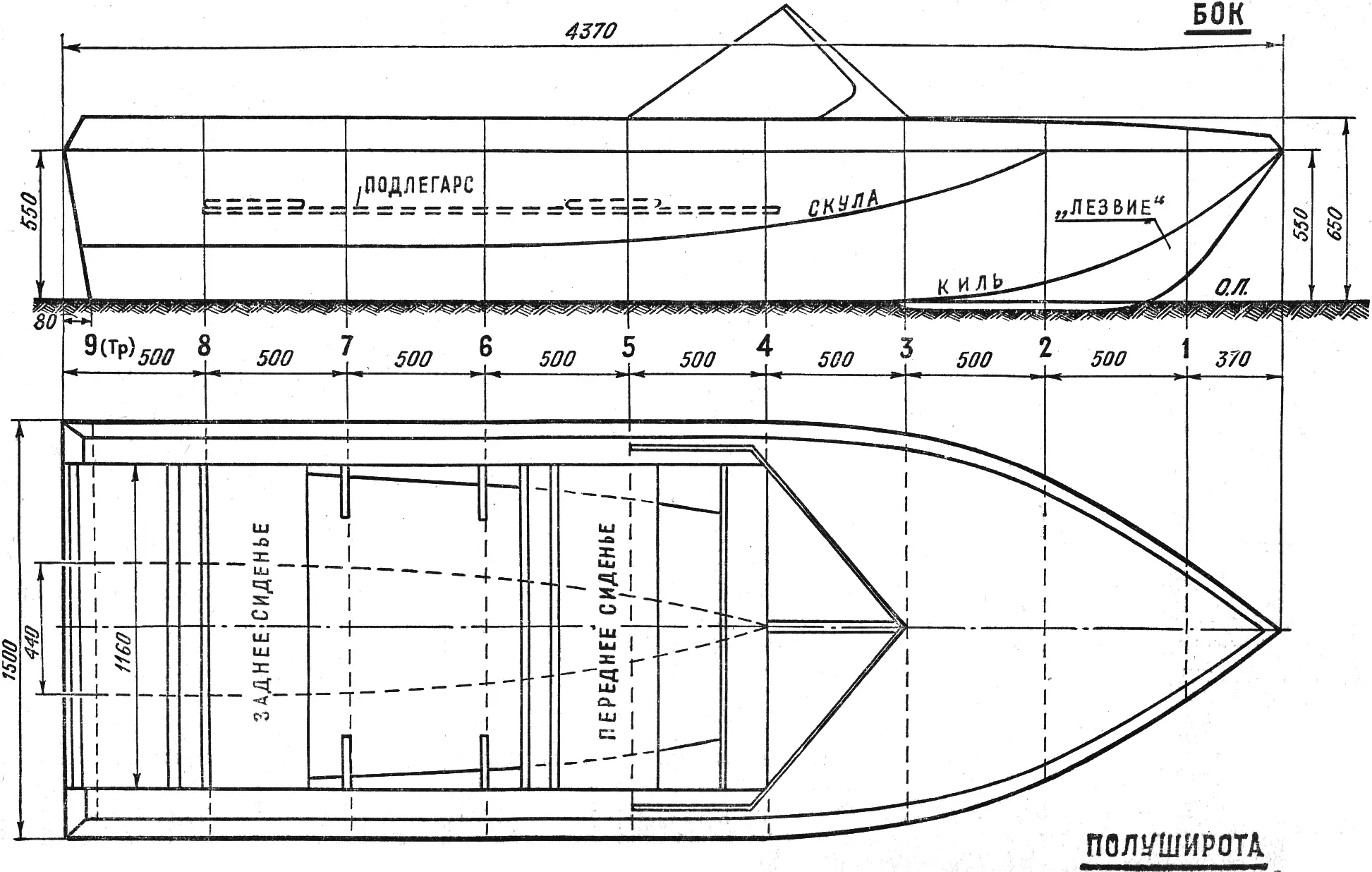
By purpose, the Lada-75 is a touring motorboat of increased seakeeping ability, designed for one outboard motor of at least 25—30 hp. A combination of “deep V” lines with a wide profiled ski along the keel and a bow section made in the form of a “blade” should provide good wave entry and a soft ride in seas up to 0.75 m without a noticeable loss of speed.
The wedge-shaped planing surface (ski) is 2.5 m long and 0.44 m wide at the transom, which allows the boat with one driver to plane while practically not touching the water with the sides (with minimum resistance) and to tow a water-skier weighing up to 80 kg.
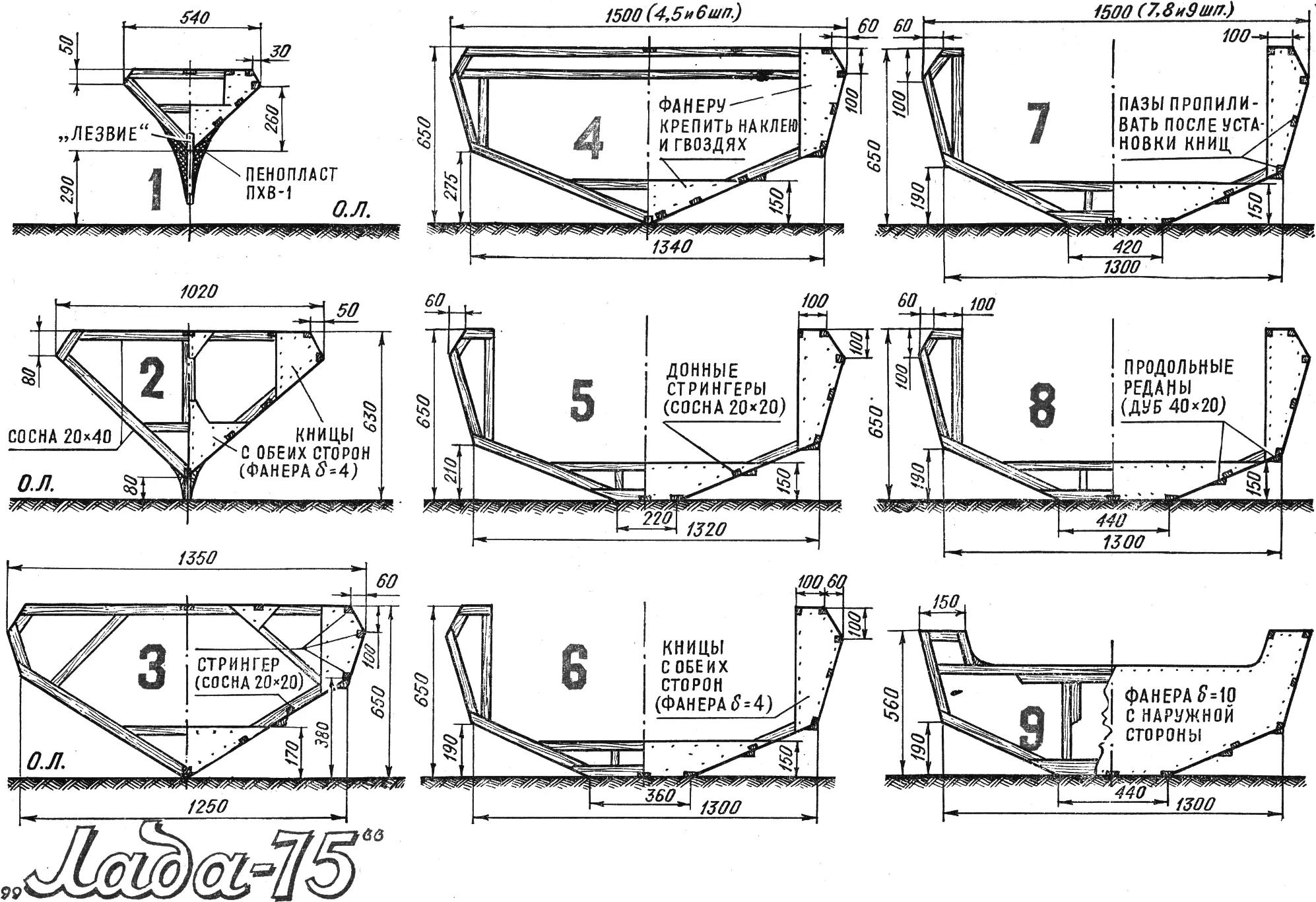
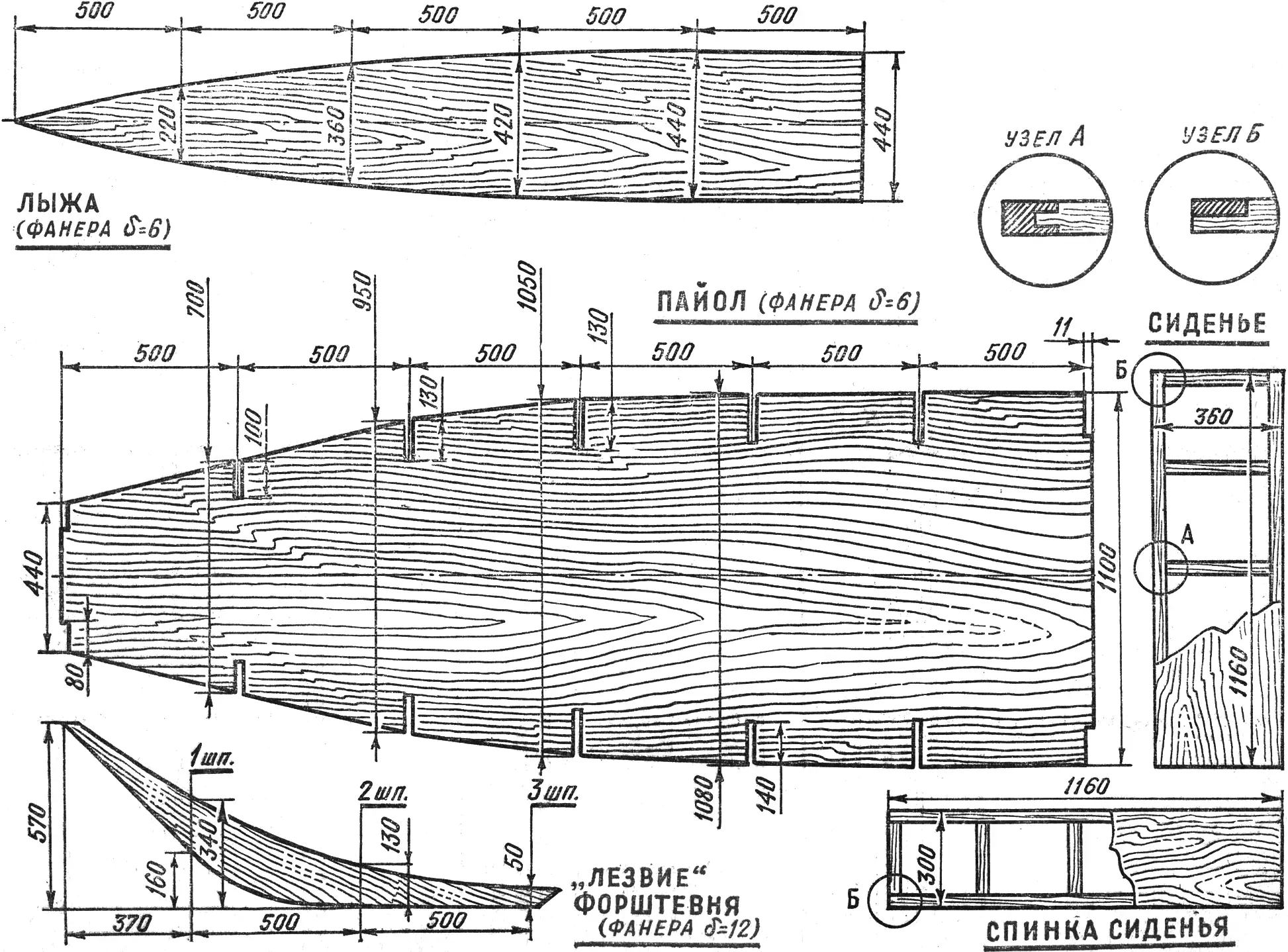
The wooden boat frame is assembled by the usual method from frame rings connected by longitudinal notched elements (stringers). Side and bottom planking is made of 3 mm waterproof plywood; the ski is made of 6 mm plywood or 4 mm plywood with subsequent sheathing in 1—1.5 mm fiberglass cloth.
The frame rings are assembled from pine battens 40×20 mm in accordance with the structural drawings shown in Figure 1. Gussets of 4 mm plywood should be fitted on both sides with epoxy adhesive and secured with 15×2 screws alternated with nails for better contact between the gussets and the frames. The spaces between the battens should preferably be filled with PS-1 foam. The transom board made of 40×20 mm battens is planked on one side with 10—12 mm plywood, also with epoxy adhesive, screws, and nails. If such plywood is not available, the transom frame can be planked with thinner material (3—4 mm) on both sides, filling the spaces between the battens with foam. The stem is a “blade” cut from 12 mm plywood (see the structural drawing). To join the “blade” to the hull lines, the space on both sides is filled with foam and covered with pieces of fiberglass cloth cut to fit on site.
Hull assembly follows the usual method, keel up on a frame mold. After plywood planking, the boat is sheathed with ASTT (b) fiberglass cloth in epoxy or polyester resin: sheer strakes, the bow deck, and sides — in one layer; the bottom (to the chines) — in two layers. After the resin has fully cured, the boat is painted with nitroglyptal enamels.
MAIN TECHNICAL DATA:
Overall length, m … 4.37
Overall width, m … 1.5
Freeboard height, m … 0.65
Passenger capacity up to 4 persons
Weight (wooden version), kg … 120
Outboard motor power, hp … 30
Maximum speed with one driver, km/h … 45
«M-K» 8’76, V. KOKOREV
Recommend to read
 NEVSKAYA “ARROW”
(SPEED CONTROL LINE MODEL CLASS 5.0 CM3). The name of the master of sports of international class Mykola Troneva from Leningrad familiar to automodellista. Since 1970, Nicolai permanent... “HOME” FOR PENCILS
The cosmetic industry offers its products to increasingly beautiful and elegant plastic packaging, which after use sometimes simply a pity to throw away. That's one of the tips of...
