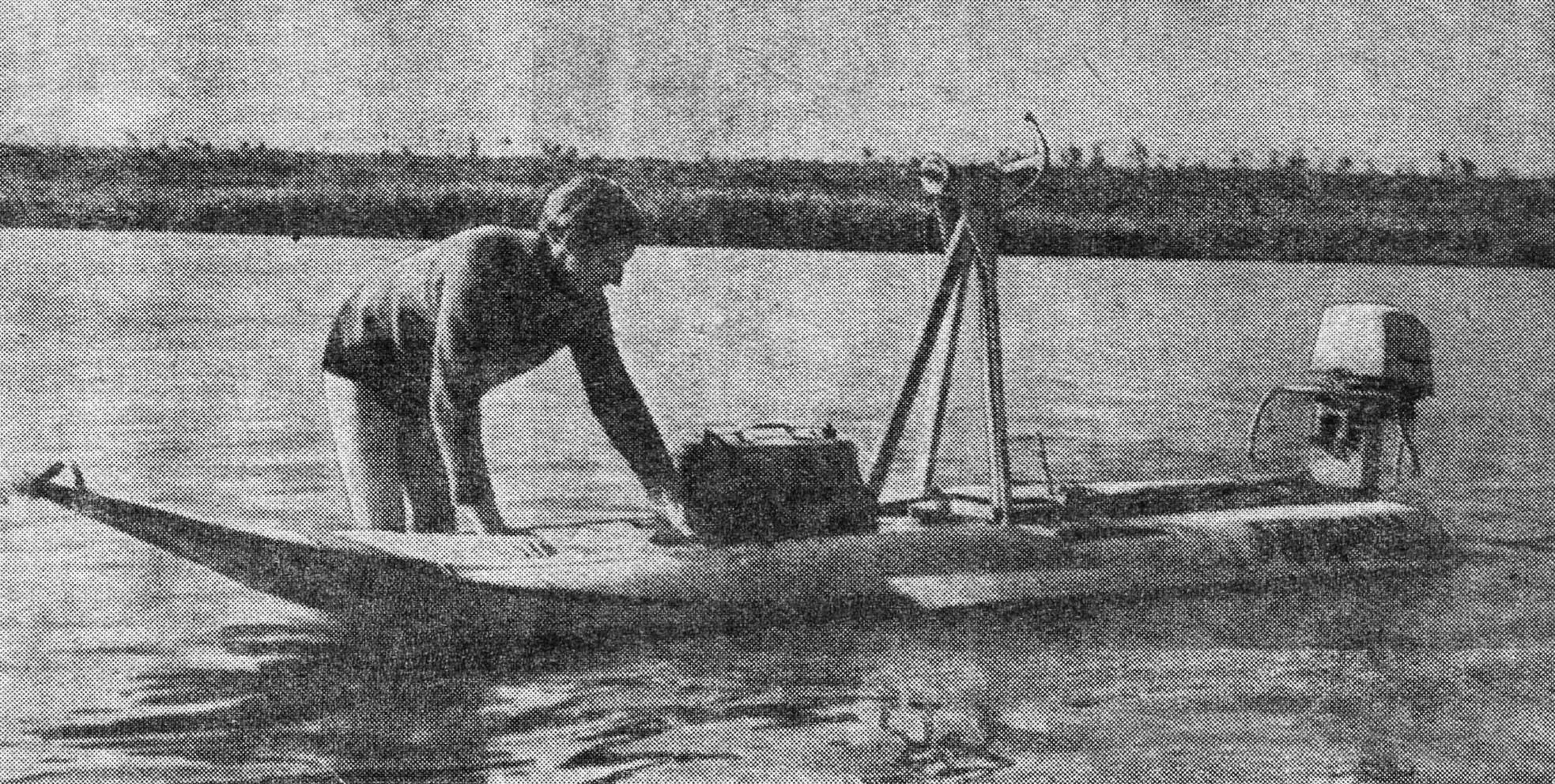
Last spring I built myself water skis. But I rarely got to ski on them, since the tow was provided by… a motorcycle with a sidecar. Building a dedicated boat would have meant considerable expense, powerful engines, and above all—time.
So I thought: why not design one large ski, fit it with an engine and controls, and ride without a tow?
The ski turned out well. I’d like to share the experience of building and riding it.
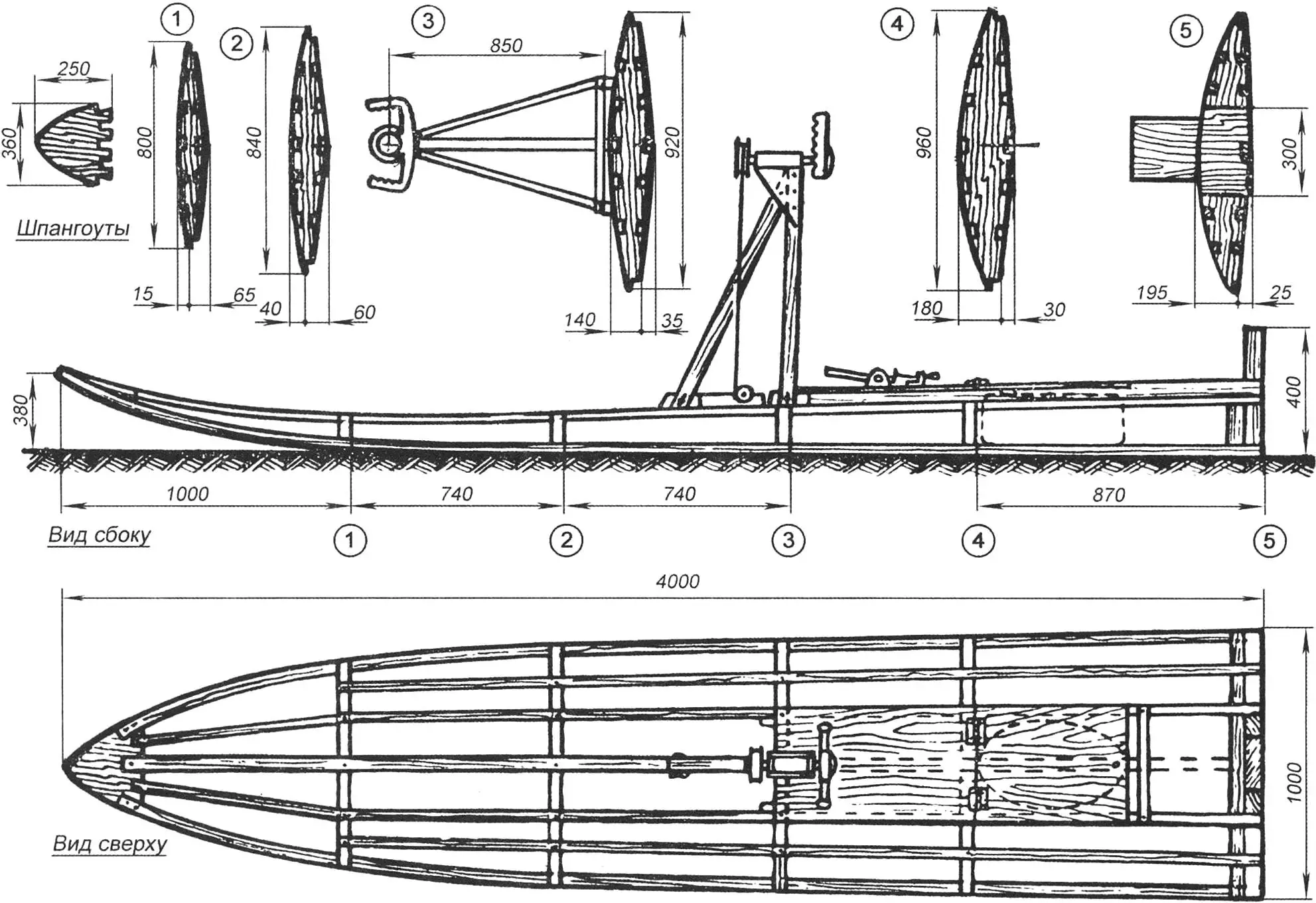
You can start assembling the monoskier hull with six sheets of 3 mm plywood in standard size (1525×1525 mm), several lime boards (for frames), and pine stringers 30×10 mm in section.
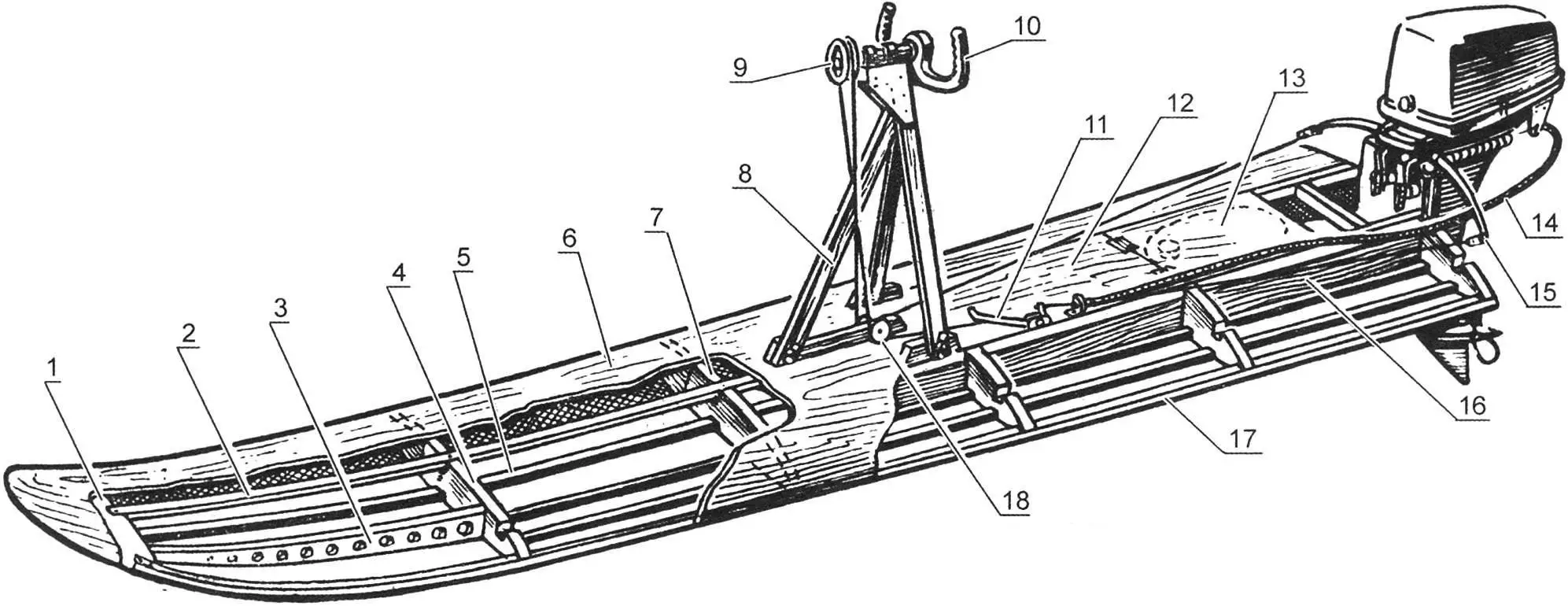
1 — weight block; 2 — centerline stringer (central under-deck stringer); 3 — stiffening rib; 4 — frame No. 1; 5 — bottom stringer; 6 — planking (3–4 mm plywood); 7 — frame No. 2; 8 — forward steering post; 9 — steering drum; 10 — steering wheel; 11 — throttle pedal; 12 — deck; 13 — fuel tank hatch cover; 14 — flexible throttle cable; 15 — steering rod; 16 — hull strength box wall; 17 — chine log; 18 — steering cable pulley F-40
First position the frames correctly, then “tie” them with the centerline stringer and stringers to form the monoskier skeleton. Then plank it with plywood cut into longitudinal blanks. The inner sides of the planking should be coated with at least one layer of epoxy before assembly.
Assembly is done with screws bedded in epoxy. At planking joints on the underside, glue on a strip of plywood and epoxy-impregnated fiberglass, then fasten the planking to the frame contour. The sheer clamp is also sheathed with fiberglass in epoxy.
The outside of the monoskier hull is covered with two layers of fiberglass in resin. First sand the whole surface with coarse abrasive. Pay special attention to sealing the planking joints.
After the hull has dried, apply a layer of filler. It is made from chalk with a small amount of wood glue, casein glue, or epoxy. When it is fully dry, sand the hull thoroughly. This is very important for reducing drag and thus improving speed and planing.
With the hull assembled, you can install the steering. For this, in the area of frame No. 3, first install blocks that are fixed with epoxy and screws through the planking to the centerline stringer and two stringers. Three posts bolted to these blocks with wing nuts form the steering column supports.
With the engine mounted on the transom, fit the controls in place. Since the engine itself acts as the rudder, a cable runs from the drum via pulleys to it, and its removable ends connect to the rod.
For the throttle sector, a Bowden cable is convenient, with a return spring on the lever so the throttle drops when you take your foot off the pedal. The clutch is disengaged directly on the engine.
Repeated runs showed that this monoskier design with a Veterok-12 outboard performs well. Good speed goes with excellent stability and handling in turns, which makes for a satisfying “slalom” on the water.
Modelist-Konstruktor No. 8’2015, S. KRIVOKHLYABA, installer, Sal’sk
Recommend to read
 THE WOODEN LACE OF LIGHT
To get out of the closet was an abandoned jig saw for cutting wood you will make, we are sure depicted in these figures are delicate fixtures. Like lace, they delight the eye with their... THE SHIP ON THE PILLOW
This is a hovercraft I built for several years. Engine - from VAZ-2108 with a capacity of 74 HP, Case - fiberglass, fiberglass epoxy resin, is made of the type "sandwich" with the...
