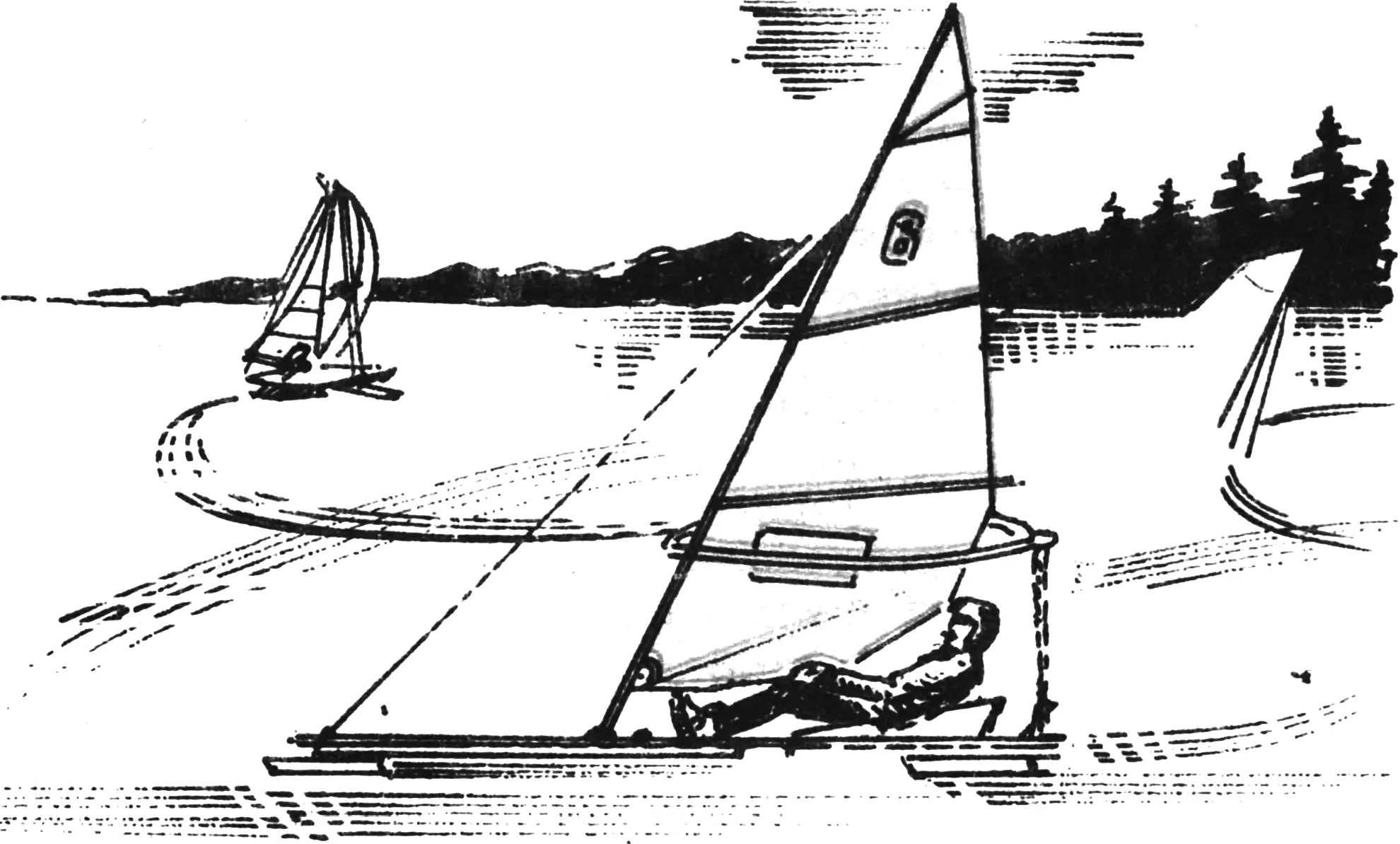
As soon as the bright spring sun drives the snow off the icy shell that has locked rivers, reservoirs, and lakes in place, colorful sails appear on natural ice courses. These are ice boats.
Any reader can become an ice boater — anyone with metalworking and carpentry skills can build an ice yacht.
The ice boat was designed according to the layout of the most common craft in the DN class, with a front steering runner, open cockpit, and tiller steering. The sail rig is taken from a sailboard. For small sail craft such as an ice boat, this is the simplest and most effective solution. Such a choice will greatly simplify building an ice yacht for amateur designers: after all, the greatest trouble in building sail craft comes from obtaining sailcloth and sewing the sails.
An ice boat of this type has good performance: in winds of 4—5 m/s on smooth ice, its speed reaches 40 km/h. It handles well and is quite safe. The ice boat’s track, which provides good stability even in strong wind, is 2500 mm, which prevents capsizing. The cross beams can flex, acting as shock absorbers under load.
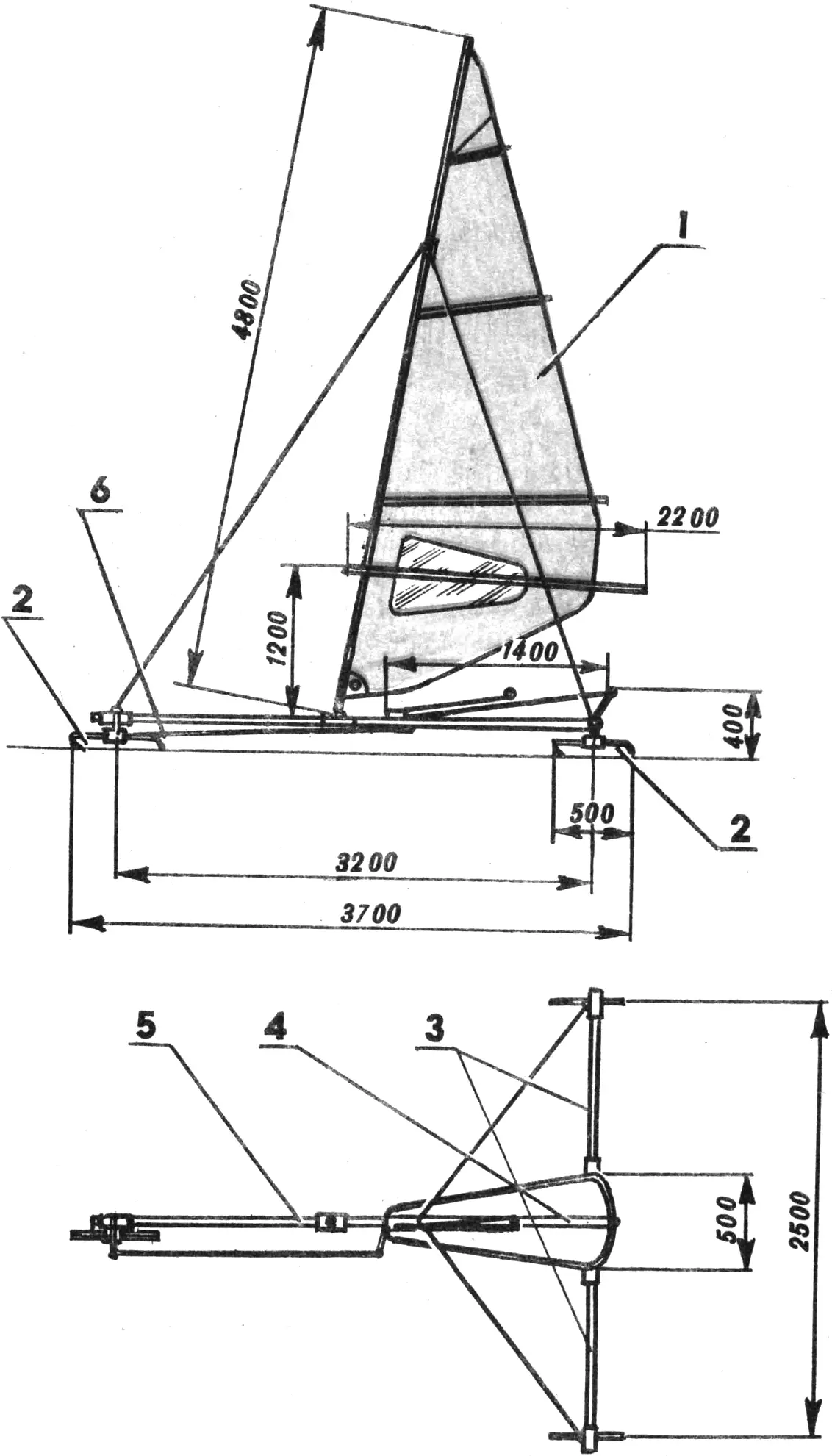
1 — sail with rigging (from an “Aquata” sailboard or another type), 2 — runners with clamps for fastening to the beams, 3 — cross beams, 4 — ice boat hull (cockpit), 5 — longitudinal beam (backbone), 6 — steering gear.
It is best to use sail rigging from an “Aquata” type board, although in principle a sail of any other type will also do. Moreover, such a sail makes it possible to reconfigure the ice boat into an ice windsurfer.
The ice boat hull is collapsible and tubular, and the length of any part does not exceed 2200 mm, which makes it possible to transport it disassembled even on city public transport.
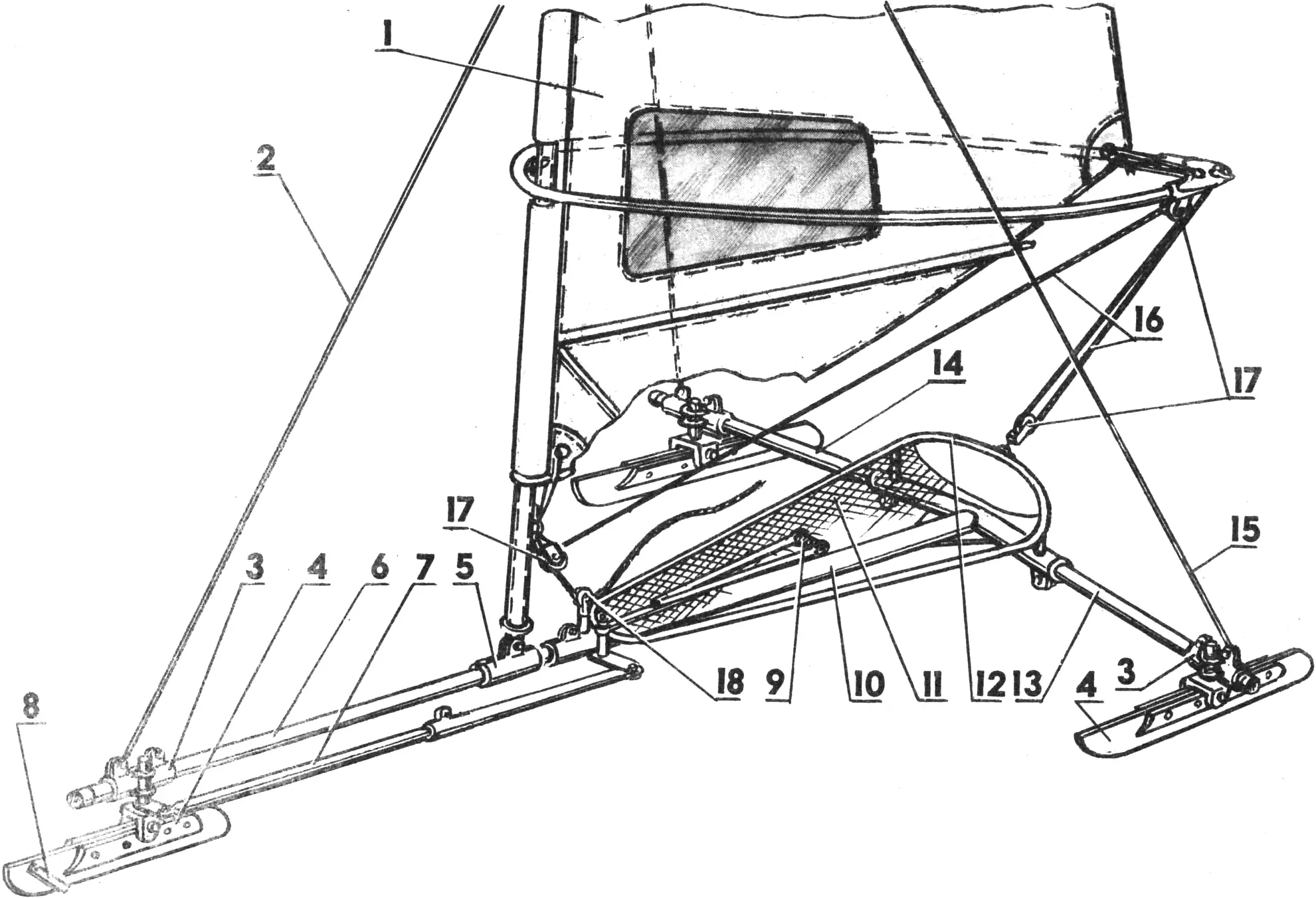
1 — sail with rigging, 2 — forestay (steel cable Ø3 mm), 3 — runner fastening clamps (3 pcs.), 4 — runners (steering and support), 5 — mast step, 6 — longitudinal beam (duralumin tube Ø40X1.5 mm), 7 — adjustable steering rod, 8 — parking brake, 9 — tiller, 10 — ice boat hull (cockpit), 11 — cockpit awning (net), 12 — cockpit guard rail, 13, 14 — cross beams (duralumin tube Ø40X1.5 mm), 15 — shroud (steel cable Ø3 mm), 16 — boom sheet, 17 — boom sheet lead blocks, 18 — block with stopper.
The basis of the ice boat hull is a cockpit welded from duralumin tubes, over the guard rail of which a thick nylon net or awning of strong, lightweight canvas is stretched. The longitudinal backbone beam is intended to increase the structural length of the ice boat. It is secured in the front part of the hull with a tubular clamp and an M8 bolt. Steering gear is mounted on the backbone — it consists of a front runner clamp with a tiller ball and lever, and a rod. The tiller ball lever is secured to the hull base. For convenient assembly and adjustment of the steering gear, its design includes an adjustable tubular rod.
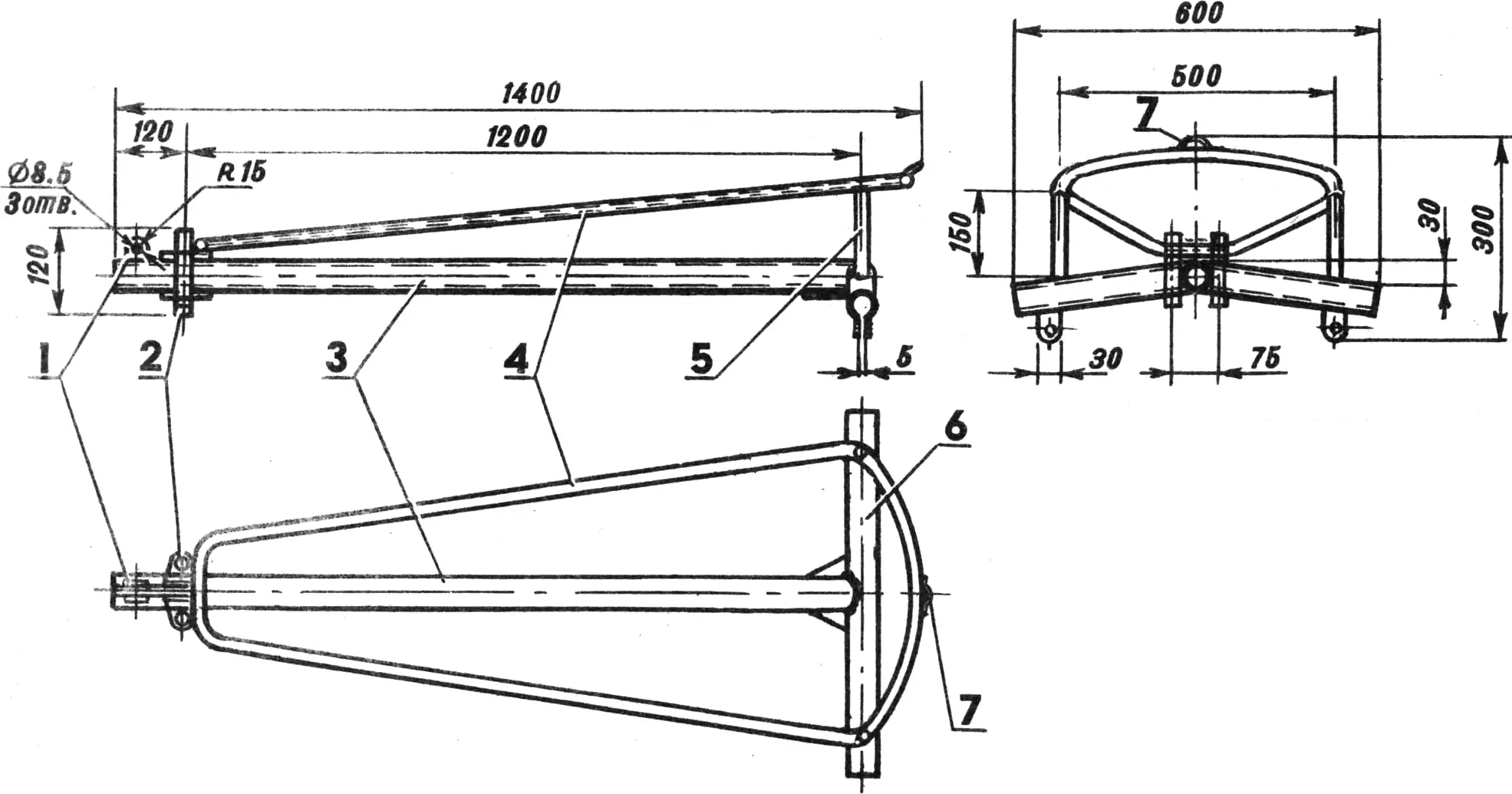
1 — cheek (duralumin 5 mm thick), 2 — bushing (duralumin tube Ø22X3 mm), 3 — base (duralumin tube Ø45X2 mm), 4 — guard rail (duralumin tube Ø22X2 mm), 5 — posts (duralumin tube Ø22X2 mm), 6 — cross member (duralumin tube Ø45X2 mm), 7 — bracket (duralumin 5X10X50 mm).
An adjustable T-shaped mast step is installed on the longitudinal beam and secured with an M8 bolt; it is made from a section of duralumin tube split lengthwise, with fastening cheeks welded to it, which serve for hinged mounting of a cylindrical cup in which the mast is fixed.
When tuning the sail rig, the mast step can be moved along the longitudinal beam of the ice boat hull and fixed in the optimal position with a locking bolt. In addition, the mast together with the mast step cup can be tilted in the longitudinal plane of the ice boat — this also allows additional adjustment.
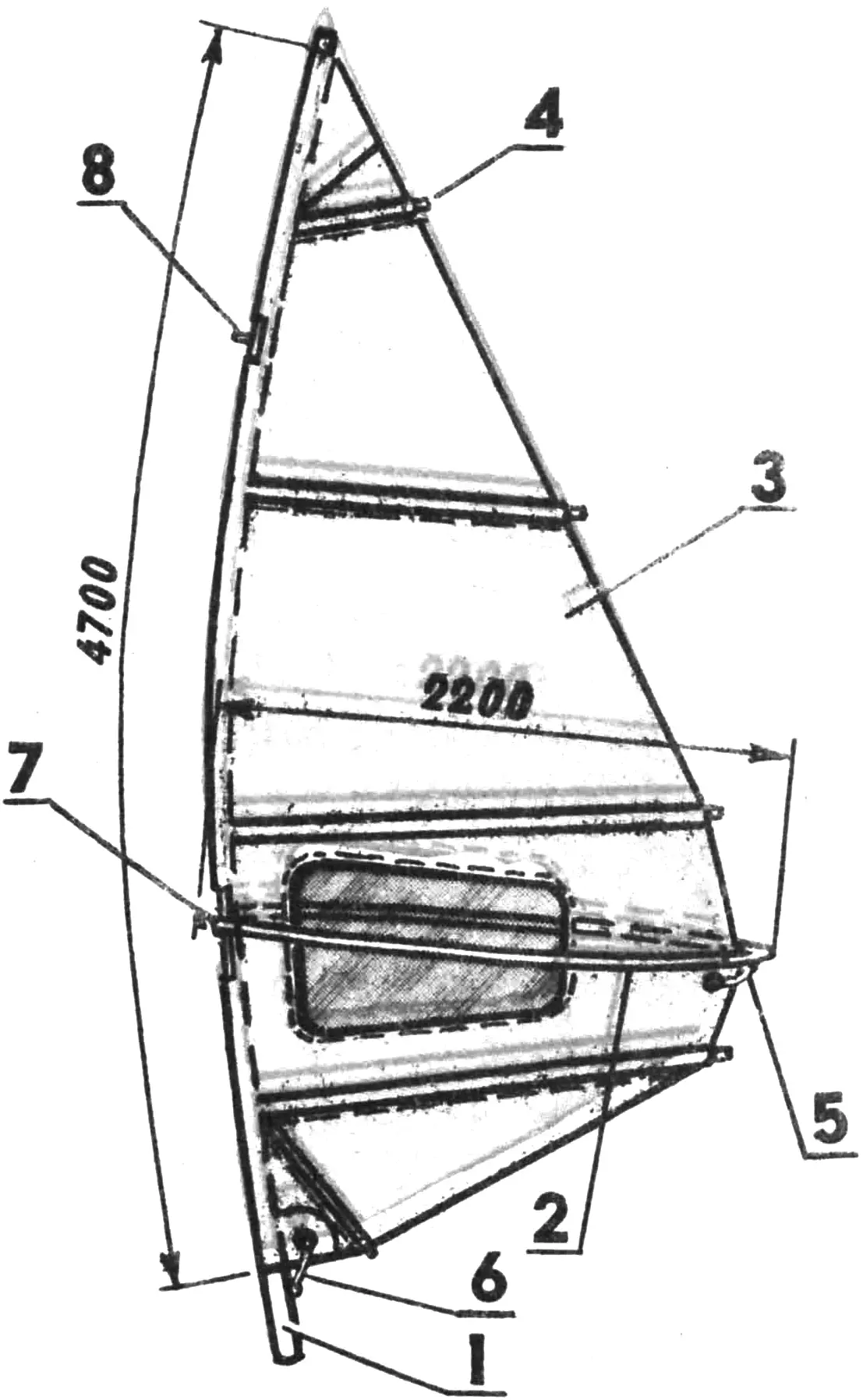
1 — mast (duralumin tube Ø40X1.5 mm), 2 — boom (duralumin tube Ø30X1.5 mm), 3 — sail, 4 — through battens of plastic, 5 — sheet vang, 6 — tack vang, 7 — sheet for fastening the boom to the mast, 8 — collar for fastening the forestay and shrouds to the mast.
The cross beams are attached at the rear of the ice boat hull. They are sufficiently elastic and can flex, acting as shock absorbers.
Depending on the condition of the ice surface, special runners of various types can be installed on the ice boat.
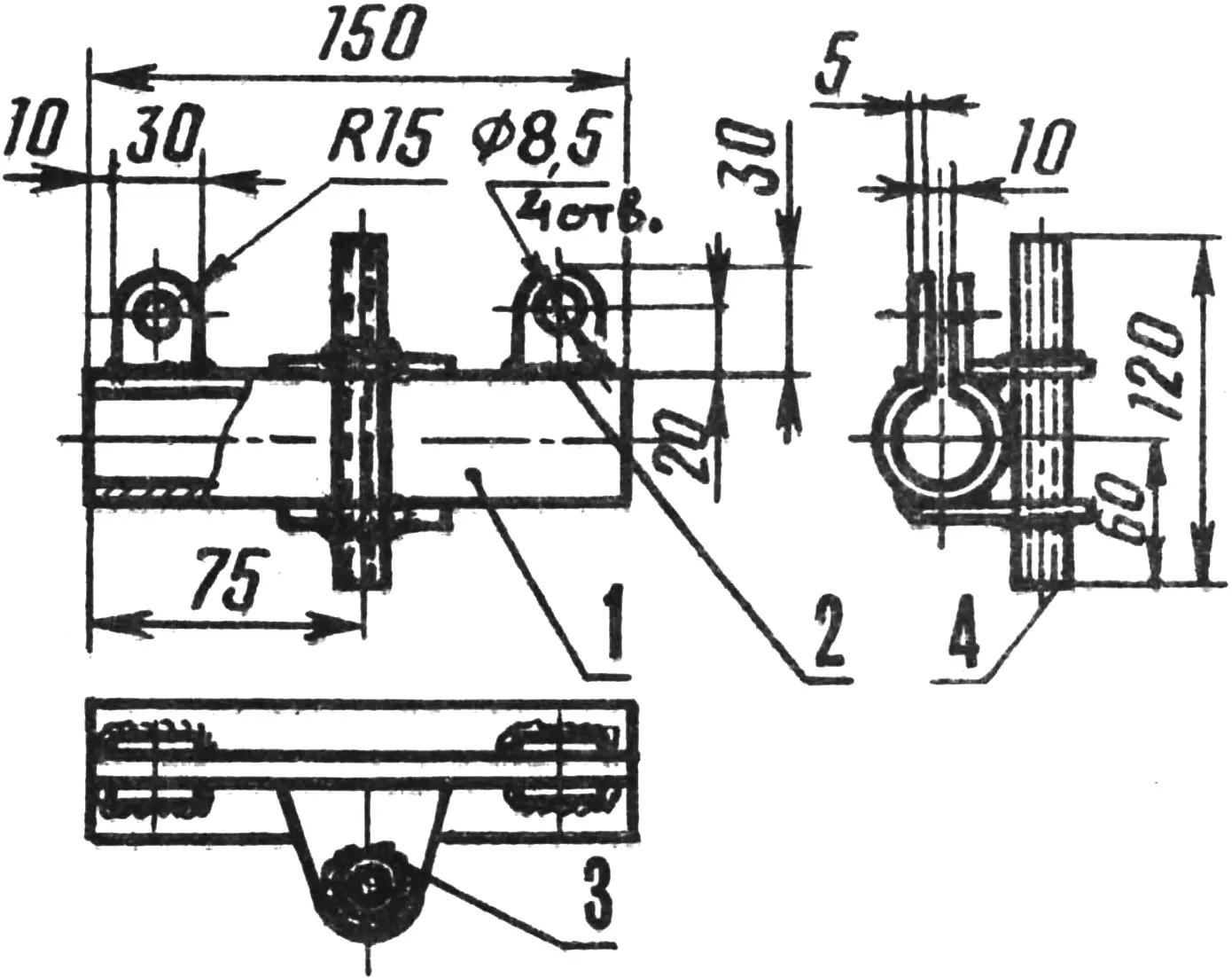
1 — clamp (duralumin tube Ø45X2 mm), 2 — cheek (duralumin 5 mm thick), 3 — gusset (duralumin 5 mm thick), 4 — bushing (duralumin tube Ø22X2 mm).
The sail rig — sail, mast, and boom — is taken from sailboards of any type. However, it is still preferable to use one from “Aquata”, which has an aerodynamically highly efficient sail made of modern materials with through battens. A collar intended for fastening the forestay and shrouds is installed on the mast, in the upper third from the top, and a corresponding window is made in the sail pocket.

1 — steering runner, 2 — steering rod, 3 — tiller, 4 — tiller ball, 5 — turning gear levers
The collar for fastening the forestay and shrouds to the mast is best made sliding. Then the tension of the standing rigging can be adjusted by changing the position of this collar with the help of a vang passing through the masthead.
When tuning the sail rig, the movable mast step makes it possible to adjust the position and tilt of the mast, thereby changing the ice boat’s center of effort.
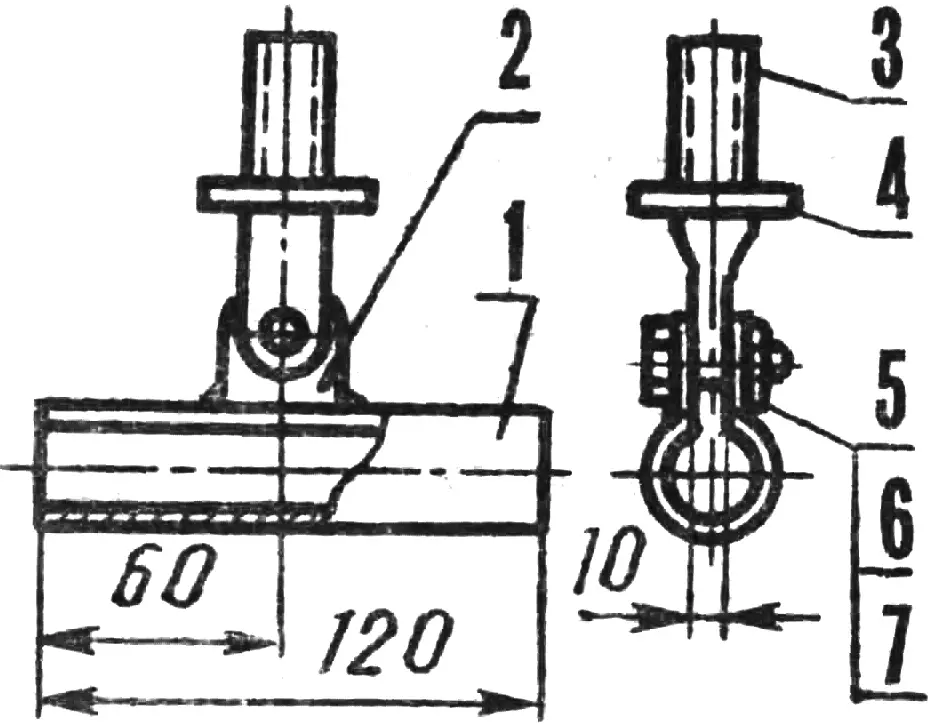
1 — base (duralumin tube Ø45X2 mm), 2 — lug (duralumin 3 mm thick), 3 — pin (duralumin tube Ø26X1.5 mm), 4 — washer (duralumin 5 mm thick), 5 — hinge (M8X35 mm bolt), 6 — M8 nut, 7 — cotter pin.
A forestay and shrouds made of steel cable Ø 2.8—3.2 mm are used to secure the mast. Ordinary turnbuckles can be used to adjust the length of the shrouds and forestay.
Four blocks are used to lead the boom sheet. One (with a stopper) is secured on the tiller head, the second — on the boom at the clew of the sail, the third — on the mast at the tack of the sail, and the fourth — on the base of the cockpit awning behind the helmsman.
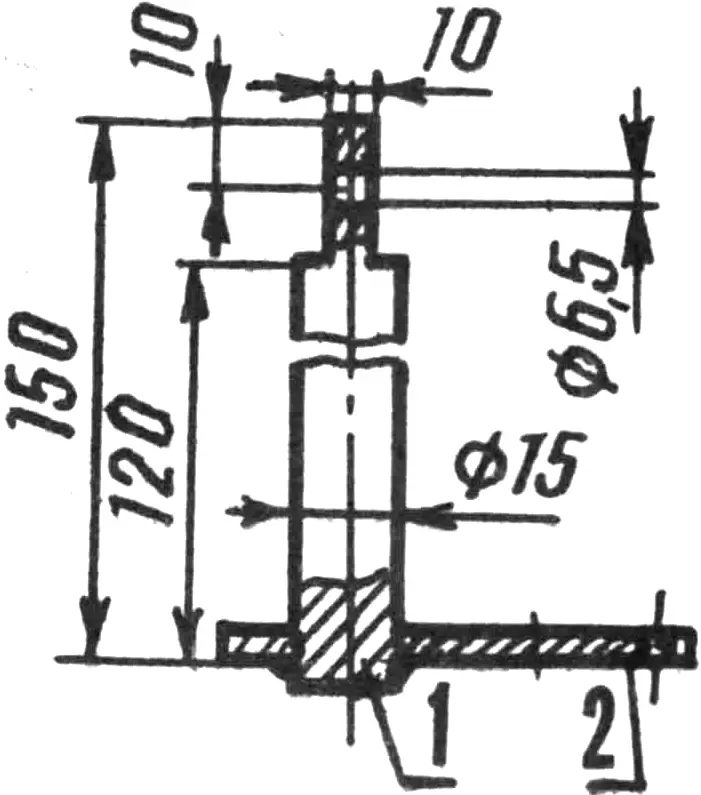
1 — shaft (steel rod Ø15 mm), 2 — turning gear lever (steel 4X35X110).
All three runners are identical in design; they are cut from sheet steel 5—6 mm thick and fitted with duralumin plates. An additional parking brake plate is mounted on the steering runner. The runners are attached to the beams without spring suspension, since the beams themselves provide sufficient cushioning for the helmsman’s cockpit. During assembly, parallelism of the runners must be ensured.
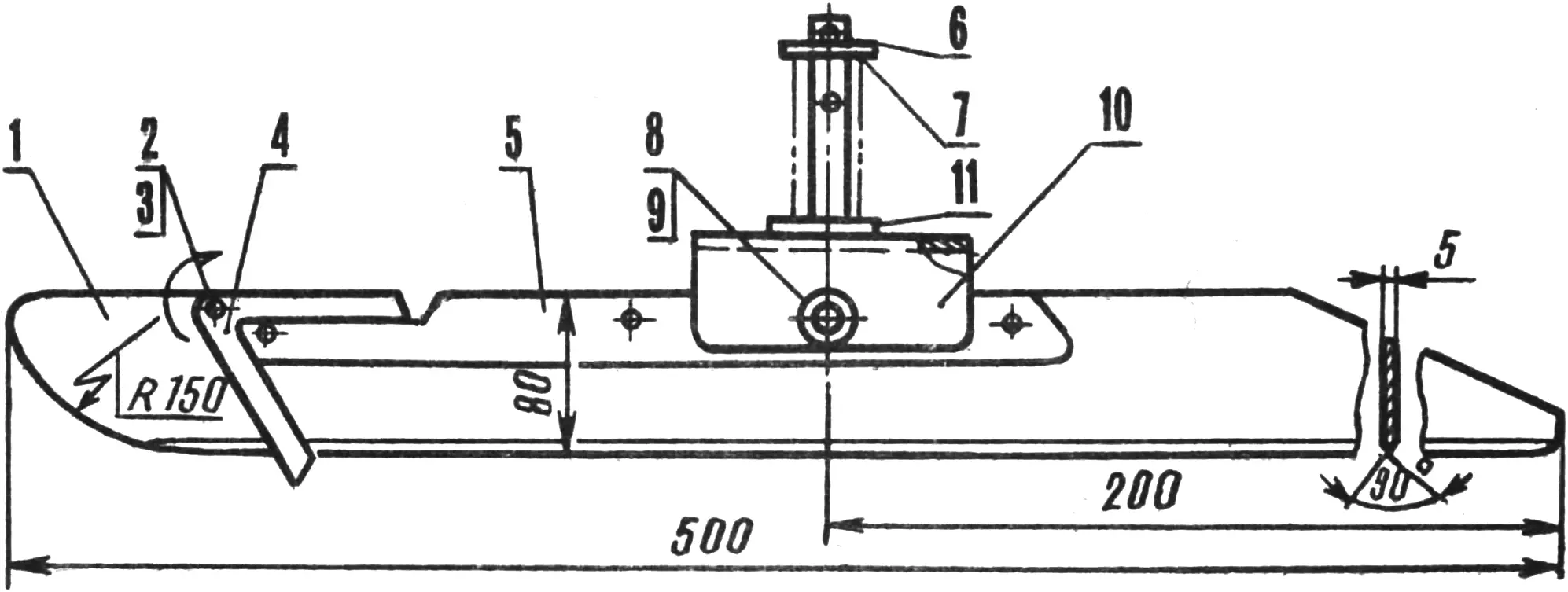
1 — runner blade (steel 5X80X500 mm), 2 — brake pin hinge (M6 bolt), 3 — nut, 4 — brake pin (steel 5X20X100 mm), 5 — plate (duralumin 10X35X300 mm), 6 — cotter pin, 7 — washer, 8 — M8X40 mm bolt, 9 — nut, 10 — fork (welded from steel angles 40X40X4 mm), 11 — turning gear lever (steel 4X35X110 mm).
On our ice boat with a front steering runner, steering is remote: structurally it is somewhat more complex than direct steering, but much more convenient for the driver.
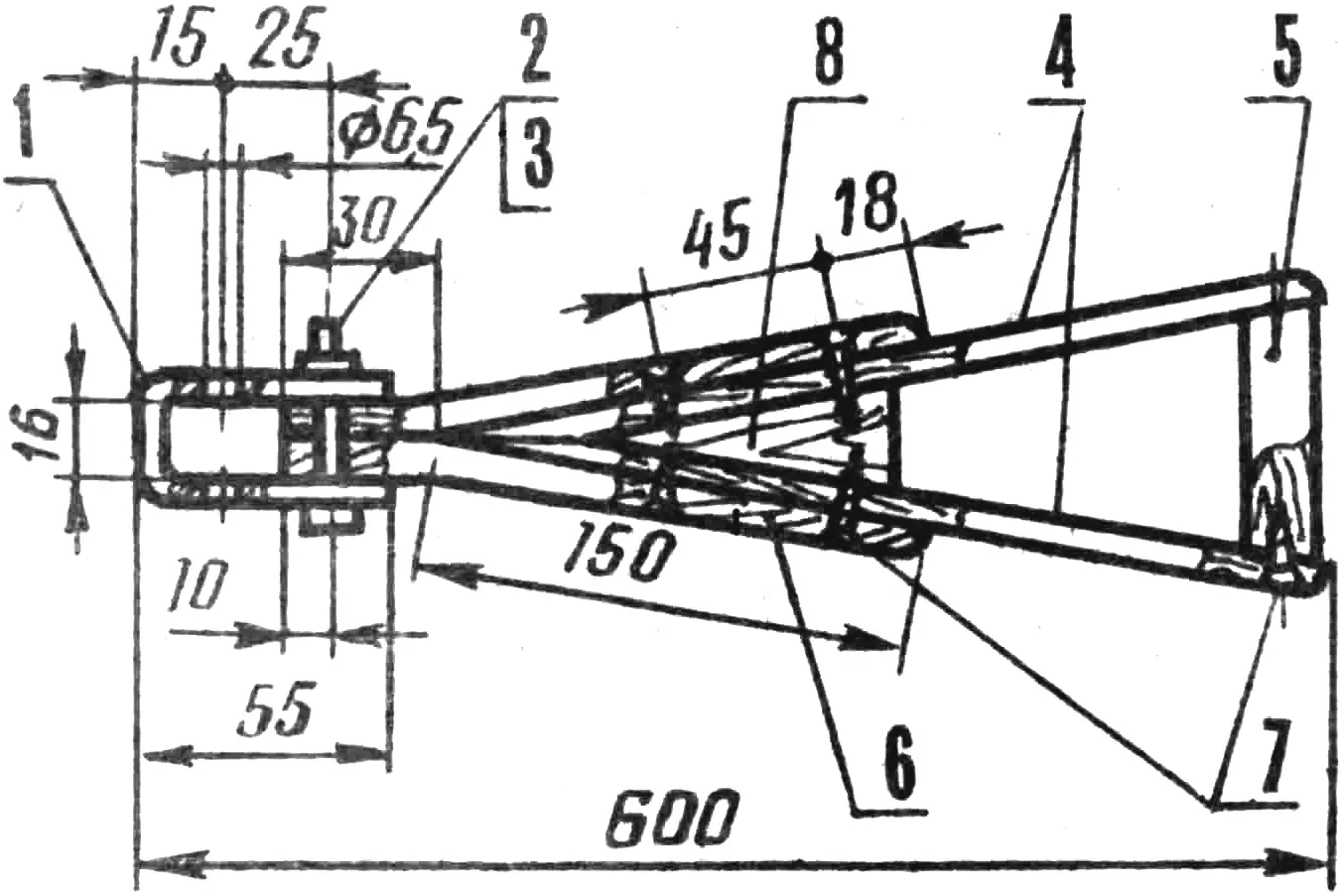
1 — bracket (steel 10X20X135 mm), 2 — hinge (M6 bolt), 3 — nut, 4 — tiller handles (oak or beech 15X20X500 mm), 5 — central handle (oak or beech Ø40 mm), 6 — collar (duralumin 10X20X180 mm), 7 — screws Ø5 mm, 8 — insert (oak or beech).
As we have already said, the ice boat has a parking brake, which is a steel plate mounted on the steering runner. While moving, the plate is raised, and when parked its end is lowered onto the ice until it stops. Ice boaters have a rule — regardless of how long the stop lasts, set the ice boat on the parking brake, ease the boom sheet, and in strong wind also take down the sail. While moving, the driver brakes with his foot.
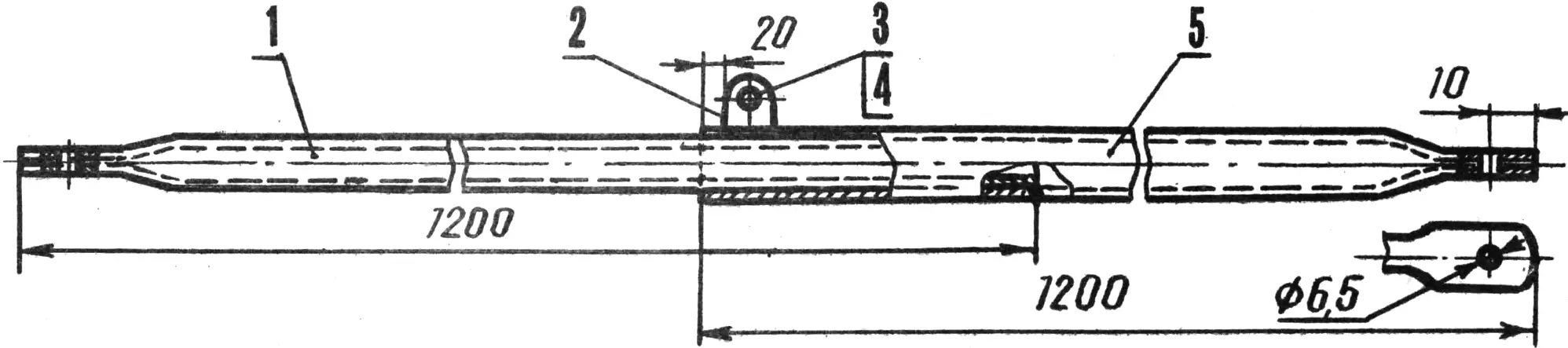
1 — rod (duralumin tube Ø22X2 mm), 2 — lug (duralumin 3 mm thick), 3 — M6 bolt, 4 — nut, 5 — telescopic rod duralumin tube (tube Ø26X1.5 mm).
The ice boat design takes into account the possibility of quick assembly and disassembly (25—30 minutes) and convenient transport.
The weight of a fully equipped ice boat is no more than 25 kg. All parts of the sail craft can be packed into two packages: a bag measuring 1400X500X300 mm (hull base, runners, sail, cables, steering gear) and a case measuring 2200X600X200 mm (boom, collapsible mast, longitudinal and cross beams of the hull, fasteners).
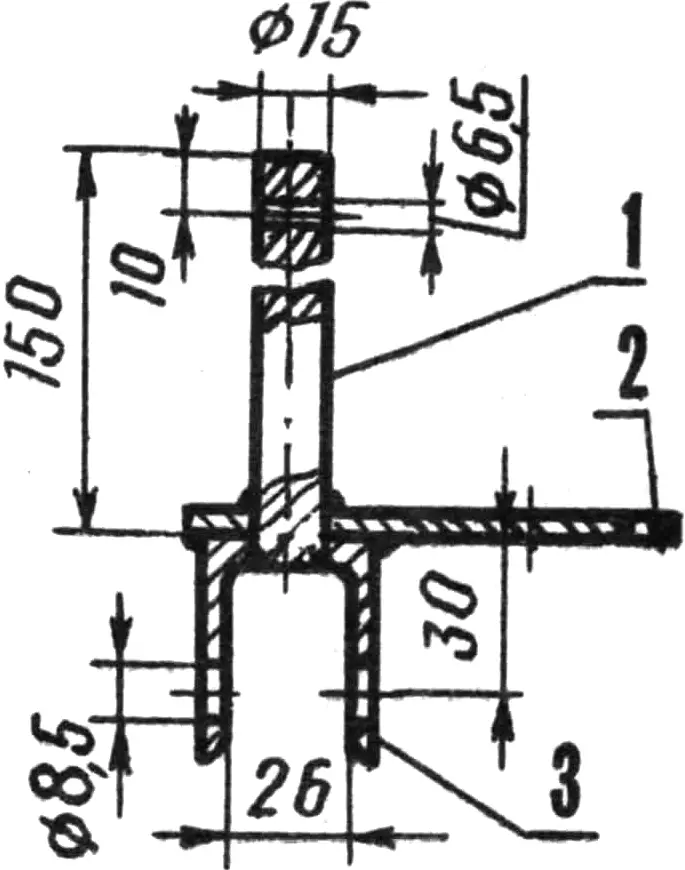
1 — shaft (steel rod Ø15 mm), 2 — steering lever (steel 4X35X110 mm), 3 — fork (welded from angles 40X40X4 mm).
We would like to warn that ice boating practice can be dangerous if a few simple rules are not followed. During turns at high speed or when the driver loses control, the ice boat may capsize. To avoid possible injuries, the driver should wear soft, warm clothing that does not restrict movement, and gloves or mittens on his hands. A helmet or ushanka must be worn on the head. One should not approach places where people gather (for example, fishermen sitting by ice holes), come close to open water, thin ice, or any obstacles.
To prevent capsizing during strong wind gusts, the boom sheet lead must ensure its unobstructed movement through the blocks.
MAIN TECHNICAL SPECIFICATIONS OF THE ICE BOAT:
Length, mm … 3700
Track, mm … 2500
Hull height, mm … 400
Weight, kg … 25
Sail area, m2 … 6
«M-K» 12’91, N. SHERSHAKOV
Recommend to read
 GARDEN CART – FROM THE PAST TO THE FUTURE
Over thirty years ago fate would have it, so I went into the house of Fyodor Nikitovich, Kuhtenko. This man's life was not easy. The dispossession of the family of the parents in the... TABLE SAWMILL
Combined table circular saw is required for each model a mug. It facilitates the performance of a number of works on wood; moreover, replacing the stanochek tool, you can sand the wooden...
