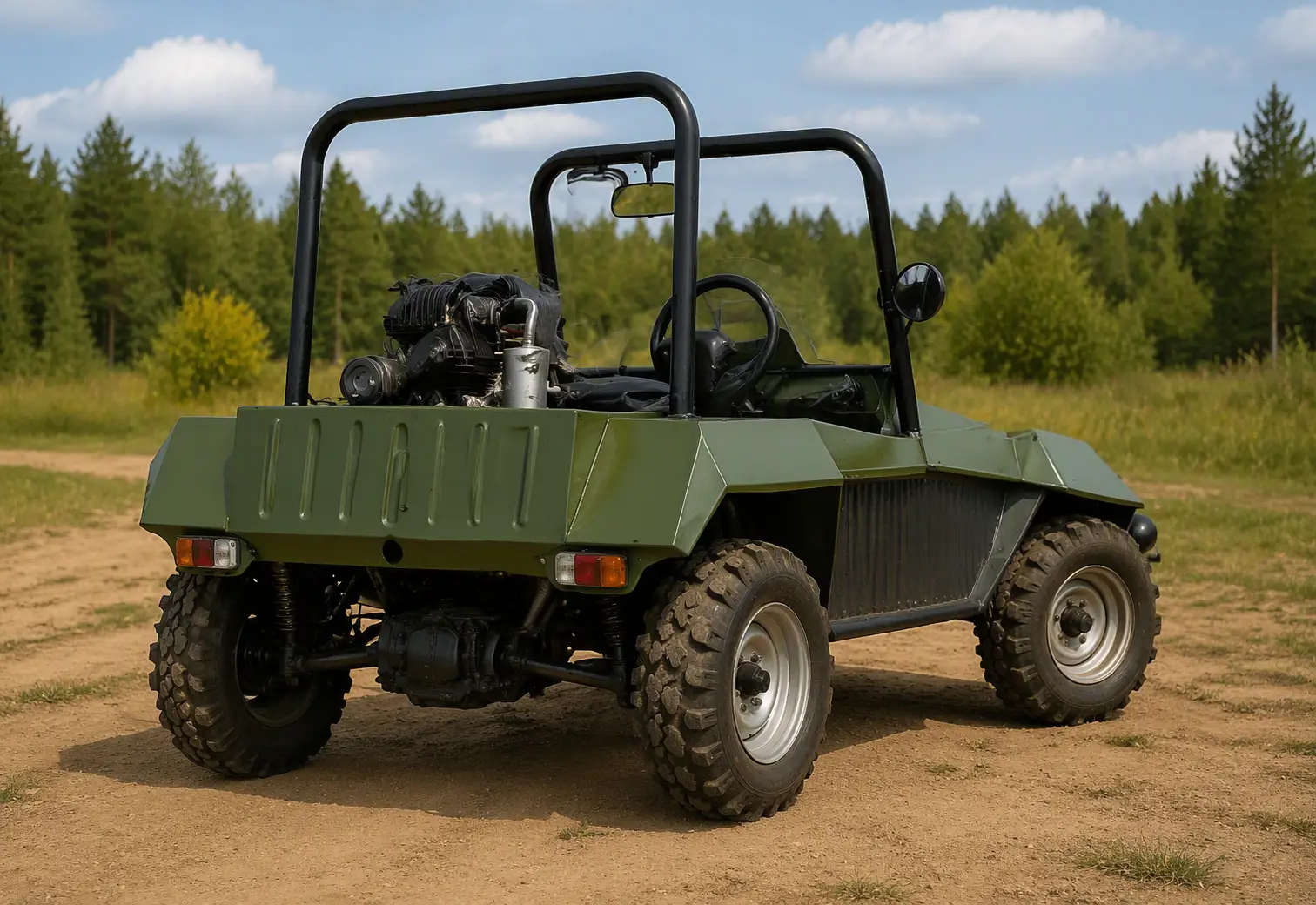
On the roads and cross-country tracks of Latvia, new sports microcars — buggies built at the republic’s Central Station for Young Technicians — have recently appeared. One of them, the school “Buggy-350”, was displayed at NTTM-74.
These nimble, agile machines move with equal success on dirt roads, highways, and heavily rugged terrain. They are also versatile in application: indispensable for competitions off tracks and motorways, and they can be used to teach senior school students the basics of automobile engineering.
Another advantage of buggies is that building them does not require large expenditures or special workshops.
The chassis of a Serpukhov motor tricycle with a 350 cc engine was taken as the basis for the car. Its units are simple in design, easy to maintain, and have proved their strength and reliability on the roads during operation. Units and assemblies from series domestic motorcycles and motor scooters were also used to build the “buggy” class car up to 350 cc.
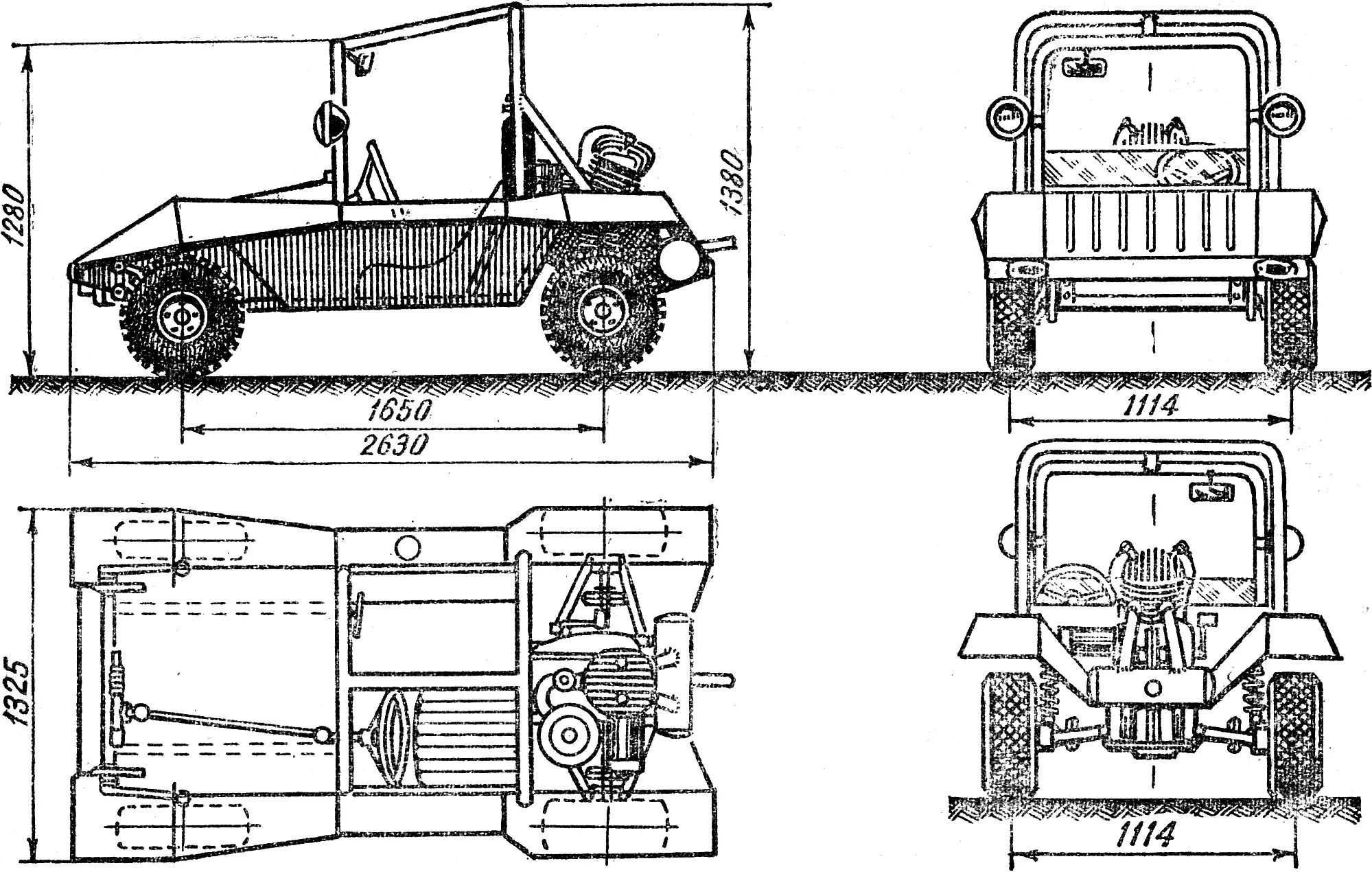
The “Buggy-350”, like its older counterparts, is equipped with headlights with high and low beams, rear side lights with turn indicators and a stop signal. An electric starter for cranking the engine has also been provided. All these electrical consumers are powered by a powerful six-volt storage battery.
The control system consists of the steering mechanism, hand brake, accelerator, brake and clutch pedals, gearshift lever, reverse engagement lever, and starter pedal.
The brakes are mechanically actuated. The front wheels use brakes similar to the rear ones. The throttle and clutch are operated by cables. The engine is taken from a motor tricycle. The forced air-cooling system was replaced with counterflow air cooling, which made it possible to reduce the weight of the car. Since the fuel tank is located below the level of the carburetor float chamber, fuel is supplied to it by a fuel pump normally used on outboard engines and operating by crankcase vacuum (for this purpose, a special hole was made in the crankcase). The use of a single-cylinder engine can be regarded as a good choice, as it is less prone to overheating.
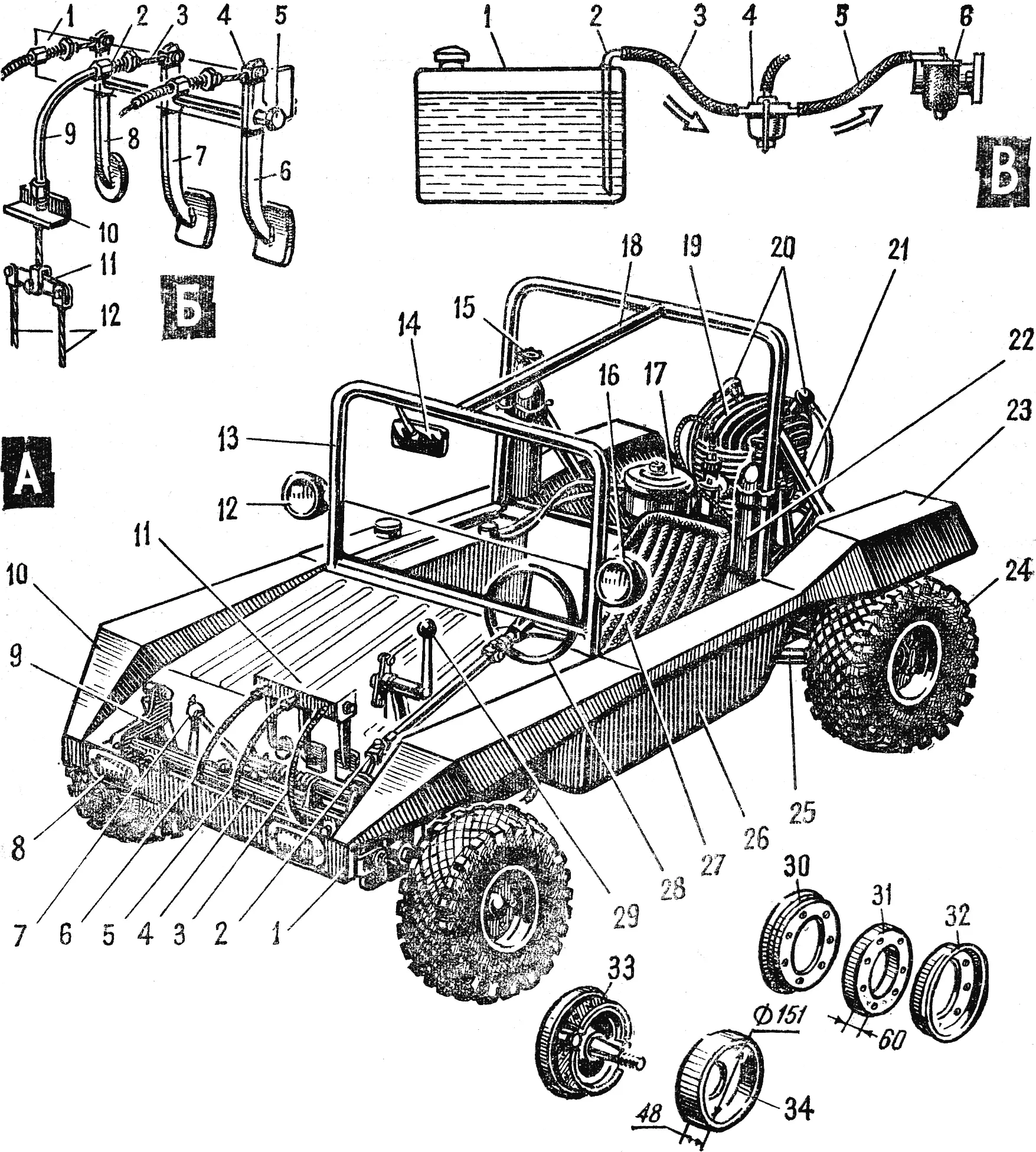
A — general layout: 1 — front body fairing, 2 — lower universal joint of the steering shaft, 3 — clutch release cable, 4 — front axle beam, 5 — foot brake cable, 6 — throttle cable, 7 — swing arm, 8 — turn indicator, 9 — front axle bracket, 10 — front body mudguard, 11 — pedal block, 12, 16 — headlights, 13 — front roll bar, 14 — rear-view mirror, 15, 22 — fire extinguishers, 17 — carburetor air cleaner, 18 — longitudinal roll-bar tube, 19 — IZH-350 engine, 20 — spark plugs, 21 — rear roll-bar brace, 23 — rear body mudguard, 24 — rear wheel “spaced out” by 60 mm, 25 — rear suspension arm, 26 — body side, 27 — driver’s seat, 28 — steering wheel, 29 — gearshift lever, 30, 32 — rear wheel discs, 31 — 60 mm spacer, 33 — front brake backing plate, 34 — brake drum.
B — pedal block design: 1 — housing, 2 — adjusting fitting, 3 — cable, 4 — cable eye, 5 — pedal axle, 6 — clutch pedal, 7 — brake pedal, 8 — accelerator pedal, 9 — sheath of the intermediate brake pedal cable, 10 — stop, 11 — equalizer, 12 — cables to the brakes,
C — fuel supply system: 1 — 25-liter fuel tank, 2 — supply pipe, 3, 5 — flexible fuel lines, 4 — pump from the “Moskva” outboard motor, 6 — carburetor float chamber.
To protect the driver and passenger in case the machine overturns, it is equipped with roll bars. The safety frame consists of two bars, one of which is installed behind the seat, the other adjoins the windshield posts. The bars are rigidly connected to each other by a longitudinal tube, and the rear bar has braces.
There is no body as such in our usual sense. It is replaced by a very simple structure. The body is open, two-seat, providing minimum comfort for the driver and passenger. This makes it possible to use the microcar not only for cross-country competitions, but also on public roads. Simplified body panels and front and rear fenders to some extent protect the driver and passenger from dirt entering the body directly.
The rear wheels have widened rims to match the track width, which also increases the machine’s cross-country capability.
“M-K” 8’74, V. YEGOROV, master of automobile sport
Recommend to read
 THE USB CONNECTOR IN THE CAR
It never hurts to have your own car, in addition to the cigarette lighter socket, and even first connector, adapted to USB or even mini USB. Such adapters are useful in many cases, for... THE SHEARERS, NOT ONLY
Shearing machines МСУ200 with a built-in handle three-phase asynchronous motor (200 Hz, 36 V, 100 W, 12, OOO rpm) we have in the village is not uncommon. Though slightly modified,...
