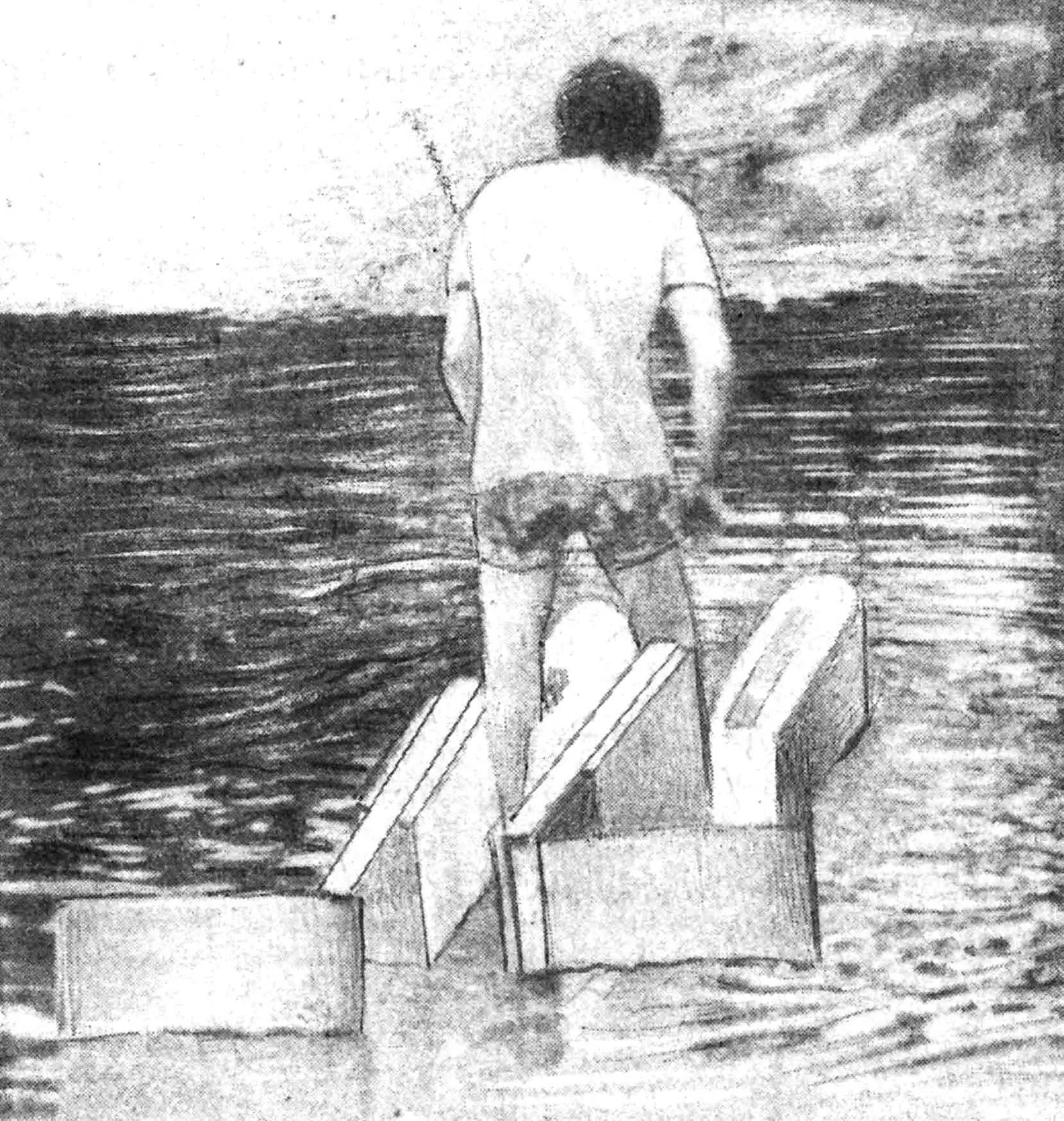
In “M-K” No. 4 for 1989, an article devoted to skis-boats… was published. I read it and regretted that I hadn’t written to the editors earlier, nor shared my developments with the readers of “M-K”.
Of course, the idea of float-skis is not new. But enthusiasts of this “vehicle” constantly repeat the mistakes of their predecessors. Therefore, practically all such watercraft look rather funny than tempting for a DIY builder. There can be no talk of any “sprints” on these skis. And it all is because the designers did not think about what makes them move when they stand on such floats. As a rule, they give the main role to poles with floats, with which they try to push off the water. And, you’ll agree, that is not quite convenient. So before starting to design such skis, let’s try purely theoretically to figure out how they can move.
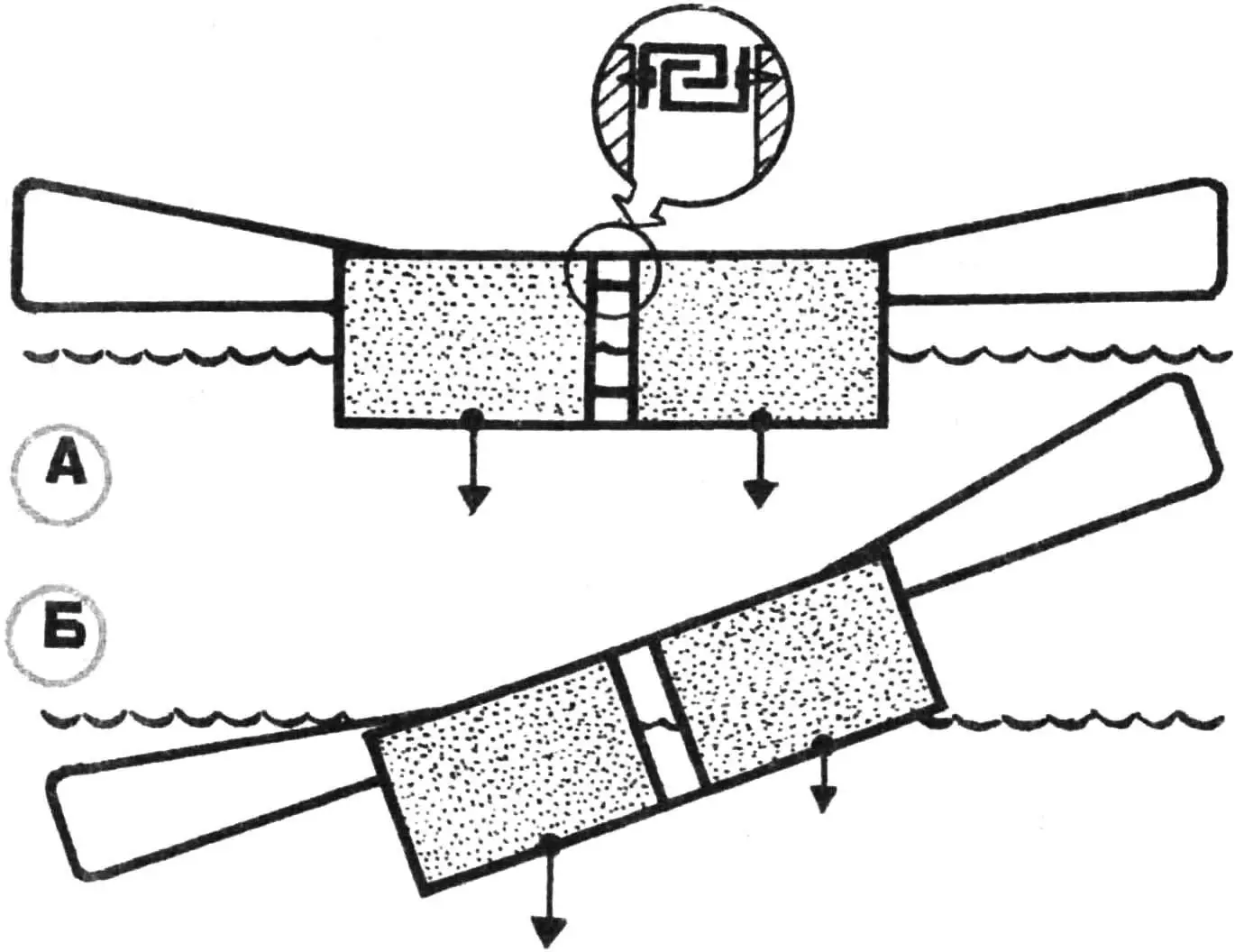
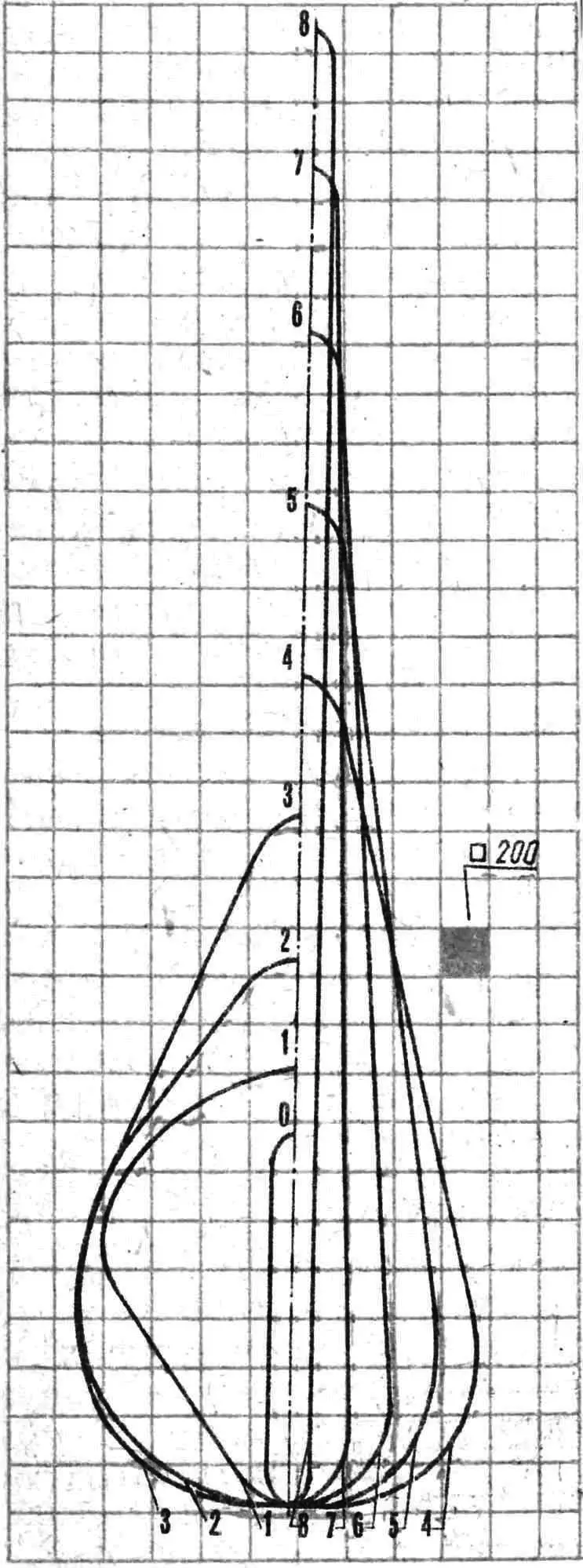
(A — the skier leans on both floats, B — the skier leans on one float).
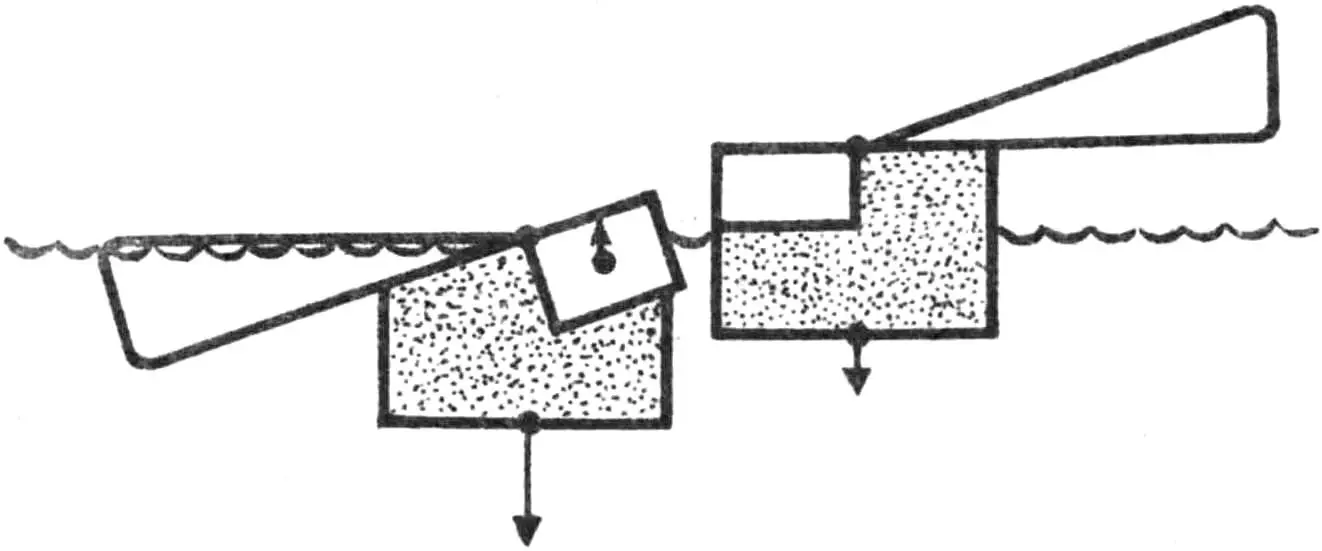
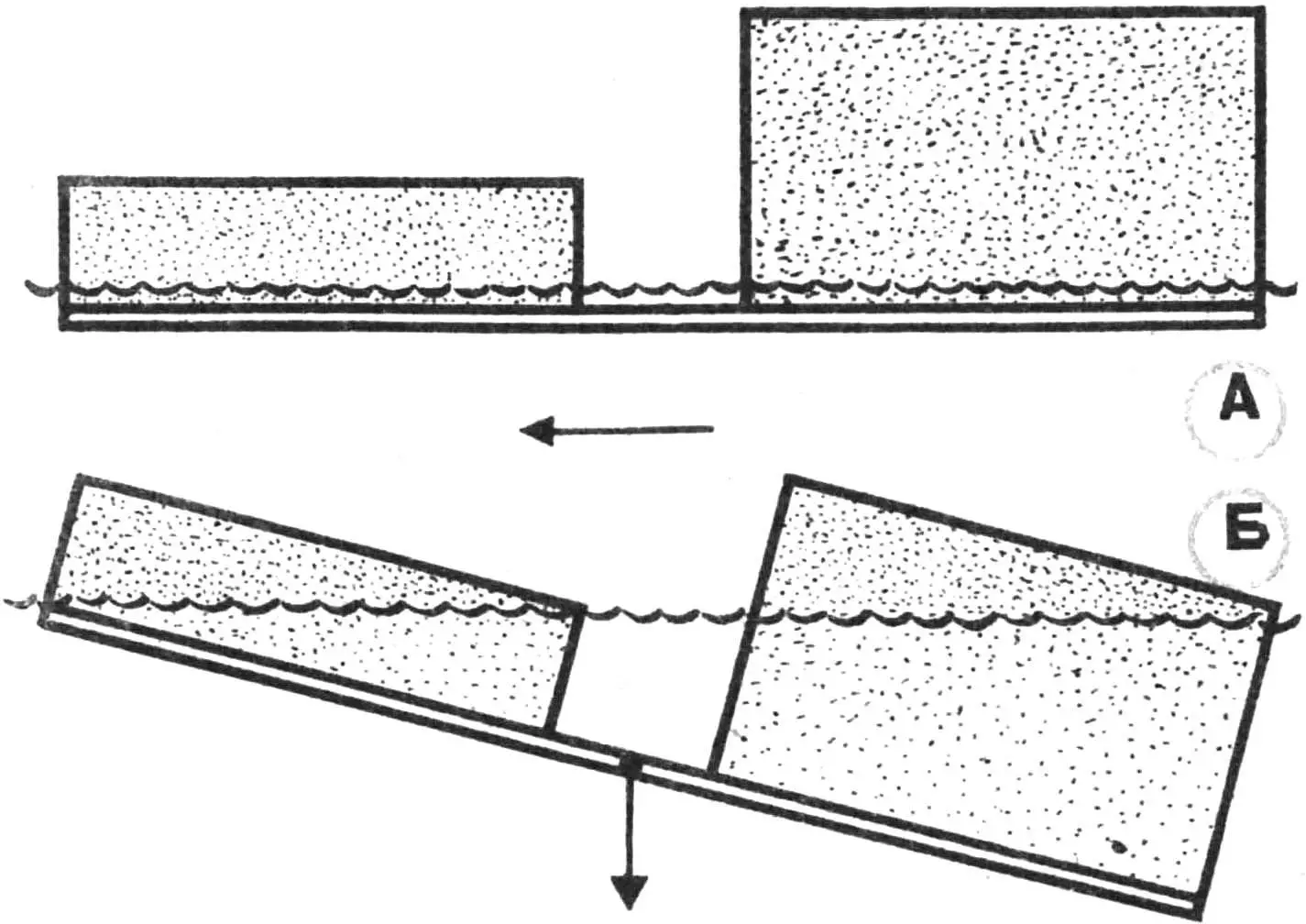
(A — the skier leans on both floats, B — the skier leans on one float).
When walking on skis over snow, a person has to push off alternately with the right and then with the left leg, transferring the full weight of their body to the pushing leg. At the same time, the second ski moves forward freely. In principle, movement over water should be organized similarly. Shifting the weight of the body onto one of the skis, the person should ensure maximum “grip” of this ski with water. The free ski should be pushed forward unobstructed and with minimal losses. After making a thrust, the skier redistributes their weight onto both floats — while resistance to motion should be minimal. To implement such a principle of movement over water, several options can be proposed.
1. Float-skis are connected so that they can move relative to each other only forward and backward. On each ski (on the right — on the right side, on the left — on the left side) there are special “paddles”. When stepping onto the right ski, the skier tilts the entire construction, and the right row of “paddles” ends up in the water. This allows a full thrust movement. Next, the person’s weight is redistributed onto both skis, the “paddles” are above water, and the pair of skis offers minimal resistance. Then the left leg takes over, copying the movement of the right, and the cycle repeats.
2. The second possible design resembles the first one, but the skis are not connected to each other. However, each ski also has a row of “paddles”. Yet these rowing elements are not rigidly fixed to the sides of the skis, but hinged on levers. On the opposite ends of the levers there are floats. When the ski is immersed, the float rises and lowers the corresponding rowing element into the water. The skier has only to make an energetic thrust with the corresponding leg and, after that, transfer their weight evenly onto both skis, to continue gliding. Then the weight is shifted to the other leg, another thrust follows, and the cycle repeats.
3. The third design has uneven buoyancy along the length: the front parts of the skis have greater buoyancy, and the rear parts — less. When the skier leans on one such float, it submerges in the water unevenly, with a trim toward the “stern”. At the same time, a row of “paddles” fixed at the rear part of each ski is also in the water.
4. From the previous project follows another option: with fins fixed at the ends of the skis. Such skis-boats allow movement not only in calm water but also when there are waves.
Last year, I tested the last two designs. I made the skis from sheet foam board, fixing its blocks on a pine board 2 m long and 0.2 m wide. In the rear part of each ski, either a “paddle” or a rubber fin was installed. I should say right away that the standard fin turned out to be not too effective as a propulsion device because of its small area. Accordingly, the speed of “running” with such a propulsive device was also insignificant. But moving on skis with “paddles” is possible more successfully — the speed reached 5 km/h, i.e., it was practically the same as that of a pedestrian.
I would like to note that I do not use any poles with floats when moving on these skis.
Based on the experience gained, I want to formulate a number of requirements for skis-boats.
1. The length of a ski should be 3…4 m. It is desirable to make them foldable — this will make transportation easier and simpler.
2. The width of each ski should not exceed 200 mm; otherwise you will have to spread your legs widely, which is rather inconvenient for movement.
3. The outlines of a ski should make sense to be as smooth as possible, well streamlined, and in shape close to those of a canoe.
4. The displacement of each ski should be somewhat greater than the skier’s weight.
Now, in more detail, about the design of the skis-boats I made. Each of them is a float with uneven buoyancy along the length; in the tail part three “paddles” are fixed. The float length is 3.5 m, the maximum width is 180 mm, the height in the tail part is 600 mm. The full displacement of each ski is about 110 kgf. It should be taken into account that skis-boats require a kind of individual adjustment depending on the skier’s mass: the displacement of each of them should be 10…20% greater than the combined weight of the skier and the ski itself.
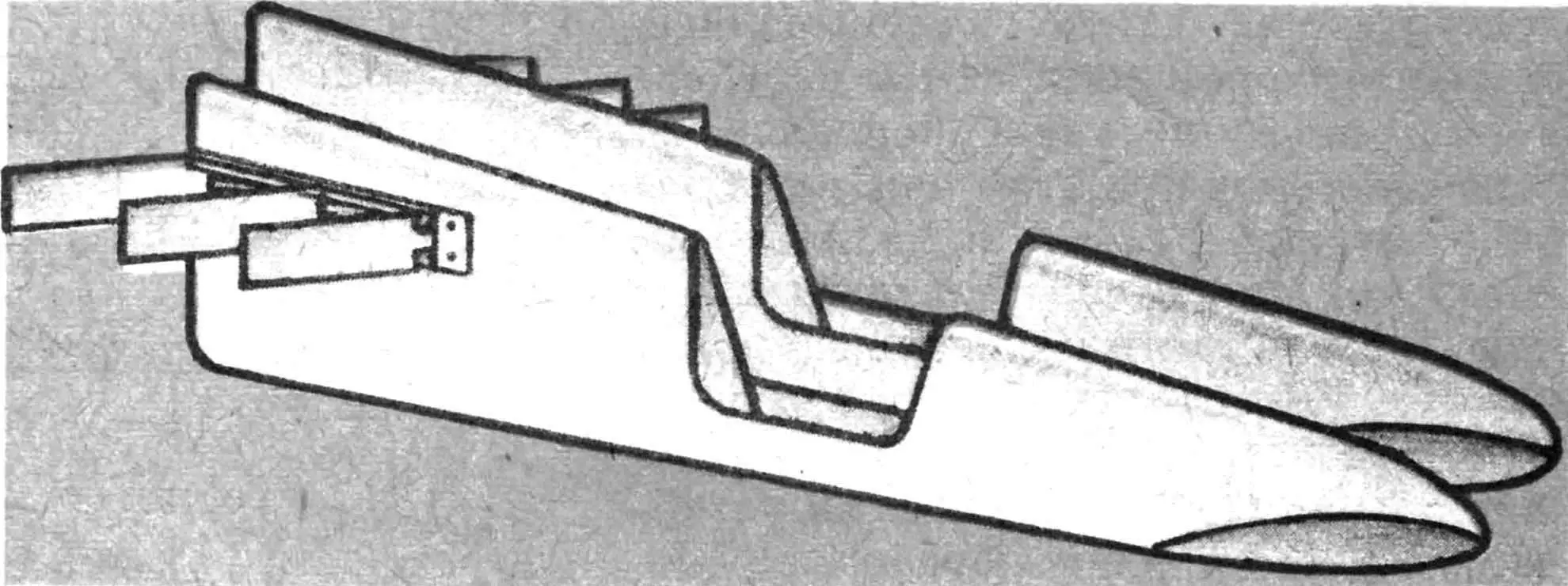
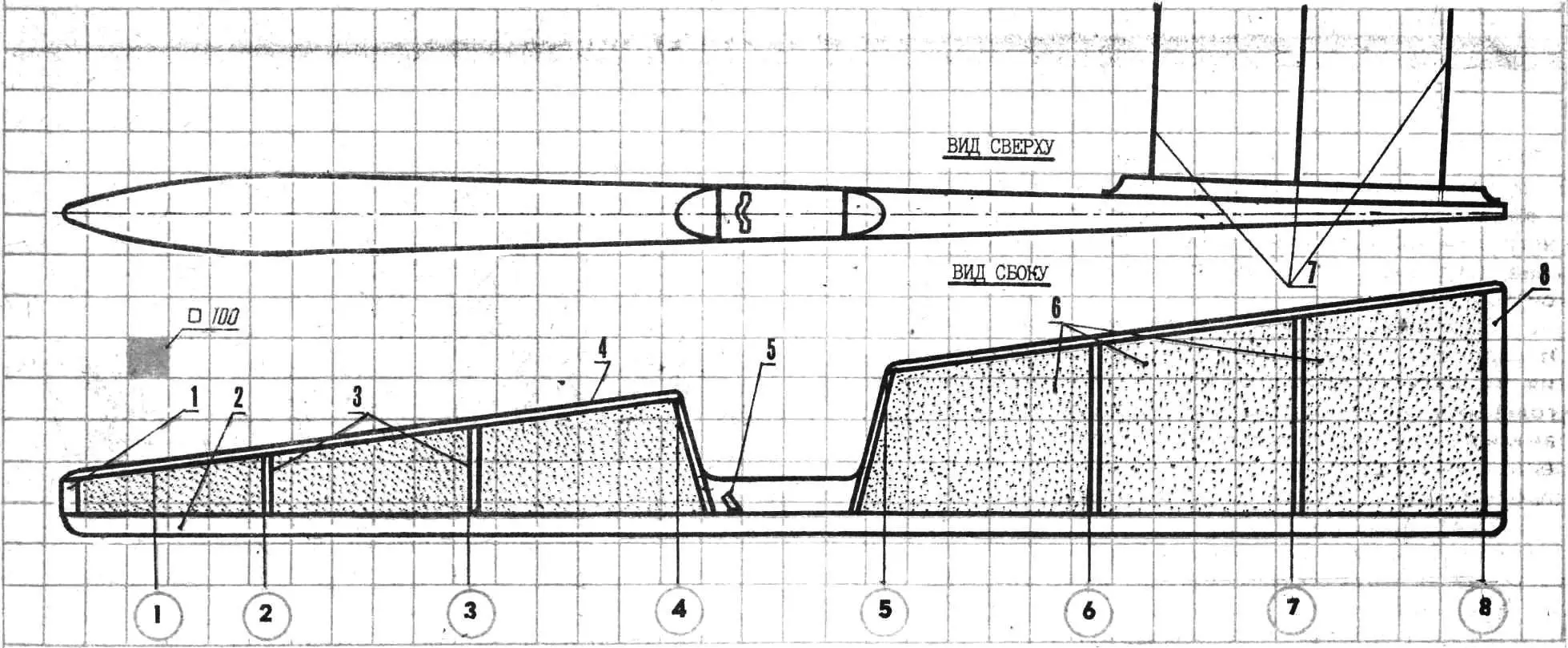
1 — fore-stem (pine block 20X50 mm), 2 — keel (pine block 30X50 mm), 3 — frames (pine board 20X200 mm), 4 — upper moulding (pine strip 20X20 mm), 5 — mounting, 6 — foam filling, 7 — paddles (plywood thickness 5…6 mm), 8 — stern-stem (pine block 20X50 mm).
The float of a ski is structurally a light wooden frame filled with construction or packaging foam, followed by lining with one or two layers of fiberglass fabric. The floats prepared in this way are puttied, carefully sanded and painted. On each float it is desirable to determine waterlines by practice: one of them is the operating one, indicating the immersion level of the ski when the full weight of a person is applied, and the other is the level when the skier rests evenly on both floats.
The most rational level, at which the “paddles” are attached, is determined practically in the same way. By the way, it is easiest to make them from 5…6 mm plywood, followed by soaking in hot linseed oil and painting.
It seems that my experience will be useful for those who want to make themselves these convenient skis-boats. It would be interesting to know these readers’ opinion about these skis (“M-K”) who will use my recommendations.
«M-K» 9’92, D. AVERCHENKOV
Recommend to read
 AUTOMATIC “WAH”
Playing the electric guitar that uses the effect of "wah", artist often have to press a pedal of a special electronic device. This often distracts the attention of the guitarist. In the... “SHARK”, AND NOT SHOWING TEETH
Reconnaissance-torpedo bomber Blackburn Shark. In 1933 the air Ministry of great Britain has issued a document S. 15/33, which stipulates the requirements for a new scout-spotter-torpedo...
