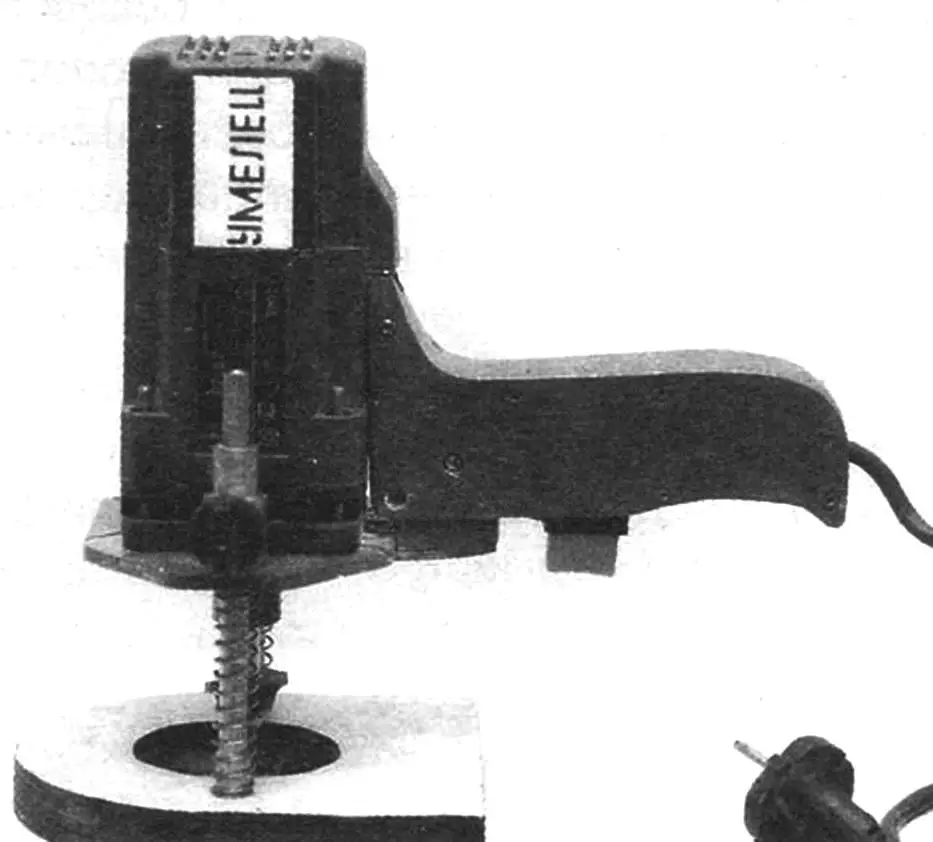
Presented tabletop milling machine will come in handy for craftsmen who enjoy working with wood to obtain relief surfaces on workpieces, various geometric ornaments, as well as to cut grooves, channels, pockets (both simple and shaped), etc.
The machine consists of two main parts: a base with guide posts mounted on it, and a spring-loaded platform on which an electric motor is installed.
The base is made of 20 mm thick plywood. In its center, a through hole of 60 mm diameter is drilled, and on the sides there is a pair of diametrically opposite nests for the guide posts. The posts I used are made of brass, but they can easily be made from any ordinary steel. They are fastened to the base with M4 screws with enlarged washers. To recess the washers into the base, shallow cylindrical recesses are milled in it, coaxial with the nests. In the washers themselves, the holes are countersunk for the countersunk screw heads.
The platform is made from an 8 mm thick duralumin sheet. It has a row of through holes drilled: a central hole with a diameter slightly larger than the electric motor shaft diameter; on the opposite sides (along the sides) — a pair of threaded holes M12 for the guide bushings and also four smooth holes of 5.2 mm diameter at the corners — for screws that attach to the motor mounting plate.
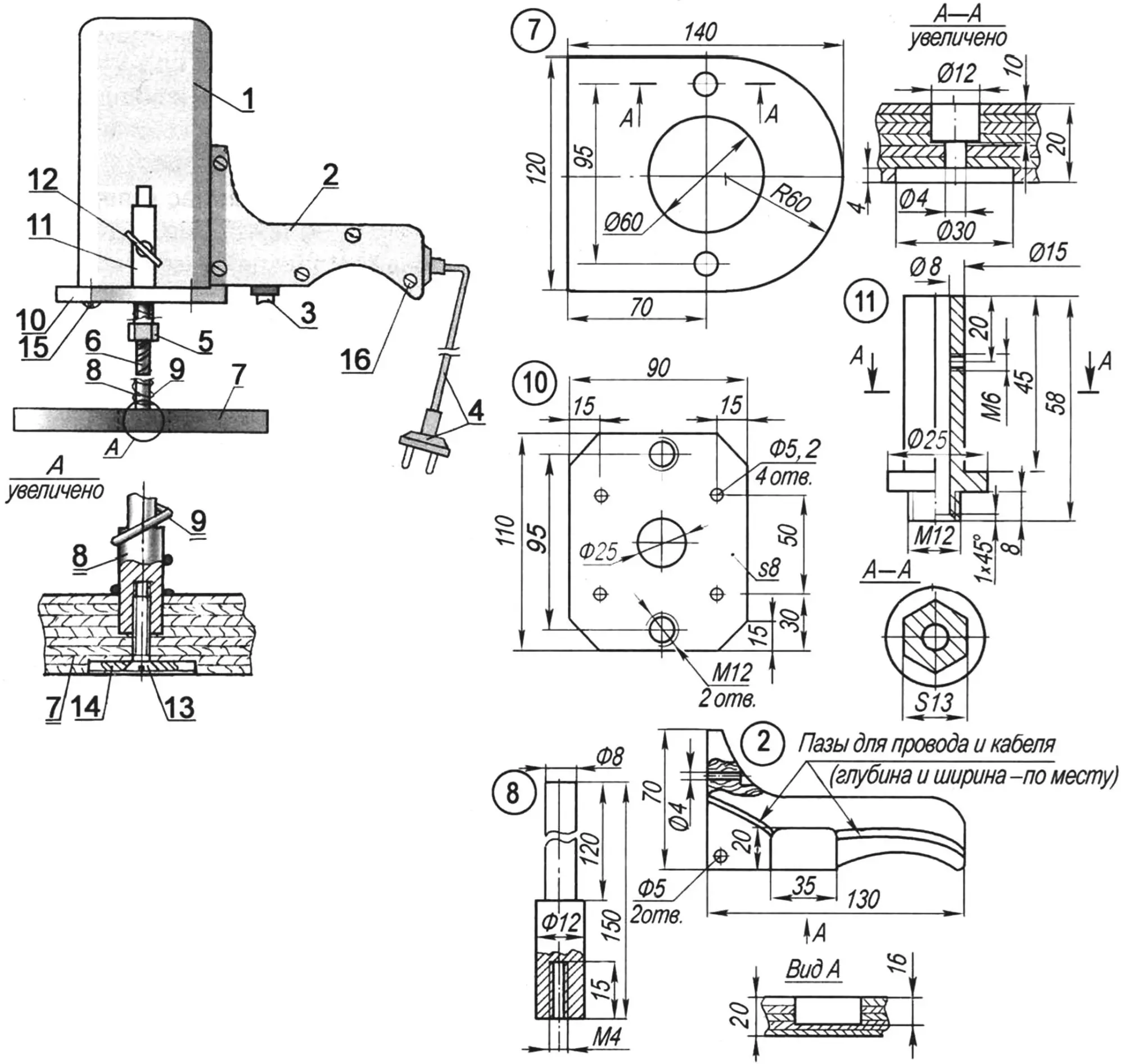
1 — electric motor U = 220V, N = 600W, n = 10 000 rpm (from an electric planer); 2 — handle (plywood s20 and s4); 3 — start button of the motor switch; 4 — power cable with plug; 5 — collet chuck; 6 — wood-cutting tool (milling cutter); 7 — base (plywood s20); 8 — guide post (steel, rod 12, 2 pcs); 9 — spring (compression coil, 2 pcs); 10 — platform (duralumin, sheet s8); 11 — guide bushing (steel, rod 25, 2 pcs); 12 — platform lock (M6 screw); 13 — fastening the guide post to the base (M4 screw with countersunk head, 4 pcs); 14 — enlarged washer (4 pcs); 15 — fastening the electric motor to the platform (M5 screw, 4 pcs); 16 — fastening the cheek/overlay to the handle (screw, 5 pcs.)
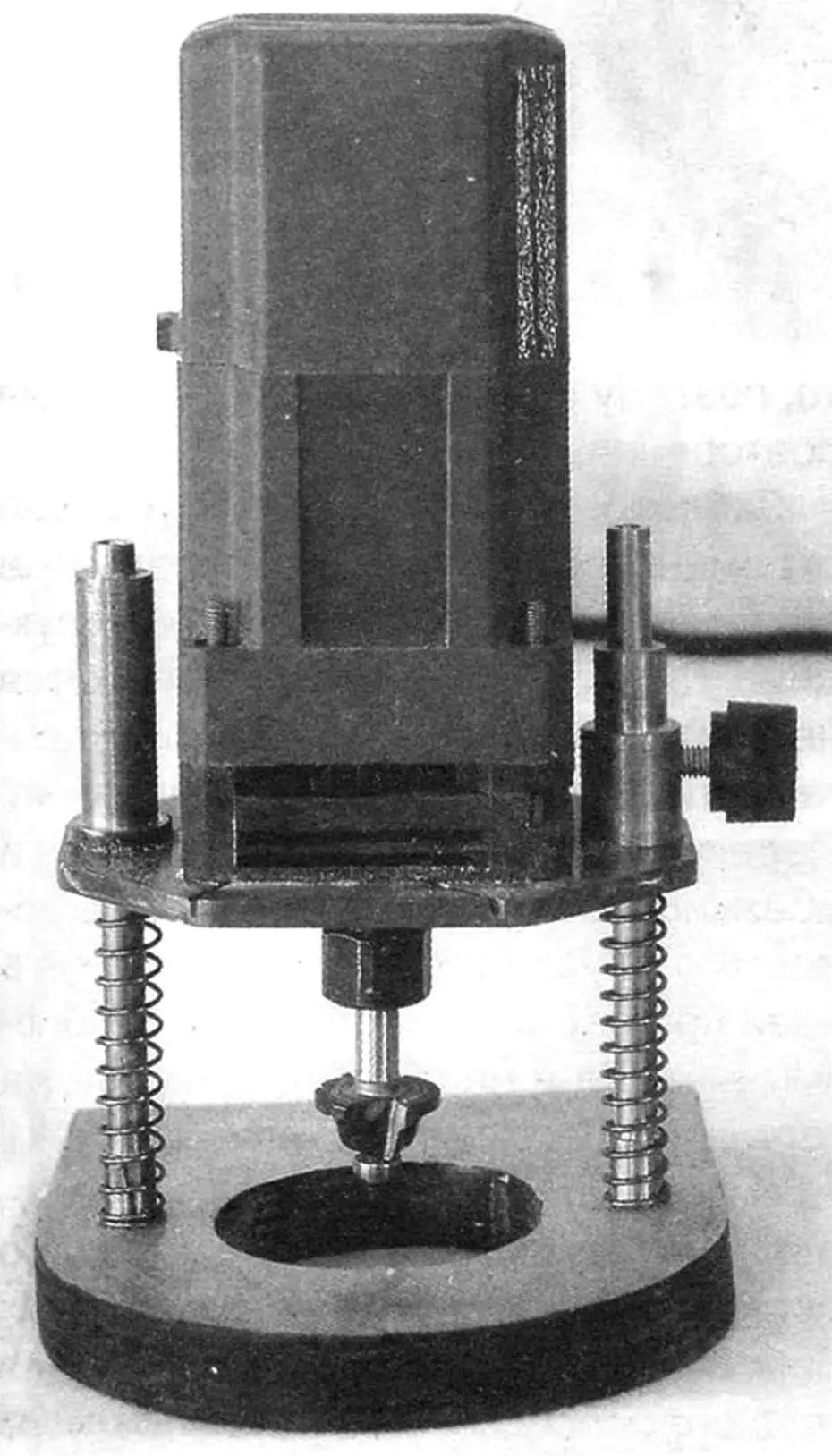
Guide bushings, like the posts, are made of brass in my case, although that is absolutely not necessary. The reason is simple: both parts were available and suitable for a small milling machine with minimal modification. By the way, in the photo of the front view, even without straining your eyesight, it is possible to notice that the bushings differ slightly from each other. However, this does not affect functionality. The bushings can also (and even should) be made of steel. In one of the bushings, I made a side threaded hole M6 for a locking screw. This screw keeps the platform with the electric motor fixed in the idle or transport position and also sets the maximum cutting depth during operation.
Assembling the machine is not difficult; the main thing is to choose a suitable motor for it — compact, high-speed, sufficiently powerful, powered from a household electrical network of 220 V. I managed to find one — from an old handheld electric planer — compact, in a plastic housing. Its power is 600 W, and the number of revolutions is 10 000 per minute. Motors with more than 15 000 rpm should not be used — the tool requires extremely precise centering, and chips fly far away as well.
The handle also had to be made for the motor. I cut it out of thick plywood (the same type as used for the platform), so to speak, on the spot, or more precisely — according to my own hand. That is why I only provide its overall dimensions. In the handle itself, on one side, I hollowed out a recess for the motor switch and a longitudinal groove for the power mains cable and the wires that lead to the electric motor. After installing the switch and laying the cable with wires into the handle, the recess and the groove were covered with a cheek/overlay made from 4 mm thick plywood, cut to the handle’s configuration, and screwed in place with screws having countersunk heads. The handle is fastened to the motor body with a self-tapping screw and attached to the platform with a rivet through a bracket-plate.
Springs are compression coil springs (normally stretched); it is desirable to select identical ones, sufficiently stiff — just so they keep the platform with the electric motor suspended.
At the end of the motor shaft, an M8 thread is cut to fasten the collet chuck, into which the required replaceable cutting tool (milling cutter) is inserted and tightened.
To avoid injuries and damage to the machine, it should not be used for machining metal workpieces, and you must work wearing protective glasses.
“Modelist-konstruktor” No. 12’2009, A. ALIBEKOV, Derbent, Dagestan
Recommend to read
 UNIVERSAL TRESTLES
Continue construction work in the country, whether harvested wood for heating furnace, or fireplace — here indispensable invariably acts as a traditional device, as is known to all... BRACKETS FOR STEREO SPEAKERS
Stereoscopy household radio equipment increasingly enters the house. Rarely one will see speakers in corners of the room... But where: on the floor, on bookshelves, on the furniture!...
