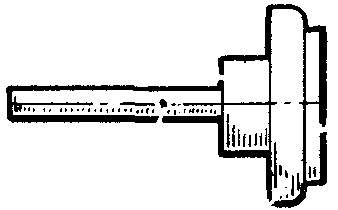
The simplest method of making “shoes” for the trace of the car based on the manufacture of the hubs of the elements of the dry type batteries А343 “prima” and the like.
From the edge of the “minus” side of the battery need to retreat to 6 mm (Fig. 1) and needle files on the markup to saw through a circular slit (by the way, here is the boundary between the graphite “face” of a galvanic cell and plastic liner-insulator). Then, the resulting “disk” with the core separated from the battery and washed.
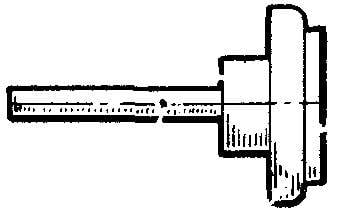
Fig. 1. Used parts from galvanic cell:
1 — plastic insert-insulator 2 — “negative” contact, 3 — a Central electrode, 4 — cut a portion of the housing. The left shows the layout of the housing of a galvanic cell type А343.
Fig. 2. The revision removed from the battery site (left — crop residues building, to the right — Department contact):
1 — “negative” contact, 2 — plastic liner-insulator, 3 — a Central electrode, 4 — cutter or knife, 5 — the remnants of the hull of a galvanic cell.
Fig. 3. Ready wheel for the trace of self:
1 — spindle, 2 — tire, 3 — wheel hub.
The next stage is the removal of the ferrule, the remainder of the battery housing and trim the plastic bezel that holds the disk “negative” contact (Fig. 2). The result is a great hub prepared with a Central hole for the bearing axis of the wheel. And external landing size under the “bus” can be varied in wide limits (Fig. 3). Together with the strength for such a hub characteristic and low weight. Tires are machined from a sheet of porous rubber, in accordance with the drawings.
Recommend to read THE LEGEND OF THE SOVIET AUTOMOBILE INDUSTRY The history of the Moscow Likhachev automobile plant dates back to 1916, when on the outskirts of Moscow began construction of a plant with the name AMO (Automobile Moscow Society),... “BEAVERS” AND “SEALS” THE KRIEGSMARINE The German Navy was engaged in an ultra-small boats only in 1944. Prior to this the Germans managed to capture a number of European States, without resorting to the use of underwater...