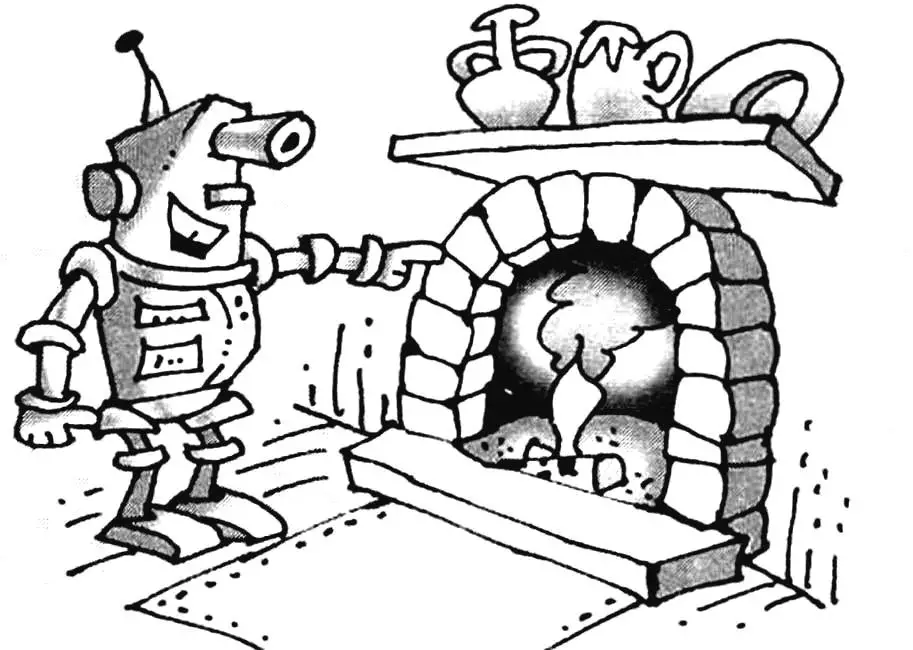
When heating a fireplace or sauna stove at a dacha with wood, the combustion process must be monitored from time to time: adding firewood, increasing draft, etc. The proposed electronic device can replace the “owner’s eye” and remind of this by signalling when the flame in the stove (firebox) diminishes.
I experimented a bit and found that infrared (IR) signal units actually respond even to a burning match with very weak infrared radiation. It was this knowledge that prompted the development of a combustion monitoring device. With a bright flame at up to 1.5 m from the hearth, the unit stays “silent”. As soon as the fire in the stove or fireplace begins to die down—the alarm sounds. It does not, however, respond to a photo flash with an IFK-120 pulse lamp (or the miniature flashes built into modern cameras).
Assembling such a device is not difficult even for a radio amateur with little experience—and you get the satisfaction of building something useful, well-earned pride in a homemade device, and thanks from the household.
The most expensive part is the infrared (IR) detector—about 80 rubles. It can also be taken from an old TV remote control receiver. Colour TV sets started to be fitted with such detectors as early as the late 1980s; a detector from one of those will work. Modern TVs also use similar IR detectors—they are suitable for this design.
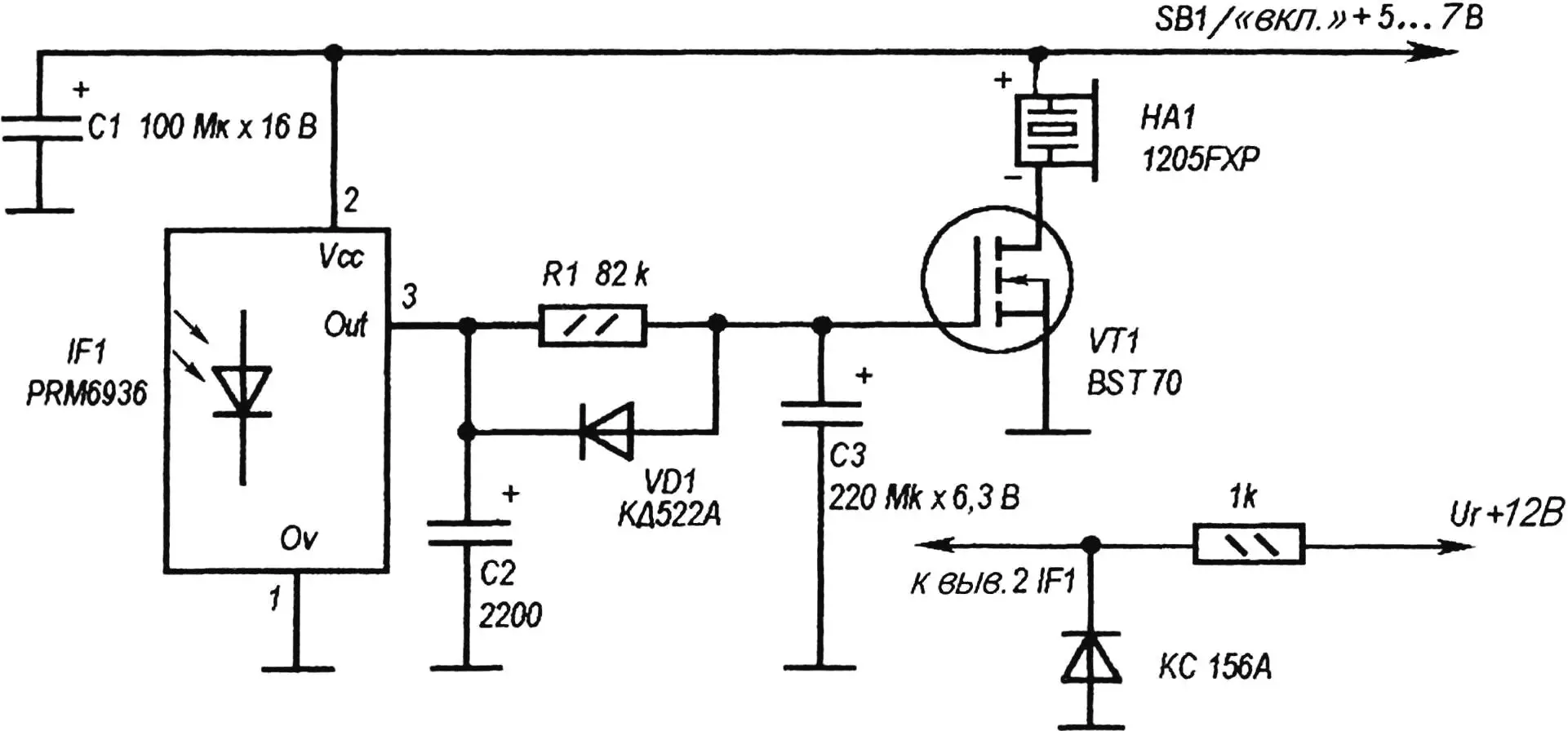
Supply voltage is in the 5–7 V range, due to the IR sensor specifications. It can be raised, e.g. to 12 V, by adding a simple limiter/regulator made of a KS156A zener (or equivalent such as BZX55C) and a series limiting resistor of 0.82–1 kΩ. Connect the zener anode to common and the junction of the zener (cathode) and resistor to pin 2 of sensor IF1; apply supply to the limiting resistor. Device current draw does not exceed 25 mA, 20 mA of which is taken by the sound capsule.
Operating principle
Electrolytic capacitor C1 smooths supply noise. The sensitive IR detector’s normal state is a low high level on its output (pin 3 of IF1). When an IR signal is present in the detector’s “responsibility” zone, negative pulses appear on pin 3. Polar capacitor C2 reduces the effect of random and external interference. It is especially useful when there is remote-controlled equipment in the same room (remotes typically use the IR spectrum; e.g. the alarm is in the living room monitoring the fireplace). If the device is used in a sauna (where such interference is unlikely), C2 can be omitted. Small-amplitude negative pulses are not enough to drive a sound (or even light) alarm or relay. So they pass through the peak detector (R1, VD1) to the gate of FET VT1, which acts as a current amplifier. The transistor drives the sound capsule with built-in audio oscillator (HA1).
When you finish firing the fireplace, the alarm can be turned off with switch SB1.
The device needs no adjustment. Electrolytic capacitor C3 provides the sound turn-off delay. This prevents the alarm from reacting to flame flicker or brief drops in combustion, so the “alert” sounds only when the flame is actually dying. The larger C3’s capacitance, the more delay you get. Sensitivity can be adjusted slightly by changing the value of resistor R1.
Parts
IR detector PRM6936 can be replaced with TSOP1736CB1 or equivalent. Pin order is counted with the detector’s convex side toward you. On TSOP1736CB1, pins 1 and 2 are adjacent; pin 3 is about 2 mm from pin 2. Do not reverse the detector connection.
Electrolytic capacitors—K50-29 or similar. FET BST70 can be replaced with BS170 or similar. Both resistors—MF-25 type. Diode VD1 can be KD522, D220, KD503 (any letter suffix) or 1N4148. Sound capsule HA1 with built-in oscillator—any 3–6 V type, e.g. TR-1203Y. Observe polarity as shown. Instead of it or in parallel, a low-current 5 V relay can be used, e.g. TRU-5VDC-SB-SL—useful for future expansion (see below).
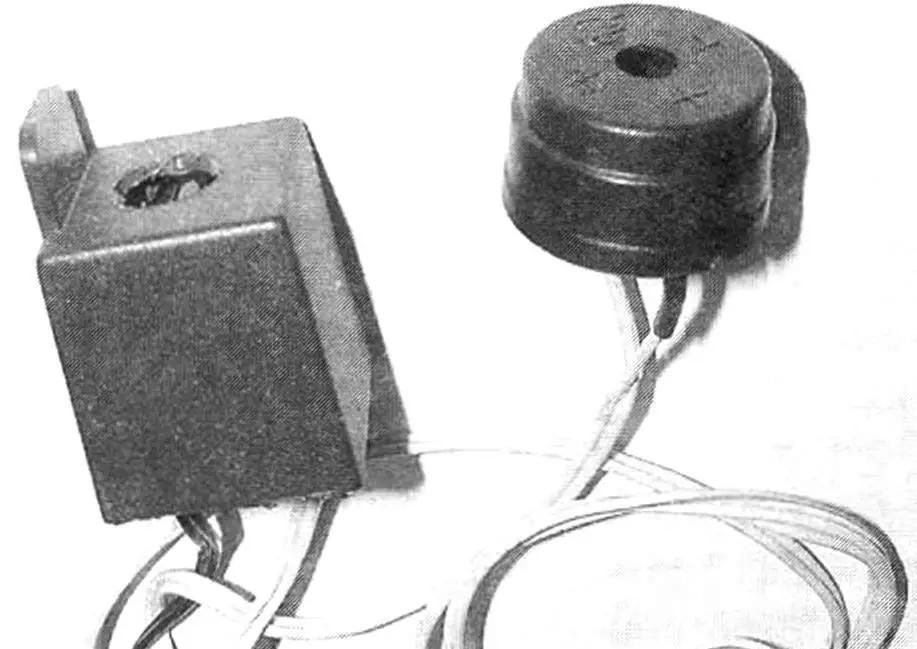
The circuit has so few parts that I did not design a PCB—I used a standard perforated board with plated-through holes and made interconnections with MGTF-0.6 wire. The photo shows the finished alarm in its enclosure (on the right—alarm capsule HA1).
Features and possible uses
The device responds well to open flame; at up to 0.5 m it even triggers on a lit match. So the same design can be used as a fire alarm. The trigger is still open flame, and effectiveness is the same by day and night: the device reacts to the infrared component of the flame spectrum, not to light, heat, or flicker, and that does not depend on time of day. Such an alarm is especially useful outdoors—in open areas, forests, settlements, streets—where smoke-based fire detectors are of little use. For controlling a heavier load (e.g. up to 6 A at 220 V), connect the load via a relay—for instance a submersible water pump.
The unit can also be used to check any remote controls (it “catches” both direct and wall-reflected IR beams); to troubleshoot and test computer peripherals and phones with IR ports; to “monitor” a room or storage where invisible IR beam alarms might be installed (as in 007 films), and in many other cases. The device is simple to build.
«Modelist-Konstruktor» No. 2’2011, A. KASHKAROV
Recommend to read
 LOBED ON PILOTAGE
What are the only propellers is not built by modelers. Due attention was paid to the three blade. Why not try to install them on a modern cord "acrobat"? If Yes, will any benefit from... IN THE CAR”DIPLOMAT” ON THE STROLLER
How not to fold walking stroller still it is quite cumbersome. And she weighs a lot, so to enter the car or bus with a child and a heavy stroller is no easy task. Besides, and stored in...
