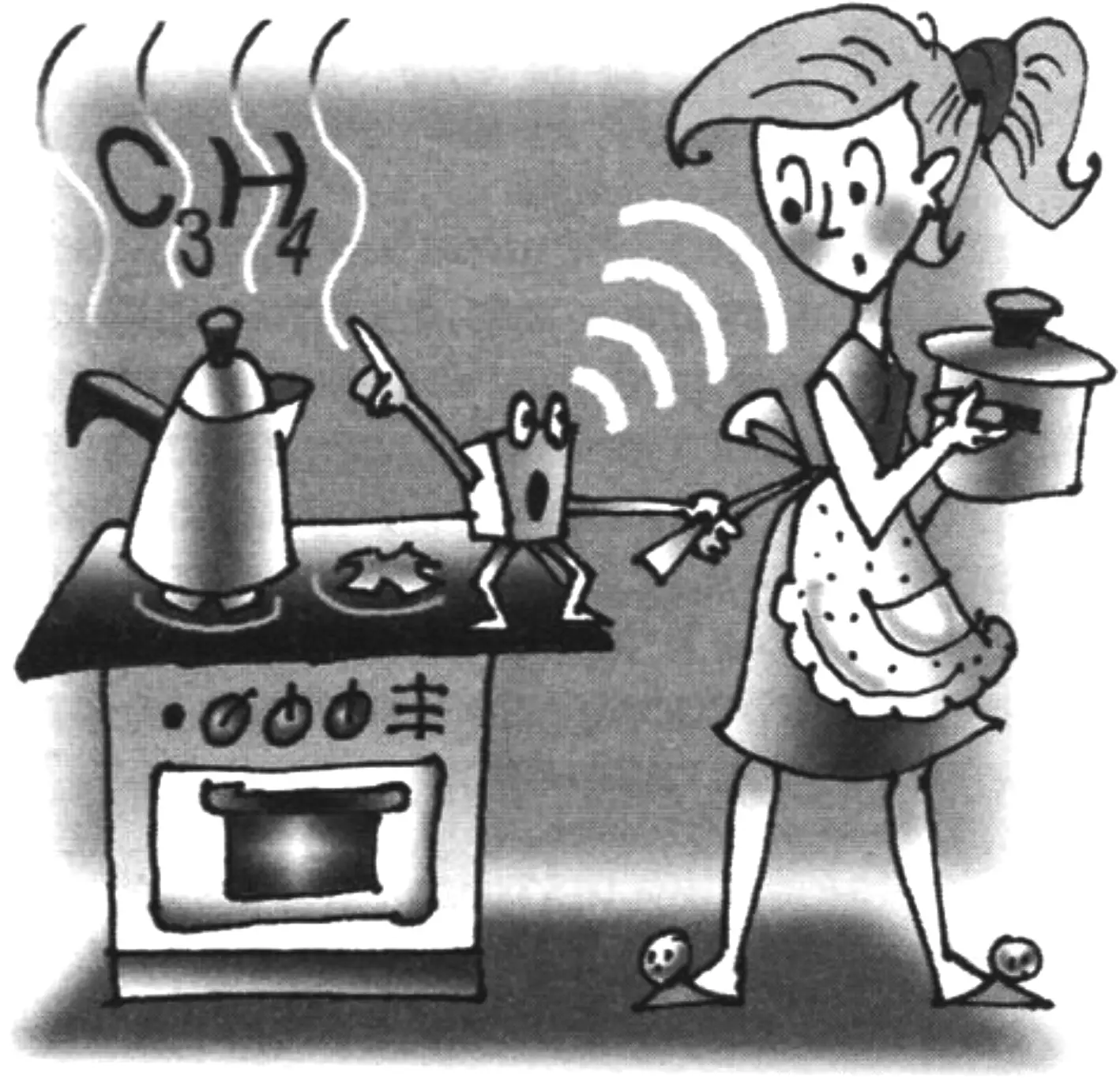
Explosions and fires caused by gas leaks are, unfortunately, not uncommon. While giving due credit to the work of administrative bodies and emergency services, radio amateur designers can also do something themselves to minimize this danger. However, in the field of gas monitoring there are almost no simple, reproducible devices, or they are unreasonably expensive.
Industrial sensors are available that convert gas concentration into voltage, current, resistance, and other parameters. Some oxides, especially SnO2 — tin dioxide doped with various additives — are capable of responding to changes in gas concentration. Based on them, you can build an electronic device yourself that responds to an excessive concentration of a particular gas in the air and gives an audible alarm. Sensors do not respond equally to every gas, so it is not advisable to replace one sensor with another. The most dangerous gas that can harm a person in everyday life is, undoubtedly, propane (C3H4). Its explosive concentration in air is 2.1—9.5%. For detecting propane, natural gas, and butane, Figaro gas sensors TGS2610 and TGS813 are suitable. The latter type is more modern and less demanding in terms of supply voltage.
Next is methane (CH4). Its maximum concentration before explosion in air is 5—15%. For detecting it, the same company has developed sensors TGS842 and TGS2611.
The electrical circuit of the device based on the TGS2610 sensor, sensitive to propane, is shown in the figure.
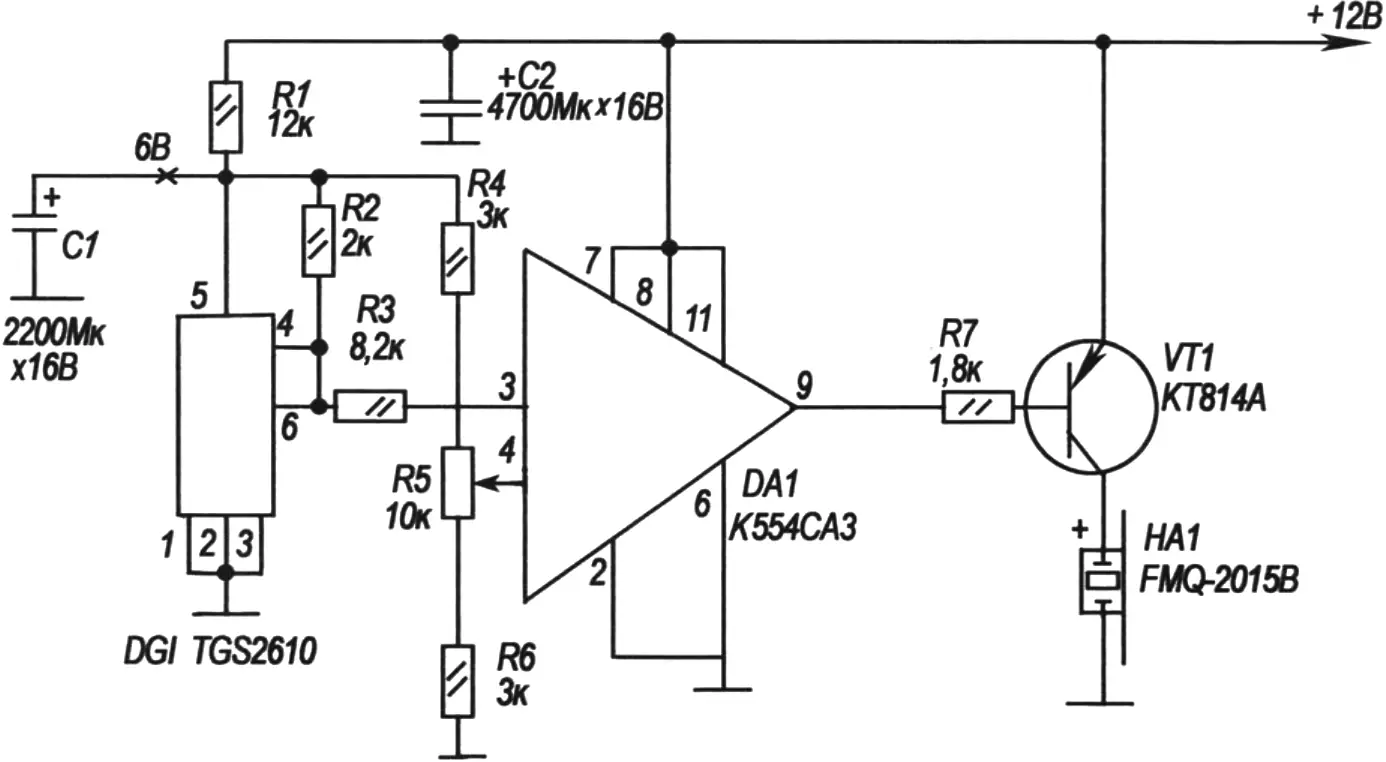
The sensor consists of a ceramic tube whose surface is coated with a resistive layer sensitive to a particular group of gases (this is, in part, the purpose of the doping additives). Heated to a temperature above +200°C, this coating responds to changes in gas concentration by changing its resistance. The heating element is an electric spiral passed through the tube (pins 2 and 5).
To reduce heat dissipation, the tube is connected to pins 1—3 and 4—6 by thin conductors that hold it in a suspended state. These pairwise connected pins come from the gas-sensitive resistor.
The wiper of resistor R5 is set so that in an ungassed room the voltage at the non-inverting input of comparator DA1 is slightly higher than the voltage at its inverting input. The voltage at the direct output of the comparator (pin 9) is close to the supply voltage, and therefore transistor VT1 is off.
When gas contamination reaches a certain concentration (2.1—9% density of natural gas in air), the resistance of sensor DG1 drops to such a value that the voltage at the non-inverting input of the comparator becomes lower than at the inverting input. In this mode, the voltage at pin 9 of the comparator will be close to zero. Transistor VT1 will turn on, and piezoelectric capsule HA1 with a built-in LF oscillator will warn of the gas hazard.
About the components
Variable resistor R5 — SPZ-38a or any other. Capacitors C1, C2 — any oxide type, for example K50-29. Piezoelectric capsule HA1 — any rated for 12 V DC, for example KPI-4332L.
The power supply is stabilized with an output voltage of 10—12 V. The current consumed by the device in audible indication mode does not exceed 30 mA.
ADJUSTMENT
Since calibrating the device directly by gas concentration cannot be recommended for safety reasons, the required trigger threshold can be set experimentally. An almost tenfold reduction in sensor resistance in an atmosphere containing air and 0.5% methane (one tenth of the explosive concentration, compared with clean air) makes it possible to set a reliably safe trigger threshold for the sensor.
To verify that the assembled device works, bring a gas lighter (with the flame blown out) close to the sensor — it should respond with an alarm signal with a delay of 2—3 s.
“Modelist-Konstruktor” No. 2’2009, A. KASHKAROV
Recommend to read
 TO HELP THE GARDENER — NAIL
We usually dig? Pushing leg, bury the shovel, then bend down, take the lower part of the handle, raise the shovel from the ground and turned a seam, having unbent, then re-bury and bend... ROLLER+ROLLER
The device shown in the illustration will be useful to all house masters, making furniture with his own hands. With its help you can easily and quickly roll while gluing forever lagging...
