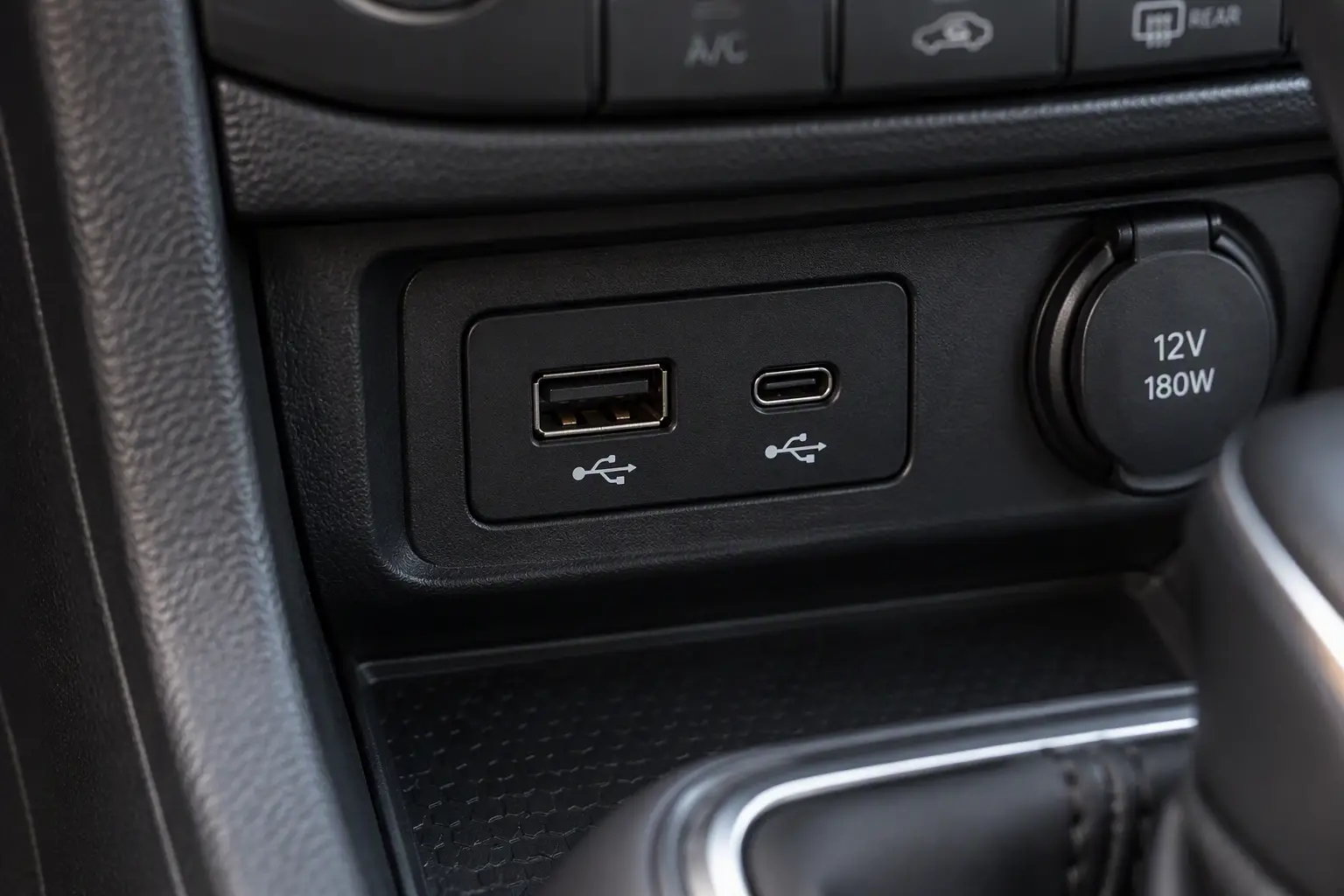
It is never superfluous to have in your own car, in addition to the cigarette lighter socket, also a service connector adapted for USB or even miniUSB. Such adapters come in handy in many cases, for example for powering PC peripherals, charging mobile phones, event video recorders, and everything that is designed to be powered from USB. And this is quite possible.
At comparatively low load currents (up to 0.5 A), when maximum efficiency is not required, the electrical circuits of voltage regulators can be greatly simplified, provided that the input voltage is already sufficiently stabilized. This is exactly that case.
The device is built around a DC-DC converter based on the MC34063A chip from ON Semiconductor. The MC34063A combines a comparator, a pulse generator (up to 100 kHz), a driver for an internal temperature-compensated reference voltage source, and a powerful output switch (Fig. 1).
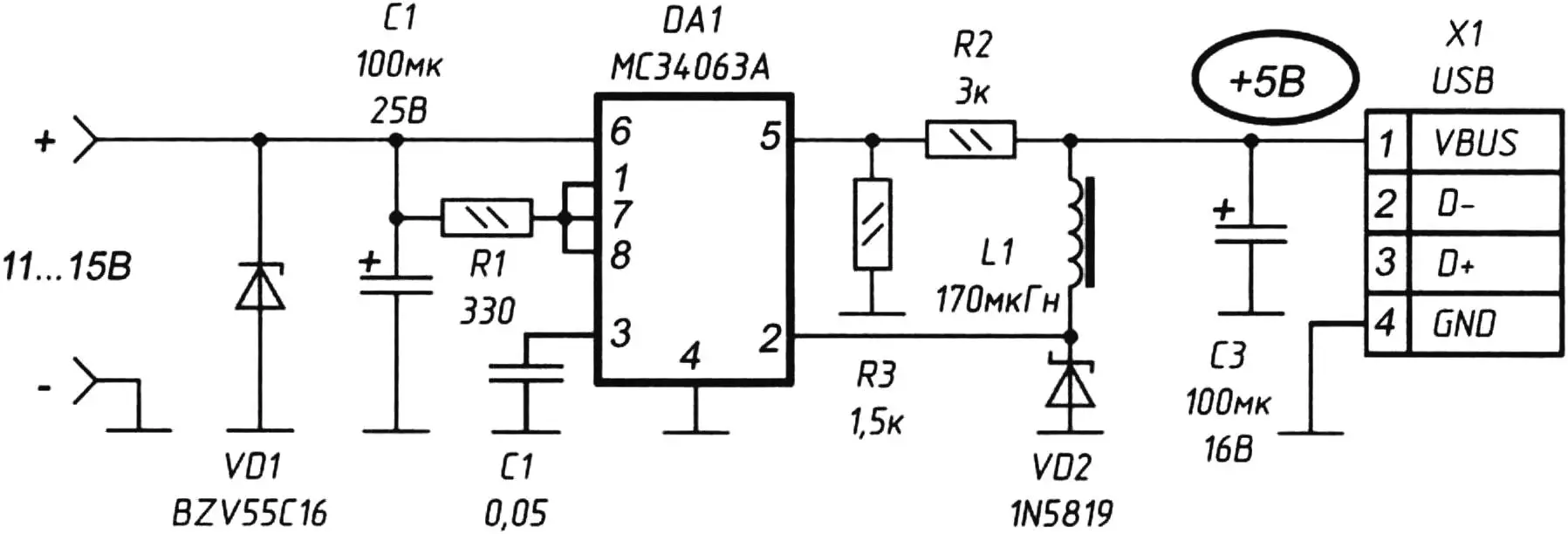
The chip’s input voltage is from 3 to 40 V; the maximum output current given in the datasheet is 1.5 A. However, in my view, a chip in a DIP-8 package (Photo 1) can deliver such a current only in an emergency, fault, and short-term mode. The safe current for this chip, installed without a heatsink or other ventilated cooling, should not exceed 0.3…0.4 A. In our case, this fully matches the task.
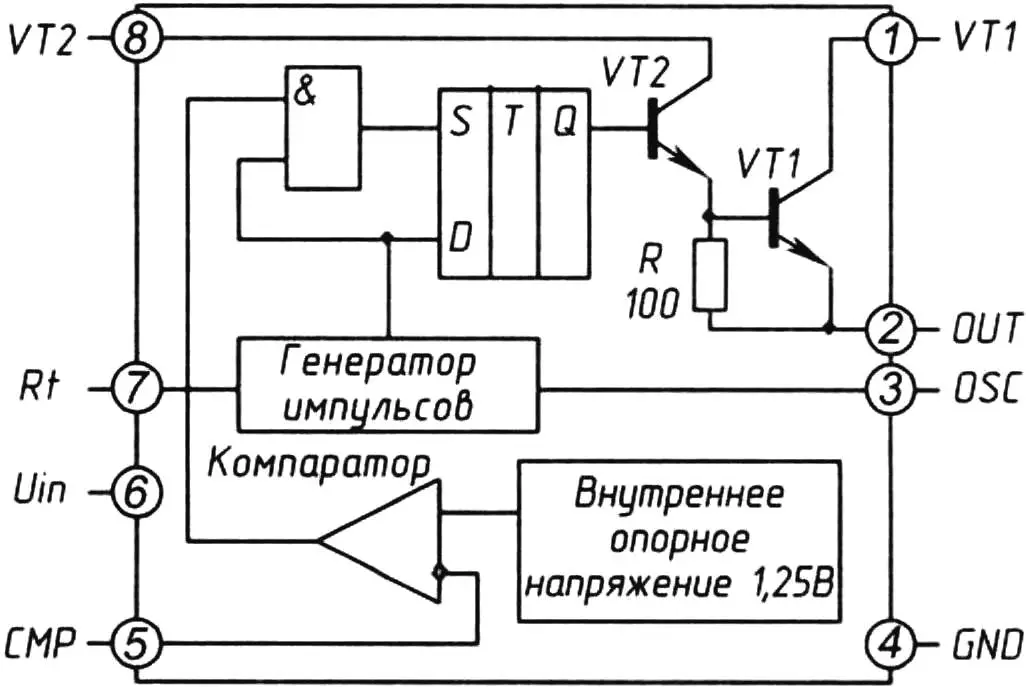
The electrical circuit of the converter is shown in Figure 2.
By the way, there are different ways to increase the output current of the MC34063A. You can read about these options yourself in the literature and on Internet forums. For example, if you increase the inductor inductance, the voltage and current in the load can also be increased.
There is no need to install a large-capacitance electrolytic capacitor at the converter output. First, the input voltage in a car is already sufficiently stable, and second, the internal protection of the MC34063A trips and prevents the converter from operating normally.
About the parts
An equivalent of the MC34063A is KR1156EU5; it can also be replaced with AP34063, NJM2360, or KS34063.
The device uses MLT-0.25 resistors or similar imported MF-25 types. Electrolytic capacitors C1 and C3 are of the K50-29 type or equivalents.
Diode VD2 is a Schottky diode 1N5819, which can be replaced with 1N5817 or 1N5818. This diode is rated for a current equal to the load current.
Inductor L1 is a coil on an 8 mm long rod of 2000НЦ ferrite and contains 40 turns of PEV wire 0.75 mm in diameter. The DC resistance of L1 does not exceed 0.1 ohm. Such a coil can be purchased ready-made at a radio parts store (for example, DM chokes with a rod magnetic core). The only condition: inductor L1 must withstand a current of up to 1 A inclusive (with a margin).
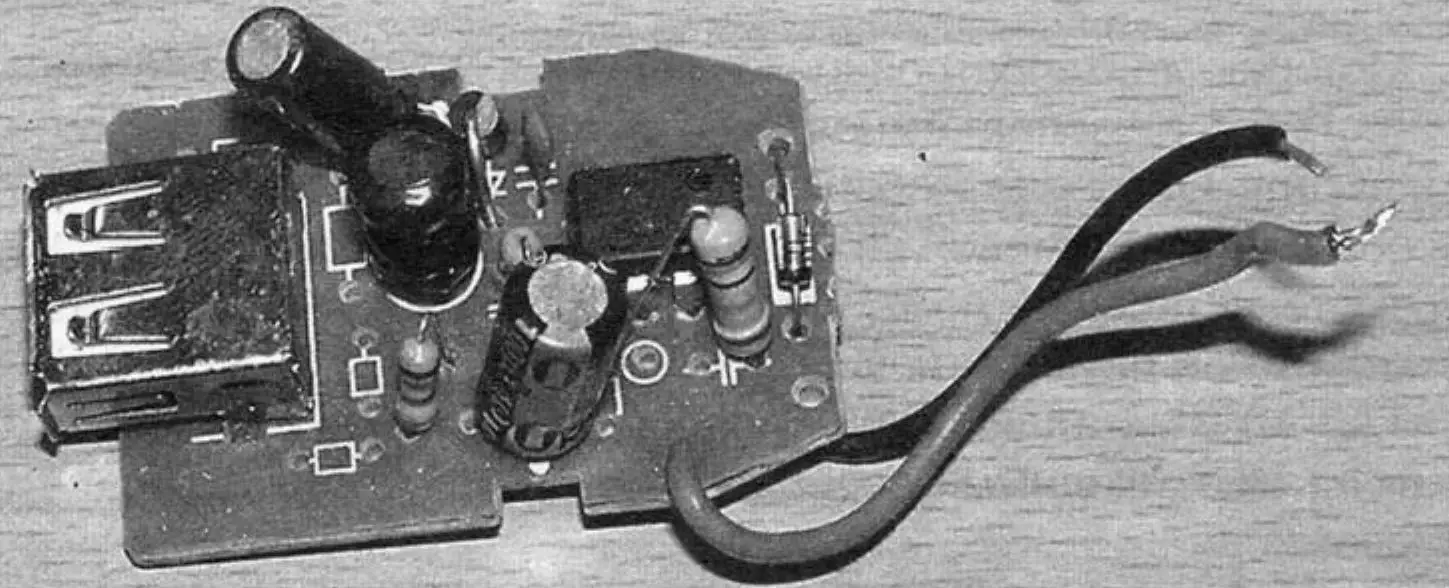
Zener diode VD1 in this case protects the input circuits of the converter based on chip DA1 from overvoltage. It can be replaced with a 1N4745A (16 V zener voltage) or even omitted entirely, since this chip is rated for an input voltage of up to 40 V.
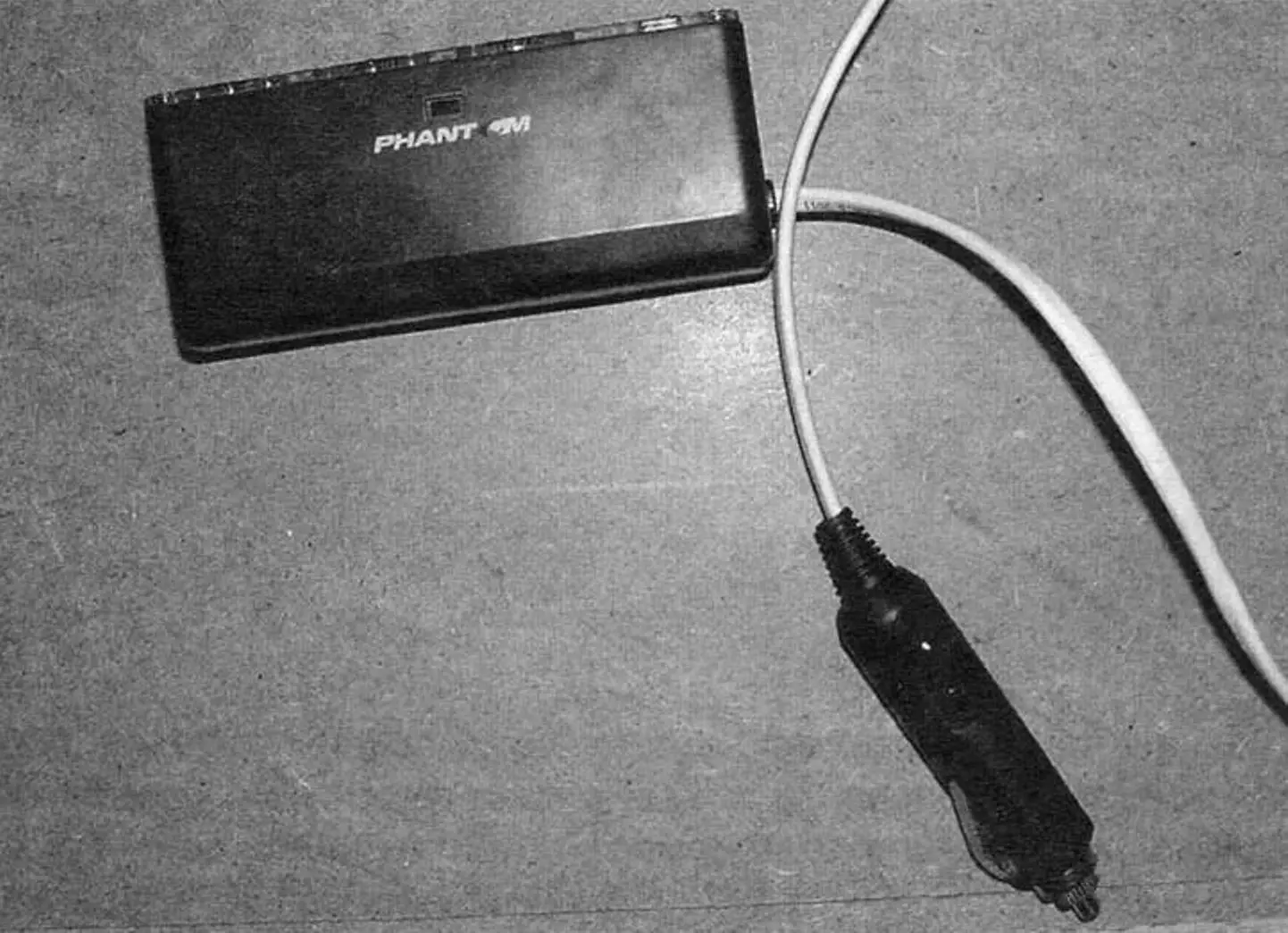
Figure 4 shows a USB connector built into a car splitter, inside which the device PCB is mounted (Photo 1).
“Modelist-Konstruktor” No. 6’2013, A. KASHKAROV
Recommend to read
 PROBE-HARVESTER
I work as an electrician. This profession is serious, requires not only deep knowledge in this field, but also special care with electricity trifled with. I have to work in different... STARTING IN TWO CLASSES
The proposed model missiles S3B allowed its Creator Tarasov from Chelyabinsk to become a winner of four Cup competitions S. P. Korolev. Moreover, it is universal: it can serve class Ѕ6В....
