Thrifty householders have always had a tradition of putting up various pickles and jams for the winter, and today it is especially relevant: food prices rise, while purchasing power lags behind. At the same time the country is experiencing a dacha boom, and plots are filled with plantings, greenhouses, fruit trees, and berry bushes. The grown harvest needs processing and canning for the winter, which means sealing numerous jars that require metal lids.
Yet craftspeople suggest that there is no need to stockpile lids — you simply need to make proper use of those already on hand. Simple devices help with this: as letters from inventors to the editors show, they let you carefully open sealed lids and straighten deformed ones so they can be reused an unlimited number of times.
* * *
In your magazine No. 1, 83’, a very useful machine was published for straightening used metal lids for glass “mayonnaise” jars. In this design, proposed by V. Stanotin from Syzran, there are, in my view, two significant drawbacks. The first is the difficulty of making the eccentric: if its two diameters are even slightly out of parallel, the lid will simply be cut. The second is that after use the lid develops irregularities from the knife, and even after trueing it will in most cases come out of the working grooves during straightening; otherwise you have to hold it with a finger, which is rather inconvenient.
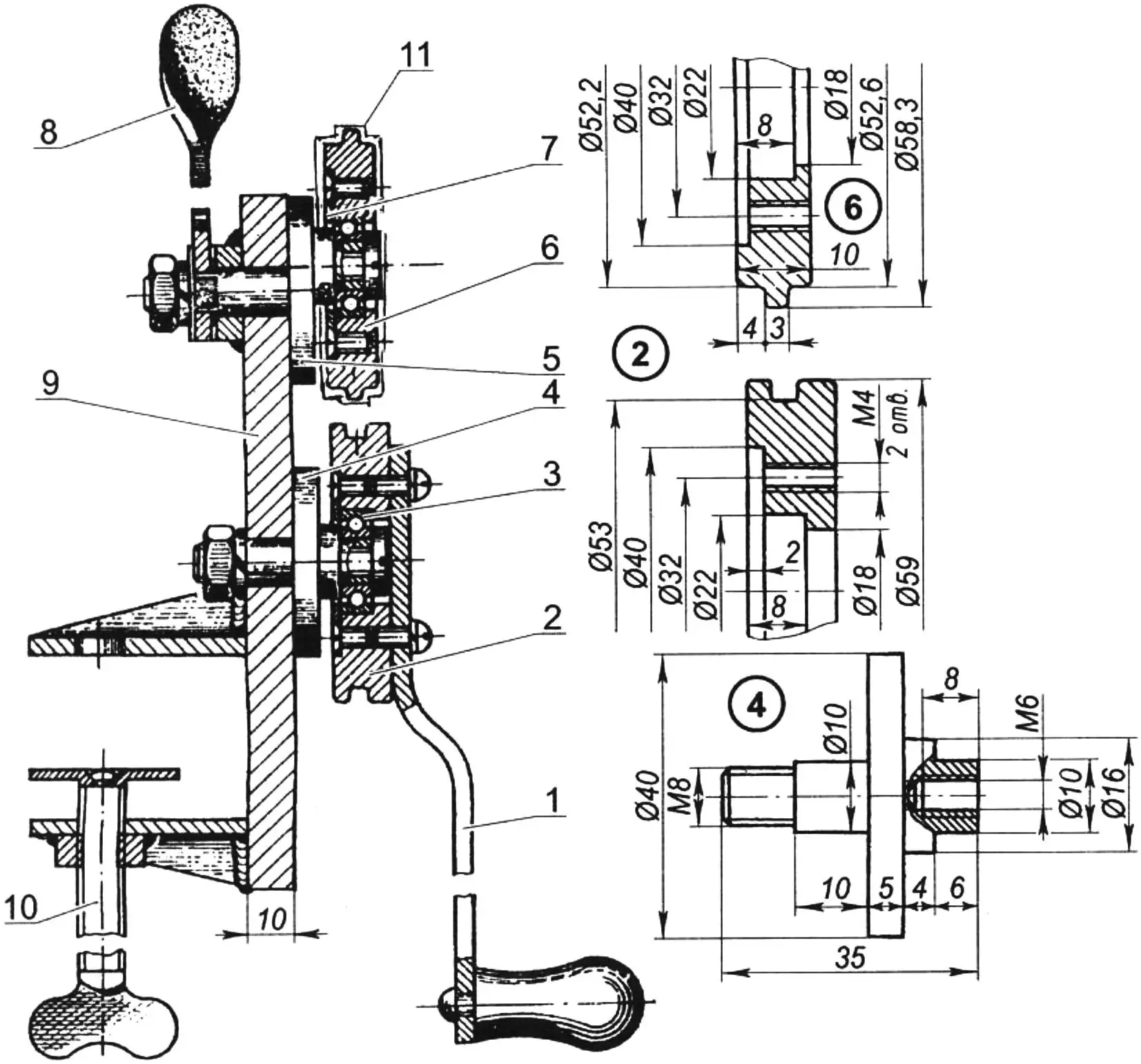
1 — tommy bar; 2 — lower roller; 3 — bearing (No. 1000900); 4 — axle; 5 — eccentric; 6 — upper roller; 7 — roller cover; 8 — handle; 9 — device body; 10 — clamp screw; 11 — jar lid
The first thing to do is replace the eccentric with a “universal” handle and also add a guide disc to the lower roller (with a minimal gap — equal to the thickness of the lid being straightened).
For axle 4 (see Fig. 1), its width of 5 mm should be increased to 7 mm, as in Figure 2; everything else remains unchanged. However, during assembly you need not strictly ensure that the ridge of roller 6 and the matching groove of roller 2 (see Fig. 1) coincide exactly.
S. PLAMADYAGA, Donetsk
* * *
In V. Stanotin’s article “Eternal lids for compotes,” a device for straightening previously used lids for home canning was described.
I made a sealing machine that is much simpler, based on a factory unit. It required only a few added parts (one steel mounting plate 2.5 mm thick with two holes and one axle made from a suitable bolt). The machine turned out universal: it both seals and straightens used lids. Switching from one operation to the other takes seconds: just turn the machine over, move the roller on the mounting plate inside the cup with the lid — and you can start straightening.
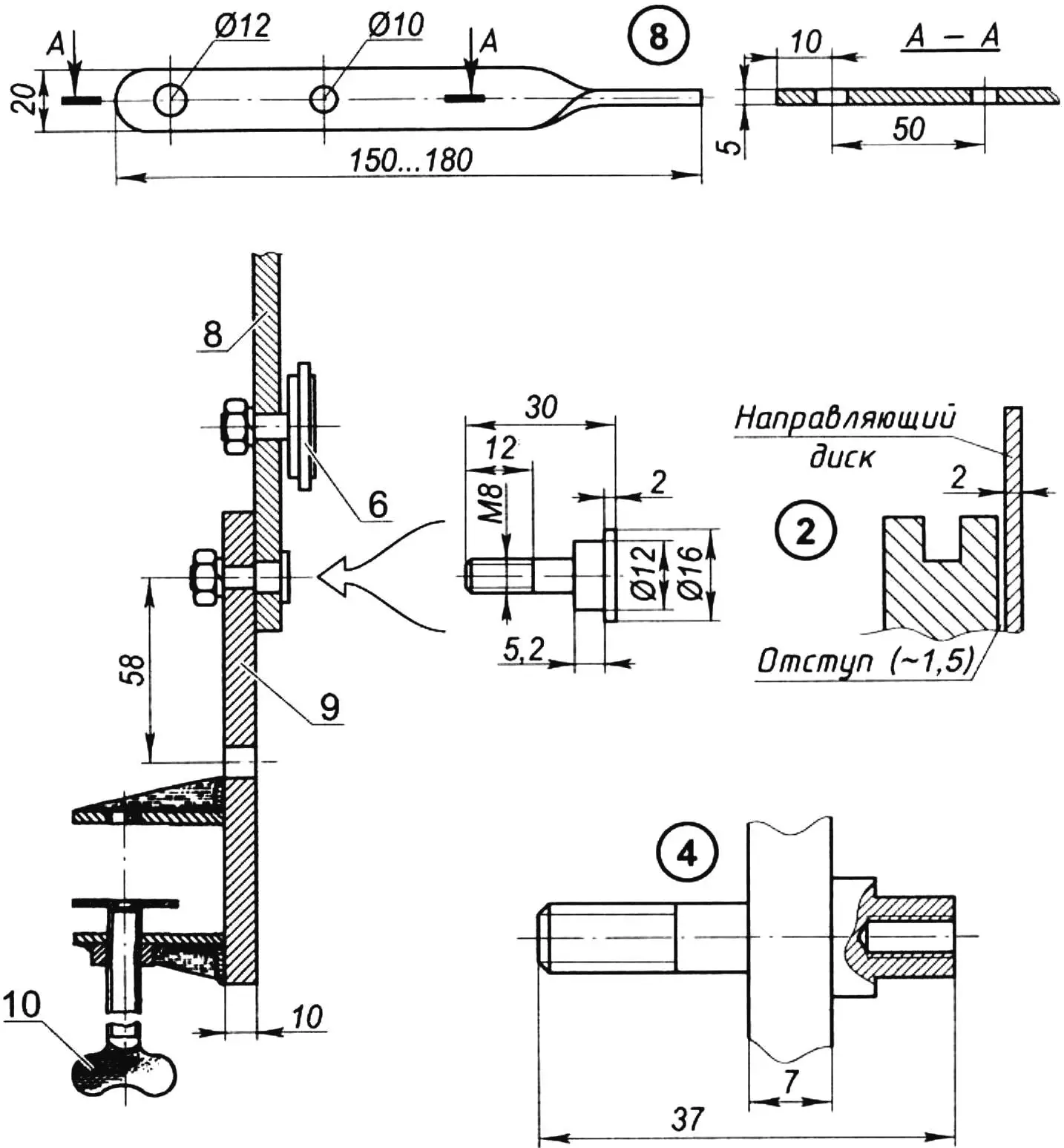
Anyone who can use a file and a hammer at home at all can make this device. I am sending a drawing of the machine in the lid-straightening version.
I hope my device will interest readers.
P. RATSIN, Khabarovsk
To make canning lids “eternal,” there is no need to build the complex straightening machine proposed by V. Stanotin. Moreover, not everyone can make it: it involves a lot of lathe, metalwork, and welding work.
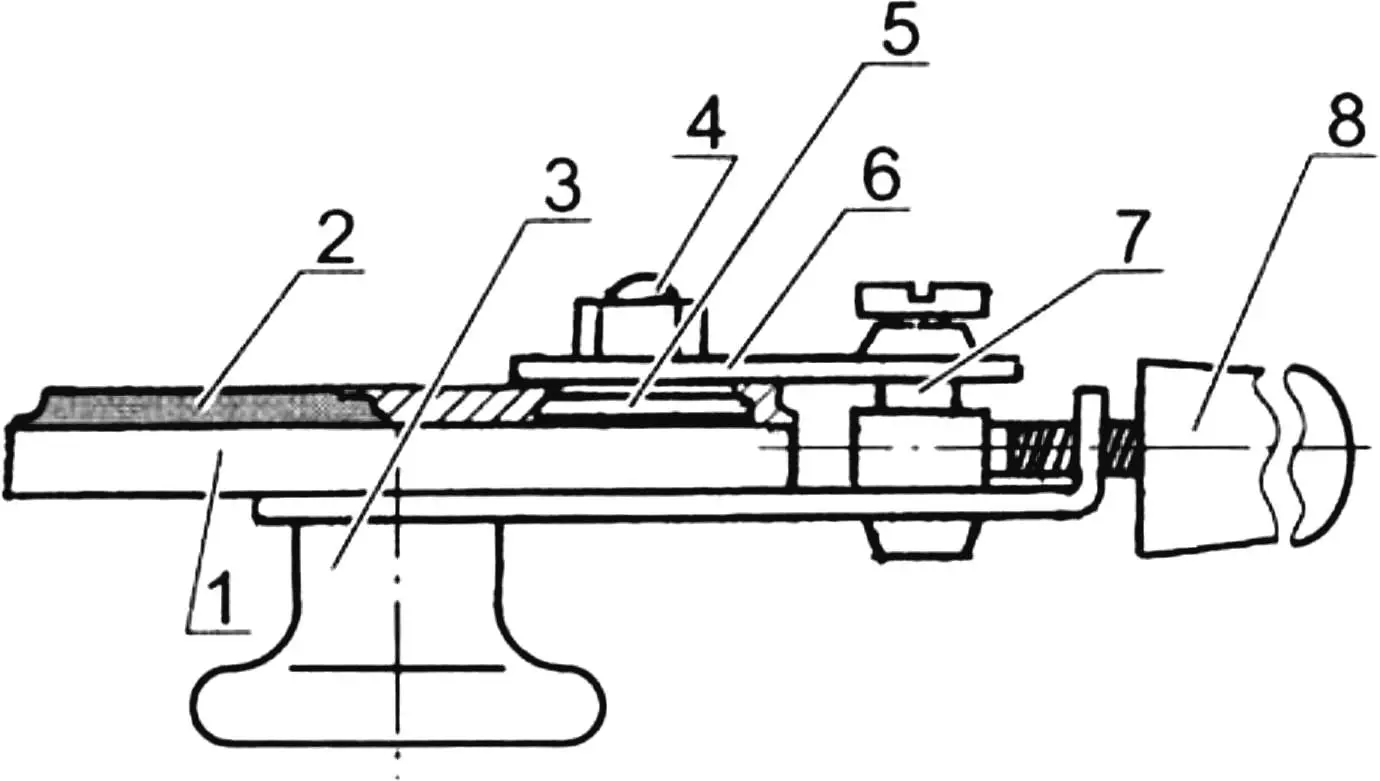
1 — body (cup for the lid); 2 — jar lid edge; 3 — handle; 4 — bolt-axle; 5 — standard sealing roller; 6 — mounting plate; 7 — standard roller axle; 8 — tommy bar
It is enough to make the key I propose for gentle opening of jars. It is easier to manufacture and convenient to use. The key’s main advantage is that when opening jars it does not deform the lid, only slightly straightening its sealed edge. After opening with such a key, the lid hardly needs straightening and is ready for the next sealing. I am sure the key will prove its worth.
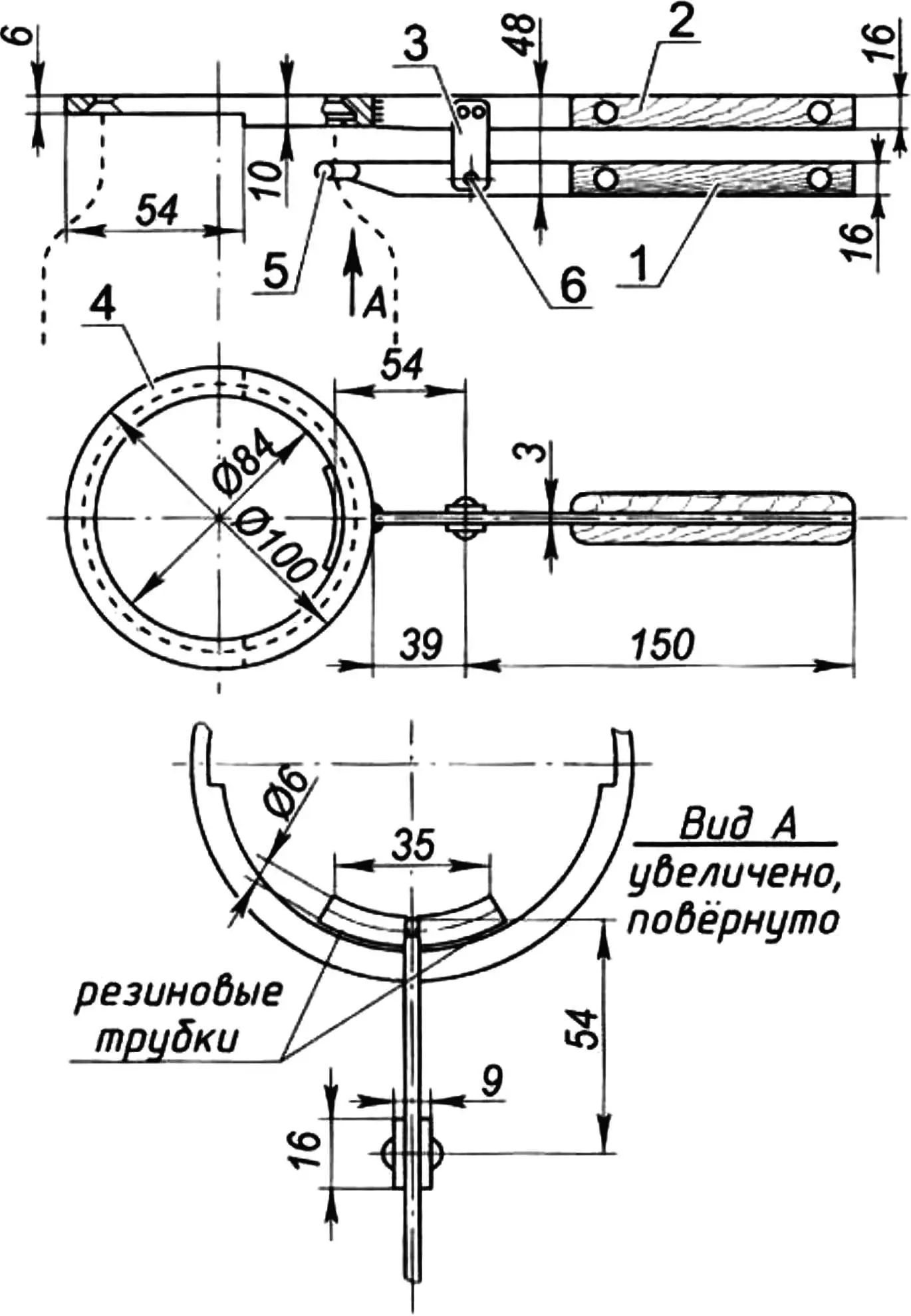
1 — lower (prying) handle; 2 — upper handle; 3 — crosspiece (2 pcs.); 4 — opening ring; 5 — rubberized stop; 6 — hinge
I did not describe the key in detail, and there seems to be nothing to explain. The design is very simple: two handles and a ring. The lower handle is the prying one and rests on the jar, while the upper one, with its ring, slides onto the lid, lifts it, and removes it from the jar.
“Modelist-Konstruktor” No. 7’2010, O. PETRENKO, Syzran
Recommend to read
 THE BOOK “COLUMN”
If you perform construction industrial bookcases and shelves, you will notice that their depth is normally twice the width of the book. So the books have to put in two rows, and it is... Rocket SHIP Be-10
With the beginning of the era of jet aircraft on the agenda was a question about a Russian military jet flying boat. Therefore, in may 1947, the OKB G. M. Beriev at the beginning of the...
