After fascist forces occupied Greece in April 1941, the British had no doubt that they would soon try to land on Crete. Fearing a seaborne landing, almost the entire British Mediterranean Fleet was urgently assigned to the island’s defense from the sea. But the Nazis, who held air superiority, “jumped over” the naval patrols and on May 20, after a fierce bombardment of British positions, began dropping airborne troops which, gradually building up strength, pushed back the garrison and on the 6th–7th day of the operation seized all key positions on the island. On the night of May 27 the command was forced to order the evacuation of the remaining 33,000 British and Greek soldiers to Egypt. Loading onto transports went on without any air cover, and the troops suffered heavy losses from Nazi air strikes.
The Crete evacuation showed that landing craft needed their own anti-aircraft defenses to fight the aerial enemy. This first led to the mounting of Oerlikons, anti-aircraft rockets, and barrage balloons on vessels of that kind, and then to the development of specialized anti-aircraft support landing craft — the so-called L.C.F. For this purpose the firm of Palmers was given two unfinished hulls of L.C.T.(2)-type tank landing barges. The first of them, fitted with two twin 102-mm gun mountings and three Oerlikons, received the designation L.C.F.(1) (134). It was a 539-ton monitor whose firepower was equivalent to ships three or four times larger. Despite its successful trials, the less successful second design went into production — the L.C.F.(2), armed with a battery of eight 40-mm AA guns and four Oerlikons. Intended for fighting low-flying aircraft, ships of this type were also used very successfully to destroy enemy manpower during landings.
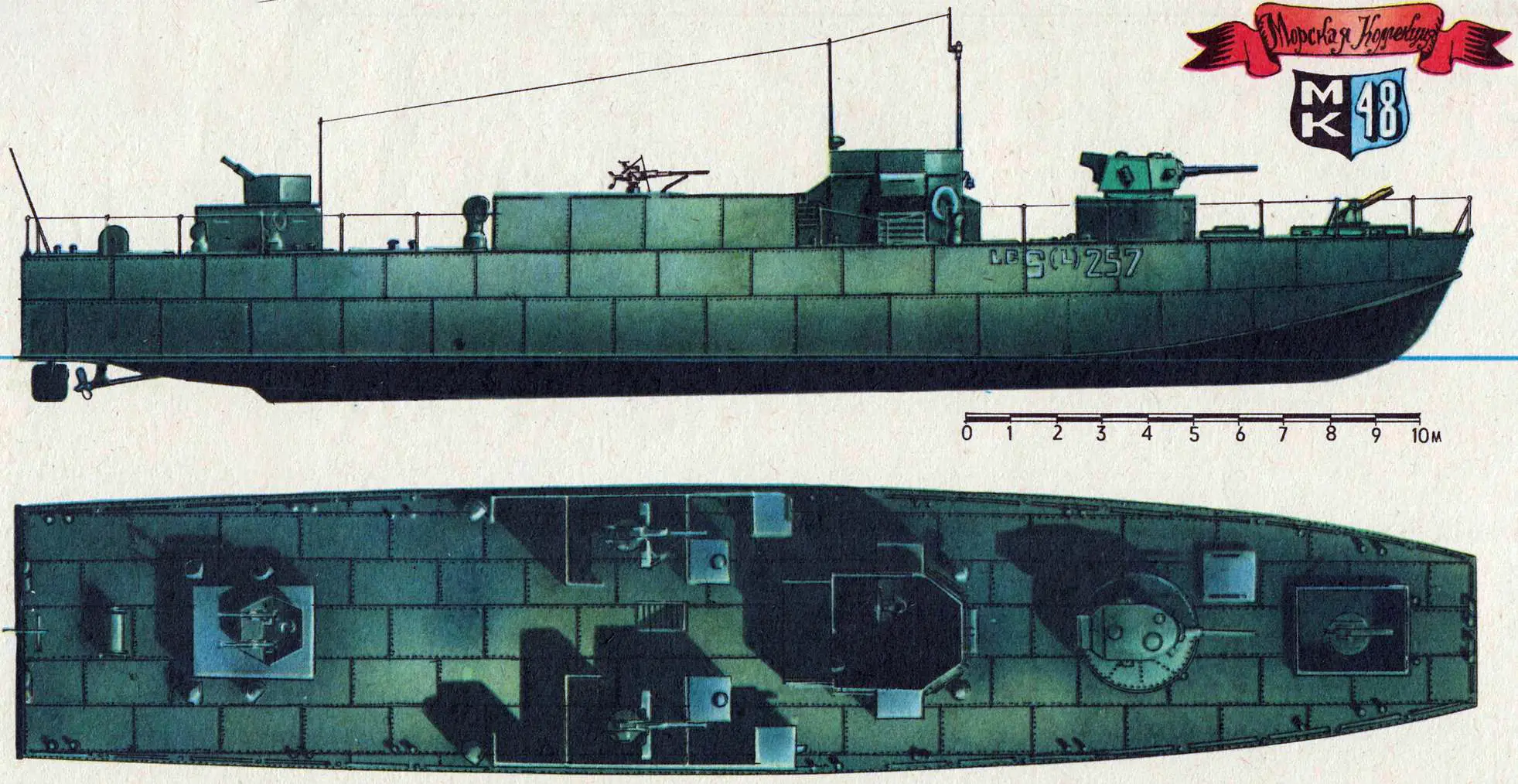
In the previous issue we wrote that British shipbuilders, having become convinced that creating an anti-tank craft of Group 3A was a dead end, turned their attention to larger craft belonging to Group 3B. Recall that under the Admiralty classification all landing craft were divided into three groups: 1 — infantry landing craft; 2 — transport landing craft; 3 — fire-support landing craft. Each group was subdivided: A — craft for action between a transport and the shore; B — for shore-to-shore operations. The displacement of Group 3A combat units was limited to 25–30 tons, and that of Group 3B to 800–900 tons. Taking as a basis the wooden hull of the small infantry landing craft L.C.I.(S), they plated it with 6-mm armor and installed a 57-mm gun in a tank turret plus AA armament. The resulting armored landing-support craft L.C.S(L)2, though it surprised people with firepower out of all proportion to its weak wooden hull, could not bear comparison with the Soviet Project 161 sea-going armored gunboat built at the same time in blockaded Leningrad.
In late autumn 1942, while preparing for the landing in Sicily, Allied command realized that enemy tanks would hardly pose any serious threat to the landing forces. The main targets for support ships would be fixed fire positions — coastal batteries, pillboxes, and bunkers. Construction of anti-tank support craft was limited to only ten units, and British shipbuilders concentrated mainly on L.C.G.-type ships.
The need for such a ship arose because monitors were unsuitable for operating in the landing zone, while destroyers and other small fleet vessels were considered too valuable to expose to point-blank fire from coastal guns. It was therefore decided to draw on the successful experience of creating L.C.F.(1)-type anti-aircraft landing-support ships. For this purpose two 120-mm naval guns and from two to four Oerlikons were mounted on the hull of a tank landing craft L.C.T.(3). The result was a new type of ship — the L.C.G.(L).
By the start of the Sicilian operation, ships of the L.C.G.(L) 3 type (135) had been built. Later, for Far Eastern operations, L.C.T.(4) tank landing craft were converted into landing-support ships, producing the L.C.G.(L) 4. Although they carried large quantities of ammunition stored above the waterline, the risk of explosion was substantially reduced by increasing the number of compartments. Experience showed that their main drawback when shelling coastal targets was the small elevation angle of the guns, which made it hard to hit covered targets.
The Sicily landing was a prelude to a larger amphibious operation — the opening of the Second Front in Normandy. During the preparations it was concluded that air superiority was an indispensable condition for a landing. Heavy fleet artillery was also to be used to breach the anti-landing defenses. Army specialists, however, considered all this insufficient: as soon as the assault troops stepped ashore, they would need the support of land artillery.
To meet that requirement, on the one hand ordinary field, tank, and self-propelled guns capable of firing straight from the deck had to be placed on landing craft; on the other, a ship with army guns mounted in naval turrets had to be developed. Army specialists insisted that such ships should duel on equal terms with enemy tanks and pillboxes and provide normal artillery support to advancing units, while the sailors wanted these ships to be able to make open-sea passages. The result was the medium landing-support ship — the L.C.G.(M).
Designers of the firm John Brown provided an interesting innovation: by flooding some of the compartments, the craft could be grounded in the landing area. This improved protection of vital parts of the ship against enemy bullets and shells and made it possible to fire from a more stable platform. To retain maneuverability, the flooded compartments were quickly pumped out by a low-pressure pump with a capacity of 460 t/h, developed specially for this ship. The firm also created new naval mountings for army 76-mm and 88-mm guns.
In May 1943 the drawings were passed to several small shipyards for series production. Yet the lead ship of the L.C.G.(M) 1 series (136) entered service only in June 1944, when the Normandy operation had already been successfully completed. Requirements for landing-support ships in the Far East were different, so on the L.C.G.(M) machine-gun armament began to be strengthened by removing the pumping installations and lightening the armor.
British shipbuilders began creating rocket landing-support ships at the same time as work on the large artillery ships of the L.C.G.(L) type. Taking the same L.C.T.(2) tank landing craft as a prototype, the designers installed launch frames for 792 rockets on its deck. A second set of rockets was stowed in magazines under the upper deck. The warhead of each rocket projectile weighed 13 kg, and the propellant charge 3 kg. A single salvo weighing 17 tons could blanket an area of 670×145 m. Later, on the basis of the L.C.T.(3)-type tank landing craft, a more powerful rocket landing-support ship, the L.C.T.(R) (137), was created, armed with 1,080 or 936 rocket projectiles depending on their type.
On May 23, 1944, the Supreme Commander of the Allied Expeditionary Force in Western Europe, General Eisenhower, informed his subordinate commanders that the Second Front would open on June 5. But on Sunday morning the weather forecast was very bad, and the Supreme Commander used his authority to postpone the operation by another day. On Monday at 4 a.m. he confirmed his decision: to begin the landing on June 6. The Normandy coast was divided into five sectors. First of all — at 6:30 — the Americans were to land on the two western beaches code-named Utah and Omaha. At 7:25 the British were to begin operations on the two eastern beaches — Sword and Gold — and at 7:45 on the central beach Juno. And everywhere, alongside aircraft and the fleet’s artillery ships — battleships, cruisers, destroyers, and gunboats — the close fire-support landing craft developed in 1942–1943 were in action…
On Utah beach, Captain Mabry went in with the first assault wave and saw these ships with his own eyes: “The shore was already quite close. The landing craft armed with 120-mm guns closed up on one another and at short ranges opened fire from their guns toward the shore. Seventeen tank landing craft with rocket launchers fired salvos of 25-kg rocket projectiles. The roar of gun salvos and the whistle of rockets drowned out the artillery barrage. And dust, smoke, and fine sand made it impossible to see anything beyond the beach…”
On Omaha beach two battleships, three cruisers, and eight destroyers were ready to fire more than 3,000 shells at the shore. Landing craft with army guns mounted on them were to come in close and pour another 9,000 shells from short range, while at the same time nine rocket ships were to fire a salvo of 9,000 rocket projectiles.
Lieutenant Rockwell — a witness to the events that unfolded off the Normandy coast on the morning of June 6, 1944 — recalled: “The landing craft approached the shore… Battleships and cruisers fired over them. On both sides of the lane left for the landing craft, army artillery and destroyers were firing. Amid the roar of guns and the bursts of shells could be heard the drone of aircraft. And when the landing craft with rocket launchers came up to the shore, the sharp whistle of the rockets drowned out all the other noise. The shore was wrapped in morning mist, and for a moment we lost sight of our landmarks…”
In the British landing sector Captain Bell, in a self-propelled barge, was approaching the shore near the village of La Rivière. It had just been bombed by six squadrons of heavy bombers; destroyer guns and landing-craft howitzers were firing on it, and two thousand rocket projectiles launched from rocket ships had fallen on it. Emerging from the pall of smoke that blanketed the coastal hills, Bell saw from the barge a sandy beach that seemed to him a lifeless desert never before trodden by man.
Summing up the first hours of the operation, British Rear Admiral Talbot wrote: “The enemy was clearly stunned by the actions of the fire-support forces alone.” And the attackers’ impressions matched those of the attacked. “Owing to the fire of the enemy’s naval artillery,” reported the commander of the German 7th Army to his superiors, “guns in field positions had to be dug out before they could be used in battle. Coastal-defense guns were in most cases put out of action by direct hits on the casemates. In counterattacks… we suffered heavy losses on the coast from enemy fire from the sea.”
But after the fighting, when the Allies inspected the German coastal batteries, they were somewhat disconcerted: although in most cases the batteries had been put out of action, there were comparatively few direct hits. On Utah beach Mabry’s soldiers came under destructive fascist artillery and mortar fire. On Omaha beach Rockwell watched in amazement how quickly the fascist anti-landing defenses came back to life. In the village of La Rivière Captain Bell’s assault troops were met by heavy fire from a platoon of Nazis entrenched in the village houses…
“The effect of naval gunfire and air bombardment on the enemy’s morale is extremely hard to assess,” writes the well-known naval historian S. Roskill. “Where the cover for both personnel and guns was reliable, the effect was slight, but the effect of bombing on the morale of unprotected units was, of course, very great.”
Thus, in the traditional duel between armor and shell, a weary equilibrium set in once again, and to change it entirely different engineering solutions were needed…
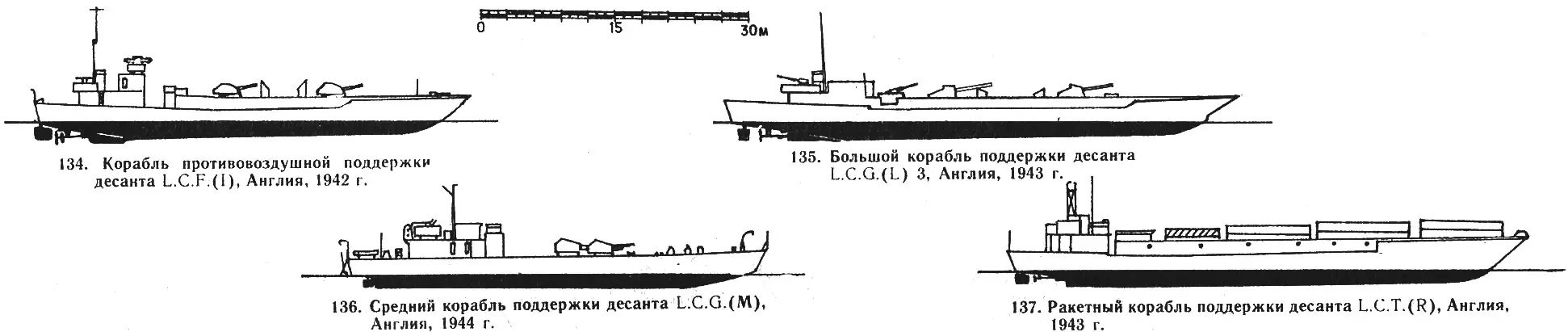
TACTICAL AND TECHNICAL DATA OF THE SHIPS
134. Anti-aircraft landing-support ship L.C.F.(1), England, 1942.
Designed in late 1942 on the basis of the L.C.T.(2) tank landing craft project. Displacement 539 t; total power of three petrol engines 920 hp; speed 11 knots. Overall length 48.78 m, beam 9.46 m, mean draft 1.98 m. Armament: two 102-mm guns, three 20-mm Oerlikon guns. In the L.C.F.(2) variant — displacement 470 t; armament: eight 40-mm AA guns and four 20-mm Oerlikon guns.
135. Large landing-support ship L.C.G.(L) 3, England, 1943.
Built on the basis of the L.C.T.(2) tank landing craft. Displacement 560 t; total power of two engines 1,000 hp; speed 10 knots. Overall length 58.56 m, beam 9.46 m, mean draft 1.83 m. Armor 15 mm. Armament: two 120-mm guns, two to four 20-mm Oerlikon guns.
In the L.C.G.(L) 4 variant — displacement 570 t; overall length 56.58 m, beam 11.79 m. Armament: two 120-mm guns and three 20-mm Oerlikon guns.
136. Medium landing-support ship L.C.G.(M), England, 1944.
Displacement 380 t; total power of two petrol engines 1,000 hp; speed 11.75 knots. Overall length 47.12 m, beam 6.81 m, mean draft 1.98 m. Armor 48, 24 and 9 mm. Armament: two 76-mm or two 88-mm army guns on naval mountings and two 20-mm Oerlikon guns.
137. Rocket landing-support ship L.C.T.(R), England, 1943.
Created on the basis of the L.C.T.(2) tank landing craft. Displacement 560 t; total power of two petrol engines 1,000 hp; speed 10 knots. Overall length 58.56 m, beam 9.46 m, mean draft 1.98 m. Armor 9–12 mm. Armament: 1,080 Type I rocket projectiles or 936 Type II rocket projectiles, two 20-mm Oerlikon guns.
“M-K” 10’87, G. SMIRNOV, V. SMIRNOV
Recommend to read
 GLIDER CG-3A – WOODEN “SCHOOL DESK” AMERICAN PARATROOPERS
In February 1941 Aviatsionny corps of the U.S. army (the predecessor of the air force, U.S. army) became interested in the possibility of using gliders in the landing and transportation... THE BEST PROPELLER FOR YOUR MODEL
Now, when the rules of the FAI, the weight of the rubber motor is reduced, and the number of rounds in the competition increased to seven, rotor group should be given maximum attention....
