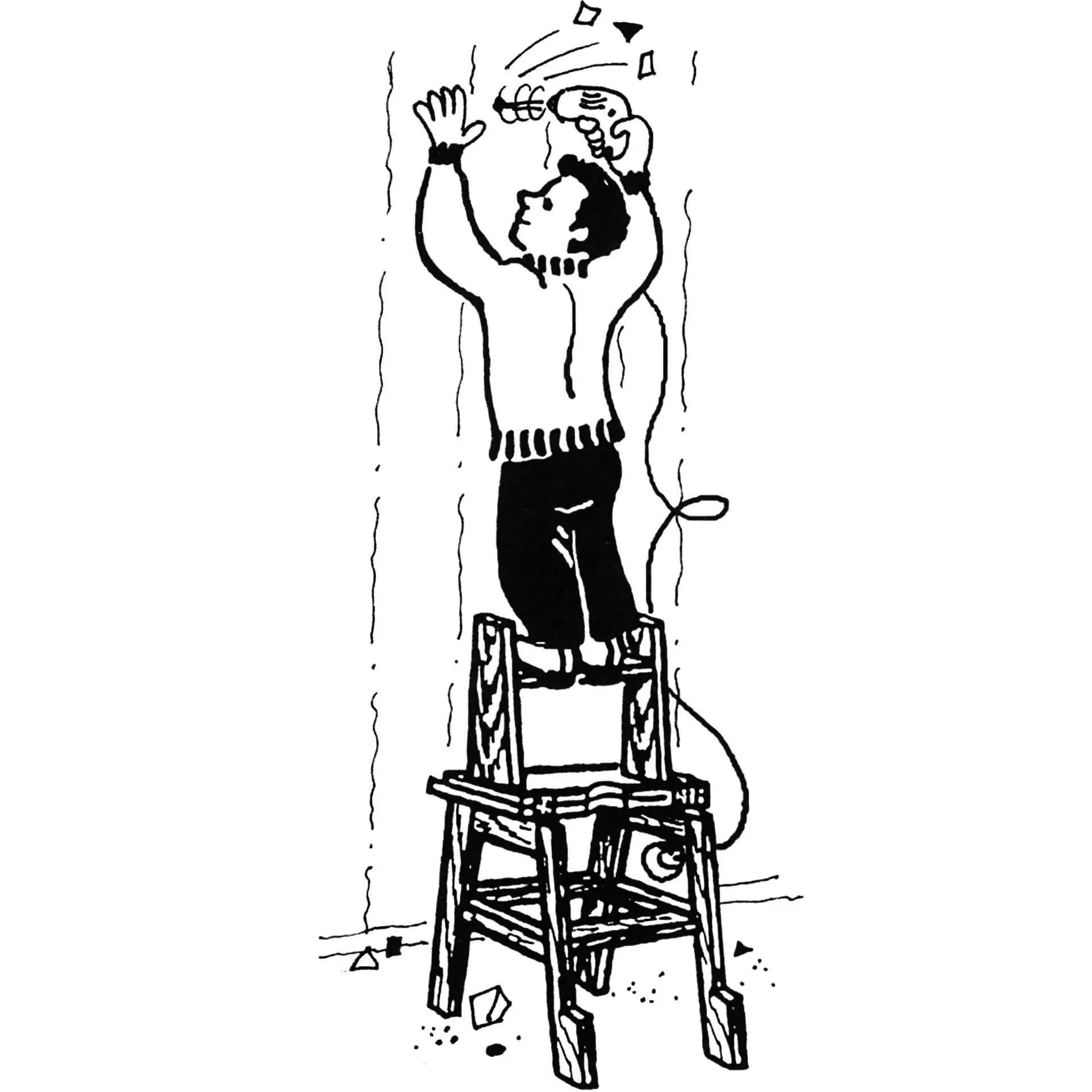
In one of the issues of previous years, your magazine published a note — “Again — a dowel”. It should be said that the suggested versions of a metal combined dowel are rather complex to manufacture, but their use is justified for hollow panels and shield partitions, which in modern new builds are not that common. A new homeowner usually faces the need to drill or punch holes in concrete, brick, and more rarely in plasterboard panels, which requires considerable skill, experience, and special tools. In addition, the noise created during work causes discomfort to neighbors.
This is something I had to experience too—more than once over the past years. That is why I looked for ways to make this job easier, faster, and less noisy, understanding how much it bothers the neighbors.
The spiral and paddle drills available for sale can drill deeper into a wall only as the concrete or brick is worn away by the central part of the drill. This means frequent clearing of the hole, strong pressure on the tool, and long drilling. The process goes very slowly because the working part of the drill cuts each sand grain in very thin “layers” until it turns into dust. Soon the cutting edge becomes dull and, in fact, drilling stops—only abrasion of the stone goes on. You have to stop the drill and break the central part of the hole with a center punch or periodically drill it out to a small depth with a thin drill. And this has to be done several times with each hole.
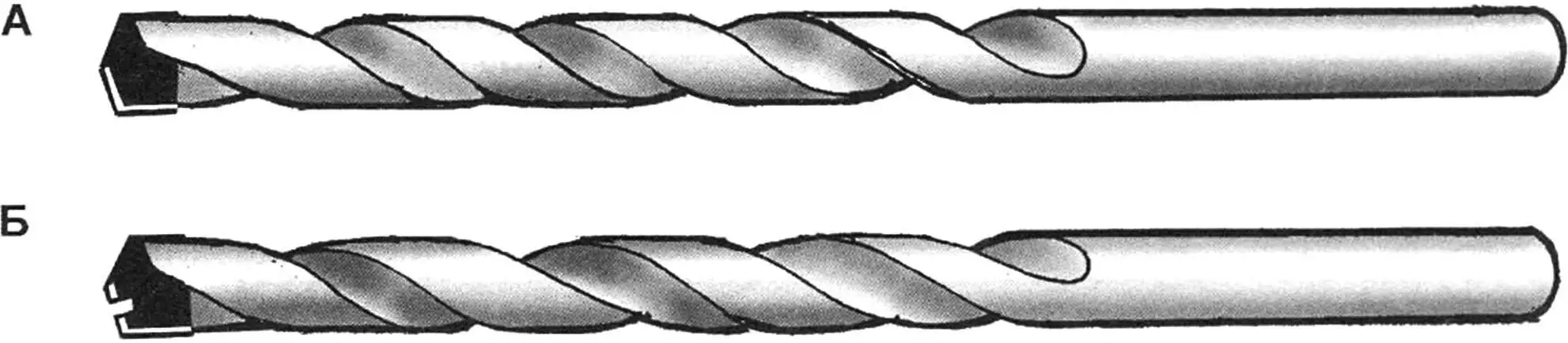
The main requirement for a concrete drill is that it should not cut each sand grain into ultra-thin layers, but “break” and chip them off. This is easier to achieve with a drill using diamond grains. Drills under the name “Dream of a new homeowner” were produced by the diamond tool plant in Terek, Kabardino-Balkarian ASSR. The “Dreams…” kit included a cylindrical annular drill and a paddle drill.
Unfortunately, neither of the drills “dreams of a new homeowner” is really such, because the annular drill has diamond grains only on the end part of the surface and not on the edges of the outer and central holes, and the drill does not go deeper than 3—4 mm into concrete. And the paddle drill has no grains in the center: it bottoms in concrete, slides over it and also does not go deeper than 2—3 mm. When pressure and drilling time are increased, they heat up strongly. Besides, they are found rarely in stores—possibly they were removed from production as completely unsatisfactory.
I could also name concrete drills of other types that appear for sale, but their design is just as ill thought-out. For example, a groove drill is a smooth rod with a selected groove that quickly and tightly clogs and requires cleaning that groove after every 2—3 mm of drill travel. It is simply surprising that for many years toolmakers have been unable to make a good drill for DIYers and new homeowners (for concrete and brick).
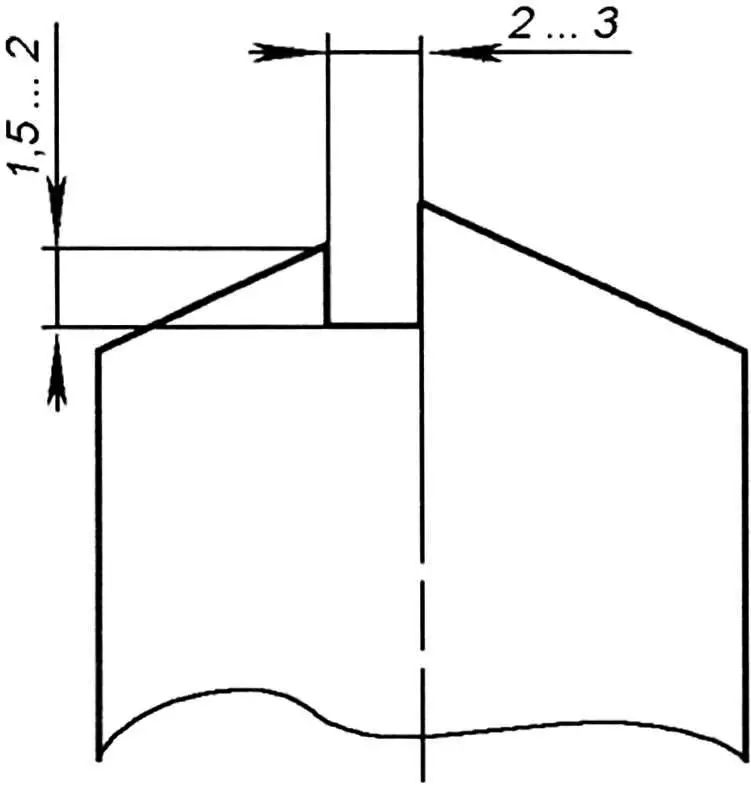
I think many people will be interested in my experience. I suggest, for example, changing the configuration of the drill with a carbide insert so that you can quickly, in a single entry, drill a hole in a concrete or brick wall to the required depth.
With a diamond file, I made a slot in the central part of the drill to a depth of 1.5—2 mm and a width of 2—3 mm for a drill diameter of 8 mm. In this case the drill works as an annular drill. The conical core made of concrete is abraded by the slot faces or breaks off, because the slot is asymmetric. The usefulness of the slot becomes even more convincing if the hole is first pre-drilled with a 2—3 mm drill. Then enlarging it to 8—10 mm takes seconds even with a regular drill, without a carbide insert.
Unfortunately, not every DIYer or new homeowner has a diamond file. That is why it would be highly desirable for industry to make such a slot (such drills) using a diamond disk.
“Modelist-Konstruktor” No. 8’2011, M. Lyovin
Recommend to read
 GREENHOUSE DOME
Gymnastic Hoop, four boards and plastic film — all that is needed for the manufacture of a simple greenhouse. Wraps cut in half and secured crosswise of the drilled holes of the frame of... INDISPENSABLE IN THE COURTYARD
Continue the story of machines and mechanisms, built by V. A. VERBELEN—Amateur designer from the village of Zelenchukskaya, Karachayevo-Cherkess Republic. Publications "walk-behind —...
