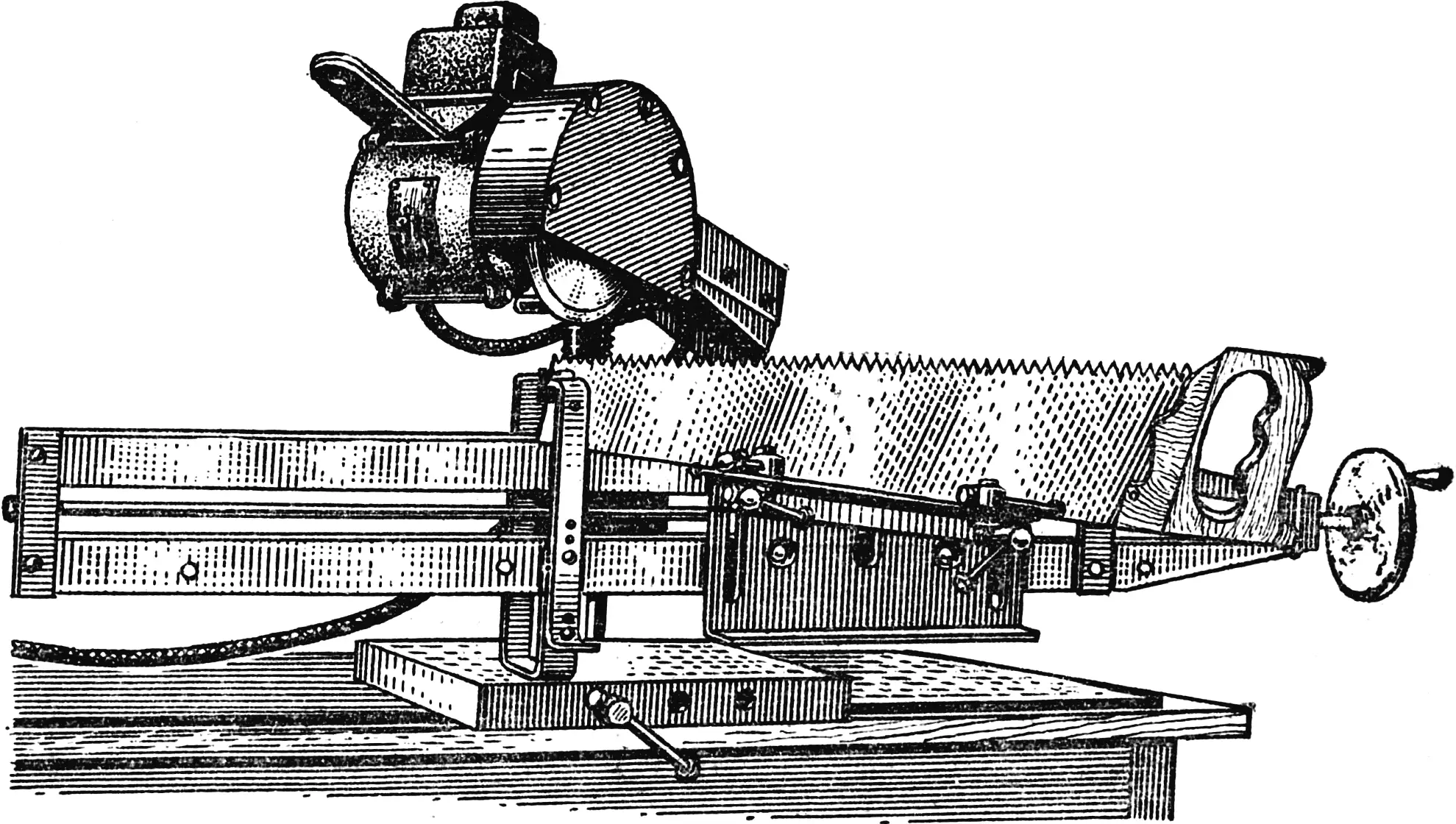
“The saw grew white-hot from the work!” wrote V. Mayakovsky in his poem “Who to Be?” Meanwhile, heating of a cutting tool first of all means that it has gone dull. In this case a carpenter, as in the old days, takes a three-square file (a triangular file, in modern terminology) and sharpens the teeth of a hacksaw by hand. A tedious and unproductive job! But perhaps this operation, too, can be mechanized? After all, there are sharpening machines for milling cutters and circular-saw blades… Here, however, is a review of a machine designed by ninth-graders of Secondary School No. 28 in the city of Ust-Kamenogorsk under the guidance of teacher A. A. Boytsov: “The electric sharpener will find wide use not only in school workshops, but also in the joinery shops of construction enterprises, as well as in carpenters’ crews on any building site. The machine is simple to make and makes it possible to sharpen a great variety of woodworking tools — hand saws, blades of bow saws, and also chain and band saws.”
The chief mechanic of the Vostokkazselstroy trust, G. I. Aksyonov, who signed this review, adds that the machine sharply improves the quality of tool sharpening and considerably reduces manual labor, which makes it possible to recommend its use in various branches of the national economy.
How is this original sharpening unit arranged? Here is what the leader of the young designers’ club, A. A. Boytsov, says about it.
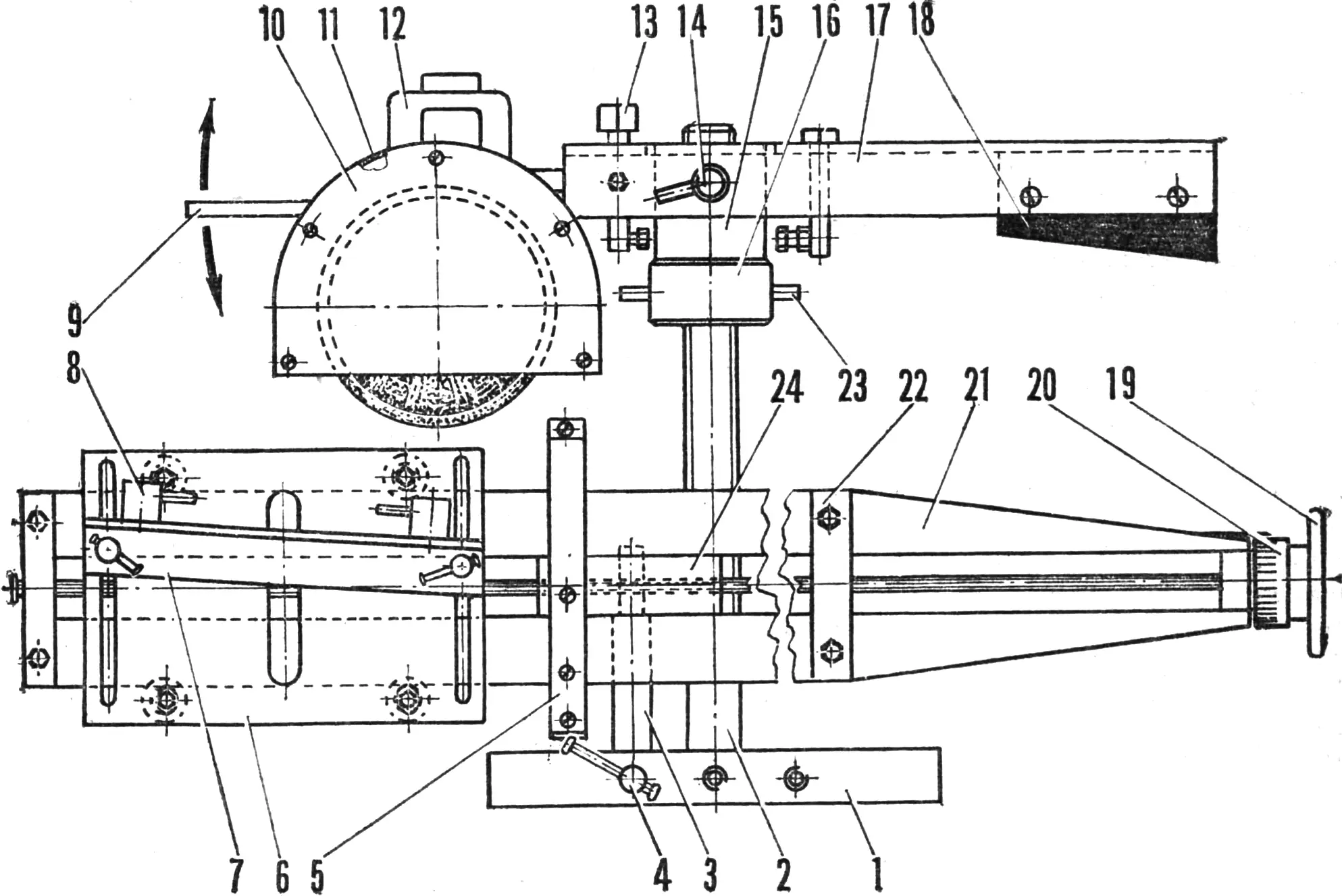
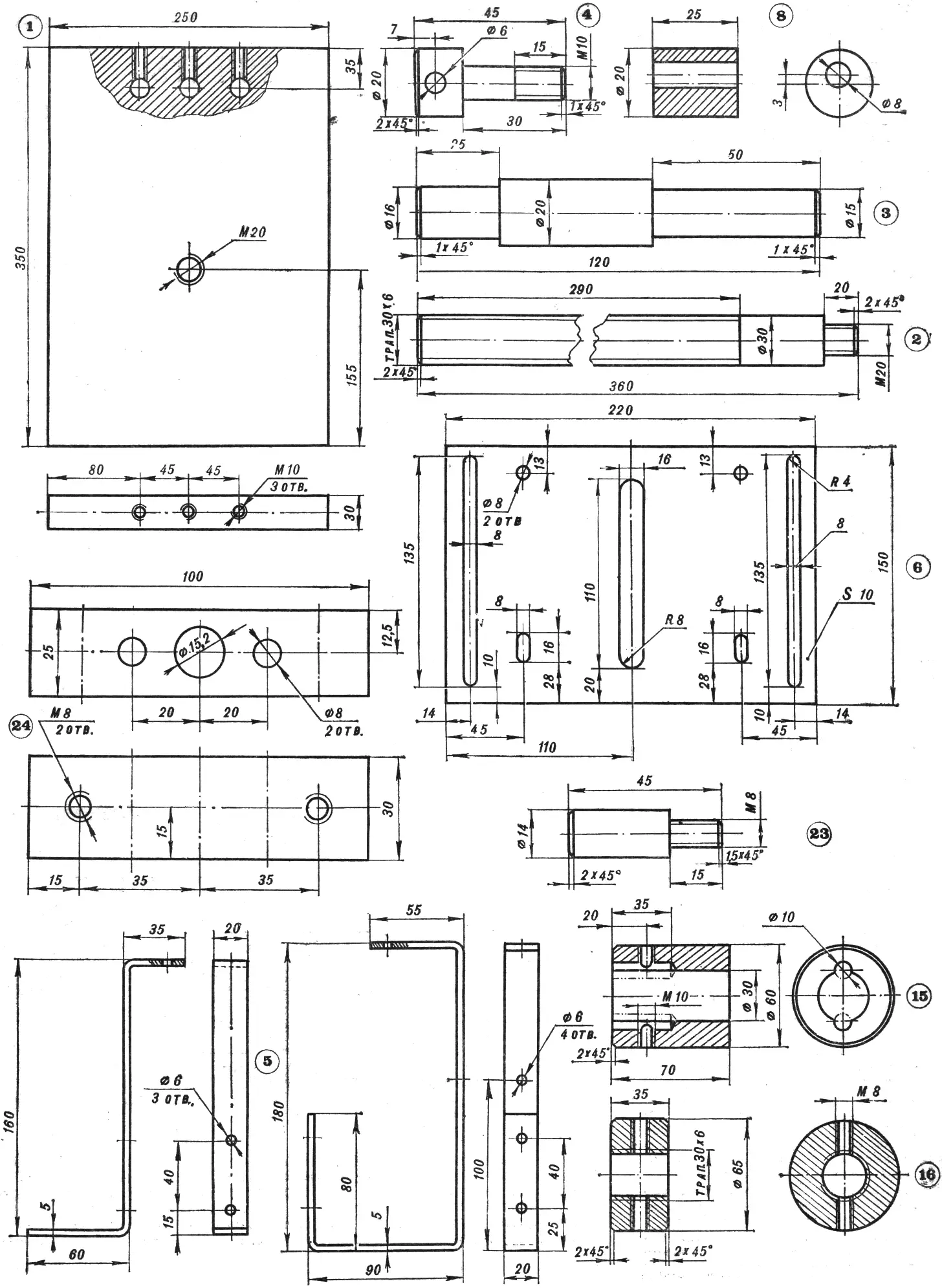
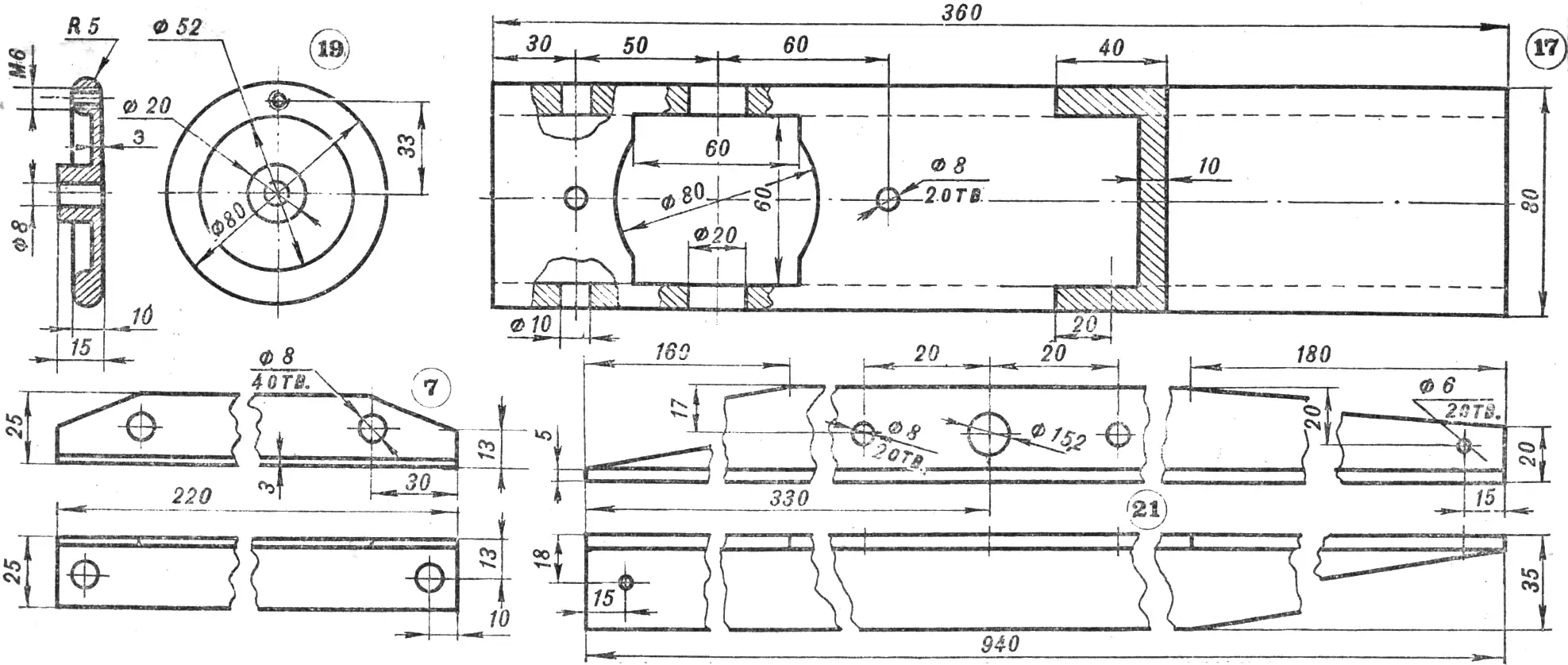
1 — bed (cast iron), 2 — column (steel 45), 3 — fence stand (steel 45), 4 — stopper (steel 45), 5 — clamp (steel 3), 6 — carriage with four rollers, 7 — guide (steel angle 25 X 25 mm), 8 — eccentric clamp, 9 — handle, 10 — guard, 11 — protective cover, 12 — electric motor, 13 — travel stop, 14 — hinge, 15 — bushing, 16 — traveling nut, 17 — rocker arm, 18 — counterweight (lead), 19 — handwheel for horizontal travel, 20 — scale for horizontal travel, 21 — slides for horizontal carriage travel, 22 — tie rod, 23 — handle, 24 — fence support (steel 3)
First of all, a few words about the main characteristics of the sharpening machine. The greatest sharpening length is 600 mm, which is quite sufficient for most carpenter’s saws. The sharpening angle can be chosen within a very wide range depending on the tool used — the grinding wheel.
The basis of our machine, as of any other, is the electric motor. Its shaft is the machine spindle: an abrasive wheel is mounted on it. An indispensable condition is that the grinding disc must be enclosed in a guard.
The bed is a cast-iron casting; however, a welded steel base is also acceptable. On the front part a guide fence with a tool holder is mounted. The motor is installed on a channel, and the latter is seated on a column fixed in the bed. A traveling nut and a thread cut on the column make it possible to lower and raise the motor. In the required position it is centered by a locking screw. The tool sharpening angle can be chosen by turning the electric motor around the column.
The tool is secured in the machine by the guide fence. Hacksaw blades are held by two eccentric clamps.
It remains to add that the machine and its creators won first place at the republican exhibition of technical creativity held in the summer of 1980 and dedicated to the 50th anniversary of Kazakhstan.
Recommend to read
 MOP-SURVIVOR
No matter how mounted brush for floors to handle, soon she still gets cranky, and there, staring, and start to come off. This will not happen if the connection is at once strengthened by... Got a hole? We’ll fix it!
One cannot help but admire the swift glide of a windsurfer catching the wind across the water, or the no less dizzying descent down a cresting ocean wave on another board resembling a wide...
