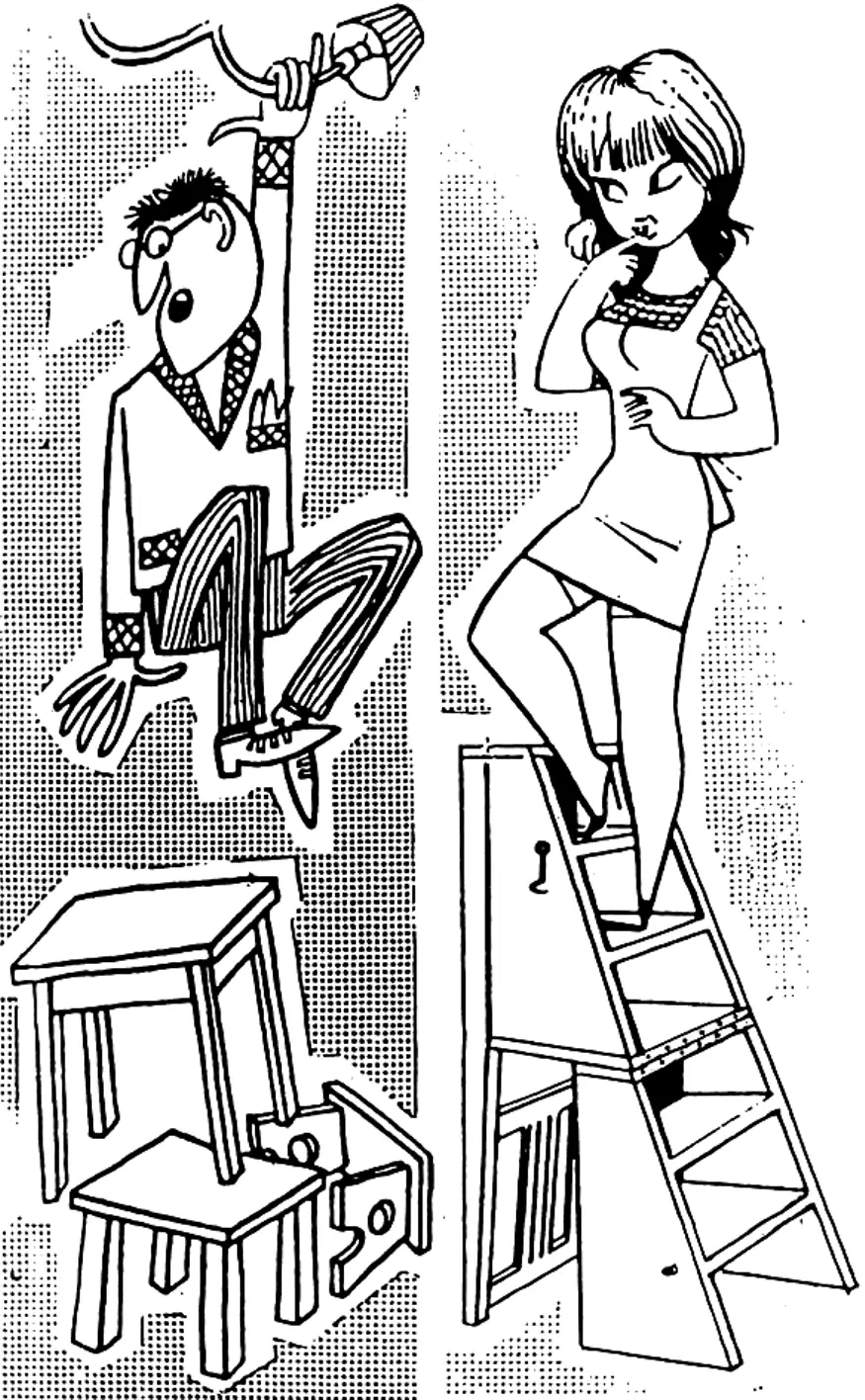
Whether you need to reach into a loft, hang curtains, or drill holes for them under the ceiling — quite a few household chores require using a small stepladder. And if there isn’t one at home, we start piling up substitutes from available furniture, which is fraught with falls and serious consequences.
Those who have acquired a stepladder face another problem: where to store this bulky item so that it doesn’t get in the way — after all, the need for it doesn’t arise often. That is why many may be interested in a clever design proposed by the Hungarian magazine “Ézermester”.
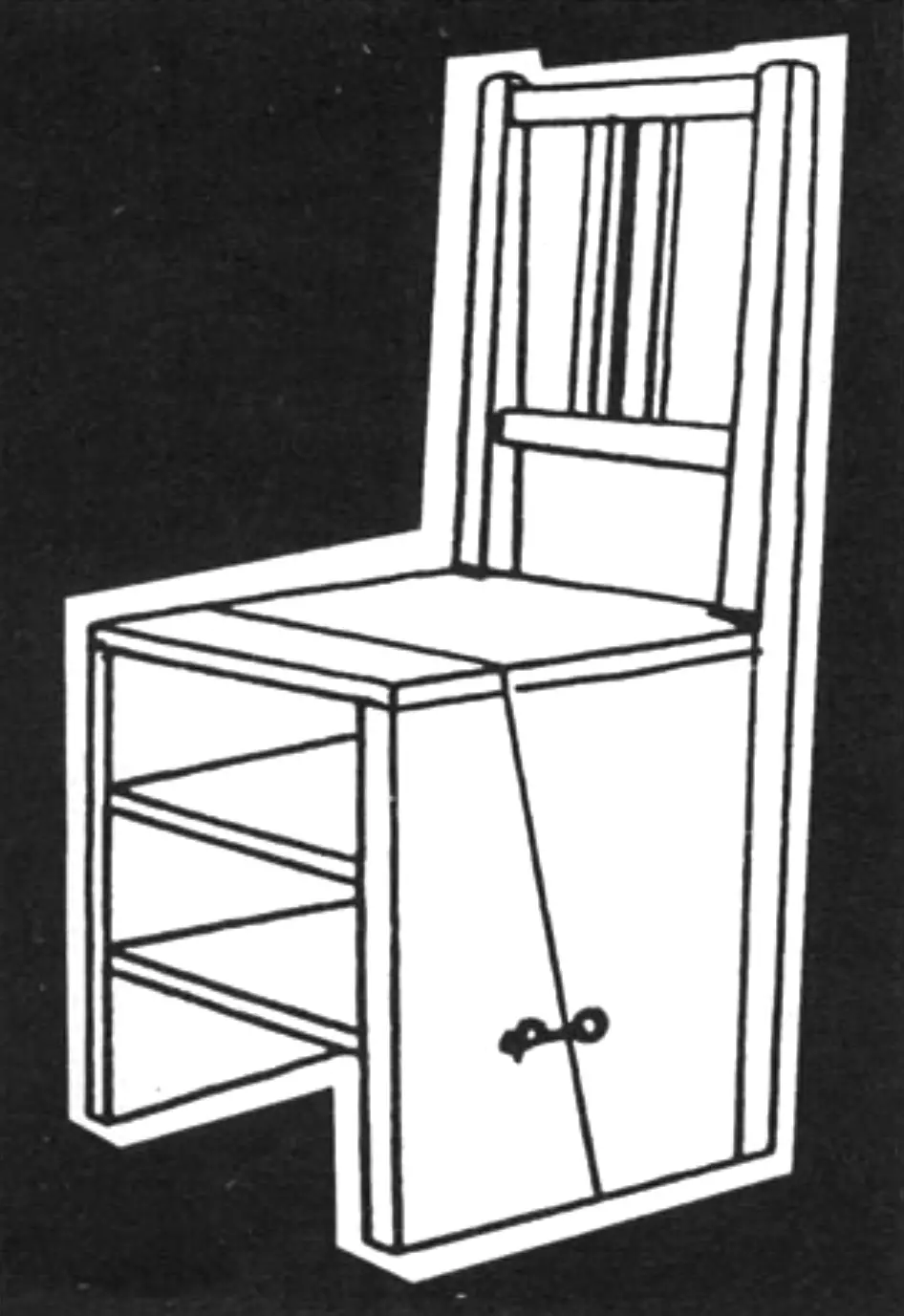
At first glance, it is a chair of ordinary dimensions, perhaps slightly heavier, which is fully forgiven, since in addition to its everyday functions, at any needed moment it easily and quickly transforms into a small ladder-stepladder. Moreover, there is no need to disassemble and reassemble it: simply pull the chair back toward you and lower it to the floor. In doing so, the chair seems to split into two halves, but they do not separate thanks to a hinge made of piano or card hinges connecting them.
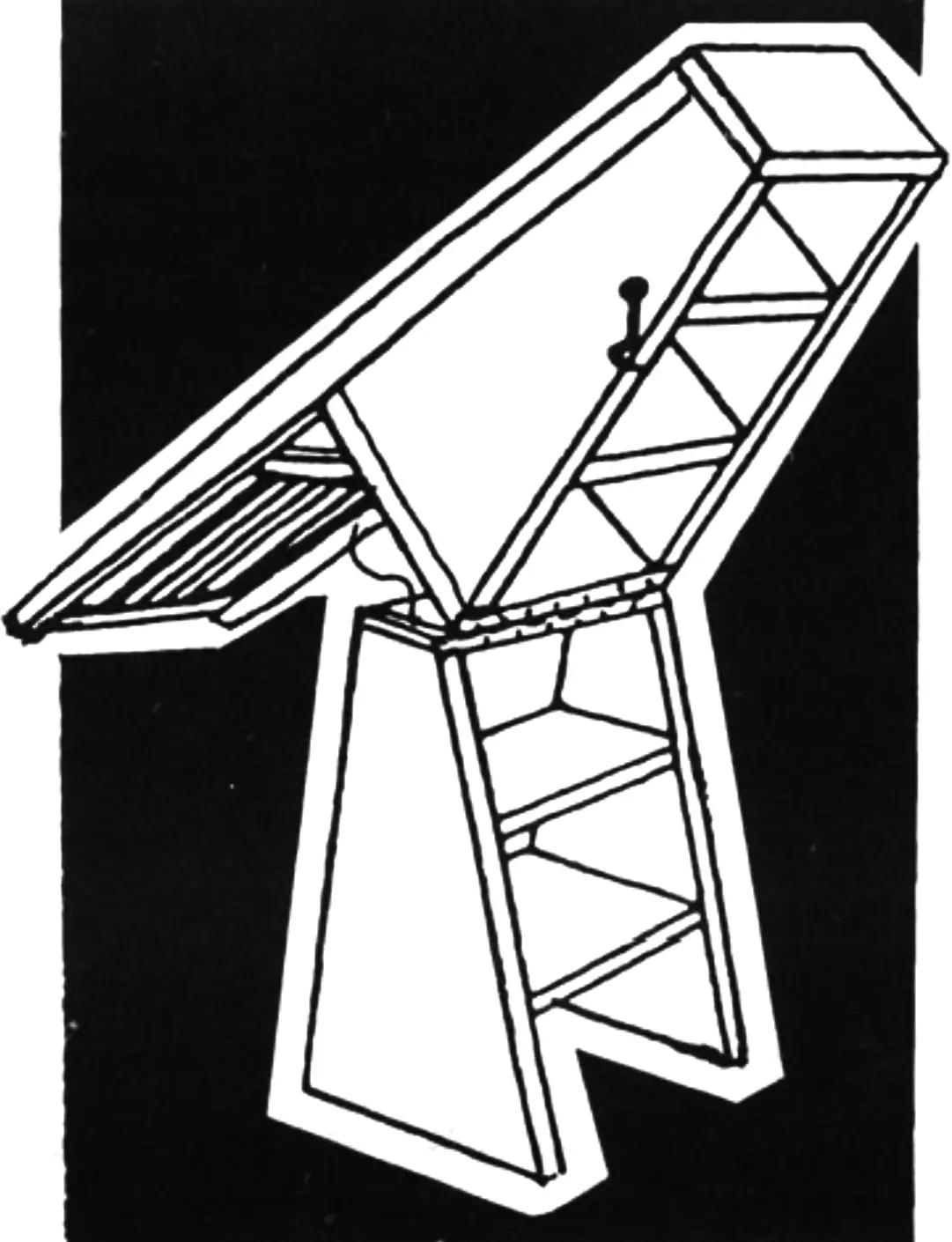
After such a simple transformation, it becomes clear that inside these halves of the chair, which ordinarily serve as the seat and legs, steps are built in: before you is a reliable, stable ladder-stepladder. And just as instantly, it can be turned back into a chair.
DESIGN AND MAIN PARTS
The main difference between the combined chair and an ordinary one is in its lower part: there are no legs as such; they are replaced by a box-like base, the top panel of which serves as the seat, and the side panels as support. Both the seat and the sides are sawn into unequal parts, with the latter cut at a certain angle, which is necessary for convenient use in the “stepladder” position.
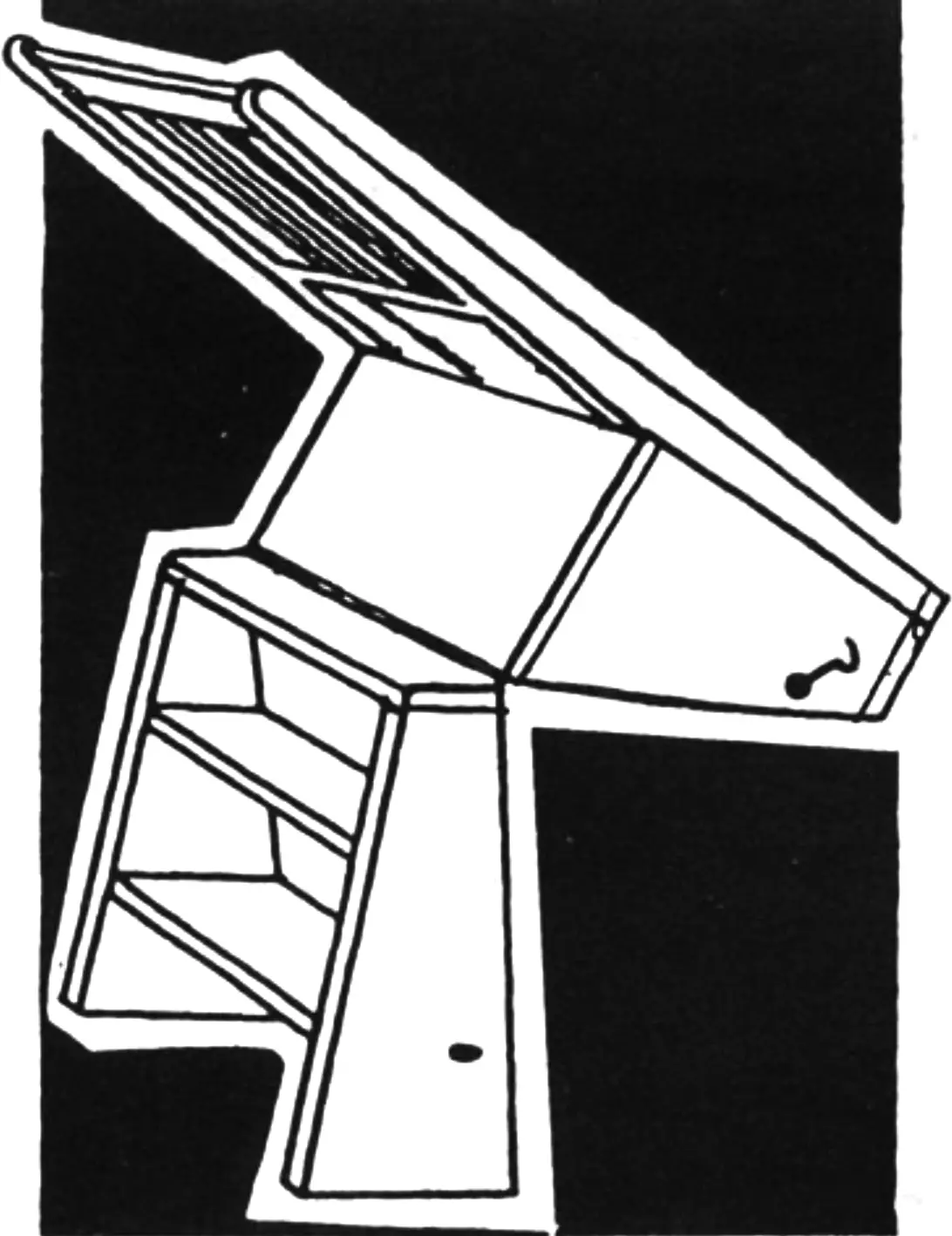
The base parts are joined into a single structure on one side by a piano hinge on the seat, and on the other also by the built-in internal steps. All base parts can be made of 19 mm chipboard; the height of the sides is standard for chairs (approximately 450 mm); their width is determined by the seat dimensions (in plan — a square with sides of 400 — 420 mm). The dimensions of the built-in steps are selected accordingly.
For the backrest, a ready-made one from an old chair can be used or one assembled specially: two vertical bars measuring 900x45x30 mm; two horizontal intermediate slats made from 20 mm board with rails between them 15 mm thick.
ASSEMBLING THE CHAIR
Both halves of the base are assembled in any order in the following sequence: first the side panels with steps, then the corresponding part of the seat is placed on top; all workpieces are joined together with dowel joints and glue (carpenter’s, PVA). After that, a piano hinge is installed between the seat parts. To prevent the base halves from spreading apart, a hook is attached to the side panels (the same kind can also be installed for the “stepladder” position).
All that remains is to attach the ready backrest to the finished base — this can also be done with dowels or thin long screws with glue in pre-drilled holes. If the backrest is homemade, its parts are pre-assembled with mortise-and-tenon joints and glue.
Upon completion of assembly, all surfaces of the chair can be painted with nitro or enamel paints.
«Modelist-Konstruktor» No. 7’2004
Recommend to read
 DEADWOOD… FILLING
Every constructor of ship models know how difficult it would be to "bind" the motor with a screw. Especially when we are talking about models up to 50 cm Dadude doing all sorts,... Amphibious vehicle “SHAH”
While still a student at the Faculty of Industrial and Civil Engineering, my father quite often fantasized about technology, transport and various self-propelled mechanisms. I remember,...
