Tasty, fragrant apples and pears. And they are not lacking in vitamins. But keeping these fruits until the next harvest is a problem — and sometimes a serious one. Drying, pickling and jam-making, and other methods of preserving come to the rescue. Moreover, according to gourmets, the value of products prepared for storage increases noticeably if the core is removed from the fruit beforehand.
An ordinary knife proves to be rather ineffective here, as does the special device available for sale. But a homemade secateur, which my family calls a “guillotine,” is beyond all praise. A bucket of apples is cut into neat slices (with the core removed from each fruit and the slices placed in a container set nearby) in 20 minutes!
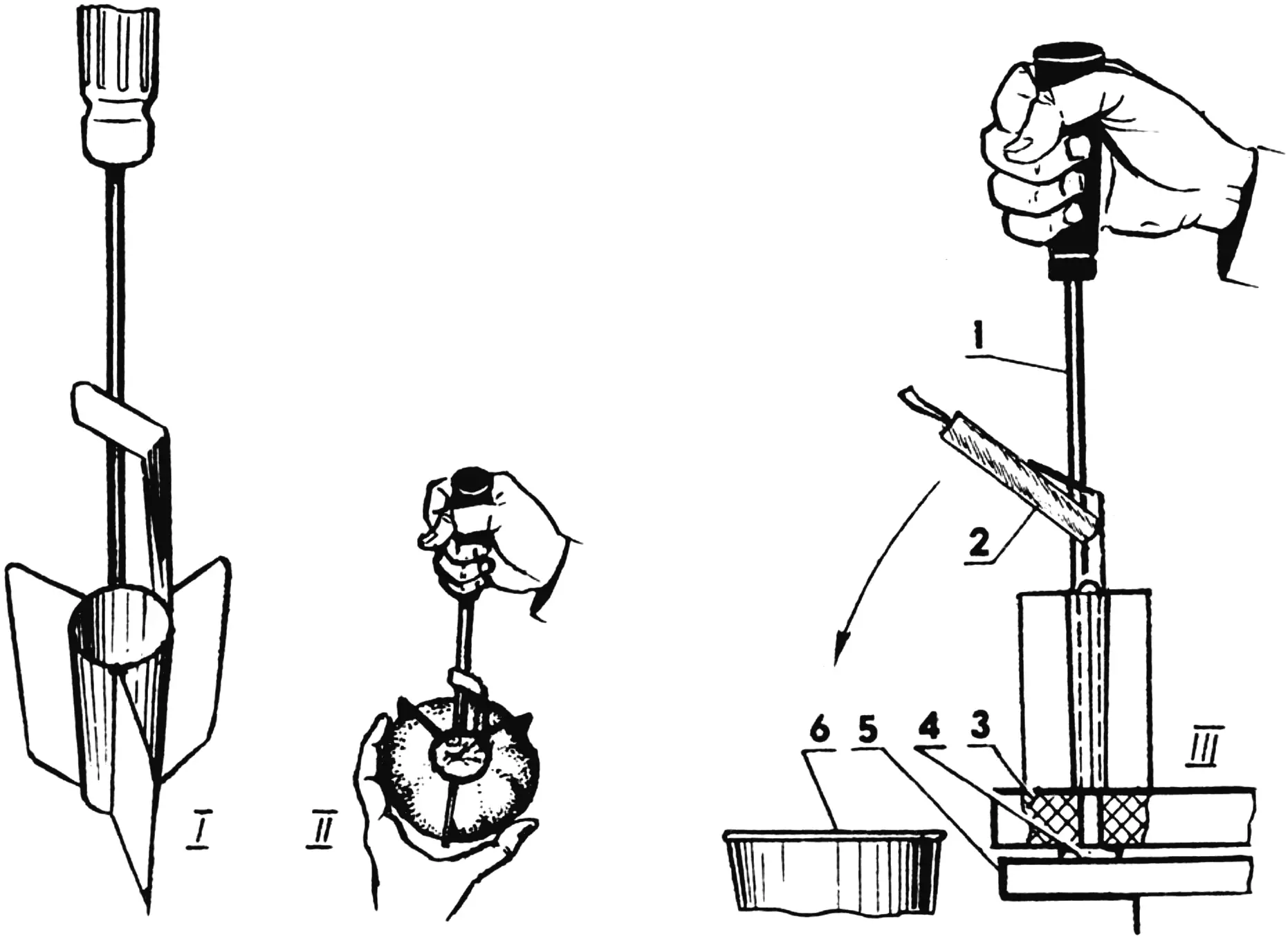
1 — handle, 2 — rod, 3 — auxiliary blade (2 pcs.), 4 — main blade, 5 — cone, 6 — deflector.
The shaped blades for such a secateur are made from scraps of galvanized sheet steel 0.5…0.8 mm thick, with subsequent soldering into a single structure (see fig.). Considering that considerable mechanical strength, corrosion resistance, and cleanliness are required here, it is advisable to use solder of the PSr-45 type. Its composition: copper — 30%, silver — 45%, zinc — 25%. PSr-45 melts at 730° C. Solders with a lower silver content (and, accordingly, a higher copper content) may also prove quite acceptable. For example, PSr-25.
An ordinary screwdriver works perfectly as a ready-made rod with a handle. It is enough simply to solder its tip to the conical part of the blades of our “guillotine.” Naturally, using solder with a copper-silver-zinc composition.
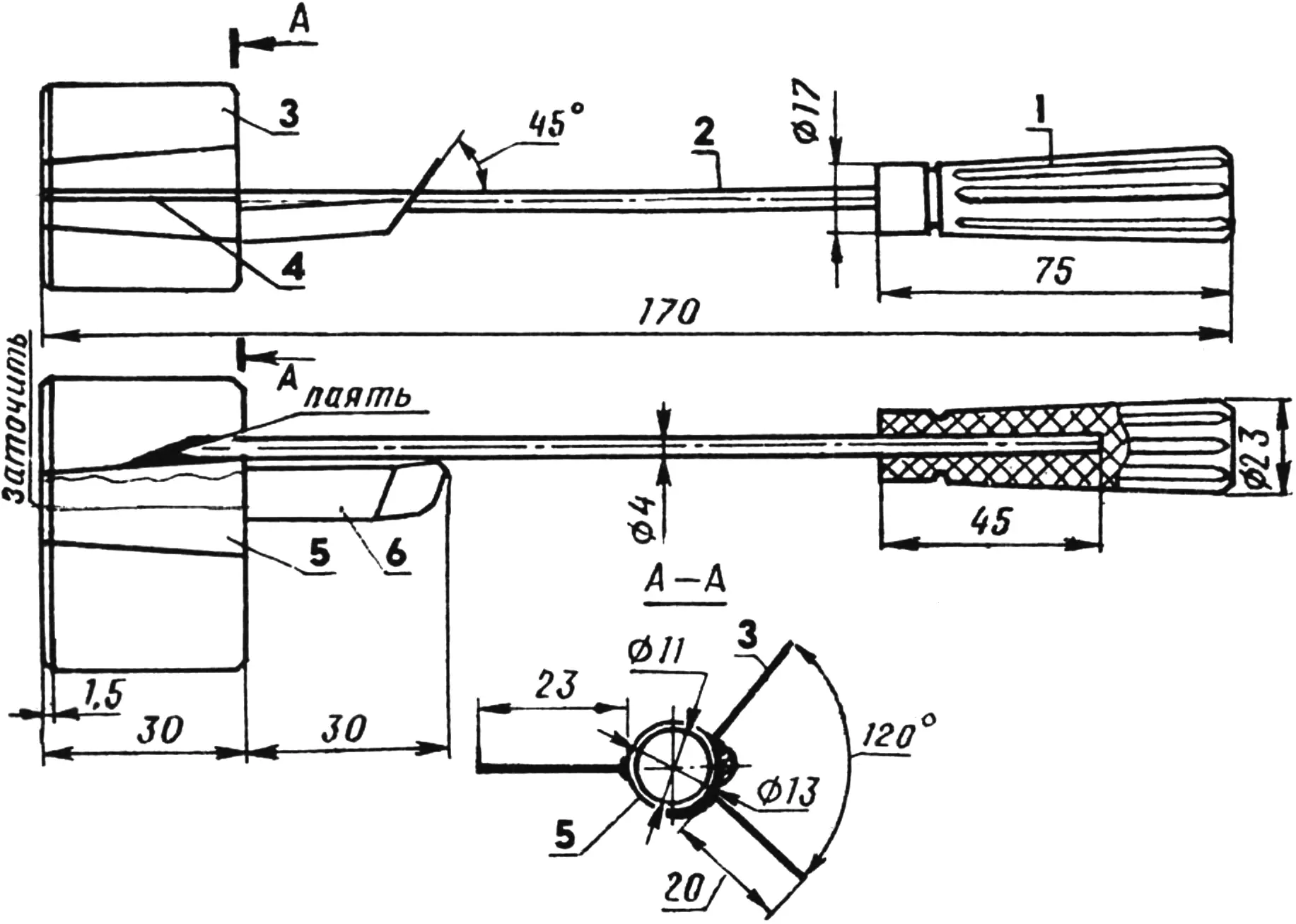
I — initial position of the secateur, II — cutting the fruit into slices with core removal, III — collecting waste; 1 — secateur, 2 — fruit core, 3 — elastic pad (from a piece of an old car tire), 4 — ejector (blunt nail), 5 — table, 6 — bucket for waste
The inner opening in the working part of the secateur is conical. This makes it much easier to remove the core cut out of an apple (pear, etc.). Moreover, this operation can be simplified and brought to automatism by using a technique worked out by my family, where the innovation is a blunt nail. It is driven into a piece of car tire on which the appetizing vitamin-rich raw material is cut. The separated core is pushed out and, with the help of a deflector soldered to the cone, directed into a bucket placed for waste. As for the sliced pieces, they are quickly brushed off into clean dishes with a swift hand movement.
“Modelist-Konstruktor” No. 11’96, R. VOLODIN
Recommend to read
 TO PIN FASTENER,…
The original secure storage for small washers and nuts it is easy to obtain from the large pins to which the fastener is threaded and then closed with a snap, held a head-lock until the... Electronic ignition for “Voskhod”
In the second issue of "M-K" for 1976, I read an article "Electronics on a Motorcycle" about an electronic ignition system. It has a DC to AC voltage converter. This circuit requires a...
