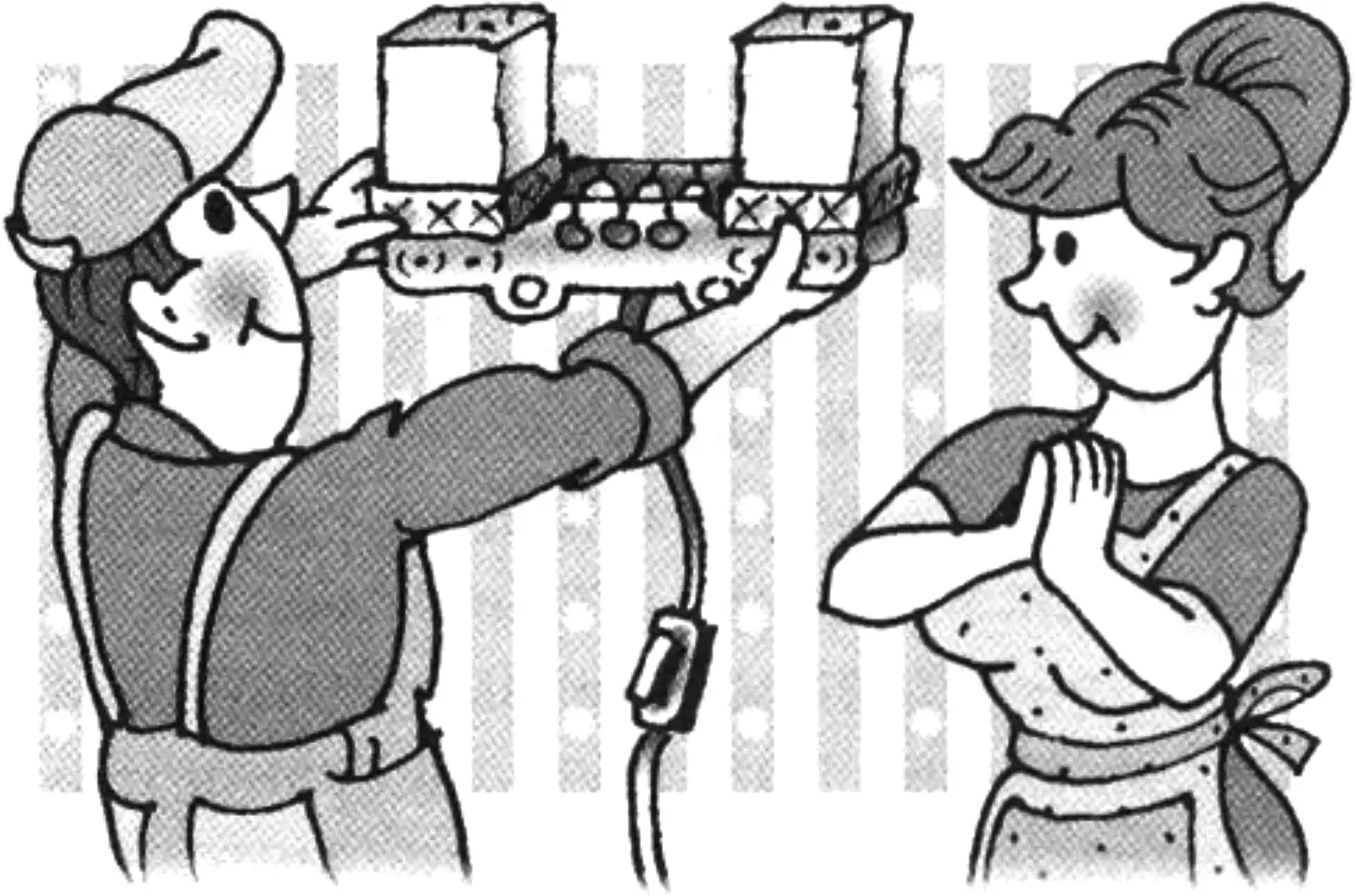
In a modern home interior, factory-made and homemade furniture items or other products can blend organically. Moreover, a few unconventional crafts can change the look of a typical apartment, give it individuality, create coziness, and even bring a sense of “warmth.” Moreover, these simple things can serve a utilitarian (practical) purpose, a decorative one, or combine both qualities at once.
An example of such a combination is the wall sconce presented here, which emits “soft,” evenly diffused light.
Making this light fixture is within the reach of a home craftsman — a beginner in wood carving.
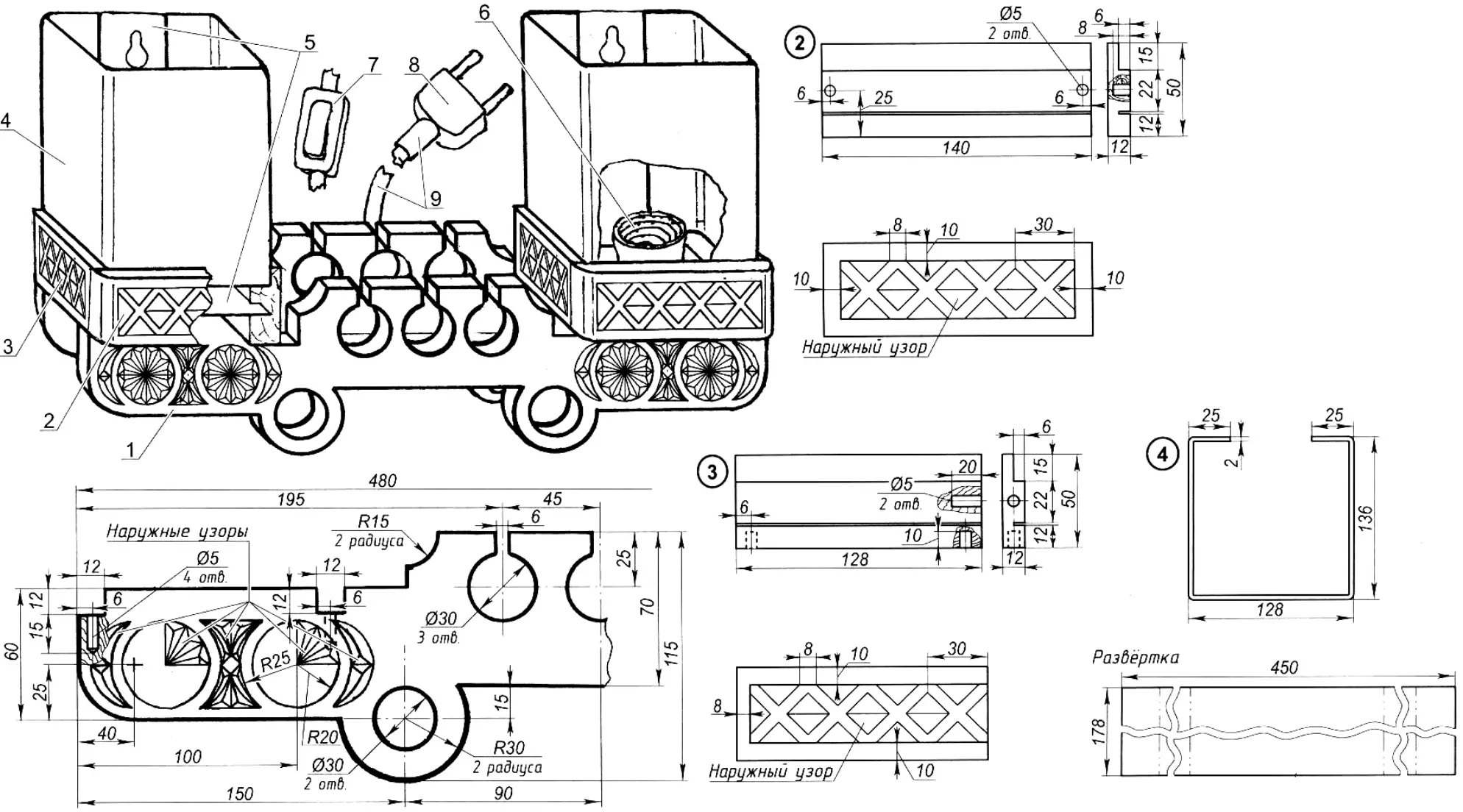
1 — base (board s12, 480×115, 2 pcs.); 2 — front strip (board s12, 140×50, 2 pcs.); 3 — side strip (board s12, 128×50, 4 pcs.); 4 — shade (matte acrylic s4, 450×170, 2 pcs.); 5 — reflector (sheet metal s1, 350×135, 2 pcs.); 6 — lamp socket (2 pcs.); 7 — switch; 8 — plug; 9 — power cord (two-wire)
The cost of the sconce is low, since even scrap materials can be used to make it: leftover birch (aspen, linden) boards, scraps of white or galvanized sheet metal. Electrical fittings: lamp sockets, plug, cord with switch — will surely be found in any DIYer’s stash.
A complete list of parts and materials for the light fixture is given in the specification. Note that the decorative box and the shade have no bottom or back walls — they are replaced by the metal reflector plate.
Since the operations for making individual parts are simple and do not require detailed explanations, I will present them as process charts — similar to those compiled for workers at factories.
Making the base (item 1)
| No. | Operations | Tools |
|---|---|---|
| 1. | Select a blank from birch board measuring at least 480×115×20 mm | ruler |
| 2. | Machine the blank to size 480×115×12 mm | handsaw, plane |
| 3. | Mark out the blank according to item 1 | square, ruler, compass |
| 4. | Drill Ø30 mm holes according to the layout (7 pcs.) | drilling machine (drill), first Ø30 mm drill bit |
| 5. | Saw the blank along the outer contour (straight section) | jigsaw (handsaw) |
| 6. | Make 12×12 mm cutouts (4 pcs.) | jigsaw (handsaw), chisel |
| 7. | Make 6 mm wide slots (3 pcs.) | jigsaw (handsaw) |
| 8. | Saw R30 mm arcs (2 pcs.) | jigsaw (rasp) |
| 9. | Mark blind Ø5 mm holes (2 pcs.) according to item 1 | ruler |
| 10. | Drill two blind Ø5 mm holes to a depth of 15 mm | (drill), Ø5 mm drill bit |
| 11. | Mark the “Radiance in a circle” pattern (4 pcs.) according to item 1 | compass, square, ruler |
| 12. | Cut out the “Radiance in a circle” pattern | cutting knife |
| 13. | Mark the “Moon” pattern (4 pcs.) according to item 1 | compass, square, ruler |
| 14. | Mark the “Central” pattern (2 pcs.) according to item 1 | compass, square, ruler |
| 15. | Cut out the marked patterns | cutting knife |
| 16. | Sand the patterns | sanding machine, set of sandpaper |
| 17. | Apply stain to the patterns | brush, wood stain |
| 18. | Varnish the patterns. Repeat operations 1 — 10 and 16 — 18 for the second part | brush, varnish |
Making the front and side strips (items 2, 3)
| No. | Operation name | Tools |
|---|---|---|
| 1. | Select a birch blank measuring at least 850×60×20 mm | ruler |
| 2. | Machine the blank to size 850×50×12 mm | ruler, plane |
| 3. | Mark a 15×6 mm quarter | ruler |
| 4. | Cut the 15×6 mm quarter | plane |
| 5. | Mark a 6×1 mm groove | ruler |
| 6. | Cut the 6×1 mm groove | handsaw, acrylic cutting knife, ruler |
| 7. | Mark the part length on the blank according to item 2 (2 pcs., allowing for kerf width) | square, ruler |
| 8. | Saw off the front strip (2 pcs.) according to the layout | handsaw |
| 9. | Mark the part length on the blank according to item 3 (4 pcs., allowing for kerf width) | square, ruler |
| 10. | Saw off the side strips (4 pcs.) according to the layout | handsaw |
| 11. | Mark the centers of blind holes according to item 2 (on two parts) | ruler, square |
| 12. | Drill two blind Ø5 mm holes according to the layout (on two parts) | drilling machine (drill), Ø5 mm drill bit |
| 13. | Mark the centers of three blind holes according to item 3 (on four parts) | ruler, square |
| 14. | Drill three blind Ø5 mm holes according to the layout (on four parts) | |
| 15. | Mark the pattern on parts items 2 and 3 | square, compass, ruler |
| 16. | Cut out the marked patterns on parts items 2 and 3 | cutting knife |
| 17. | Sand parts items 2 and 3 | sanding machine, set of sandpaper |
| 18. | Apply stain to parts items 2 and 3 | brush, wood stain |
Making the shade (item 4)
| No. | Operations | Tools |
|---|---|---|
| 1. | Select a blank of matte acrylic measuring at least 450×200 mm | ruler |
| 2. | Mark a 450×200 mm rectangle on the acrylic piece | square, ruler |
| 3. | Cut out the marked strip | cutting knife |
| 4. | Bend the shade box according to the layout | acrylic bending fixture |
| 5. | Finish the shade edges | square, straightedge, sandpaper |
Making the reflector (item 5)
| No. | Operations | Tools |
|---|---|---|
| 1. | Select a blank of white sheet metal (galvanized) 350×135×1 mm | ruler |
| 2. | Mark out the part according to item 5 | square, marking gauge |
| 3. | Center-punch hole centers according to the layout | center punch, hammer |
| 4. | Scribe a Ø16 mm circle according to the layout | compass, ruler |
| 5. | Cut out a Ø32 mm circle | paddle bit |
| 6. | Punch four Ø2 mm holes | punch, hammer |
| 7. | Punch Ø4 mm and Ø10 mm holes | punch, hammer |
| 8. | File the punched holes | file |
| 9. | Saw through the bridges between Ø4 and Ø10 mm holes | needle file |
| 10. | Trim the blank along the contour and blunt the edges | tin snips, file |
| 11. | Bend the blank at a right angle | vise, mallet (bending fixture) |
The front and side strips of the decorative box are joined butt-to-butt at a right angle. So that the side edges of the front strip do not interfere with the perception of a uniform pattern across different parts, they (the edges) must be rounded to a radius of 12 mm after assembly.
Such a light fixture, made with your own hands, not only gives light but, one might say, also warms — it warms the soul.
In conclusion, I would like to remind beginner craftsmen that when creating their own piece, they must observe the laws of composition: proportionality and unity of parts, repetition of elements, and completeness of images. The aesthetics of applied art — neat execution and careful finishing — also matter greatly. Without meeting these conditions, it is hardly possible to expect a beautiful object, let alone a work of high artistic quality.
«Modelist-Konstruktor» No. 9’2010, V. PUSHKIN
Recommend to read
 “DANCING” THE CAR
In fact, the first word of the title should not be enclosed in quotation marks. Because the vehicle N. Katchko can waltz, that was demonstrated to the participants one of the programs of... THE SMALL TRACTOR FIELD
The word "cultivator" has entered our lexicon relatively recently. In principle it is the same tractor only built on the basis of single-axle chassis and designed to actuate a...
