Strawberry, wild strawberry… They are often confused with one another, but the best of berries, by right, are considered to be strawberries. Bright, juicy, fragrant. With sugar and cream they make an excellent dessert. Jam, jelly, and medicinal pick-ups are also wonderful—especially from strawberries. Strawberries have an almost rounded-conical shape, a whitish coloring over more than half of the berry, and an extremely strong, pleasant scent. In large-fruited garden wild strawberries, also known in everyday life as “strawberries,” these traits are expressed a little weaker. However, in terms of yield and drought resistance, the rival surpasses, so it is cultivated extremely widely.
And, of course, whichever “sweet berry” it may be, it requires careful care. You need supplies and a suitable (strawberry) tool. For example, something like the one in the published selection compiled from letters from our readers.
SECOND LIFE OF A SAW, A SHOVEL, AND BROKEN FORKS
Over time, a tool that has served its purpose becomes unusable. But in the capable hands of a careful owner, it can gain a second life—both broken forks, and a bent shovel, and a saw blade eaten away by rust around the handle. I was once again convinced of this on my neighbor’s dacha—where I saw his inventory of tools as a passionate gardener and vegetable grower.
For example, here is a tool for working between rows. An extremely convenient device, I’ll say! I appreciated it by comparing it with the primitive ripping-out of weeds that seem to be growing like mushrooms. But what’s it made of so practical a cultivator from…? From broken forks, on the remaining outer horns of which the neighbor put (then fastening it with screws with countersunk heads) working elements of a heart-shaped profile, made from a piece of saw blade. As the master claims, you can also use two old ridging tools, welded together appropriately (GOST 23707—79). The front edges of the working elements have a sharpening profile whose width varies from zero (at the back of the “wings”) to 14 mm (a spear-shaped front part with a spread of cutting faces at 125°). Heat treatment — 40…47 HRC.
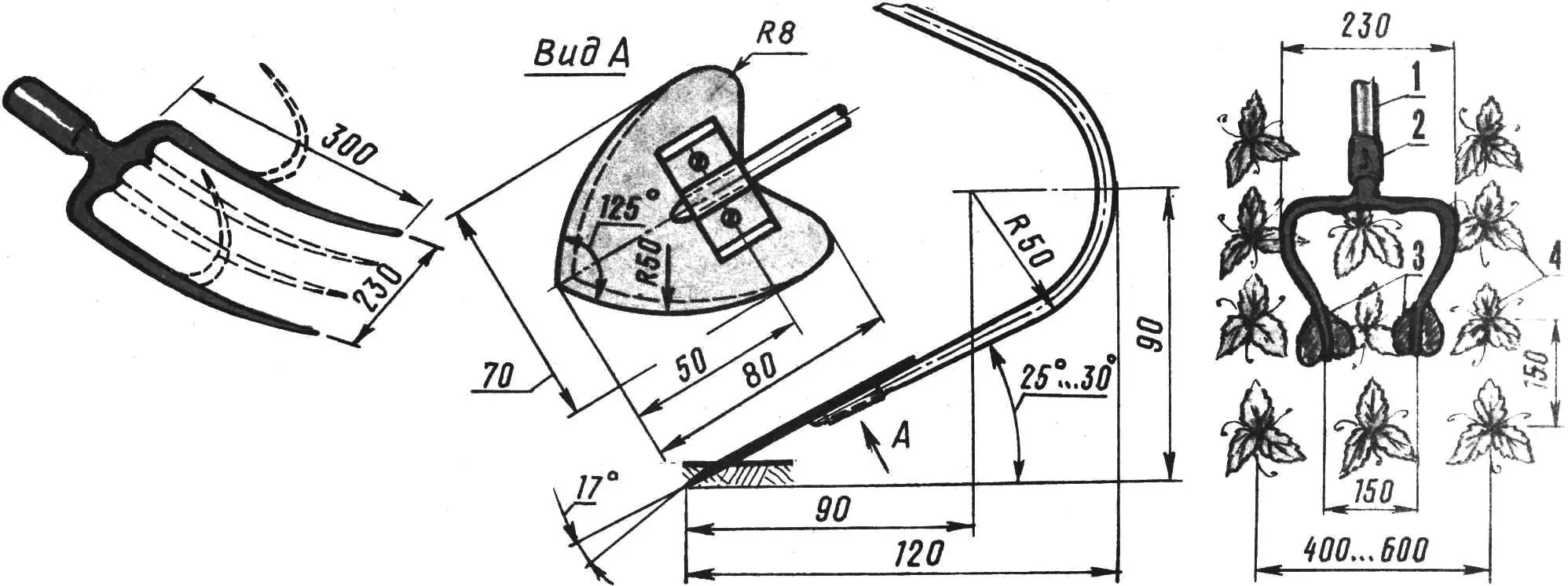
1 — handle, 2 — body (a fastening tube was used, with two remaining outer horns from broken forks), 3 — cutting elements (from a saw blade canvas that has come to an unusable state), 4 — plants being processed.
Again, a piece of fork (but with the central horn preserved and reinforced with a stiffening rib) the neighbor—an able maker—adapted for working with strawberry bushes, as well as for weeding, loosening, thinning onion beds, and other garden crops. He managed this by welding on a special blade to the horn half bent at 110°. The latter has a sharp front and a blunt rear cutting edge, and also a pointed tip sharpened like a knife. The beginning of the horn is inclined to the longitudinal axis of the handle (the fastening tube) at 25°.
They work with such a loosener-cutter as follows. The tool is set with its point down. Then, having turned the handle slightly to the right, the loosener-cutter is moved forward and away from you with the sharp edge, without bending. After cutting a furrow (removing a “shaving” from the soil), they pull the tool toward themselves with the blunt edge, and then repeat the operation. By changing the angles (the position of the blade relative to the surface being processed), they determine the optimal inclination, working width, and loosening depth. When weeding narrow inter-rows, they orient the tool so that the obtuse angle is always in the working soil at the bottom. Then, when the blade touches the plants with its blunt edge, it will gently part them without damaging them.
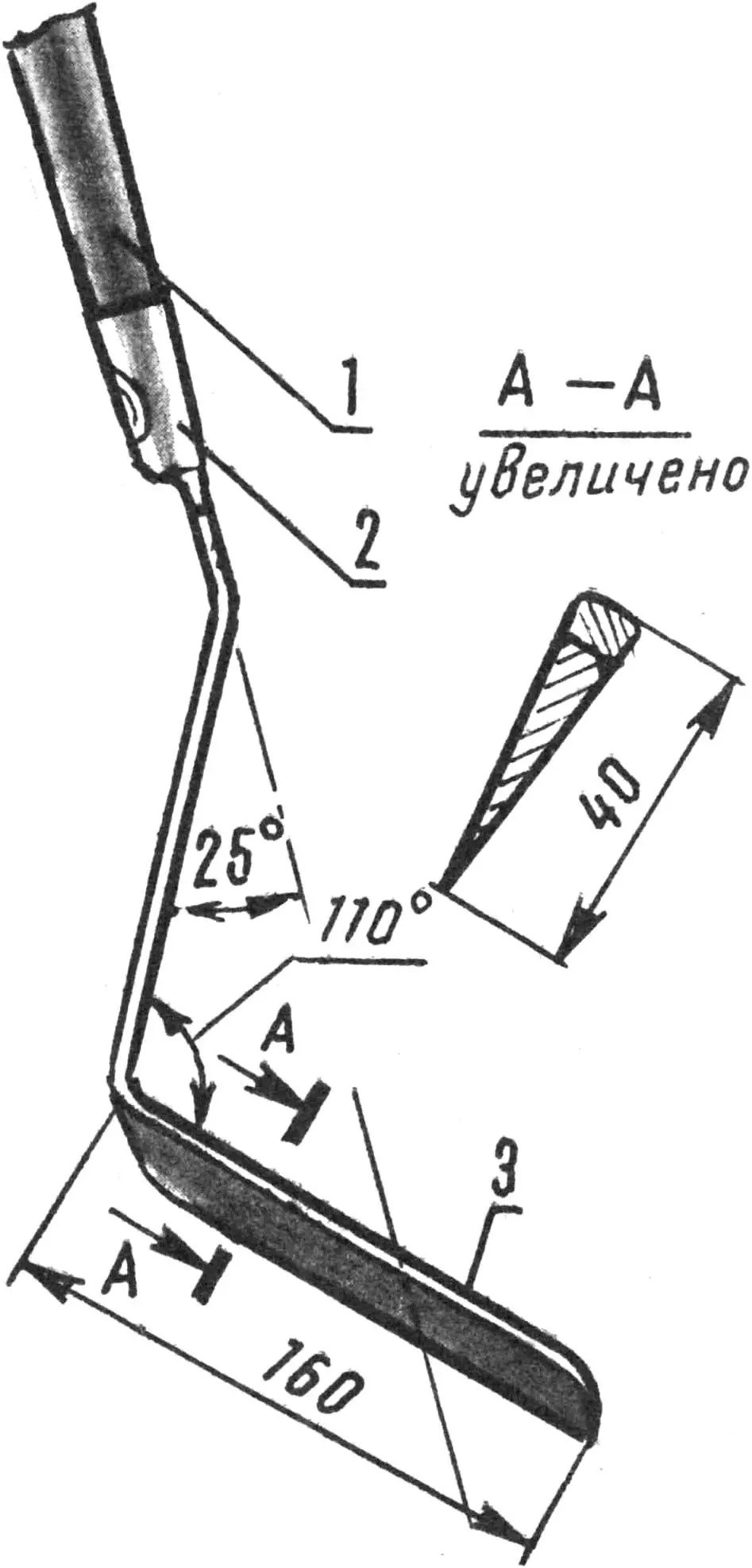
1 — handle, 2 — fastening tube from broken forks with the central horn preserved, 3 — blade with a sharp front and blunt rear cutting edge, and a pointed tip.
As for cutting off mustaches and unnecessary rosettes on a plot with strawberries (wild strawberries), everything is, as they say, very simple here too. From the sides of the row, this work is done by placing the tool blade horizontally. And in the row, trimming is carried out with the obtuse angle turned down. The tip end is raised; the direction of movement of the tool is away from you.
But better, as practice has shown, for such a specific task to use a shaped cutter in the form of a little hoof. Such a tool is made from a shovel that has served its purpose. The blade is “released” over fire, cut accordingly, and rolled into a half-funnel. To the resulting body, spacer limit brackets are welded. The cutting edge is sharpened and heat-treated to 37…53 HRC.
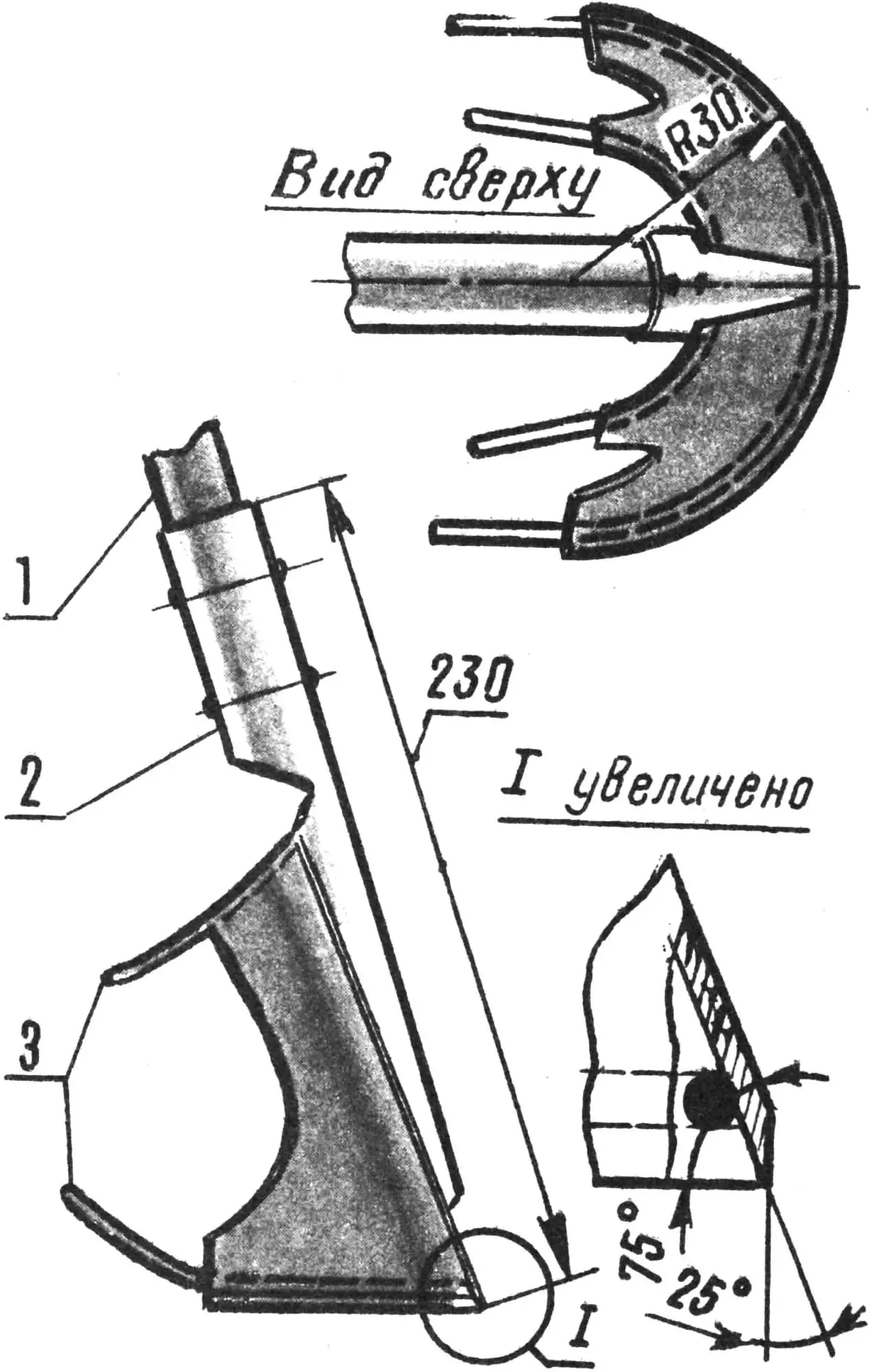
1 — handle, 2 — sleeve with a blade bent into a half-funnel and cut accordingly (from a shovel that has become unusable), 3 — spacer limit brackets.
During work, the shaped cutter is brought under a strawberry bush. At that moment, the point does not bury into the soil. The stems are pressed toward the center by the top spacer limit bracket. Then comes a sharp push on the handle. The sharply sharpened lower edge cuts into the soil, cutting off the mustaches (stolons) in a half-circle. The same operation is performed when approaching from the other side. As a result, the mustaches are removed. The main bush and the root system of the cultivated plant remain undamaged.
A. TIMOSHENKO, engineer, Feodosia
KNIFE FOR… STRAWBERRIES
Using scissors and a pruner to remove mustaches of wild strawberries, as well as using various hoes for loosening the soil on the bed, did not suit me: it was tedious and hard, and also, in terms of preserving the root system of the bush, it was far from ideal. A special knife turned out to be more convenient, with an arched blade and an asymmetrical cut-out on the back side.
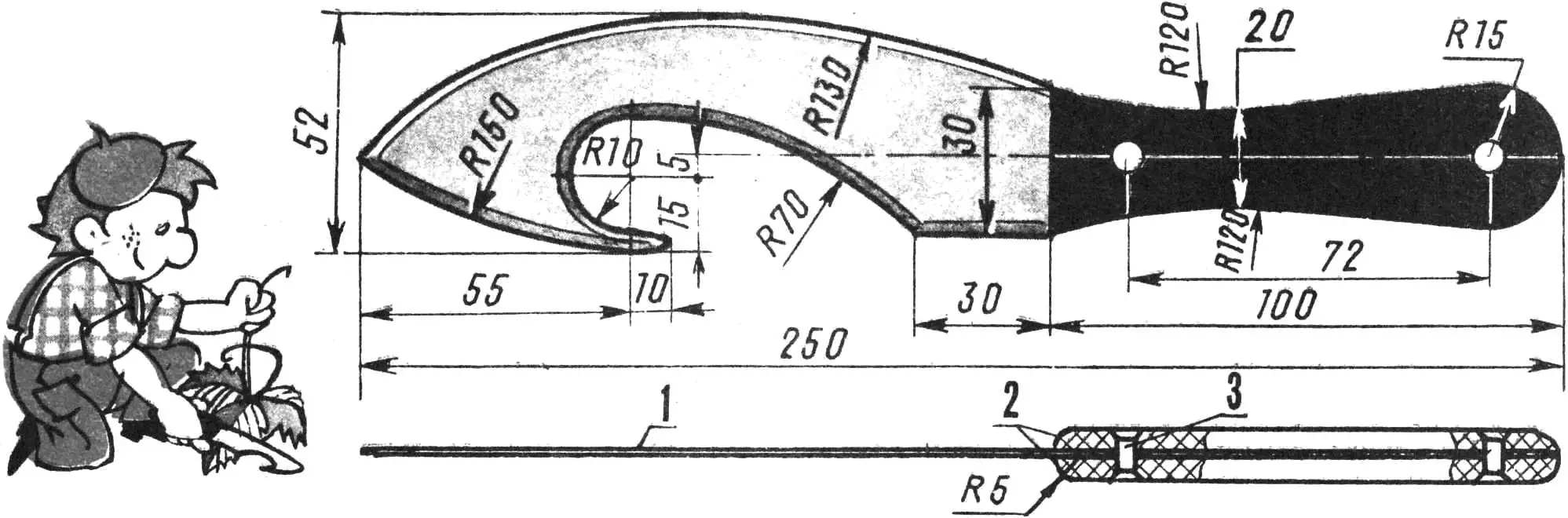
1 — arched point with a notch having a sickle-like sharpening, 2 — ebonite overlays on the handle, 3 — rivets Ø 4 mm with countersunk heads.
The knife dimensions were clarified by practice. Practice also suggested that it is useful to make the surface of the notch not razor-smooth, but with micro-serrations—like a sickle. This eliminates “idle run,” i.e., slipping of mustaches and stems off the knife without cutting them.
The blade of the tool is made from a fragment of a hacksaw blade. The handle has ebonite overlays; the sharp edges are rounded. And the specific use of such a knife on a strawberry plot, apparently, will not cause difficulties for anyone.
«Modelist-konstruktor» No. 5’92, I. KRONBIKHLEr, mechanic
Recommend to read
 PAINT WITHOUT SECRETS
Assortment of paints (coatings) are currently quite wide, and therefore, in such a variety without the advice quite difficult to understand. Get expert advice from the seller not always... TOY TABLE
I have another homemade. As a prototype for my toy I took Bogorodskaya toy "blacksmiths", and replaced the movement mechanism with parallelogramma on the mechanism of the two...
