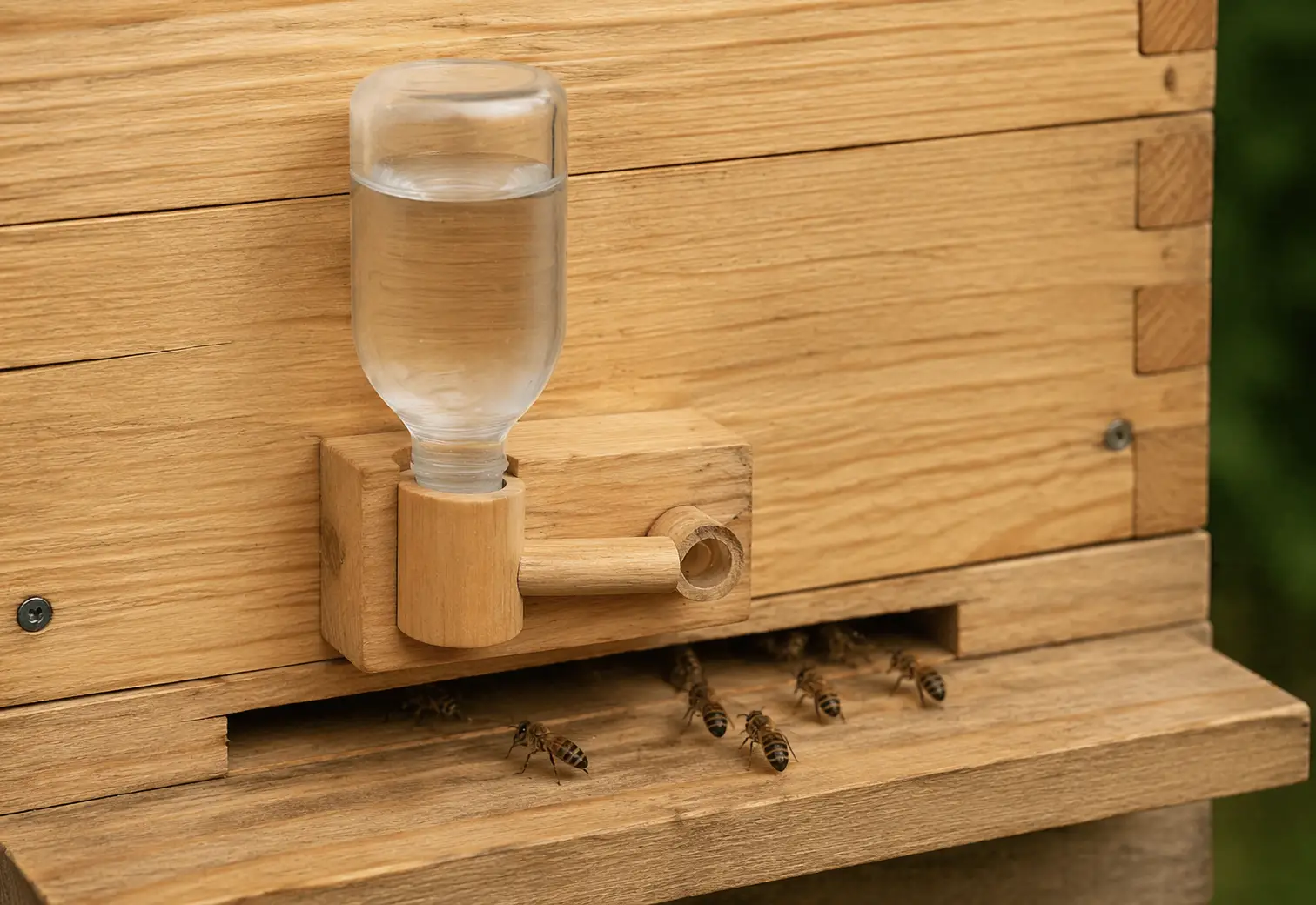
When I leased three apiaries with the right to buy them out, I realized how difficult it is to maintain a large number of bee colonies. I solved some of the problems with a feeder-drinker, slightly improving designs proposed by experienced beekeepers on the pages of periodicals.
Each of the bee feeder-drinkers I use consists of a wooden holder into which a threaded glass or plastic bottle is inserted. It is best to make the holder from dry birch — there are fewer splinters during machining.
A hole 28 mm in diameter and 33 mm deep is drilled in the top of the blank. Another hole, 20 mm in diameter, is drilled from the side until it meets the first one. On the same side, the blank is turned down to 28 mm in diameter over a length of 20 mm.
Holes are made in the bottle caps for the free outflow of liquid. To attach the holder to the hive, the slot or round entrances are plugged and new ones, 28 mm in diameter, are drilled.
In April and May I pour 250—500 ml of sugar syrup with added plant medicinal and preventive extracts, decoctions, or tinctures into the bottles. I refill the bottles as the feed is consumed over two to three weeks, depending on the strength of the bee colony.
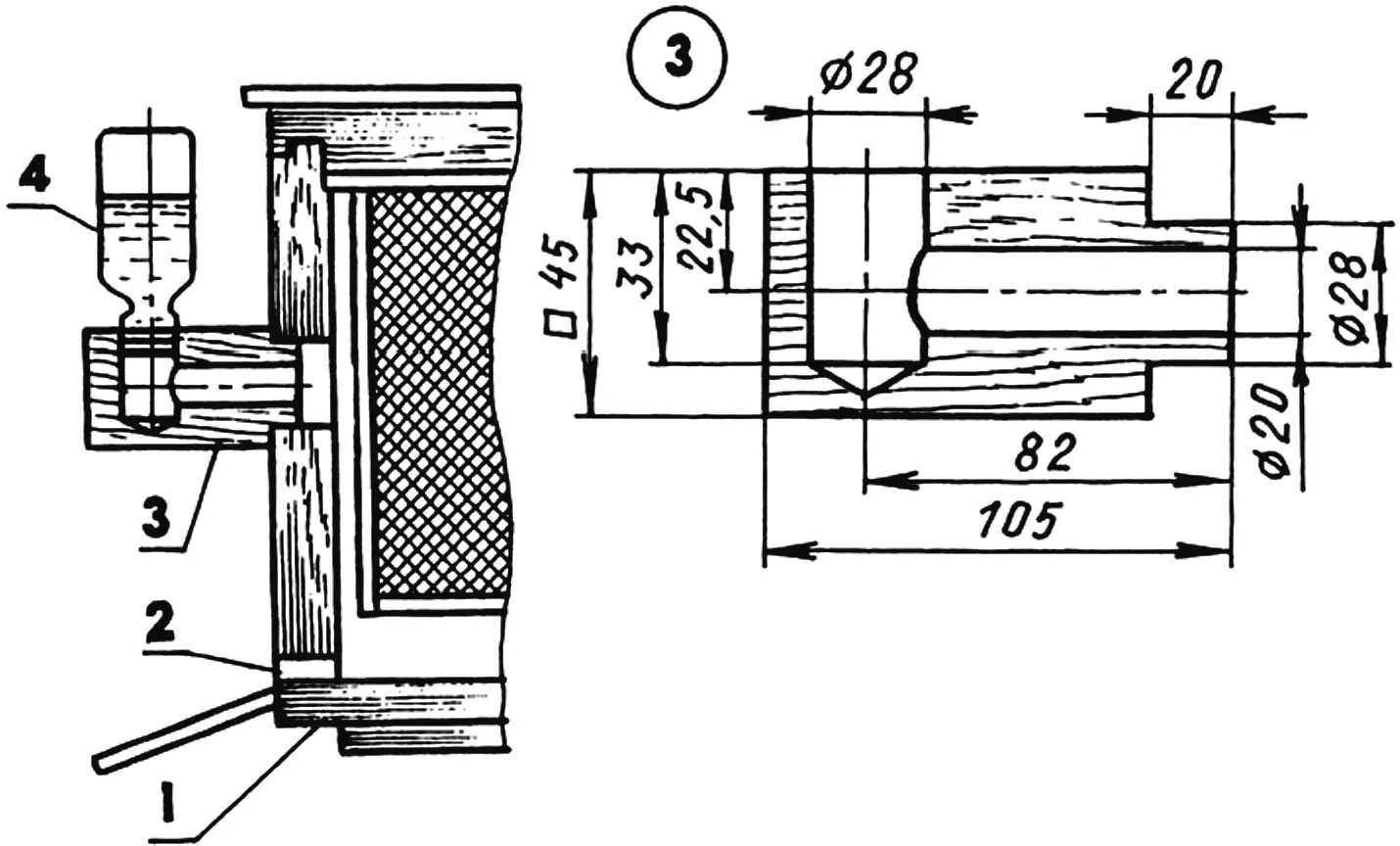
1 — hive; 2 — entrance; 3 — holder (dry birch); 4 — threaded glass or plastic bottle
The feeder-drinker is convenient to use during the day when bees are flying intensively and when feeding nurse colonies, since the design makes it possible not to disturb the colony and protects it from robber bees. I also carry out medicinal and preventive feeding in August and September — after the last honey harvest.
I would also like to share recipes for extracts, decoctions, and tinctures that I add to sugar syrup. In particular, to prepare PINE NEEDLE DECOCTION, I pour water over young buds and fresh pine and spruce needles and boil them in a pressure cooker, then cool under a warm cover and strain. I add the infusion to the syrup at a rate of 50 ml per 1 l. It has a general strengthening effect.
Together with the pine needle decoction I give my bees GARLIC EXTRACT, which has phytoncidal properties. To prepare it, I run peeled garlic cloves through a meat grinder and store the resulting mass in a sealed container. I add one tablespoon of extract per 1 l of syrup.
To obtain BITTER PEPPER TINCTURE, I put 50 g of crushed dried fruits in a thermos, pour in 1 l of boiling water, steep for a day, and strain. I add it to the syrup at a rate of 50 ml per 1 l. The mixture is useful for varroosis and nosema disease. It also stimulates the work of bees and their queens.
I prepare THYME TINCTURE from dried tops of the plant collected during flowering. I add it to the syrup at a rate of 50 ml per 1 l. It is a good antiseptic and helps with varroosis.
To prepare HAWTHORN TINCTURE, I put 50 g of crushed fruits in a thermos, pour in 1 l of boiling water, and steep for 2—4 hours. I add the decoction to the syrup at a rate of 50—100 ml per 1 l. The mixture increases resistance to disease and activates the work of bees and their queens.
«Modelist-Constructor» No. 7’2003, E. KORABLEV
Recommend to read
 SUPERPOLITIK JUNIORS
Attempts to use the competitions to openly simplified educational technology in the classroom cord aerobatic models, naturally, can not give good results even when well developed the... THE SECOND BIRTH OF THE “FIVE HUNDREDTH”
Compact car FIAT 500 Nuova. The reconstruction of post-war Italy was slow and difficult, Even the car manufacturers the leader of the Italian industry FIAT for a long time have not...
