
The apricot is a valuable fruit crop that came to us from Central Asia. However, not all of its varieties are suitable for drying because of the low content in them of the substance whose main component is sugar. These are, as a rule, early-ripening varieties. To obtain high-quality dried fruit, it is desirable to use fruit with a sugar content of at least 19—20 percent.
Fruit should be picked when they have reached a certain size, accumulated the greatest amount of sugar, and acquired a normal, natural color. If such an apricot is cut open, you can see that its flesh is evenly colored and the stone separates freely from the flesh. To the touch, the fruit is firm but not hard. You cannot get good dried fruit from underripe apricots, just as you cannot from overripe ones.
The varieties most recommended for drying include: mirsanjeli, babai, kondak, isfarak, khurmai, suphoni, luize, and others. Fruit for such processing is taken ripe but still slightly firm. Apricots are washed by immersing them in water together with the basket two or three times.
Stones are removed from cuts on the stem side (later, from such cleaned fruit you get kayisi — the best product of dried apricots), or the fruit is cut in half (for kuraga, and with the kernel from the stone inserted inside — for ash-tak). But apricots can also be dried with the stone, producing shantala (from the juiciest varieties with smooth skin) or uruk.
To preserve a lighter color, the fruit are fumigated with sulfur before drying (2 g per 1 kg of fruit) for two hours. Fruit must never be over-fumigated, otherwise they become unfit for consumption. And children should not be given product treated with sulfur at all!
With increased doses of sulfur and longer treatment, you can obtain a product that looks attractive on the outside, but it acquires an unpleasant bitterness and an elevated content of sulfurous acid (more than 0.01 percent).
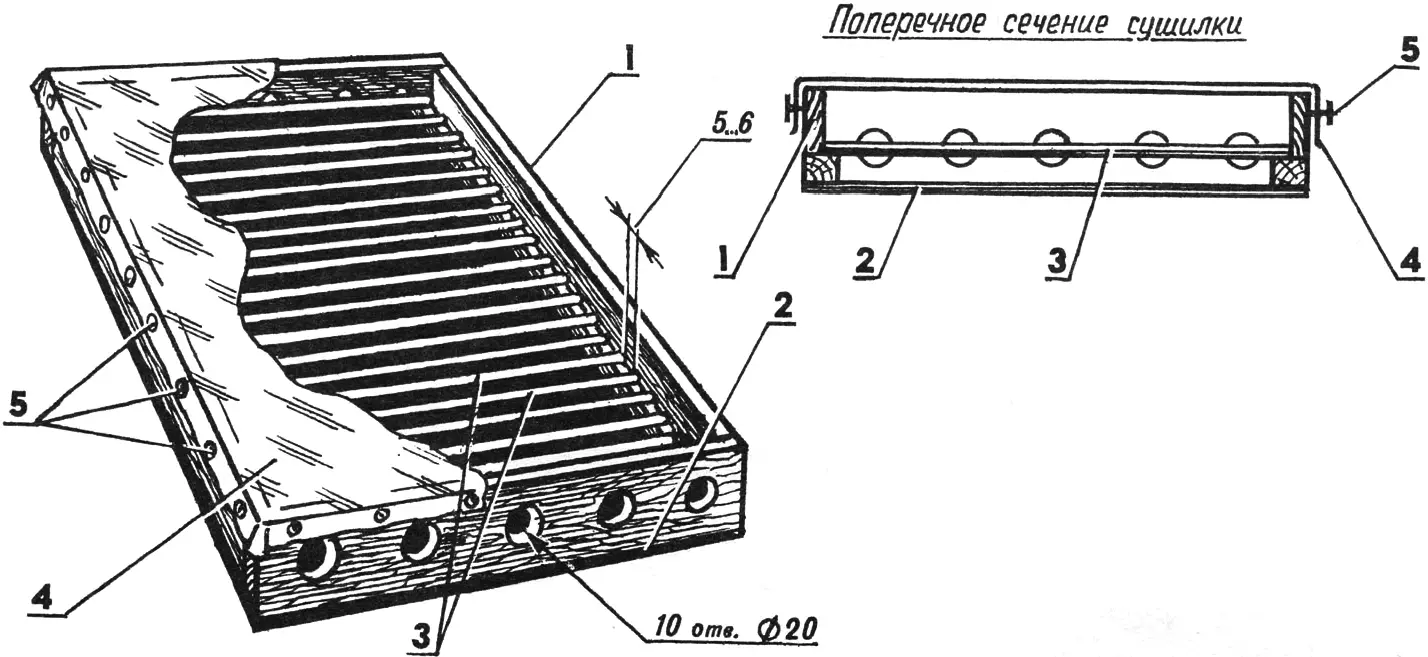
1 — wooden frame; 2 — blackened sheet metal or plywood bottom; 3 — grate rods; 4 — polyethylene film; 5 — stationery push pins
Fumigation is a lengthy and unsafe process, so people try to replace it with so-called wet sulfuration, that is, treatment with an aqueous solution of sulfur dioxide (at a rate of 2—4 g of the substance per 1 l of water). The fruit are held in the solution for 3—4 minutes, and in this case the sulfur content is not so high.
In any case, the prepared fruit are spread on trays (sieves) cut side down and dried either in the sun for 5—8 days (for fruit with stones) and 4—7 hours (for halves), or in an oven, in a kitchen oven, or over a gas burner at a temperature of 85 to 90°C for 30 minutes in three or four sessions with periodic cooling of the fruit and stirring them with a wooden stick.
Apricots dried in the Czech manner have a very distinctive taste. In this processing, ripe apricots are cut in half and the stones are removed. To keep the fruit from darkening, they are placed in water acidified with citric acid, then allowed to dry. After boiling the apricots for 5—10 minutes in sugar syrup (1 kg of sugar per 1 l of water), the semi-finished product is removed from the stove for a day. Then the apricots are taken out, allowed to drain, and dried in the sun or in a dryer: first at 50°C, then at 65°C, and finished at 60°C.
They can also be dried over gas at 60—70°C for 12 hours. Finished apricots are kept in the air in the shade for one or two days, after which they are poured into a paper or cloth bag for storage.
Given the sharp rise in price (and sometimes shortage) of gas, our district long ago switched to homemade solar dryers. Stoneless apricots, for example, dry in such a heliodevice in two or three days; stoneless plums of the “Volgogradskaya” variety take a week.
Cherries, apples, and other fruits also dry well. The temperature in the heliocabin rises to 80°C. The only drawback is that the dryer does not work in cloudy weather. But the product will not spoil in one or two days. If it rains, the fruit do not suffer either, because the dryer is covered with film.
The heliocabin is a wooden frame with a grate in the middle made of slats, lath, or willow rods. The gap between the slats is 5—6 mm. Instead of a grate, stainless steel mesh can be used. Five to eight holes 15—20 mm in diameter are drilled in the ends of the box and covered with fly screen. The frame is lined on the bottom with plywood (particle board is not used — it is toxic!).
Matching the design of the solar dryer, the rules (or rather, the procedure) for using it are simple. Plums and apricots are broken apart, the stones are removed, and they are placed on the grate skin side down. Sliced fruit are simply poured on, leveled, and covered with film secured with stationery push pins. After that, the dryer is placed in the sun tilted toward the south.
“Modelist-Konstruktor” No. 6’2001, N. BULIK, Khmelnytskyi region, Ukraine
Recommend to read
 Useful around the household
The magazine “Modelist-Konstruktor” has published many thematic selections about simple but effective homemade devices that no smallholding can do without (see, for example, issues 7’92,... GLIDER CHAMPION
The triumph of the Soviet athlete V. Extencive in the class of models of gliders ended the world championship in 1973. Short nose and a relatively small shoulder are the main design...
