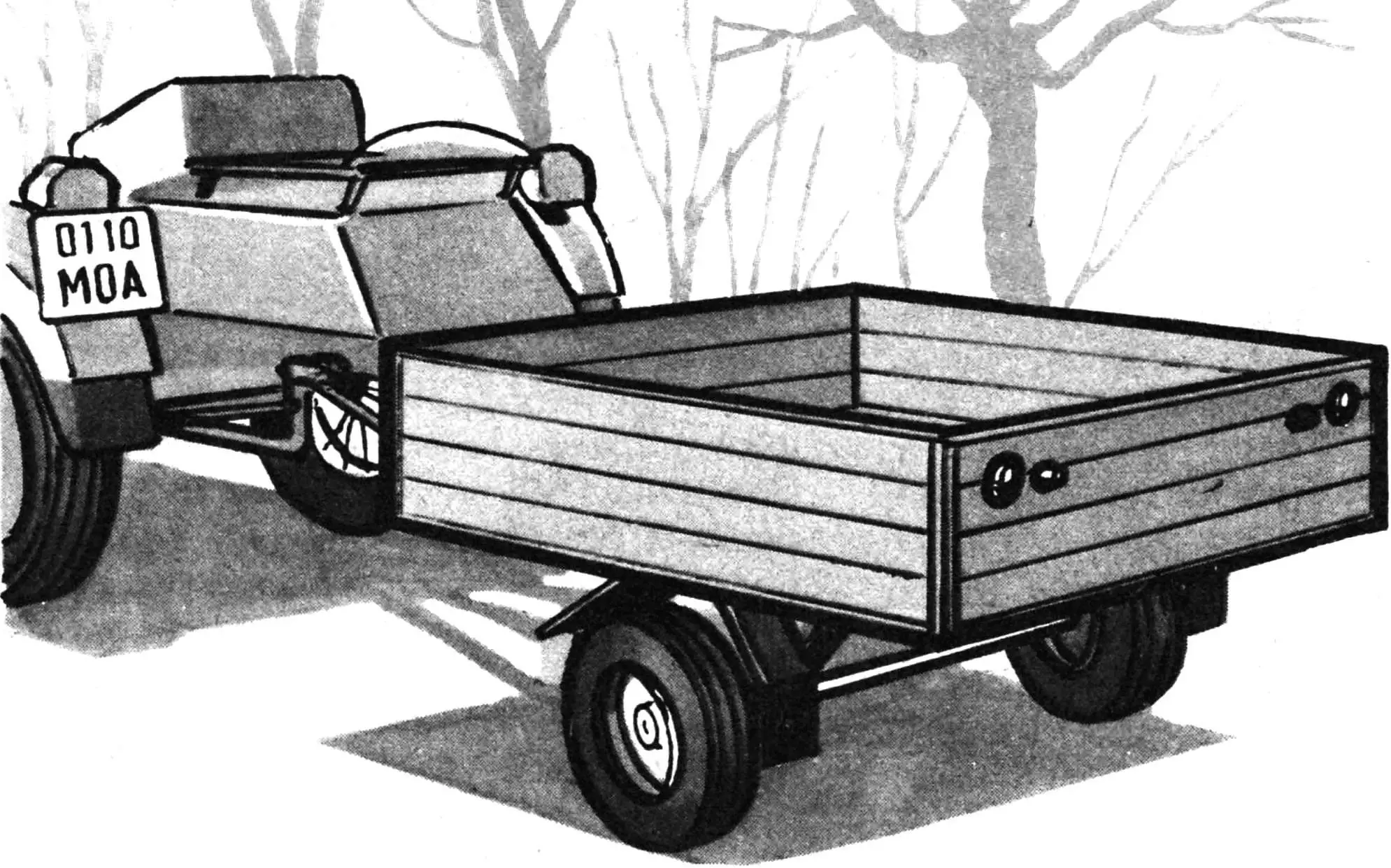
I have been engaged in creating various devices to facilitate work on the homestead plot for many years. However, I have not yet presented my developments to the readers’ judgment; this is my first attempt.
It all started when motorcycle trailers appeared on sale — in particular for the “Voskhod”. This prompted me to build a trailer for my “Jupiter-4K”. In principle, towing behind a motorcycle with a sidecar was never prohibited by the rules.
The trailer I made is suitable for towing by any motorcycle with a sidecar, as well as by the “Muravey” cargo motor scooter. It turned out to be quite successful; soon my neighbor made the same trailer for his “Muravey”.
First of all, I had to modify the sidecar frame. I welded an L-shaped bracket to it, bent from a steel tube Ø60 mm, attaching it to the longitudinal frame tube with two clamps (with welding fixation) and two tubular braces welded to the frame and the bracket. The braces are also water pipes with an outer diameter of 22 mm. The length of the blanks is 600 and 780 mm, however, their final size is adjusted on site.
In addition, a steel tube is welded to the posts on which the sidecar body rests, allowing the rear part of the body to be slightly raised so that its shell does not catch on the L-shaped bracket. It is also necessary to additionally weld a steel gusset to increase the frame rigidity.
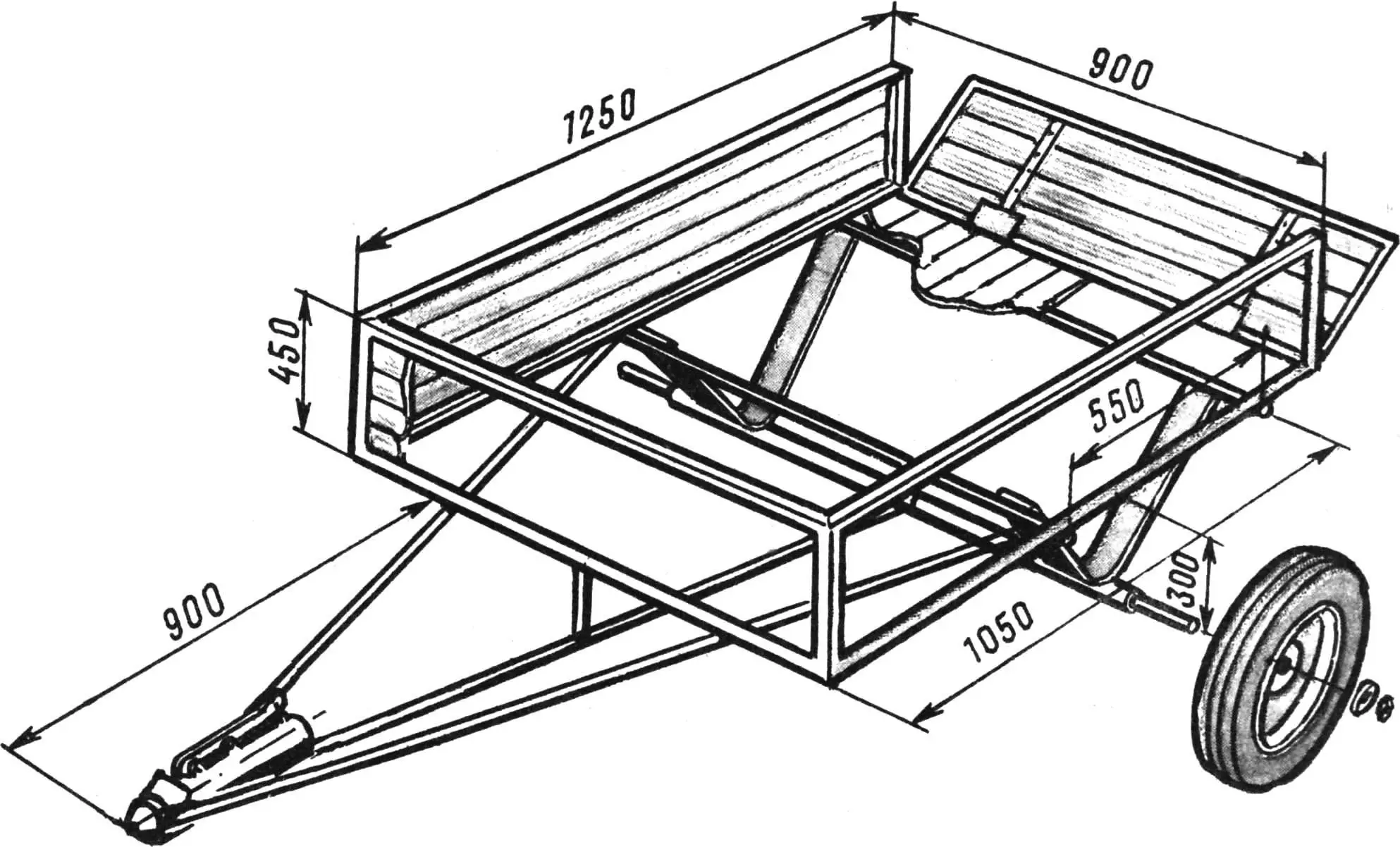
The trailer frame itself is also welded. The drawbar and cross member parts are made from Ø22 mm tube, the trailer axle is a Ø60 mm tube, and steel angles with a flange width of 15 mm were used for the cargo platform. The latter is connected to the axle through V-shaped brackets bent from a steel strip with a cross-section of 7X70 mm.
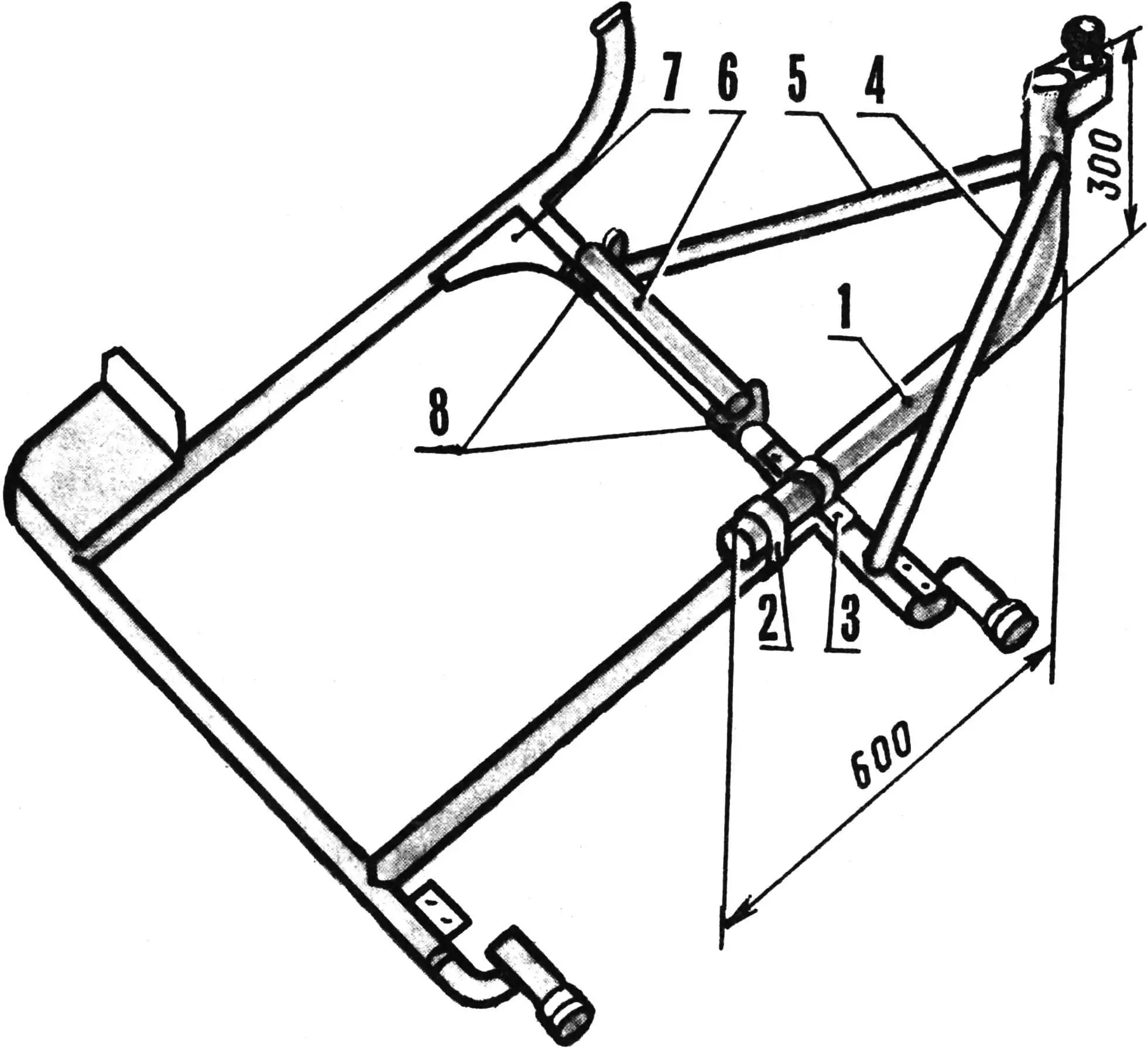
1 — L-shaped bracket, 2 — front clamp, 3 — rear clamp, 4, 5 — braces, 6 — adapter tube, 7 — reinforcing gusset, 8 — posts.
The wheel rims and tires are from the “Muravey” motor scooter, the hubs are from a decommissioned seeder; after trimming, they perfectly mated with the rims.
The bottom and sides of the body are sheathed with ordinary planed tongue-and-groove boards (attached to the frame with screws). The rear side can be opened and removed if necessary, as it is hung on ordinary door hinges.
The trailer has all the necessary lighting equipment: stop signal lights, turn indicator lights, as well as clearance lights. Reflectors are installed on the fenders.
Its weight is about 55 kg. The maximum load capacity is up to 350 kg, however, according to the rules, it should not exceed 50% of the towing vehicle’s weight. The “motor train” reaches speeds of up to 60 km/h. Brakes are not provided, since the motorcycle’s brake system is quite capable of braking — of course, if it is well adjusted and the sidecar brake is engaged.
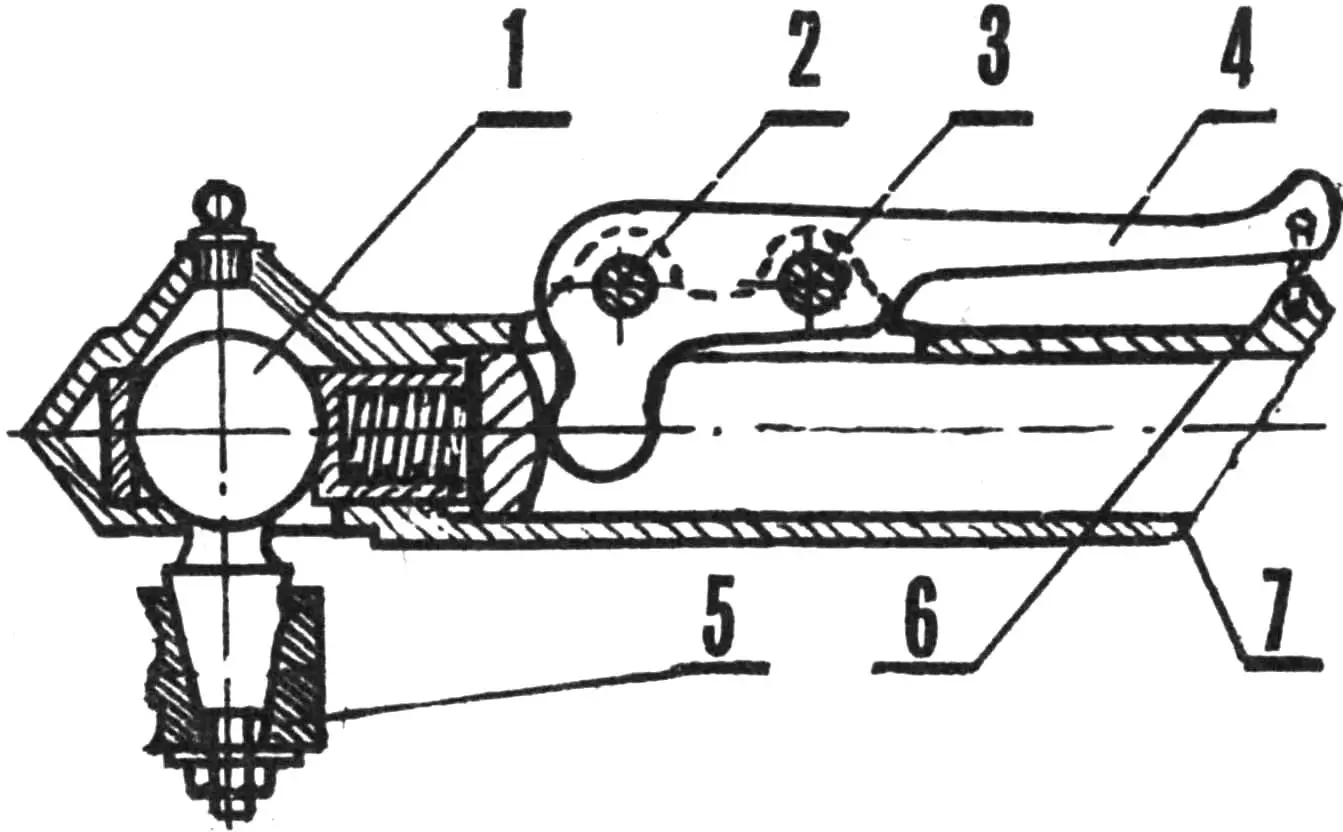
1 — ball (steel Ø50 mm), 2 — locking lever axis (steel, Ø12 mm), 3 — stop (steel, Ø10 mm), 4 — locking lever (steel, thickness — 15 mm), 5 — drawbar installed on the towing vehicle, 6 — lock washer, 7 — hitch housing.
This trailer has been in operation for more than four years and is still serving me well. There were no significant breakdowns or problems when using the trailer with the motorcycle. The “motor train” remained as mobile and maneuverable as the motorcycle itself. The use of the trailer did not affect the engine either. It still works reliably, steadily, does not overheat, and did not require any modifications.
I think my homemade product will interest those owners of motorcycles with sidecars who live in rural areas. There are countless transport tasks on the homestead. Whether it’s bringing hay, taking potatoes to a collection point, or delivering fertilizers — everywhere a cargo vehicle is needed. Meanwhile, nowadays, almost every second yard has a motorcycle with a sidecar, spending its 20—30 hp only on serving the driver and passengers. So isn’t it time to put these horses to work?
FROM THE EDITORIAL BOARD. The trailer for a motorcycle with a sidecar, designed and built by our reader V. Sedov, has one significant drawback — its hitch does not meet the standards required for such units by the traffic police. Therefore, the editorial board considered it necessary to depict on the drawings a trailer with a standard hitch (ball joint).
V. SEDOV
Recommend to read
 SANDING PAD
When grinding surfaces usually use bars wrapped around or nailed sandpaper. It is impractical, often have to throw away the pieces with a wide, completely untouched edges. We offer... WITH A ROPE
in the construction of garden houses, flooring, poloa often ispolzuyutsya shields composed of slats or strips. To ensure a snug fit to each other by using a simple device consisting of...
