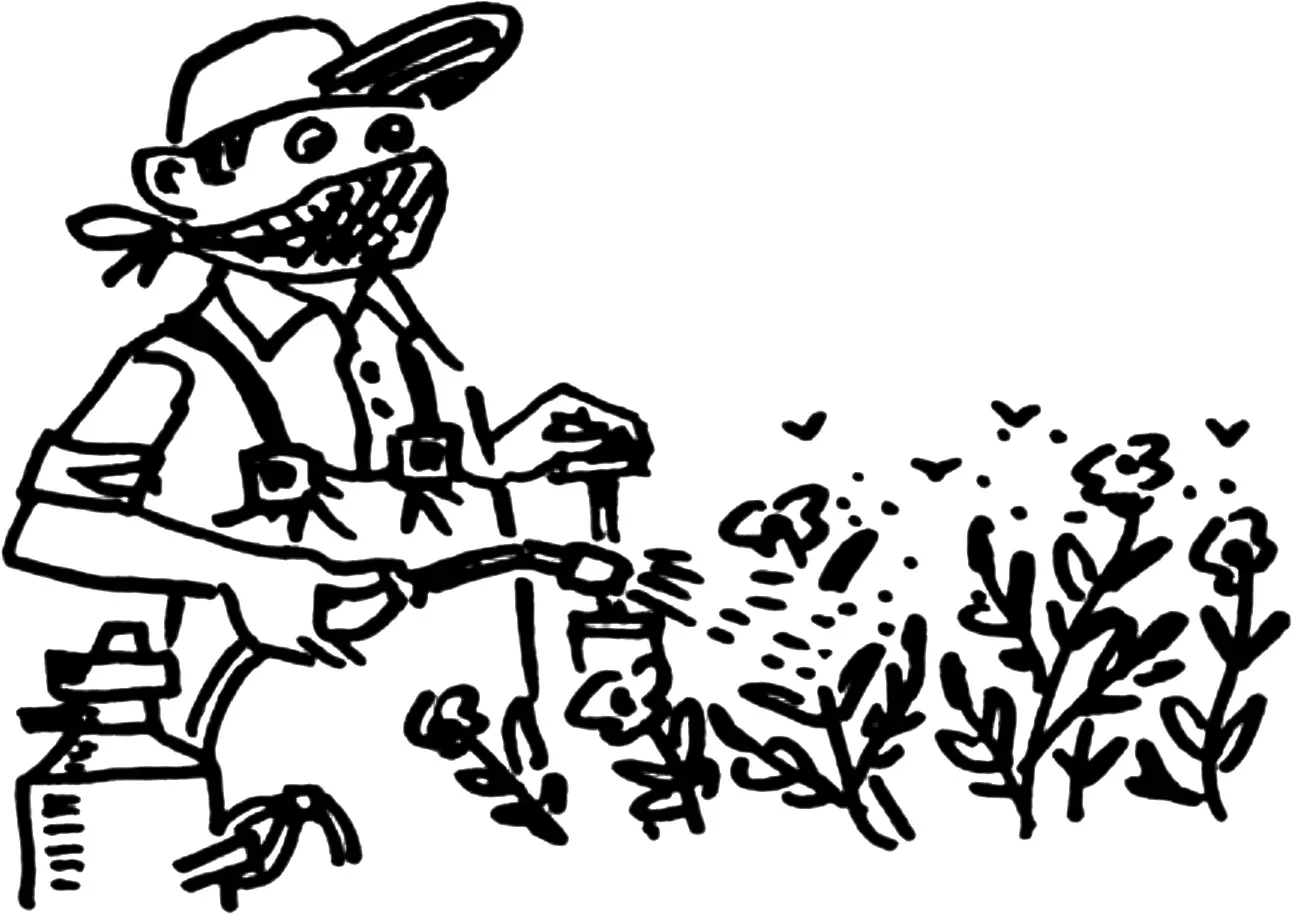
There are many different tools, devices, and pieces of equipment whose value is determined primarily by their practical purpose, while their appearance and technical aesthetics are of secondary importance. It seems that the garden sprayer belongs to this category — an apparatus used to spray chemicals in the fight against plant pests. If you have at least basic metalworking skills, you can make a sprayer yourself from a suitable container. In terms of operating principle and technical parameters (capacity, output, and so on), it differs little from those offered by industry.
A foam fire extinguisher that has served its time is very well suited for making a sprayer. First, it has an optimal capacity for manual plant treatment, and second, converting it requires only minor modifications.
First of all, after unscrewing the cap, we empty the extinguisher, observing all safety precautions. Then we remove the lever from the cap itself, and weld up the hole through which the stem passed (if welding is not available, the hole can be riveted, threaded and plugged with a screw, filled with sealant, and so on). We insert a rubber gasket inside the cap.
Next, we unscrew the nozzle from the neck of the extinguisher body, and in its place, placing rubber washer-gaskets on both sides, we install a valve from a motorcycle inner tube (one from an automobile tubeless tire will also do). We pre-bend the outer washer to match the radius of the extinguisher shell.
Then, in the lower part of the cylinder, 10—15 mm from the bottom, we weld on a pipe 50—60 mm long and drill a hole in the extinguisher wall to match its inner diameter. This operation can also be done in reverse order: first drill the hole, and then weld the pipe to that spot. If welding is not available, the pipe can be connected to the cylinder with a threaded joint.
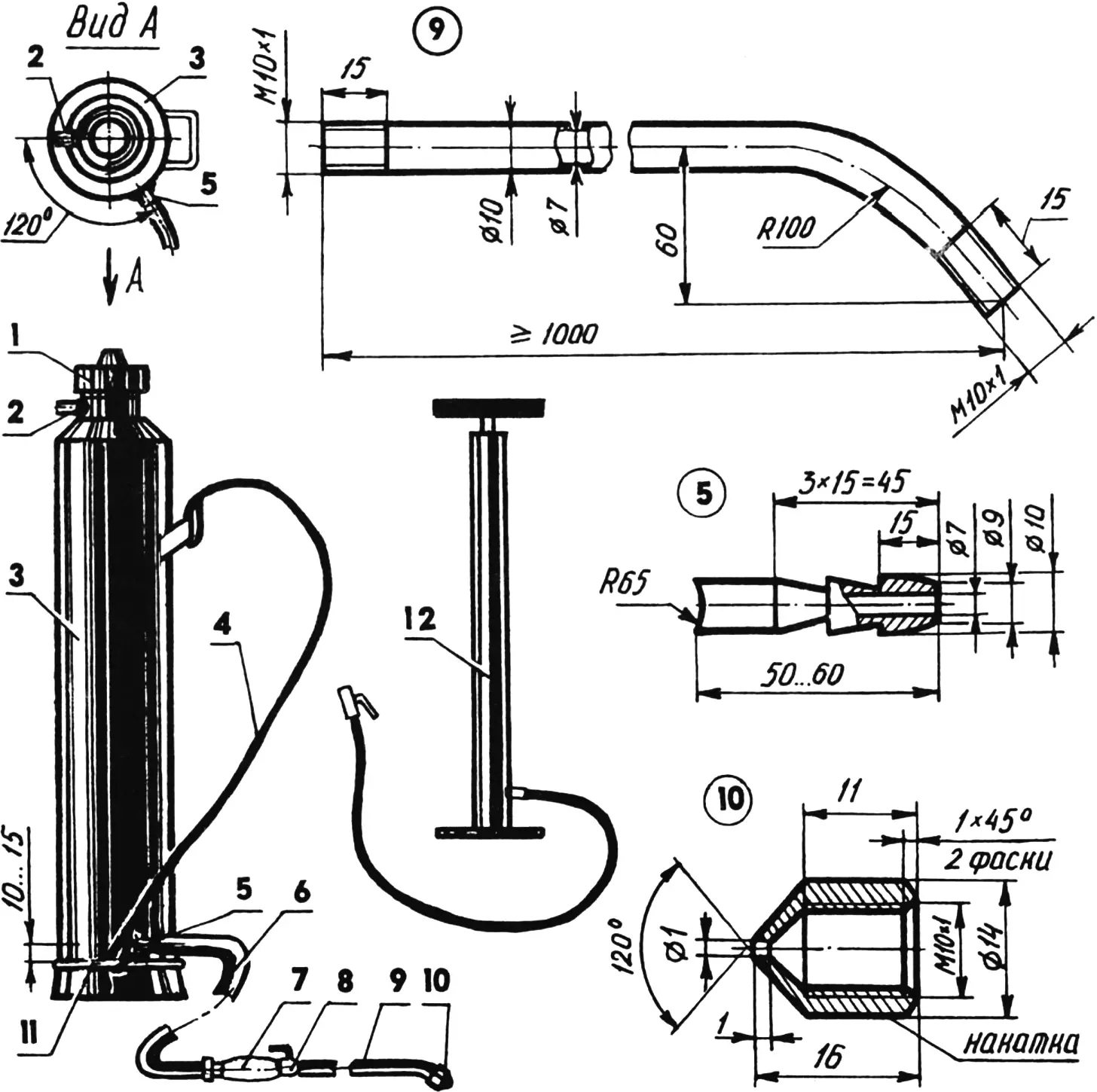
1 — cap (not shown on view A for clarity); 2 — valve (from a motorcycle inner tube); 3 — cylinder (from a foam fire extinguisher); 4 — strap; 5 — pipe (steel tube 10×1.5); 6 — rubber hose with two clamps; 7 — handle (wood); 8 — two-position tap with M10x1 thread; 9 — spray tube (steel tube 10×1.5, L1000); 10 — spray head (bronze); 11 — wire clamp (wire Ø3); 12 — hand pump
The outer diameter of the tube must not exceed 10 mm; otherwise, a hose with a larger inner diameter will be required, which will reduce pressure in the system.
It is better to place the pipe to the side relative to the valve. In this position it does not interfere with carrying the sprayer, and the flexible rubber hose connected to it does not kink. We attach the spray tube to the other end of the hose. We make it from the same tubing as the pipe.
The spray tube should be at least 1 m long. This makes it possible to treat not only tall plants and trees, but also protects the operator from splashes and fumes of the solution.
At one end of the spray tube we make a handle and, next to it, a tap (preferably two-position: open — closed), and at the other end — a spray head. It is best to make this part from bronze or brass. For convenient spraying, we slightly bend the free end of the tube.
For transport in backpack position, we attach one or two straps to the sprayer: one end of each to the upper handle, and the other to a clamp (wire twist) encircling the band between the cylinder and its lower false bottom.
To fight pests, with the tap on the outlet hose closed, we pour about 5 liters of solution into the cylinder (approximately two-thirds of the vessel’s volume) and screw the cap on tightly. Then we connect the pump hose to the valve and make 70—80 strokes. If there are no air leaks from the cylinder (except through the nozzle when the tap is open), this pressure is sufficient to spray the entire volume of solution. If solution remains in the container after spraying is finished, we pump in more air.
After finishing work, we release the air from the sprayer by slowly unscrewing the cap, drain the solution from the cylinder, and rinse the entire system with water, which is then poured out in a safe place.
It is worth reminding you to observe safety precautions. When spraying plants, work in a respirator, goggles, and rubber gloves, and position yourself on the leeward side of the plants.
“Modelist-Konstruktor” No. 5’2003, D. POTAPOV
Recommend to read
 VYZHIGATEL IN A NEW ROLE
Why would a self-similar wheels protector? Go RC micromachines on the asphalt, the dirt it knead not necessary. But let's see what kind of speeds these cars run, what turns them brought... THE VICTORIOUS OPPOSITION
The real work of creating a new heavy tank in the program Panzerkampfwagen VI began in late January 1937, when the company Henschel was commissioned and started to design the combat...
