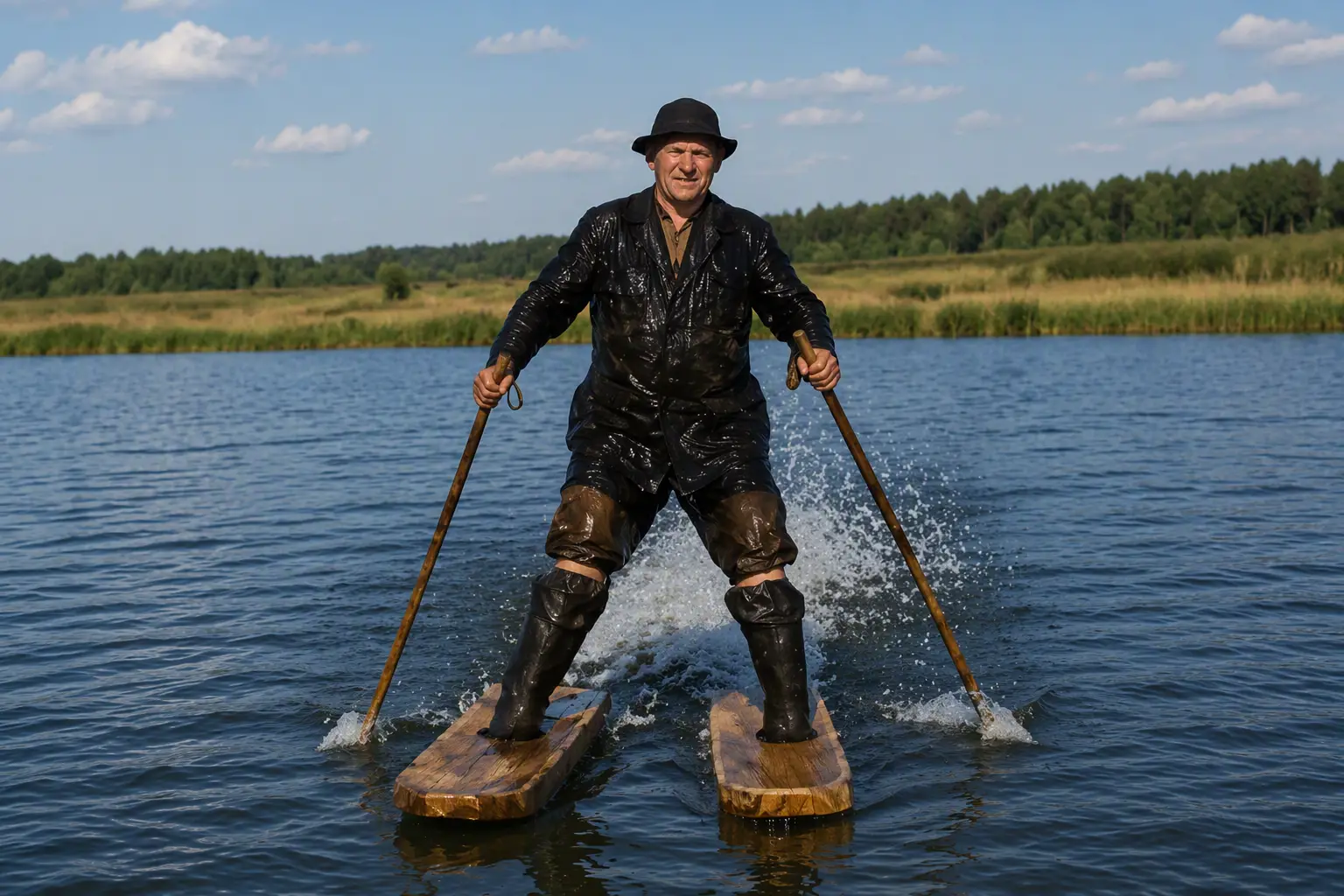
I live in Siberia and have been fond of hunting and fishing for a long time. Our places are wonderful. There are many rivers and lakes rich in fish and game.
I love hunting waterfowl most of all. But sometimes it is impossible to get it: impassable bogs, floodplains, quaking bogs, impenetrable reeds.
I thought a lot about how and on what to get there after the game. And I settled on water skis of a special design. Only on them can you go everywhere. But what to make them from? The search began.
The first version was like this: wide wooden skis, and on top — several volleyball inner tubes. These skis had buoyancy, but the tubes got in the way. I also tried another option: riveting containers from thin sheet metal — again, not the right thing.
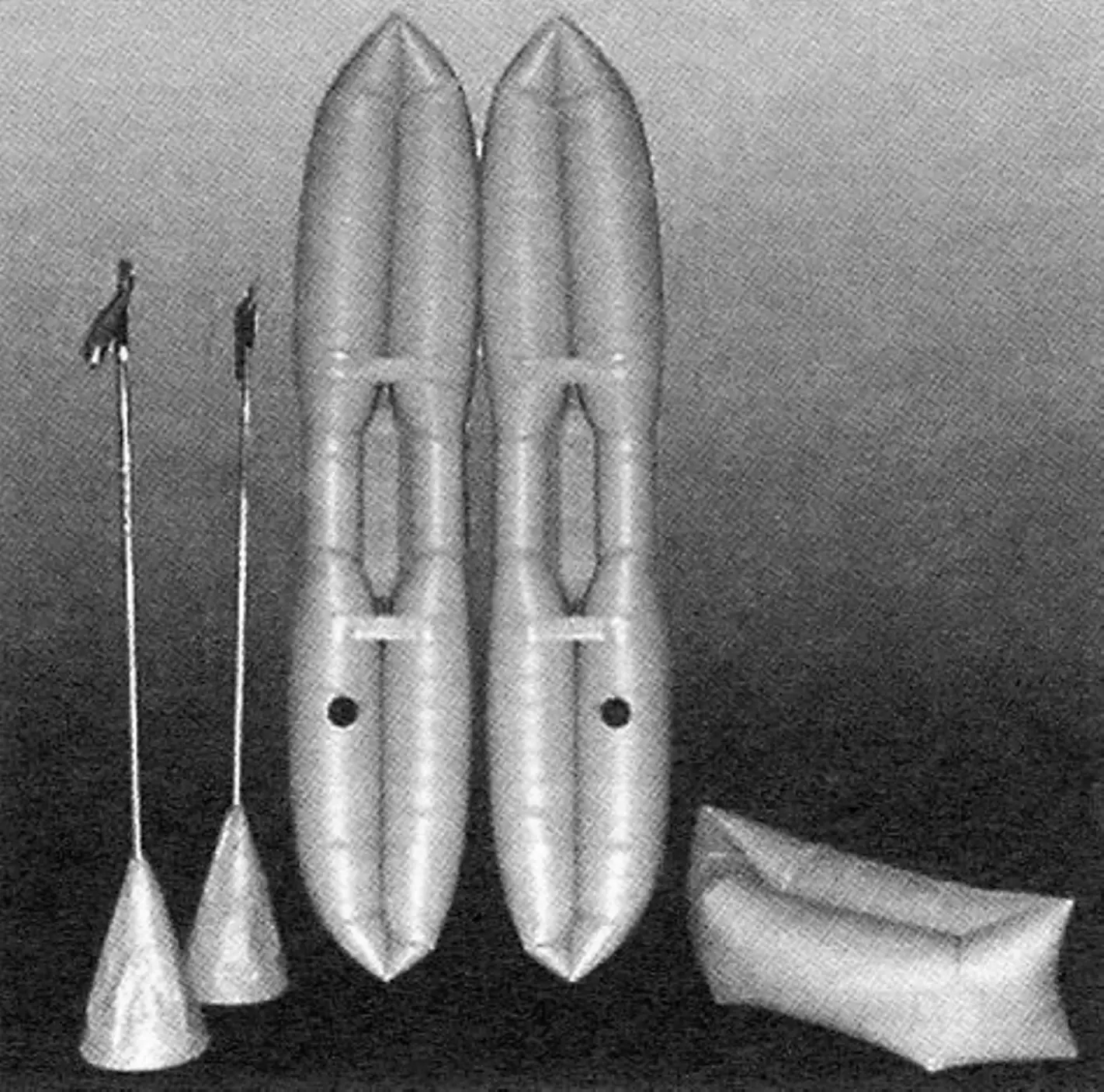
But somehow I got hold of foam plastic. It turned out to be exactly the material I had been subconsciously looking for so long. The first experiments confirmed this.
I started with a model. I molded a little man from plasticine, weighed him, placed him on miniature foam skis, and checked buoyancy in a bathtub with water. I calculated so that half of a ski could support a person’s weight.
Then I moved on to designing full-size skis. They turned out excellent. I am very pleased with them. Light, convenient, maneuverable. For several years now I have been hunting and fishing on them: everything is on foot, and my hands are free — I do not need helpers.
I remember my first “ski” outing on the lake. The whole village came out to the shore: how interesting! A man is walking on the lake on foot! After all, the skis are not visible from a distance.
Three fishermen came up on dugout boats: “Aren’t you afraid! The depth here is up to 30 meters.” But then they were convinced that my skis are more reliable than their dugouts.
People who wanted them began to crowd around me and advised me to make drawings. I made them and decided to offer them to the readers of your magazine.
I tried to make it so that my skis could be used not only for hunting or fishing. I think they should also be used for sports and rescue purposes: after all, one pair of skis can keep 8–10 people afloat.
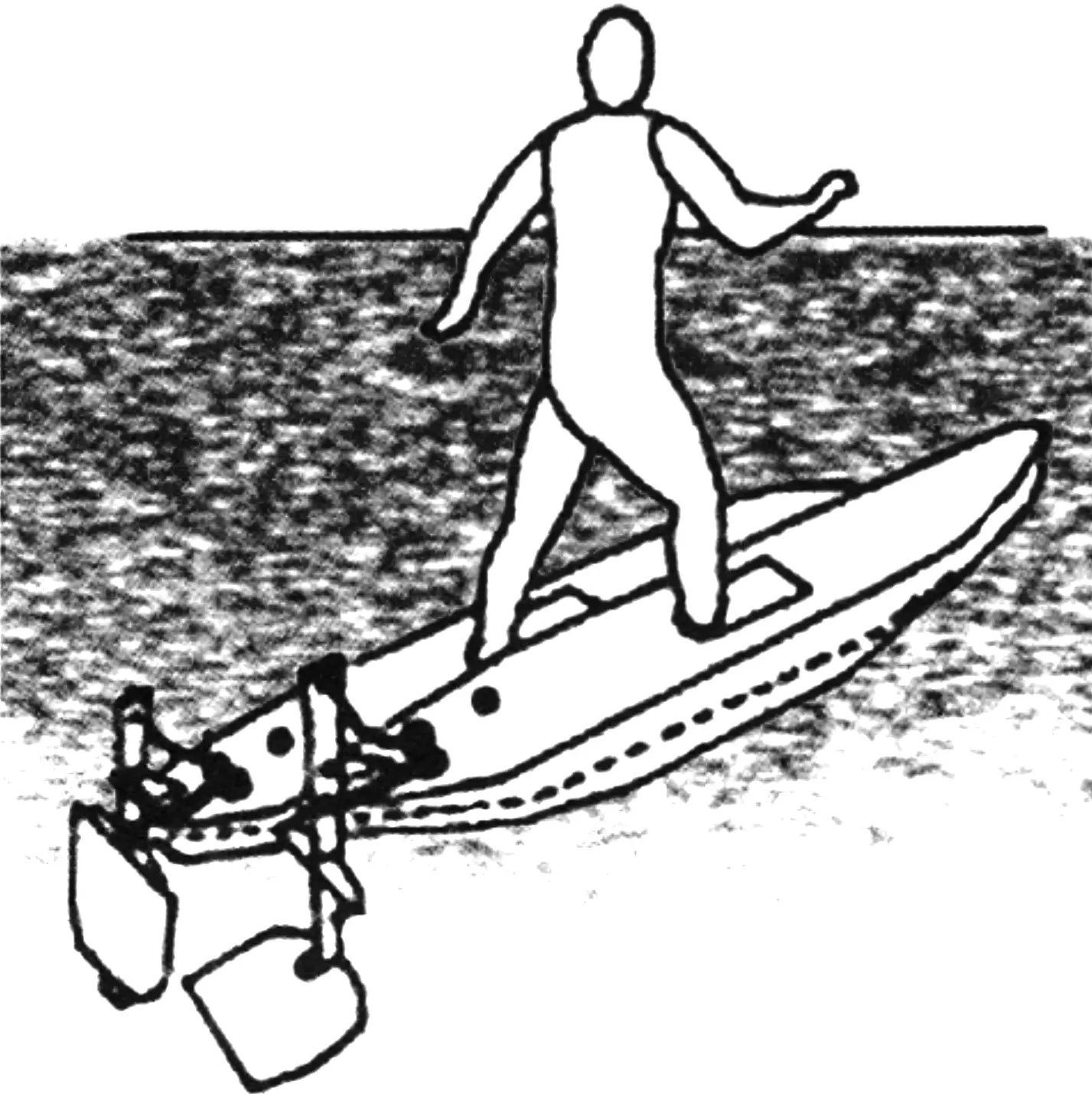
Water skis can be made from a light porous material — foam plastic. Then their total weight with poles will be only 9.5 kg. That is twice as light as a folding boat.
Making the skis is not difficult. We take three sheets of foam plastic 900×900×90 mm and cut each into three parts (foam plastic cuts, saws, and planes well on a woodworking machine). We get nine pieces. Eight go for the skis, and the ninth — for the seat of the catamaran. They need to be glued into a block with epoxy resin, having first given the plates a smooth surface.
Each ski is assembled by the bricklaying method; the blocks are joined to each other with wooden dowels, which give the structure additional strength. They are glued into the foam body with epoxy resin. All ski parts are fastened with the same resin using screws screwed into wooden plugs. After assembly, the skis are coated with casein glue and painted to match the prevailing vegetation on the water body.
The left (1) and right (2) skis (Fig. 1) have holes 20–25 mm in diameter on the inner side, into which duralumin tubes (3) — sockets for posts — are inserted with glue. Cross angles (4) with nuts are built into the front and rear parts of the skis — for assembling the skis into a catamaran. A removable duralumin angle (6) 35×35×1000 mm is fixed on the inner side, with four holes 7–9 mm in diameter for assembling the skis into a catamaran. An eye bolt (9) is riveted in the center of this angle — for attaching a safety line (10). This is for beginners (later such a cord is not needed).
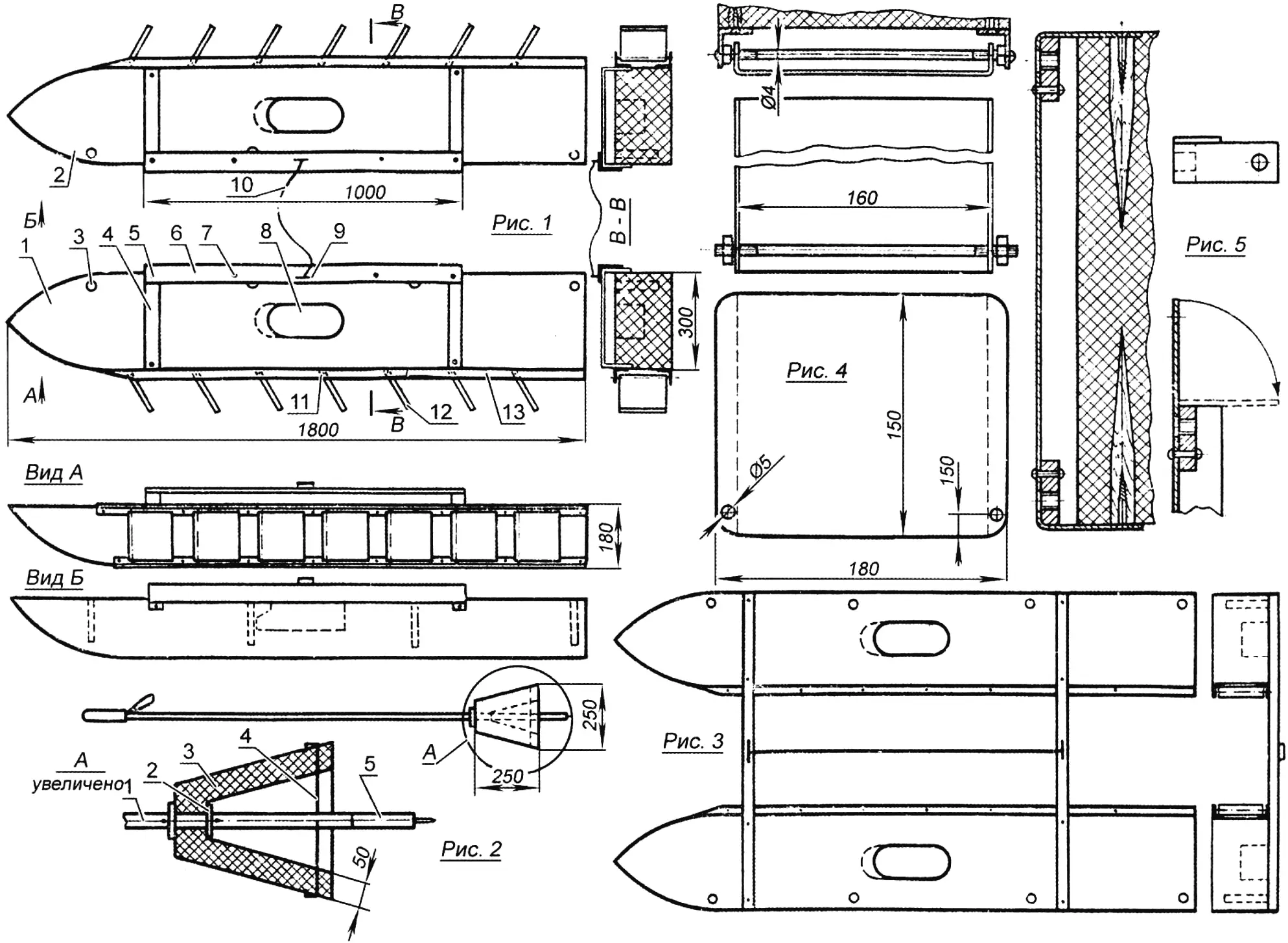
1 — 2 — left and right ski bodies; 3 — sockets for posts (duralumin tubes Ø22 mm); 4 — cross duralumin angles; 5 — M6 or M8 bolts for assembling the skis into a catamaran; 6 — removable duralumin angles; 7 — mounting holes for bolts 5; 8 — foot recess; 9 — eye bolt; 10 — nylon line; 11 — blade mounting post with outer angle; 12 — hinged blade; 13 — outer duralumin angle.
A — side view from the outside; B — from the inside
Fig. 2. Pole for water skis:
1 — duralumin tube; 2 — support and locking rings; 3 — hollow foam cone; 4 — wire centering tie; 5 — tip from a ski pole
Fig. 3. Catamaran made from water skis
Fig. 4. Blade pattern and its mounting
Fig. 5. Cross angle mounting
On the outside of the skis (Fig. 1A), two angles measuring 20×20×1500 mm — upper and lower (13) — are attached with epoxy resin and screws. Posts (11) with small “fin” blades (12) are fixed on them. They provide the push on the water: when the skis move forward, each flap is pressed down, and when pushing off, they move away, resting like oars almost perpendicular, which creates the pushing effect.
Poles for the “water walkers” are made from ordinary ski poles, but instead of a support ring, a hollow foam cone is installed, which is secured with rings and cotter pins (Fig. 2).
To assemble the skis into a catamaran (Fig. 3), the left and right skis must be swapped so that the blades end up on the inside, between them.
Next, bolts (5) are unscrewed, and the longitudinal duralumin angles (6) are detached — they become crossbars: one in front, the other in the back. They are screwed on with the same bolts (5) to nuts built into the cross angles.
When assembled into a catamaran, holes (3) on the skis will be on the outside. If small sticks are inserted into them and a canvas deck is stretched, it is convenient to place your load on it — a duffel bag, ammunition, fishing tackle. The canvas deck can also serve as a sail, and the ski poles — as its fastening. By placing the poles in different holes, we adjust the direction of the catamaran’s movement under sail.
A hunting blind is also easy to assemble from these skis. Poles 1–1.5 m long are installed in the holes (depending on the desired height of the shelter).
Then take a nylon net 1–1.5 m wide and 10 m long (such a net takes up no more space than a tin can and weighs 150–200 g). Stretch it over the poles around the perimeter, in one row. Camouflage material is poured onto the net: grass, hay, reeds. A second row of netting is thrown on top — to secure the camouflage layer. You get a floating blind from which it is convenient to hunt anywhere on the water body. From it you can also set out decoy ducks or stuffed birds and pick up shot game.
After hunting, the catamaran will serve you overnight as a tent: you only need to stretch a cord over the poles, and on top — a light canvas cover or film. Unneeded camouflage material is laid on the canvas floor — and a shelter for two is ready. You can sleep on the water, in the reeds.
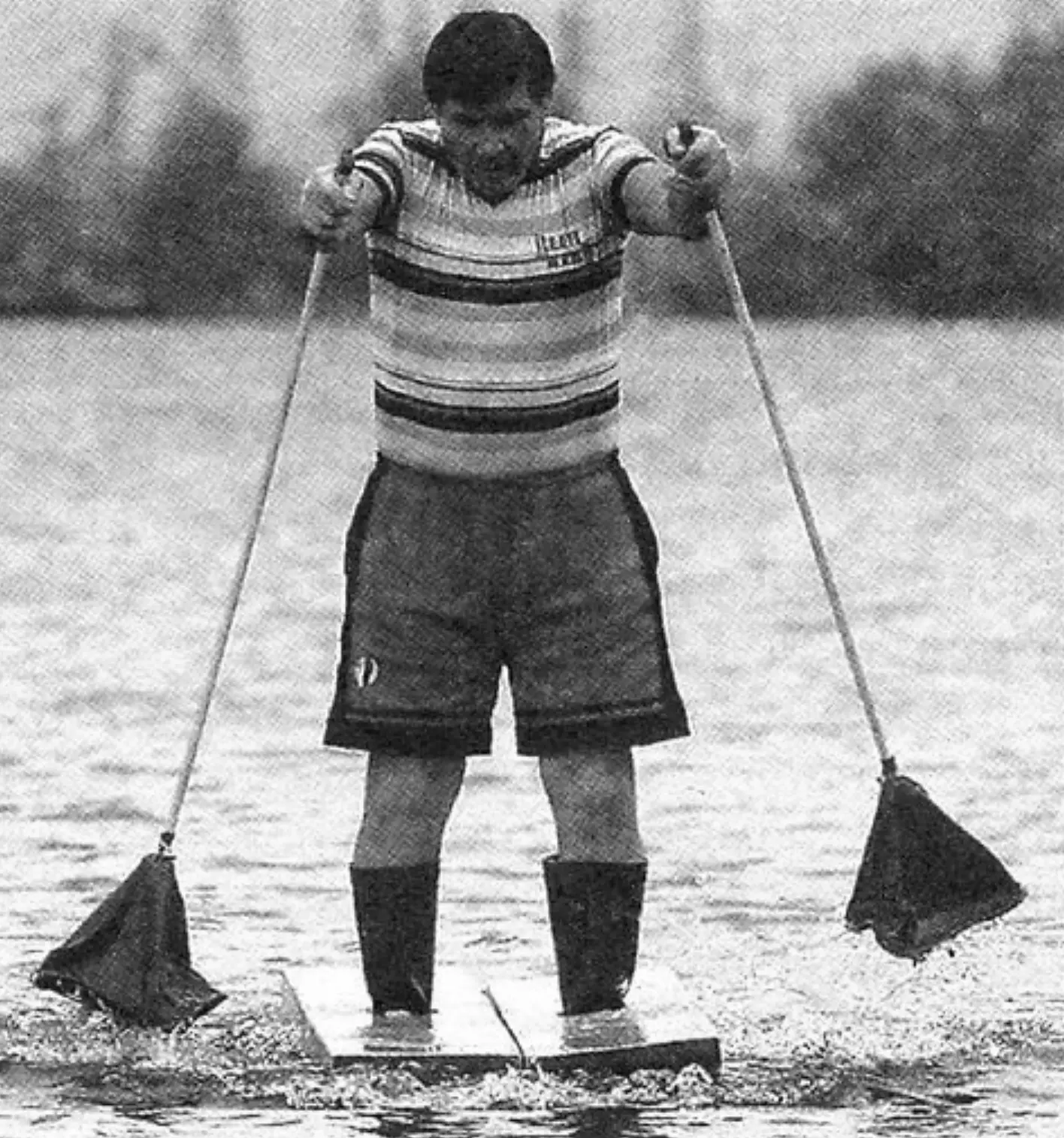
I made the first skis with the blades mounted underneath. However, I later moved them to the sides. With lower “fins,” it is good to move over open water: the push is effective; but it is harder in floodplains, quaking bogs, and reeds. With side-mounted blades, you can move both over clear and over overgrown water bodies. On my skis I make my way where you cannot walk or drive on anything else. I assemble a catamaran from them in 2 minutes, a blind in 20 minutes, and a tent from the blind in 5 minutes.
I plan to make the next version of the skis even lighter and, without reducing load capacity and stability, increase travel speed and maneuverability.
“Modelist-Konstruktor” No. 8’2015, A. RUSANOV
Recommend to read
 FORGE OF THE SIX BRICKS
The tinkerers are often faced with the need to forge some tools or household items. A temporary forge is easy to make from scrap vehicles. Enough six refractory bricks, blowtorch and... MIRACLE-TERRAIN VEHICLE
I created the all-terrain vehicle (developed design and manufactured a working model) is designed for movement in cross-country. The Rover has a two-piece articulated frame and wheels in...
