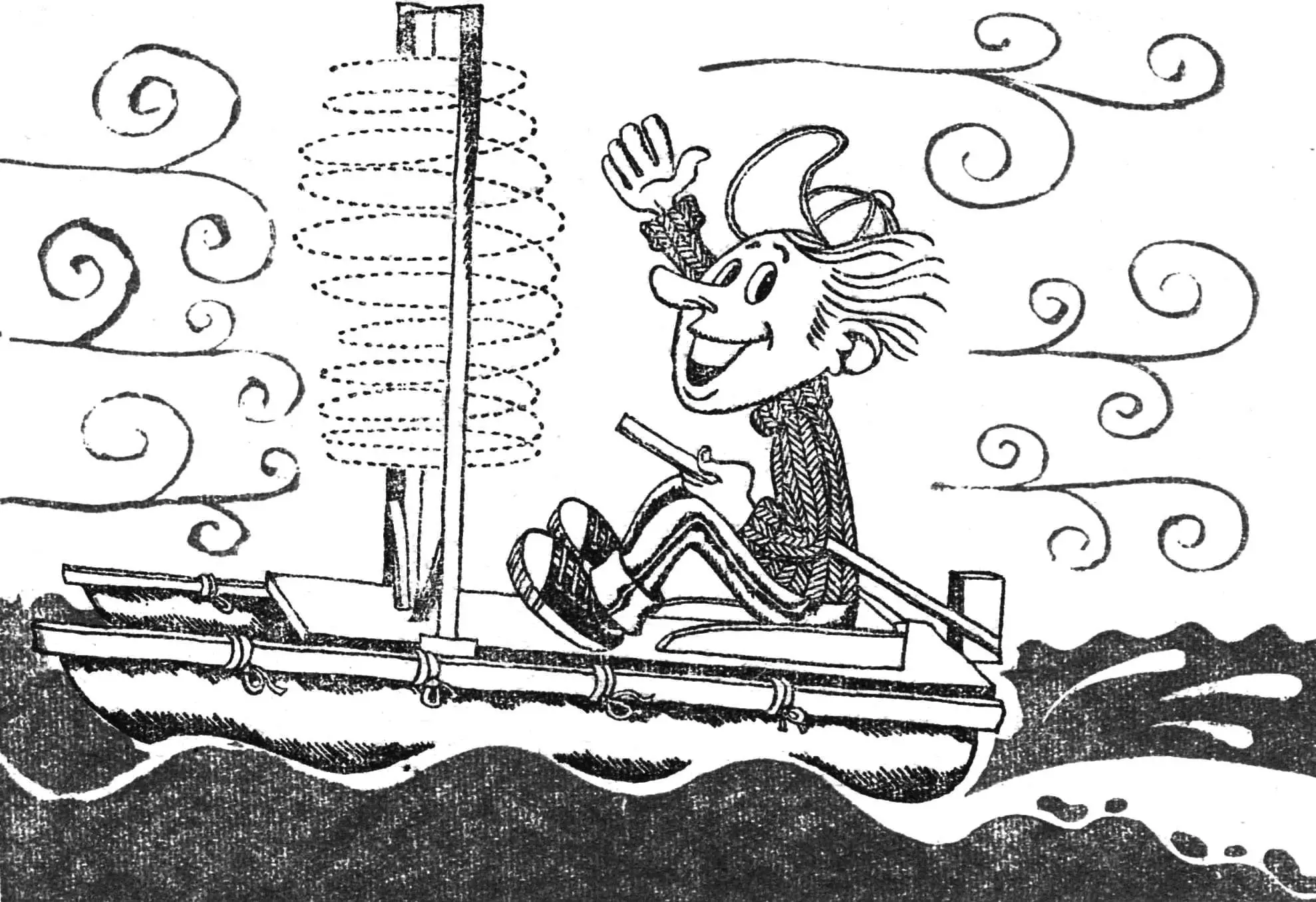
I would like to tell the readers of the magazine about a catamaran whose movement was achieved using the Magnus effect.
The Magnus effect consists in the fact that when a rotating body is flowed around by an air stream, a force is formed that is perpendicular to the direction of the stream. When a cylinder rotates, for example, the air layers close to its walls also begin to move in a circle, due to which on one side of the rotating body there is an increase in the speed of the stream flowing around the cylinder, and on the other side — a decrease. As a result, zones of increased and decreased pressure are formed near the surface of the cylinder, which leads to the formation of a force that can be used for the movement of vessels. This is the same force that changes the direction of flight of “cut” balls in tennis and football.
In order to reduce the flow of air from the high-pressure zone to the low-pressure zone, disks of larger diameter are installed on the ends of the cylinder.
Experiments have shown that the Magnus effect manifests itself most strongly when the linear speed of the rotating surface of the cylinder is approximately four times greater than the wind speed. In this case, the rotor thrust is ten times greater than the thrust of a sail of equal area.
In the twenties, two large-tonnage vessels were equipped with similar rotors. They even made transatlantic voyages, but were not built further, largely due to the bulkiness of massive metal rotors, which could cause the vessel to capsize in strong winds.
…Once, while vacationing at the Krasnoyarsk Reservoir, I, with the help of friends N. Beskrovny and V. Brin, built a catamaran with a collapsible soft rotor. We had only three weeks at our disposal, so we had to make a less efficient Savonius rotor, which does not require an engine.
The Savonius rotor consists of two semi-cylindrical surfaces shifted relative to each other by the length of the radius.
Under the action of wind, the rotor rotates, and its linear speed does not exceed 1.7 times the wind speed. Because of this, the Magnus effect on the Savonius rotor manifests itself 2—3 times weaker than on forcibly rotated rotors.
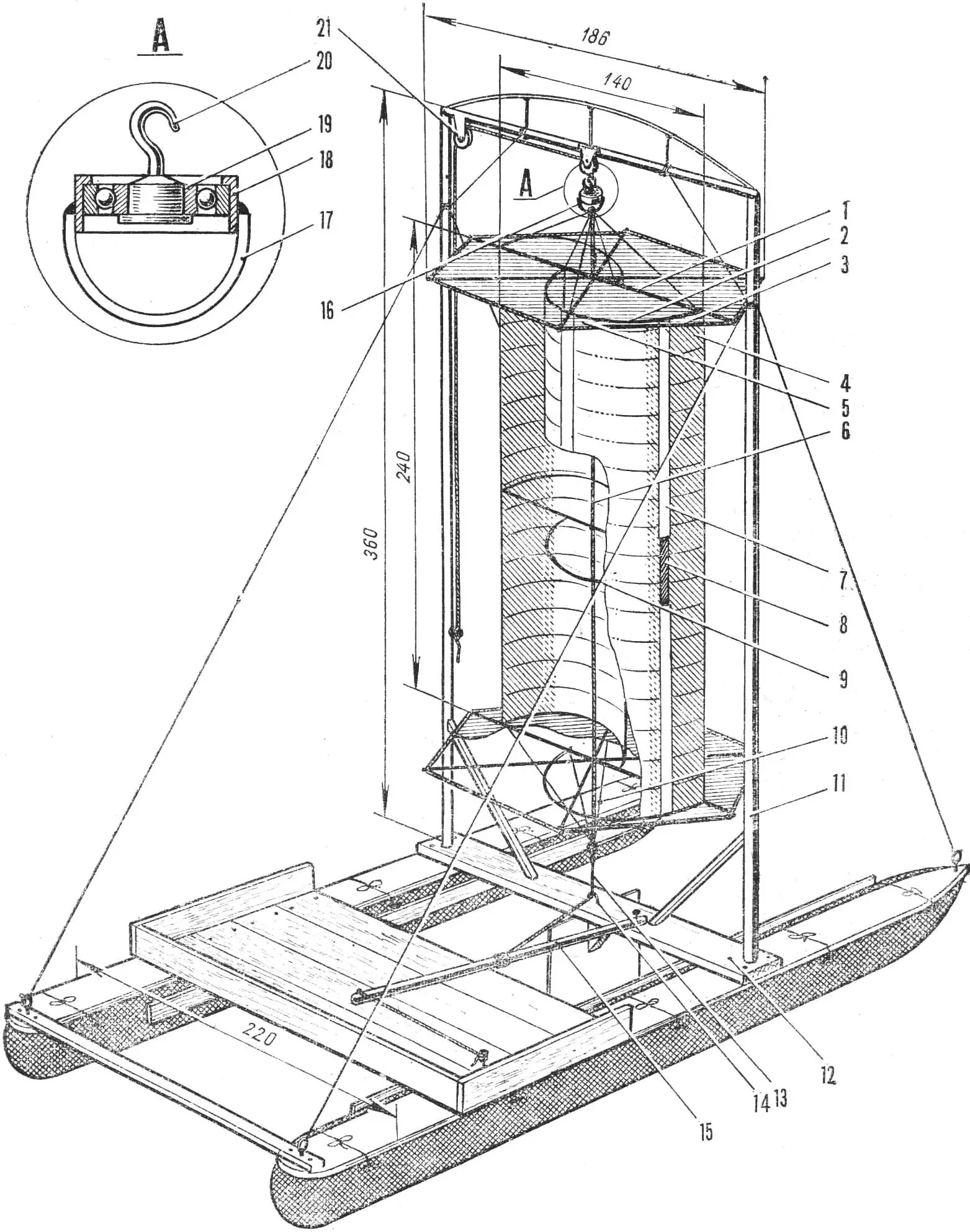
1, 2 — top of half-frame, 3 — rotor disk frame, 4 — rotor panel, 5 — disk panel, 6 — rope rotor axis, 7 — fabric strips, 8 — soft frame (medical rubber bandage), 9 — rigid half-frame, 10 — rope stays, 11 — U-shaped mast-support, 12 — catamaran cross beam, 13 — lower tension cable, 14 — beam bracket, 15 — tension cable lever, 16 — rotor suspension, 17 — suspension bracket, 18 — bearing housing, 19 — bearing, 20 — suspension hook, 21 — block. Rudder is conventionally not shown.
The rotor (see fig.) consists of two frames — disks and semi-cylinders, welded from rod Ø 10 mm. The rods forming the frame of the semi-cylinders are connected to each other by panels of dense fabric. The ends of the frame of both disks are tightened with rope. The hexagons formed at the top and bottom are covered with canvas. The rotor axis is also a rope, which allows the sail to be folded.
Two fabric strips are sewn to each of the panels, under which rubber medical bandages 6 cm wide and 80 cm long are passed; their ends are tied to the rods. A rigidity frame made of steel rod Ø 4 mm is attached to the panels. The flexible axis and ropes that provide rotor tension are tied to mounting brackets connected to support bearings. We used ordinary ball bearings; they fully justified themselves — the rotor rotated at the slightest breath of wind.
The catamaran floats are canvas covers. Each contains three balloons made of rubberized fabric (ball chambers can also be used). We tied the floats to a frame knocked together from driftwood (there is a lot of it on the shores of the Krasnoyarsk Reservoir). The construction of the catamaran hull is not described in detail, since the almanac “Boats and Yachts” has repeatedly told about inflatable catamarans of better design than ours.
The rotor is installed as follows. First, it, tightened with rubber bandages, is raised up using a rope passed through the blocks of the U-shaped support. Then it is tensioned manually with a rope passed through a ring fixed in the catamaran beam. The last 15—20 cm of rope have to be pulled out with a lever.
We tested the catamaran for 10 days in very light winds. We considered the wind strong if a 30 cm long thread deviated by 30—40°.
In such wind, the catamaran drifted and could not sail at an angle sharper than 100—110° relative to the wind. To change tack, it was necessary to turn the rotor over, which took us 5—6 minutes.
We did not measure the speed, but the following summer the same catamaran sailed with a regular 6 m² sail approximately the same as with the rotor, however, with the sail it tacked better.
We do not recommend our catamaran as a model for exact copying, since a number of structural units turned out to be unsuccessful. For example, the edges of the end disks should have been made from rod or plastic tubes. Our experience only testifies to the possibility of building by amateurs a vessel with a very original and, in our opinion, promising method of creating thrust.
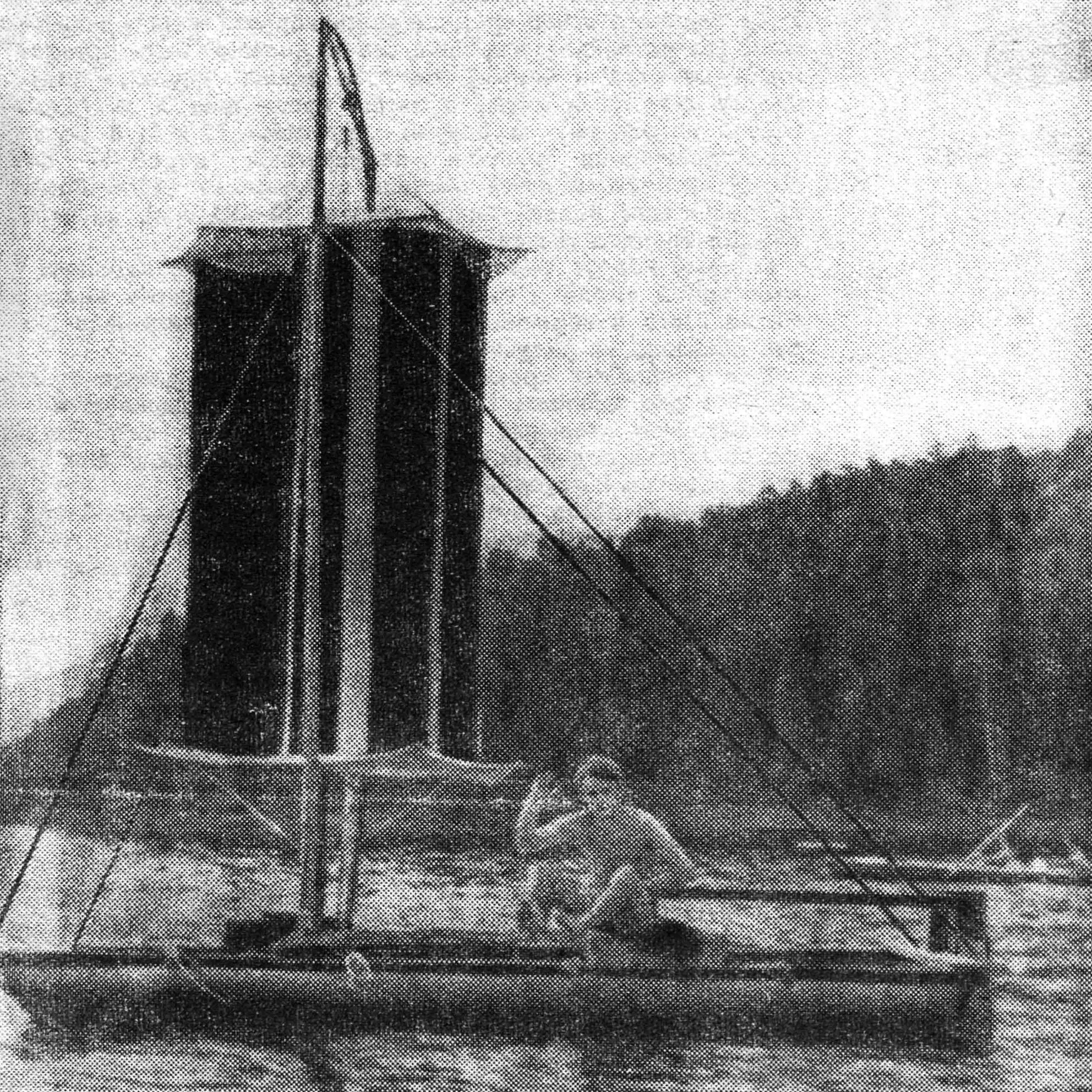
Readers interested in rotor ships will certainly be able to build more successful designs. It seems to us most interesting to build a catamaran with a collapsible cylinder that would be rotated by a light internal combustion engine. The cylinder can be made in the form of an inflatable balloon or have a stretchable structure, like the rotor we made.
Designs tested by amateurs may find application in the national economy as well.
In our opinion, inflatable or stretchable rotors with electric motors installed using cargo cranes can be used as auxiliary engines on cargo vessels as well.
“Modelist-Konstruktor” No. 9’76, V. KHABARIN
Recommend to read
 PROTECT CLIP
Even when the blade cut along a wooden ruler — there is no guarantee that the edge, huddling, does not crash or find yourself on it. This will not happen if the shaver to wear a... WALK-BEHIND-TRUCK
Offer to readers design their new walk-behind. But before describing it, a little background. Village life is hard their daily monotonous work in summer and winter, rain and snow......
