Water skiing appeared relatively recently in our country and immediately gained numerous enthusiasts. A skier racing across the water surface always draws a large crowd of spectators on the shore. Watching how effortlessly and gracefully they perform dizzying turns, everyone involuntarily feels the desire to be in their place, if only for a moment. But many are intimidated by the water skier’s speed and especially the consequences of a fall. Of course, water skiing requires courage and bravery. Yet they are accessible to everyone—from 7 to 70 years old.
The most difficult part of water skiing is the first start. It rarely ends successfully. The result of a fall is disappointment and loss of confidence in one’s abilities. To avoid this rather unpleasant moment, training and preparation for the first start should begin on shore. Training sessions can be completed using a special set of exercises for beginner water skiers. Those who want to experience their “weightlessness” on water for the first time will also be helped by the proposed monoskis design. It is very simple, and anyone with even basic carpentry skills can make it. Moreover, for the monoskis to plane, the speed of the towing boat can be half that required for conventional, mass-produced water skis.
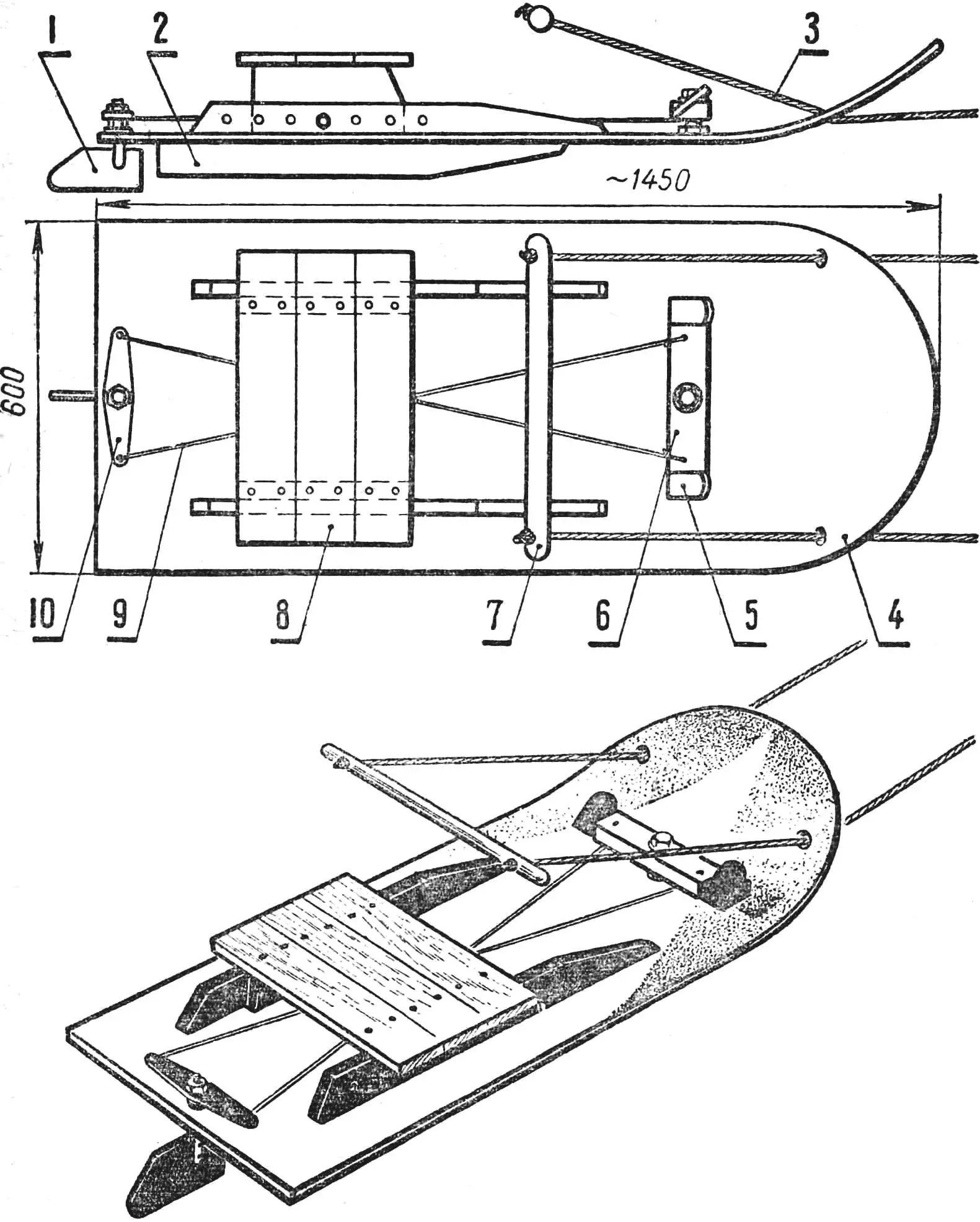
1 — rudder blade; 2 — keel; 3 — tow rope; 4 — monoskis base; 5 — pedal; 6 — steering bar; 7 — wooden handle; 8 — seat; 9 — flexible linkages; 10 — rocker arm.
To make the monoskis (Fig. 1), you will need one sheet of plywood 3 ÷ 4 mm thick, several slats, and basic carpentry tools. It consists of a base, a control system, and a seat.
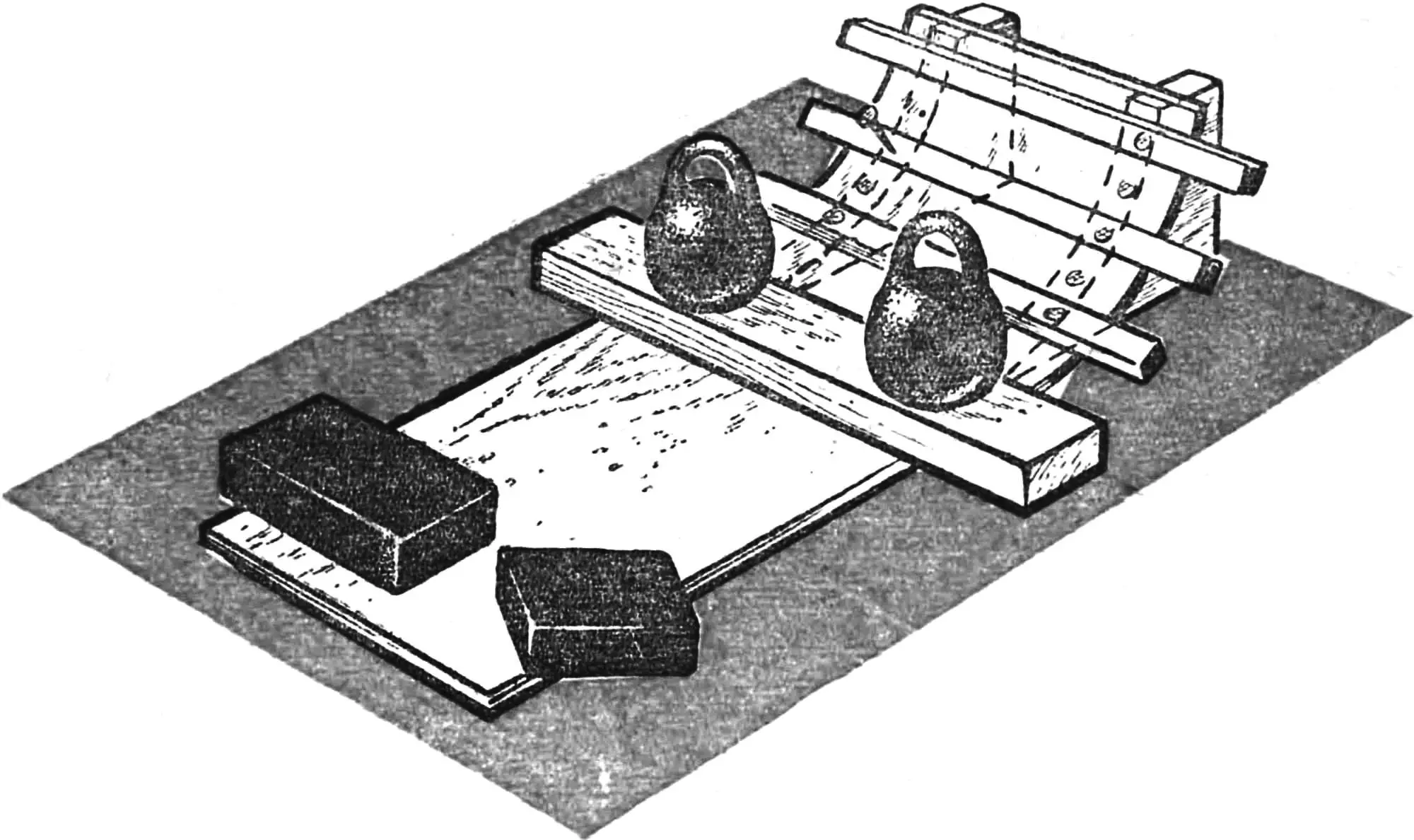
The ski base is glued from 2 layers of plywood. Cut two strips 600 mm wide and 1525 mm long. The top layers of plywood should be oriented along the ski. Apply glue (casein, VIAM-BZ, epoxy) to both strips and place them on a pre-prepared jig—two templates on a level surface (Fig. 2). Both plywood sheets are pressed together using weights, auxiliary planks, and nails. When the glue has completely dried, remove the blank from the template and finish it to size.
The seat is assembled from 3 ÷ 4 slats with a cross-section of 50X15 mm so that its dimensions are 400X280 mm. The mounting points can be reinforced with a duralumin angle 20X20X3 mm. Centering is adjusted practically—by moving the seat relative to the base. In the desired position, it is fixed with two M6 or M8 bolts with washers.
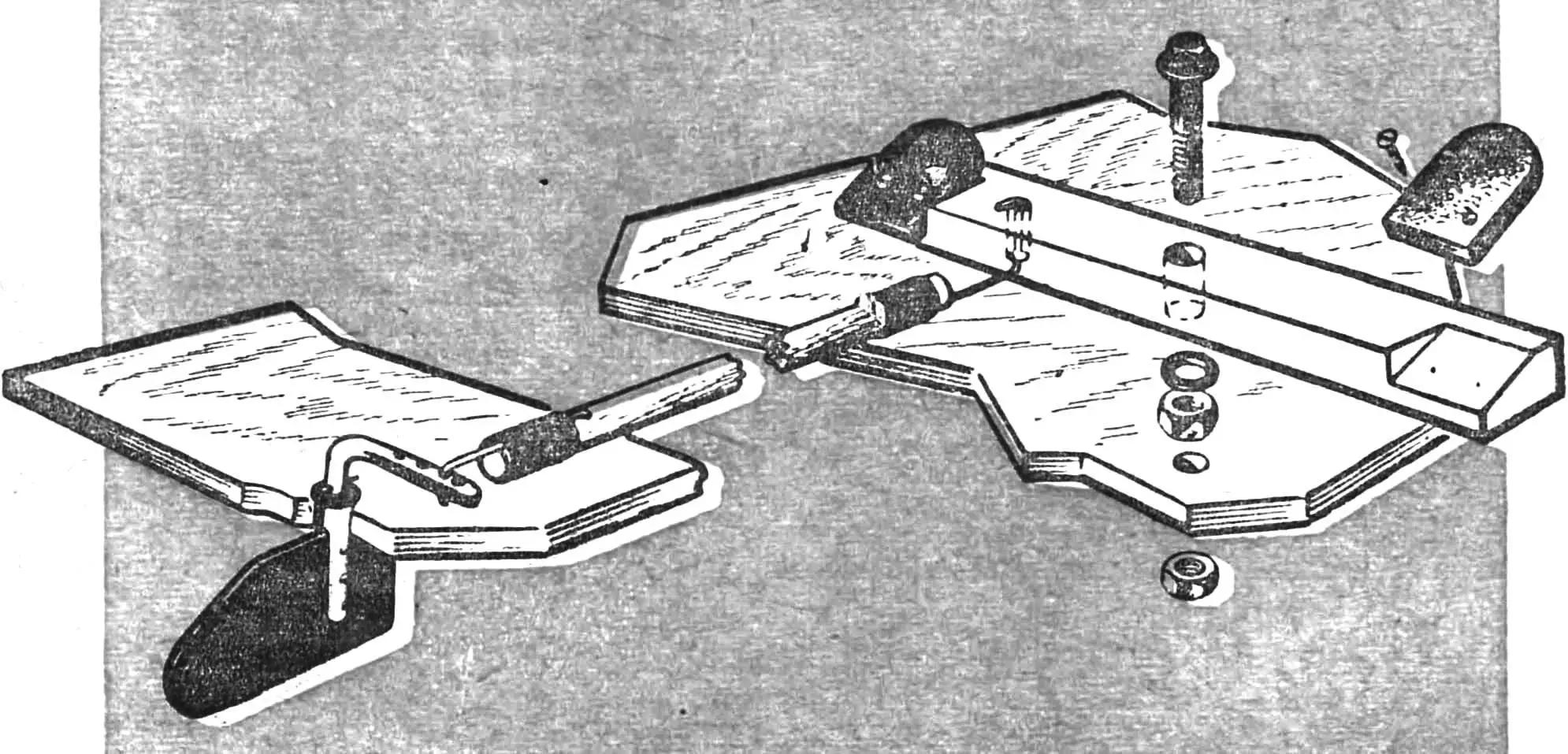
The control system allows smooth turns and maintaining the desired course behind the towing boat. It consists of a steering bar, linkages, and a rocker arm connected to the rudder. Structurally, the control can be implemented in two variants. For example, with two flexible linkages and a rocker arm on the rudder (Fig. 1) or one rigid linkage and a rocker on the rudder (Fig. 3). The rudder axis can be a tube Ø 14 ÷ 16 mm (In addition to crossed, straight cable routing is also possible.)
Any available materials can be used to make the monoskis. The ski design can be modified at your discretion, keeping only the main dimensions. Its appearance and service life depend on the manufacturing technology and quality of finishing. Three finishing options are possible.
The first option does not require scarce or expensive materials. The finished product is impregnated two to three times with hot linseed oil (natural or “oksol”, at t = 110 ÷ 120°). Pay special attention to the ends, as these are the most hygroscopic areas. They should be coated with linseed oil four to five times. After the linseed oil and putty have completely dried, paint the entire structure two to three times with oil paint.
The second option is less labor-intensive. Instead of linseed oil, coat the ski twice with nitro varnish (emalit, nitro-glyptal furniture varnish No. 754, etc.) and after puttying—with nitro paint.
Even better if you have epoxy and polyester resin. Their substitute can be Polish floor varnish. Before coating with resin or varnish, color the wood with various aniline dyes. Polymer coating increases the service life of the monoskis.
Despite the system’s reliability, the possibility of falling during water skier training cannot be ruled out. Therefore, the learner must be able to swim, and the towing boat driver must have experience towing skiers. The boat must have a life ring. Before starting, the learner should put on a life vest or jacket. One should not immediately strive to perform complex movements (jumps, sharp turns, etc.). All this will come naturally after several starts. The tow rope length is taken within 18 ÷ 25 m. Too short a rope will not give the skier freedom, and the steep wave from the towing boat will interfere.
A planing boat or a boat with a “Veterok” motor (or more powerful) with a minimum speed of 15 ÷ 20 km/h can tow a water ski of this type. The monoskis design is designed for a skier weighing up to 50 kg. For a heavier skier, for every 10 kg, it is necessary to increase the ski width by 50 mm.
B. MIRONOV
Recommend to read
 SPROCKET FOR CHAIN TRANSMISSION
the Designers often have to choose the right transmission ratio, and in this regard to look for suitable veins. The case is ungrateful, requiring large expenditures of time. It is much... “SLAVUTICH-M1”: WING PLUS MOTOR
"Slavutich-M1" is a hybrid of conventional hang glider and the trike. Constructive simplicity, light weight, collapsibility, balance management principle and availability of the engine...
