Spring sunshine has barely had time to properly warm the ground that froze over winter; snow patches still linger in the forests — yet die-hard hikers are already setting out on their first trips. From storerooms and attic shelves come backpacks, tents, mats, and sleeping bags: the boldest hikers head out for the weekend, even with overnight stays.
By the campfire it is warm even in the cold, but what about at night in the tent? You cannot light a fire there, a candle will not really warm it, and it is unsafe.
However, hikers are a resourceful bunch. Experienced Moscow trekkers A. Rokshin and L. Tsukanov came up with a clever method of unusual “steam” tent heating. After all, the fire is right nearby — why not use the generous heat of the campfire. And they figured out how.
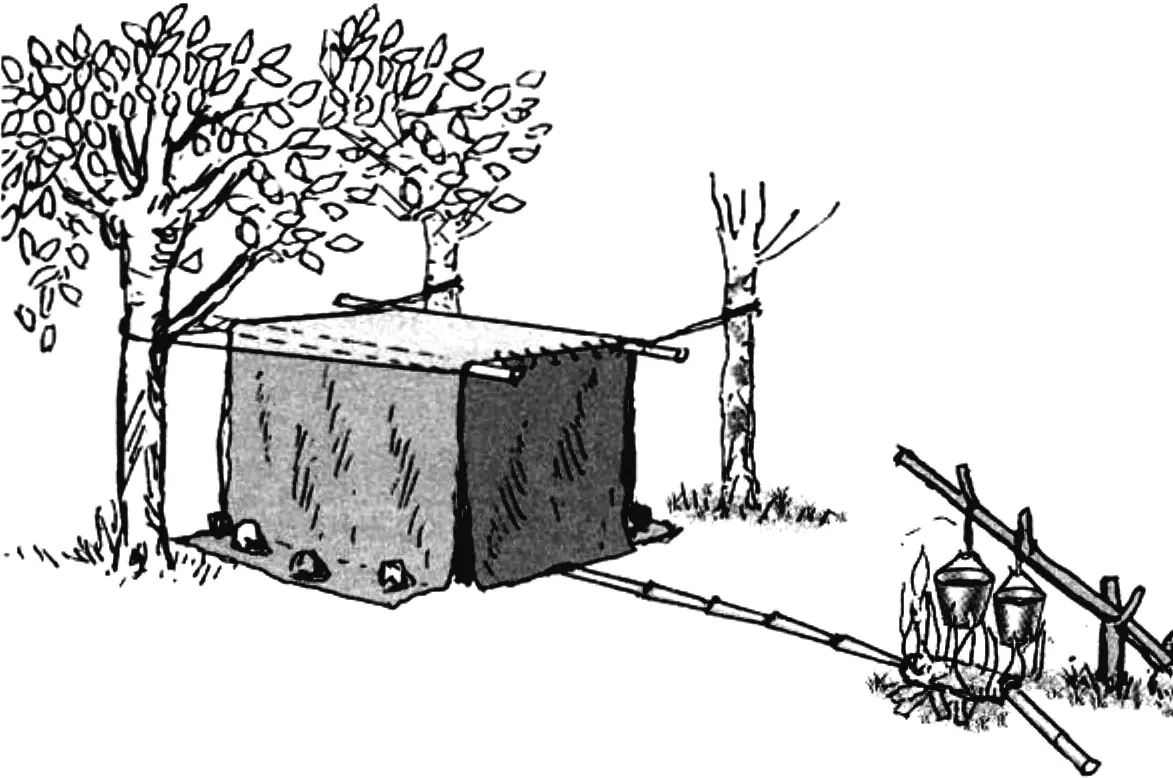
…A rest stop is chosen, the tent is set up, and at a safe distance from it branches are already crackling in the fire and pots are hanging to cook simple trail food. It is time to think about a warm night’s sleep. For this, a section of metal pipe is laid into the fire so that its ends extend beyond the burning logs and glowing coals. A hose leading into the tent, or several tubular sections (in diameter and connection similar to a vacuum cleaner), is attached to the end facing the tent: heated air from the pipe in the fire will be drawn through them into the tent, while cold air will be sucked into the other end of the pipe. For good draft, it is best to run the “pipeline” on an upward slope toward the tent: the steeper the slope, the more intense the flow of heated air. To keep the air from getting too hot, the pipe in the fire can be wrapped with asbestos or coated with clay. The temperature of the air entering the tent can be regulated by partially covering or blocking any of the openings in the “pipeline.” Such heating is quite safe and can confidently be left on overnight for as long as the campfire burns and smolders.
Interestingly, the principle itself, on reflection, is quite universal and can be used not only for the purposes described.
A “disposable” sauna
(Illustration at the top: A system for drawing heat from a campfire to set up an improvised trail sauna)
For tourists or geologists on a long expedition, the described technology will help organize a steam bath in the field. A spacious tent will do, and if there is none, it is easy to make one from greenhouse film by draping it over ropes stretched between trees and weighting the edges with stones. All that remains is to run the described “pipeline” from the campfire. And while water heats in buckets suspended over the fire, the sauna will warm up too — to the delight of travelers who miss civilization.
For such a steam bath, you can prepare everything needed at home in advance and take the corresponding components on the trip; fortunately, they are not particularly bulky or burdensome cargo.
Frost is no threat
For gardening enthusiasts growing plants in greenhouses at their dachas, a sudden cold snap or spring night frosts — whose arrival is usually completely unpredictable — cause a lot of trouble.
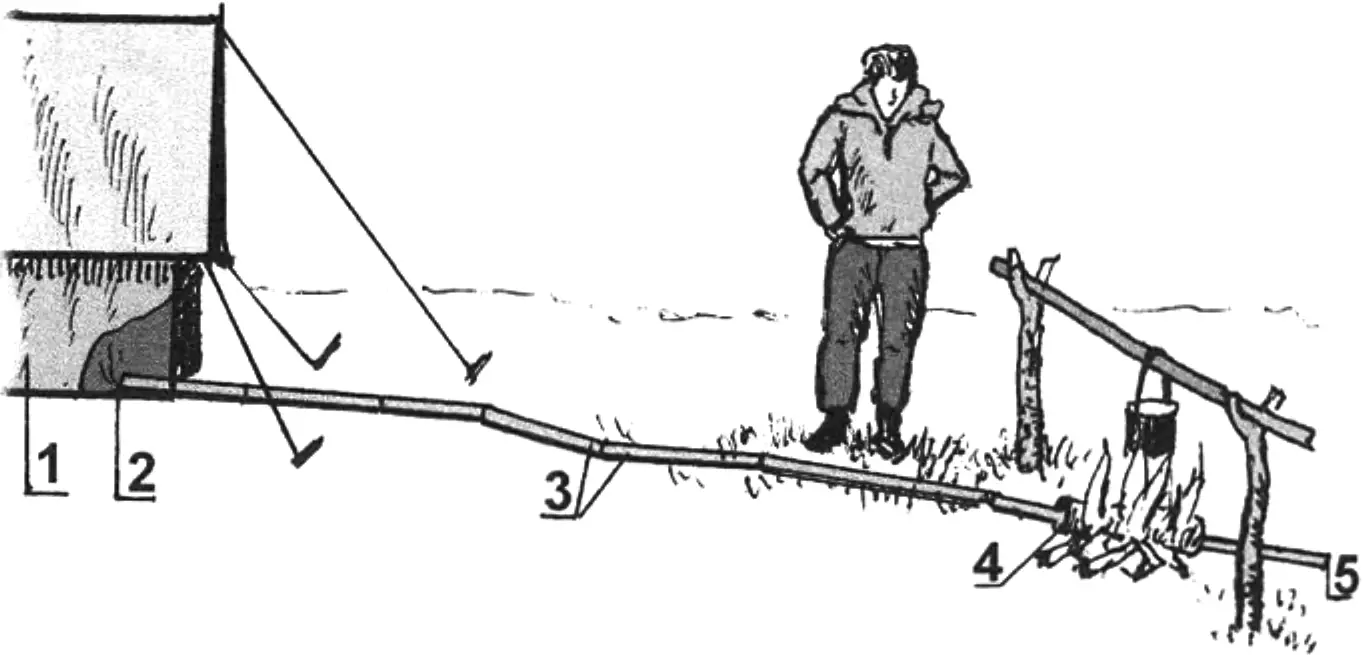
1 — tent; 2 — outlet end of the heating pipe; 3 — sections of the “pipeline”; 4 — campfire pipe; 5 — inlet end of the pipe (air intake)
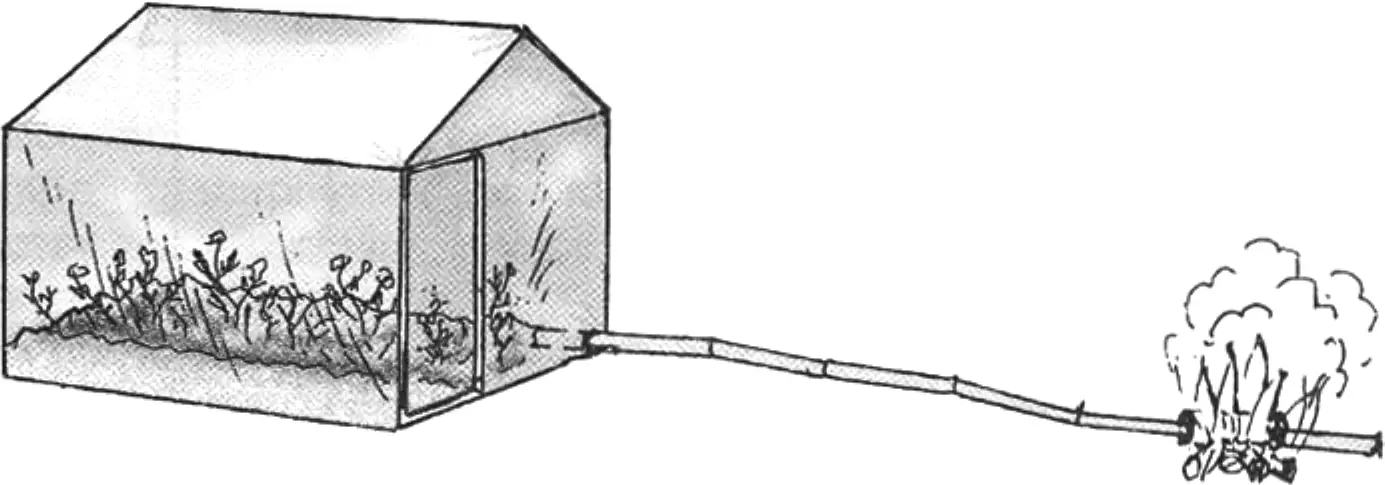
However, “campfire heating” can help here too during a dangerous period for plants. It is enough to prepare the fire pit in advance and run a suitable hose or pipe from it to the greenhouse, and when low temperatures arrive, light the fire — fortunately, firewood is never a problem on dacha plots. All that remains is to monitor the degree of air heating in the greenhouse and ventilate if necessary to maintain the optimal temperature for the plants.
And the ice will melt
Where water supply is organized through outdoor water columns, they often freeze in cold winters when an ice plug blocks the water. Then it is worth remembering the described technology to thaw the column. For this, an improvised cover of sheet material (cardboard packaging, linoleum, or roofing felt) must be built around it, and hot air from a nearby campfire must be fed into it. After a while, the ice in the column will melt and water flow will be restored.
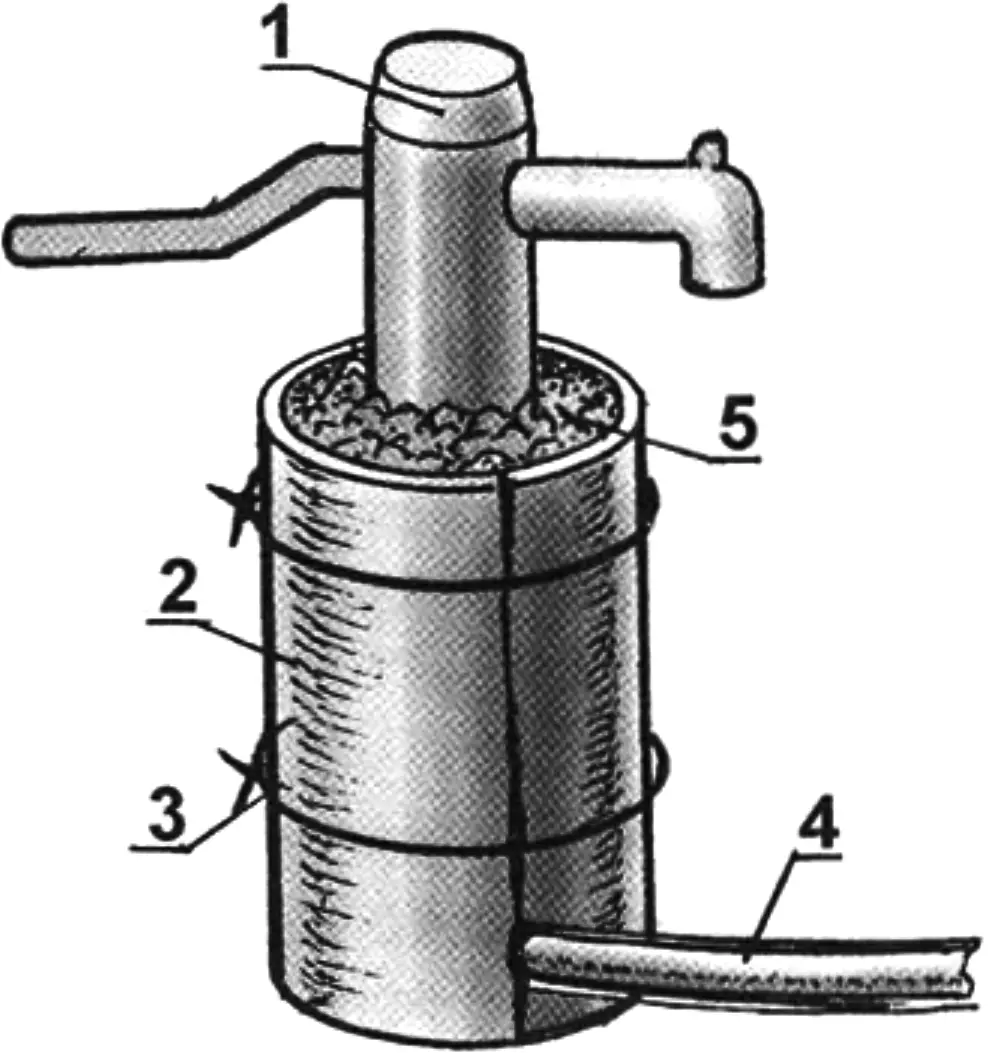
1 — column; 2 — cover; 3 — wrapping of cover sheets; 4 — heat duct hose from the campfire; 5 — rags
The same method will help if a section of water pipe has frozen. The corresponding spot is also wrapped in a temporary cover of heat-retaining materials, and hot air from the campfire pipe is fed into it through a hose.
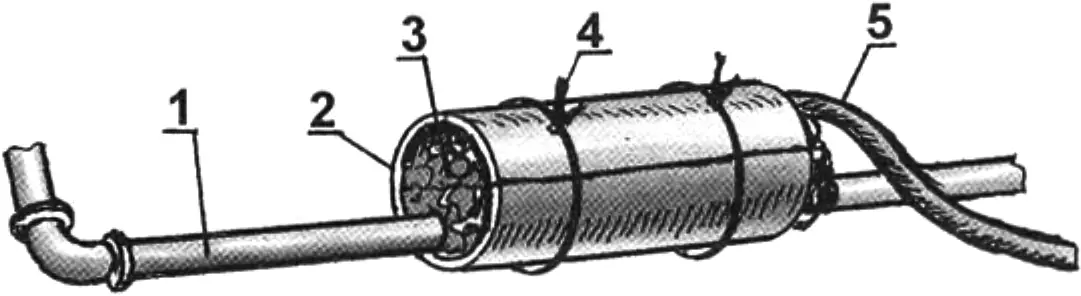
1 — water pipe; 2 — cover; 3 — sealing the cover with rags; 4 — tying the cover sheets; 5 — heat duct hose from the campfire
Such covers are wrapped loosely and overlapped around the water pipe, then tied with cord or wire on top. The end openings of the cover are blocked with packing of old newspapers or rags. If necessary, the end of the pipeline from the campfire entering the cover is also secured with wire.
“Modelist-Konstruktor” No. 5’2010, B. VLADIMIROV
Recommend to read
 THREAD-LOCK
the Stopper of a thermos under prolonged exposure to high temperatures over time, weakens and poorly kept in the neck of the vessel. A reliable lock can provide a strong thread or thin... VACUUM CLEANER-VODEOS
Unfortunately, vacuuming can remove dry dust and debris. But what to do if you want to collect the spilled oil finally, just dirt? Surely the old fashioned way to use cloth? Suddenly...
