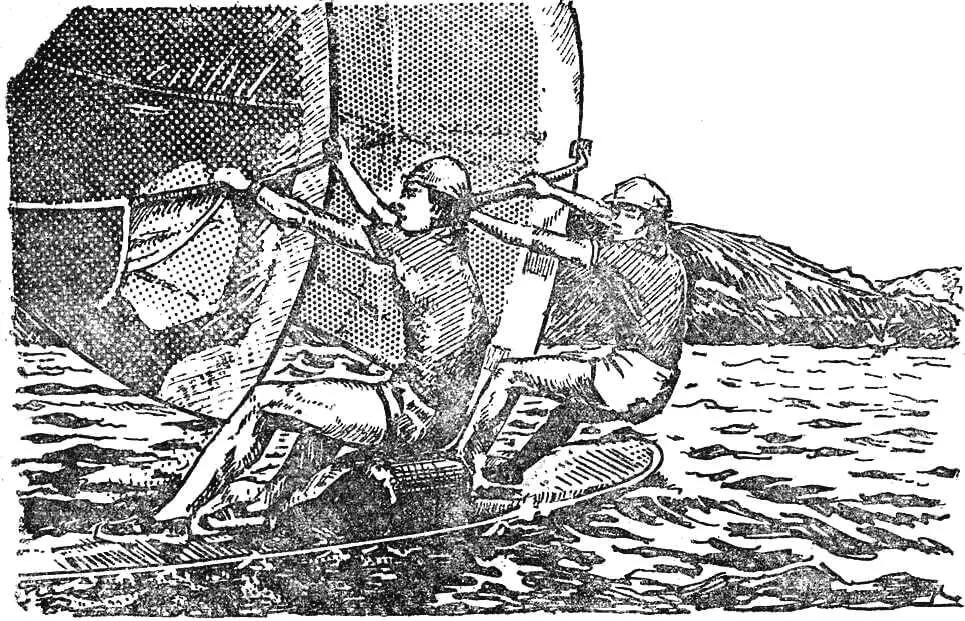
The city of Arsenyev in Primorsky Krai is not that close to the sea. However, the now widely spread passion for sailing on sailboards — windsurfers — led to the appearance of a section here in 1976. There are now about thirty people in it.
They started, as they say, from scratch. They read specialized magazines, studied the intricacies of proven designs, sketched their own, and stocked up on materials for construction. Then they began designing and building surfers.
Things got off the ground quite quickly. Obviously, because most of the section members are professional designers.
Now the Arsenyev residents have a whole fleet of various sailboards of their own manufacture, not counting many matrices and other technological equipment for gluing windsurfers of various classes.
Interestingly, as a result of research work, enthusiasts came up with the idea of a tandem surfer. And more for tourist purposes than sports. This is how the “Dubl” and “Strannik” tandems appeared, which underwent a cycle of comprehensive tests.
Engineers Vitaly Vorsin and Vyacheslav Rezunov, the creators of “Dubl”, accumulated rich experience sailing on it on various bodies of water and even in the open sea. They made several autonomous (without escort vessels) trips along the shores of Amur Bay and the islands of Peter the Great Bay in the Sea of Japan. About four hundred kilometers of the path traveled — a difficult test, but “Dubl” passed it with honor. V. Rezunov tells about this design.
We came to the idea of a tandem in a rather unusual way. In 1977, it happened to ferry two single windsurfers by sea from one bay to another, where our camp was located.
The wind was blowing from the shore at a speed of 10—12 m/s. By the end, we were carried out to the open sea about three kilometers. We had to roll up the sails, jump into the water and swim, pushing the boards in front of us. We reached the shore only three hours later.
This journey, accompanied by quite tense situations, led us to formulate the principle of safe sailing. The main thing in it is not to separate on different vessels, but to sail on one.
And so two years later “Dubl” was ready. Since such tourist vessels in the “windsurfer” class do not yet exist, our tandem was registered in the city OSVOD as a “fiberglass kayak, collapsible, with a suspended sail; hull weight 52 kgf, displacement 450 kgf.”
Tests and refinements lasted several years. The maximum daily passage was once 47 km, which confirmed the possibility of using the tandem as an autonomous vessel. We made do with what we had on board. We spent the night on the shore in a tent made of sails, and cooked food on a primus stove.
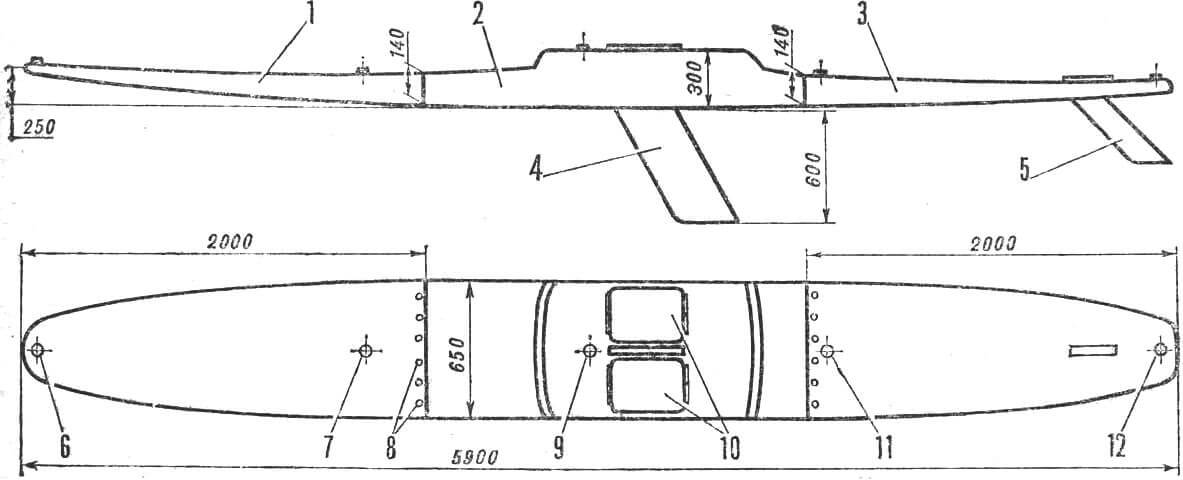
1 — bow section, 2 — middle section, 3 — stern section, 4 — centerboard, 5 — fin, 6, 12 — drain plugs, 7, 9, 11 — mast steps, 8 — connecting screws, 10 — hatch covers.
However, we still failed to fully utilize the capabilities of “Dubl”. According to our calculations, it can cover up to a hundred kilometers per day, or even more. Experience has shown that a tandem as a tourist vessel has a number of advantages compared to a single windsurfer. This is greater speed (up to 16 km/h), the ability to place necessary cargo on board, safety and autonomy of sailing. In addition, two crew members can always sail alternately, using the watch method. And on land, the tandem in packaged form is easily transported on a two-wheeled cart.
* * *
The hull of “Dubl”. Its lines were chosen taking into account the conditions of the sailing area, analysis of existing prototypes, and matrices of a single windsurfer were also used to make the bow and stern sections of the tandem.
In the bays of Amur Bay, the wind, as a rule, drives high short waves. The nose of a conventional windsurfer with a convex bottom and concave deck, when hitting a wave, behaves like an airplane wing with an inverted profile: the hydrodynamic force is directed downward. It dives, the hull brakes sharply and throws off the rider.
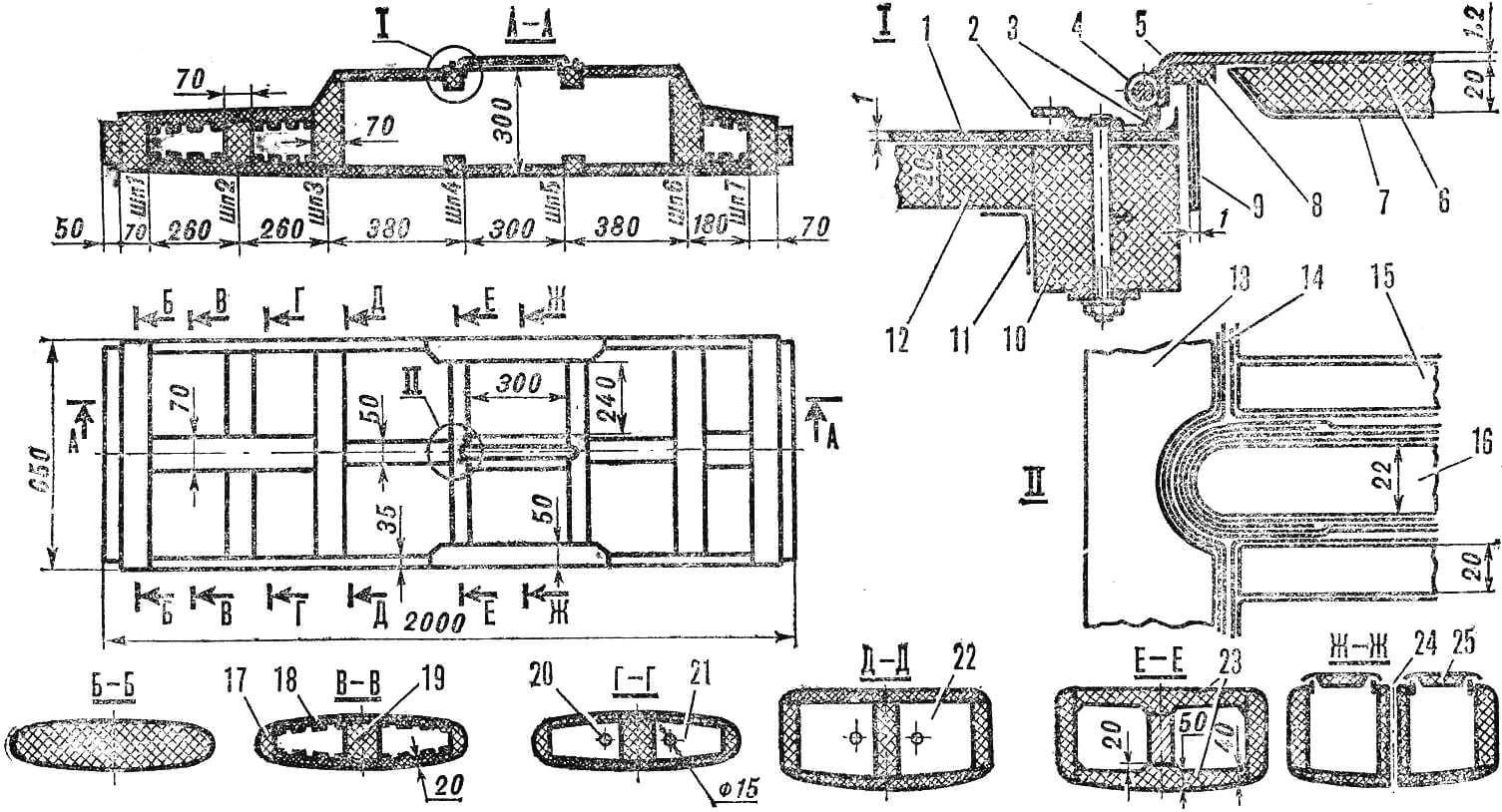
1, 9 — fiberglass laminate, 2 — bolt with head for external rigging attachment, 3 — hatch mounting bracket, 4 — dowel connection, 5 — hatch cover, 6 — foam, 7, 11, 14 — fiberglass cloth, 8 — rubber seal, 10, 13, 23 — frame No. 4, 12 — foam, 15 — centerboard well side, 16 — embedded part (removed), 17 — side, 18 — sheathing, 19 — stringer, 20 — drain hole, 21 — frame No. 2, 22 — frame No. 3, 24 — centerboard well, 25 — hatch.
To get rid of this phenomenon, the longitudinal profile of the deck of the bow section of the tandem was made convex, which increased its volume, and hence buoyancy. The wide raised bow allows sailing in high short waves; when burying into a wave, the hull seems to shoot out from there to the surface.
Prominently marked chines and a slight concavity of the bottom in the transverse direction make it possible to lower the chine lines, respectively increasing the lateral resistance of the hull compared to the directional one, which gives an advantage when sailing on a tack. The wide stern at low speed with the bottom edge at the waterline has low resistance.
The hull consists of three parts, each 2000 mm long. The most complex in configuration is the middle one. In plan, it has a rectangular shape, and in profile — curvilinear, with a thickening in the center. In this thickening, two sealed compartments with a total capacity of 120 dm3 are equipped. Between the covers of their hatches is located the centerboard well.
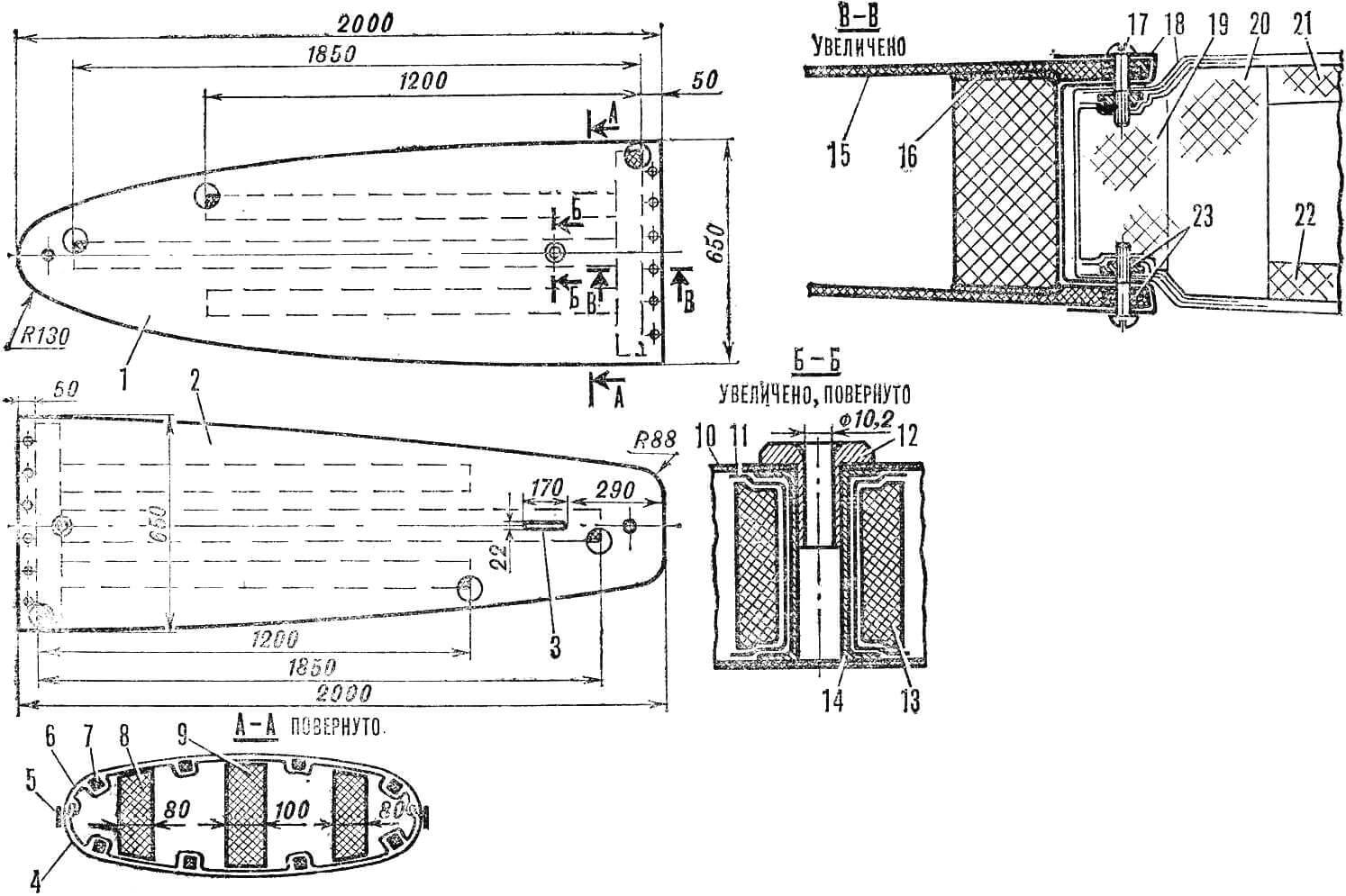
1 — bow section, 2 — stern section, 3 — fin well, 4 — lower panel, 5 — fiberglass tape (around perimeter), 6 — upper panel, 7 — stringer, 8 — side stringer, 9, 13 — central stringer, 11, 18 — fiberglass cloth, 12 — mast step, 14 — step bushing, 16 — technological gap compensator, 17 — connecting screw, 19 — connecting frame of the middle section of the hull, 20 — frame No. 1, 21 — deck (foam), 22 — bottom, 23 — steel inserts.
The middle section is made of foam, its surface is sawn along the theoretical contour and covered with fiberglass cloth, which is then cut at the location of the centerboard well.
Among the technological features, it should be noted that the bow and stern sections of the hull are made with fitting to the middle one when it is already ready: their upper and lower panels are pressed against its connecting belts and glued together.
The hull is connected into one piece with M5 screws (24 pcs.) made of stainless steel. For accurate assembly, the connecting holes are first drilled in place, then M5 threads are cut in the holes of the middle section.
A large number of connection points is necessary for uniform load distribution and increased connection reliability. To make the screws protrude less, their heads are given a lenticular shape with a large support surface.

1 — stringer (30X30 mm), 2 — upper panel fiberglass cloth, 3 — lower panel fiberglass cloth.
The panels of the bow and stern sections of the hull are glued from fiberglass cloth using matrices of a single windsurfer. Their four-layer sheathing is reinforced with foam stringers (full length) and stringers. In the upper panel, a gap is formed along the edge by laying a strip of sheet rubber with CIATIM-201 lubricant applied to it between the fiberglass layers. After polymerization of the epoxy adhesive, the strip is removed, the gap is cleaned of lubricant residues and degreased. Along the edge of the lower panel, a notch is made to the thickness of the upper panel.
Panels are formed separately. The fiberglass layers are impregnated with epoxy resin and laid in the matrix in a wet state sequentially, smoothing from the center to the edges to remove air bubbles. Foam stringers are fixed with additional strips of fiberglass cloth. After laying the structural layers, another one is placed on top — a technological layer of fiberglass cloth or tracing paper impregnated with polyisobutylene to remove excess resin.
The matrix together with the molded panel is placed in a vacuum bag and air is pumped out to a pressure of about 0.9 kgf/m2. Instead of a vacuum bag, sand can be used — it is poured into the matrix. This is a simpler method, but the pressure created is less, and installing the matrix on supports requires care, otherwise under the weight of the sand it will lose its shape.
After polymerization, the technological layer with excess resin that did not absorb into it is peeled off. Panels are removed from the matrices, edges are processed and foam stringers and frames, bushings for drain plugs and mast supports — steps — are glued into them. As a technological compensator for gaps in joints, epoxy resin mixed with fine sawdust is used.
The connecting gap around the perimeter is smeared with epoxy adhesive, and the stringers — with foam adhesive, after which the panels are connected by inserting the edge of one into the gap of the other.
The fully assembled hull is coated with epoxy and sprinkled with sand or fine rubber crumbs (so that the athlete’s feet do not slip), then primed and painted using stencils.
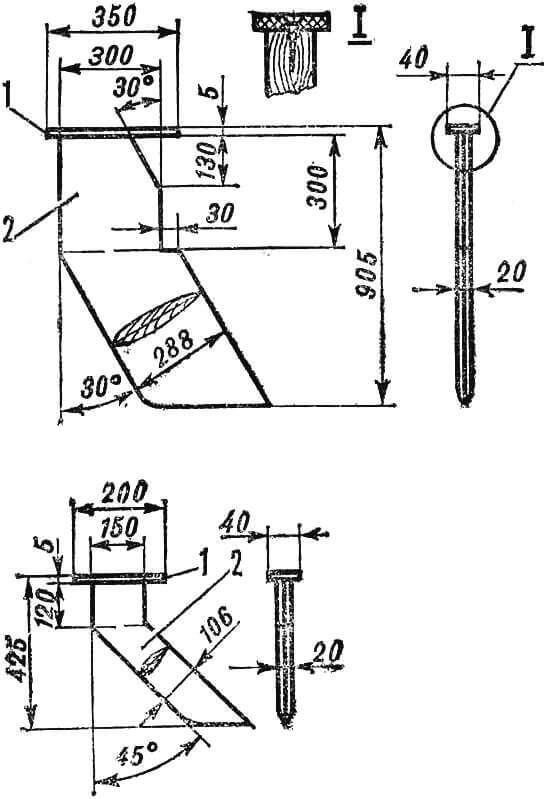
1 — support plate (fiberglass), 2 — blade (wood).
The centerboard and fin are of the dagger type, removable, made of wood and have an arrow-shaped shape in plan, which allows achieving high surface finish quality. They are sanded, puttied and painted with epoxy paint.
The connection of the mast to the hull is conventional: a universal joint design with a textolite washer and a spur with a landing Ø 10 mm. Since steps are glued into the stringers in all three parts of the hull, the tandem can sail under one, two, or even three sails.
The sail rigging has an area of 2X5.6 m2, the same as on a single windsurfer. Material — lavsan or dacron. Sails can be lowered down the masts and reefed along the lower luffs. Along the rear luffs in the area of the batten pockets, small loops are sewn, allowing the sails to be stretched on the ground when used as a tent. Windows on the sails are made of transparent lavsan film, reinforced around the perimeter with three layers of adhesive tape.
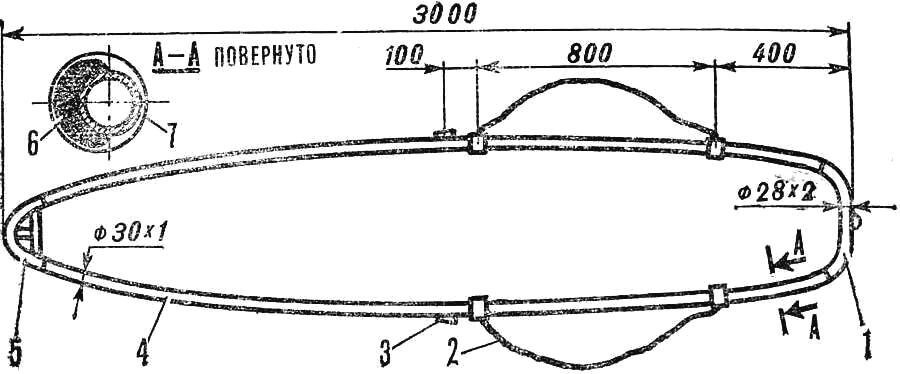
1 — front end, 2 — synthetic rope for trapeze, 3 — sail outhaul clamps, 4 — boom branch, 5 — rear end, 6 — rubber, 7 — elastic bandage.
The boom consists of two duralumin tube branches and two magnesium tube ends, connected to each other with M6 bolts made of stainless steel. The ends are bent in a heated state with a filler (sand). In the front part, where the rider holds with his hands, the branches are smeared with sealant on the inside, on which a strip of sponge rubber 25 mm wide and 6 mm thick is laid, and all this is wrapped with an elastic medical bandage. The sealant serves as a heat insulator and securely fastens the rubber and bandage to the branch tube. Fingers do not slip from such a coating.
Then bushings with rope for the trapeze are placed on the boom. The trapeze allows you to extend training time and provides good insurance when sailing in fresh weather. Its task is to free the muscles of the shoulder girdle from heavy work, leaving them only to control the sail. It is made in the form of a vest made of lavsan fabric with shoulder and waist straps sewn to it. It is also useful to sew a pocket for storing an emergency food supply, as well as various small items that may be useful in an emergency.
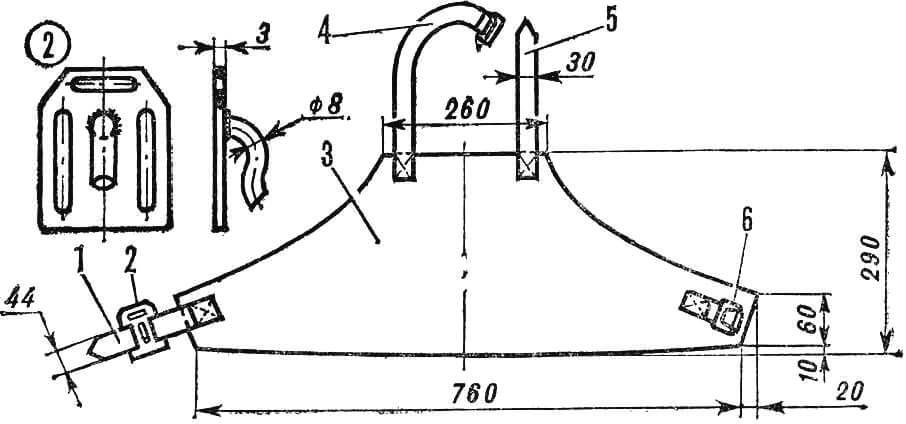
1 — waist strap, 2 — buckle with hook, 3 — lavsan, 4, 5 — shoulder straps, 6 — quick-release emergency buckle.
The trapeze is used as follows. Holding onto the boom, the hook is hooked behind the rope and the hands are released. For emergency release, there is a quick-release buckle coated with lubricant so that its mechanism does not corrode in seawater.
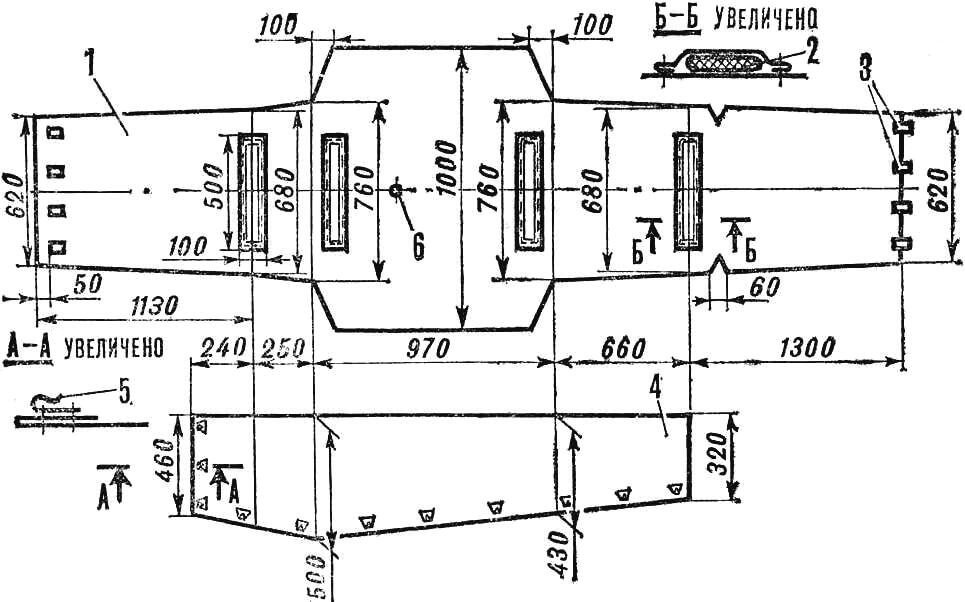
1 — main panel, canvas, 2 — sponge rubber, 3 — buckles, 4 — side, canvas (2 pcs.), 5 — hook, 6 — hole for pin.
Transportation. The disassembled hull is packed in a canvas cover: the narrow ends of the cover are connected with plastic fasteners, and the sides are laced with nylon rope along hooks. All this is installed on a two-wheeled cart. So as not to accidentally damage the tandem, pockets with sponge rubber inserted into them are sewn on the cover in those places where it can touch the ground. The rigging and kayak oars are collected in a separate bag and tied to the general package. The protruding parts of the rigging can be used as handles for movement.
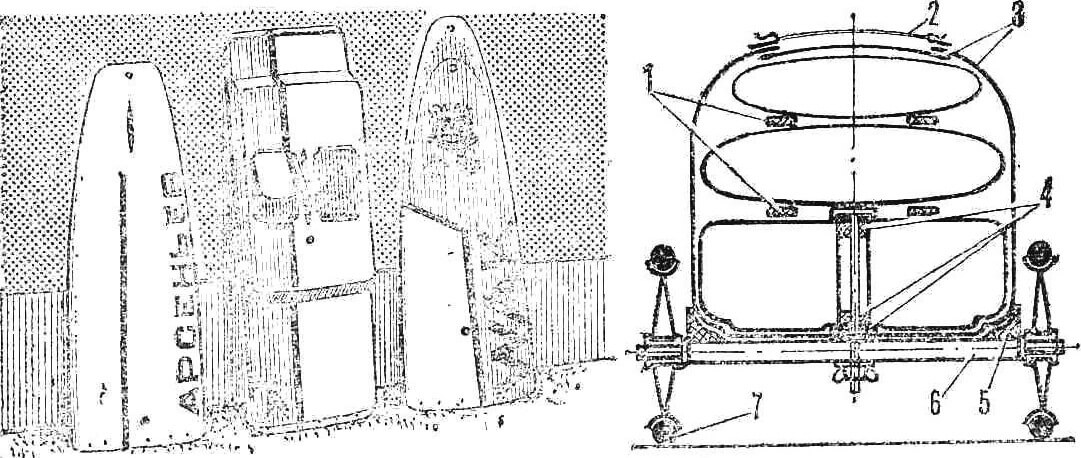
1 — foam pads, 2— tie rope, 3 — cover, 4 — inserts with pads, 5 — support, 6 — cart axle, 7 — wheel.
The cart is a duralumin tube with wheels from a children’s bicycle. Two supports covered with rubber are attached to it. The packaged tandem is fixed on the cart with a pin with a wing nut.
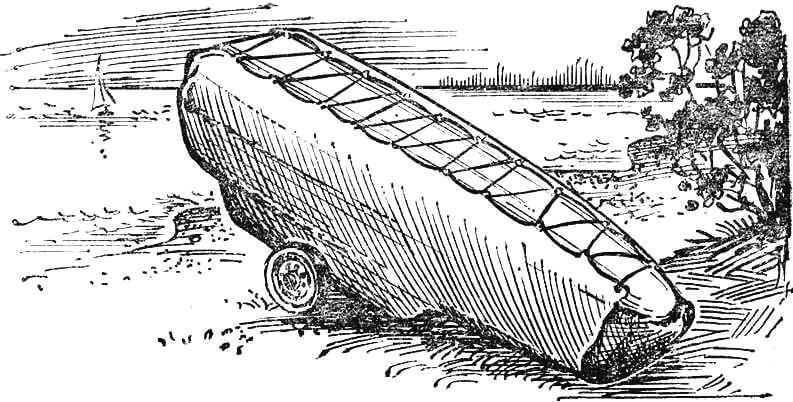
On the water, the cover is put away in the hatch, and the cart is turned over and laid with supports on the hull of “Dubl”. Now in any place you can swim to the shore, pack the tandem, put it on wheels and go to the pier or railway station on foot.
Recommend to read
 “DOLPHIN” IS AIRED ON THE CHANNEL
Dreams everyone has their own. Who about what, and Sergey Rudenko, an employee of city station of young technicians, in Slutsk, Minsk region, dreams of a children's technology Park. And...- EMERGING OUT OF THE PICTURE
the Table is a working Board which can be raised and fixed on the wall very comfortable. This is usually done by one of the ends of the tabletop is attached to a wall bar on the hinges...
