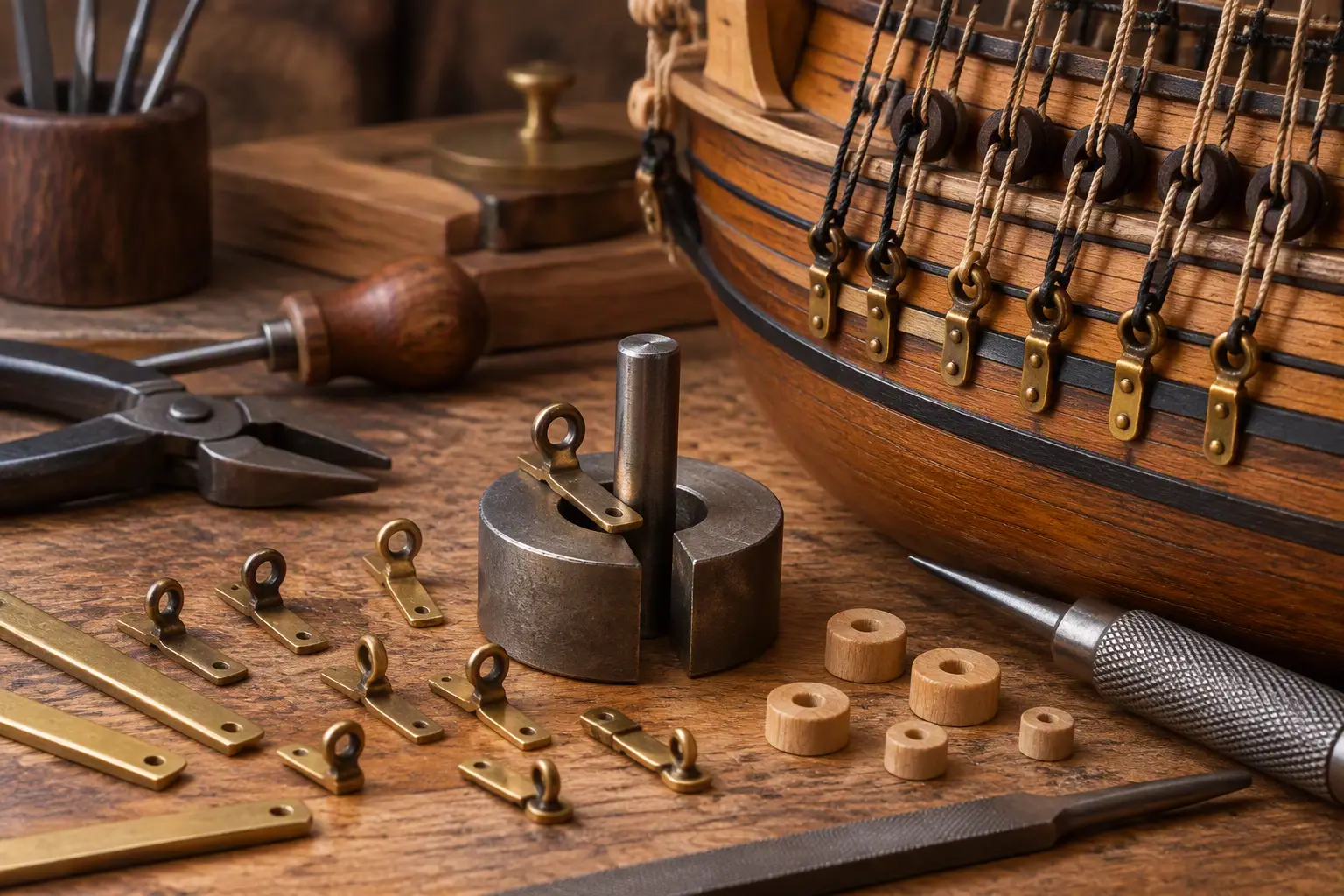
When building small-scale sailing ship models, a great deal of work goes into making realistic chain plates. I use a simplified method of imitating these parts and fittings entirely from a single piece of metal. Using a special forming jig makes it possible to achieve good results both in accuracy and in appearance.
At a scale of 1:100 it is convenient to use brass or copper strips 0.4–0.6 mm thick and 1.5–1.7 mm wide as blanks. At the end of the strip a ring is rolled close to the required diameter of the fitting and placed in the jig. With an insert rod the ring is trued and brought to exact size, after which the end of the chain-plate blank protruding from the jig is bent 90 degrees with pliers. The joint of the blank must then be hard-soldered (outside the jig, of course). The resulting part will be wider than the scale size — it must be filed down to the required dimension with a needle file. After drilling the mounting holes, the finished chain plates are oxidized or painted black.
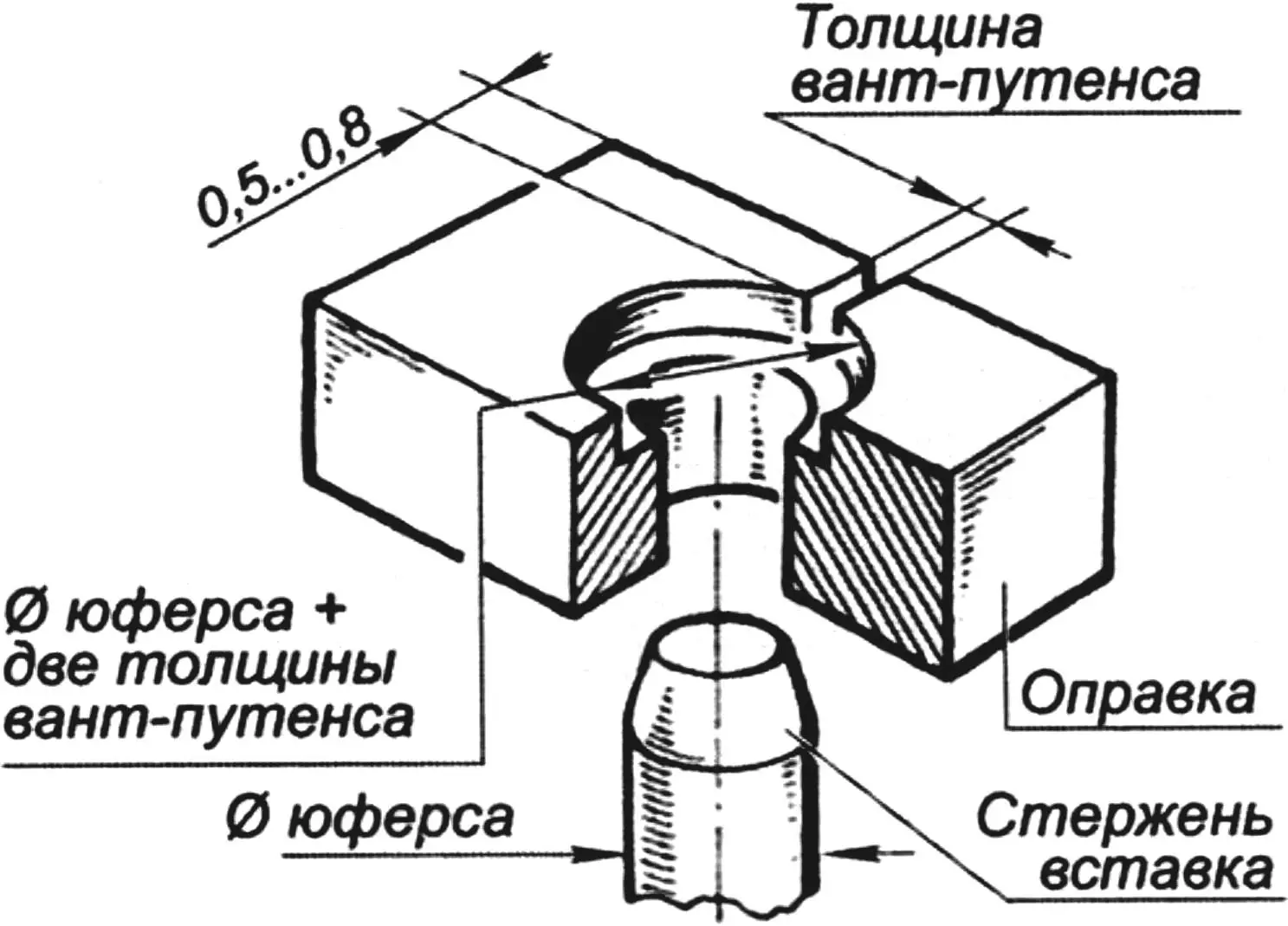
Deadeyes are turned from wood. They are held in the fittings by a tight fit. Since the inner diameter of fittings made by the proposed method varies within ±0.02 mm, increasing the deadeye diameter by 0.05–0.07 mm above the specified value ensures a secure hold of the parts.
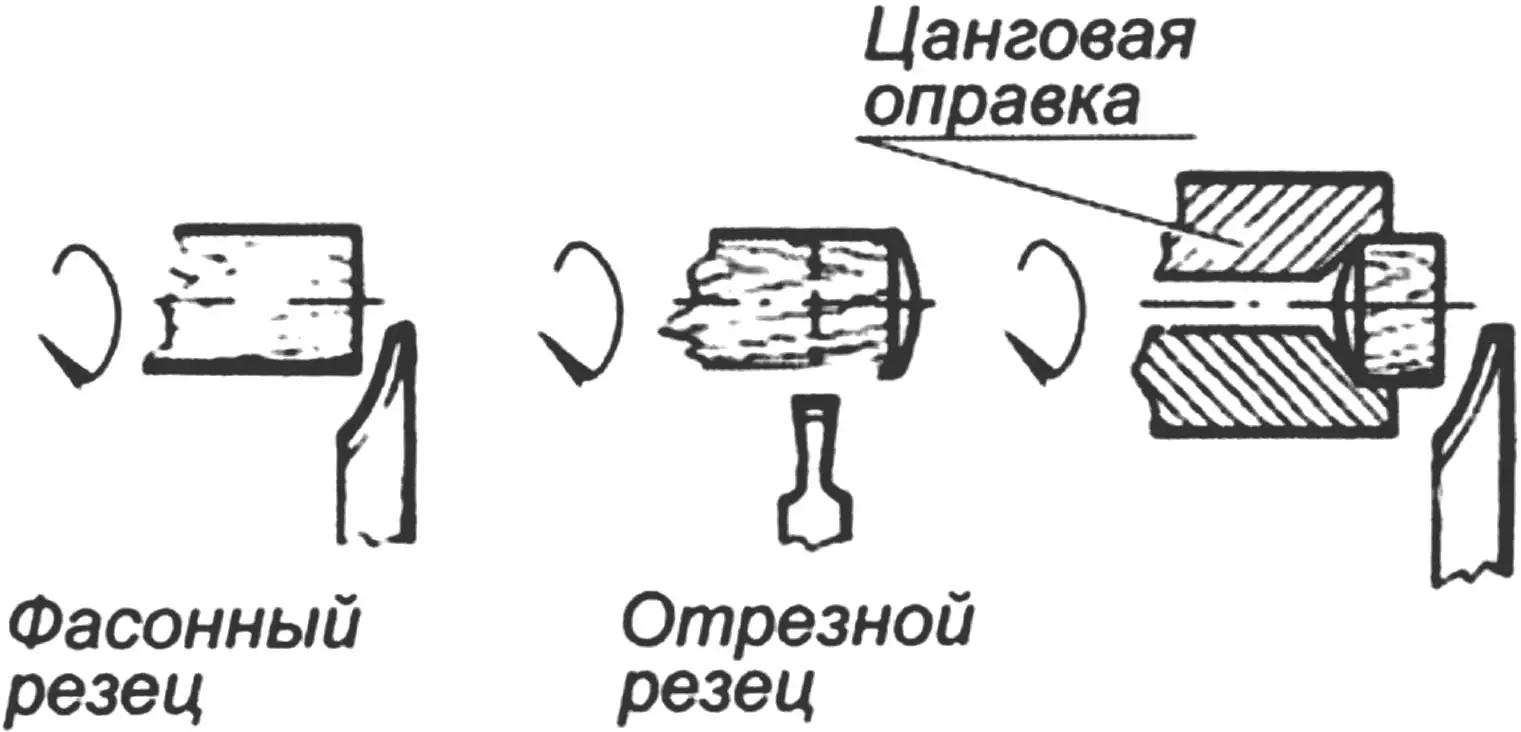
At first glance this process may seem somewhat complicated, but when making 30–40 chain plates for a three-masted sailing ship model, the effort spent preparing the jig fully pays for itself.
«Modelist-Konstruktor» No. 9’2025, Sergey NAIDANOV
Recommend to read
 THE BAG OF THE TOURIST
Travel wallet in French means "necessary". Usually this kit for anything in a special case. Well-known bags nail, drawing (drawing), road, containing Cutlery or toiletries. Tourists are... IN THE OCEAN — RUSSIA ARMORED
The end of the 80-ies of the XIX century was for the Russian shipbuilding a turning point. The Navy finally became "steel"; changed the materials, machinery, artillery, ammunition,...
