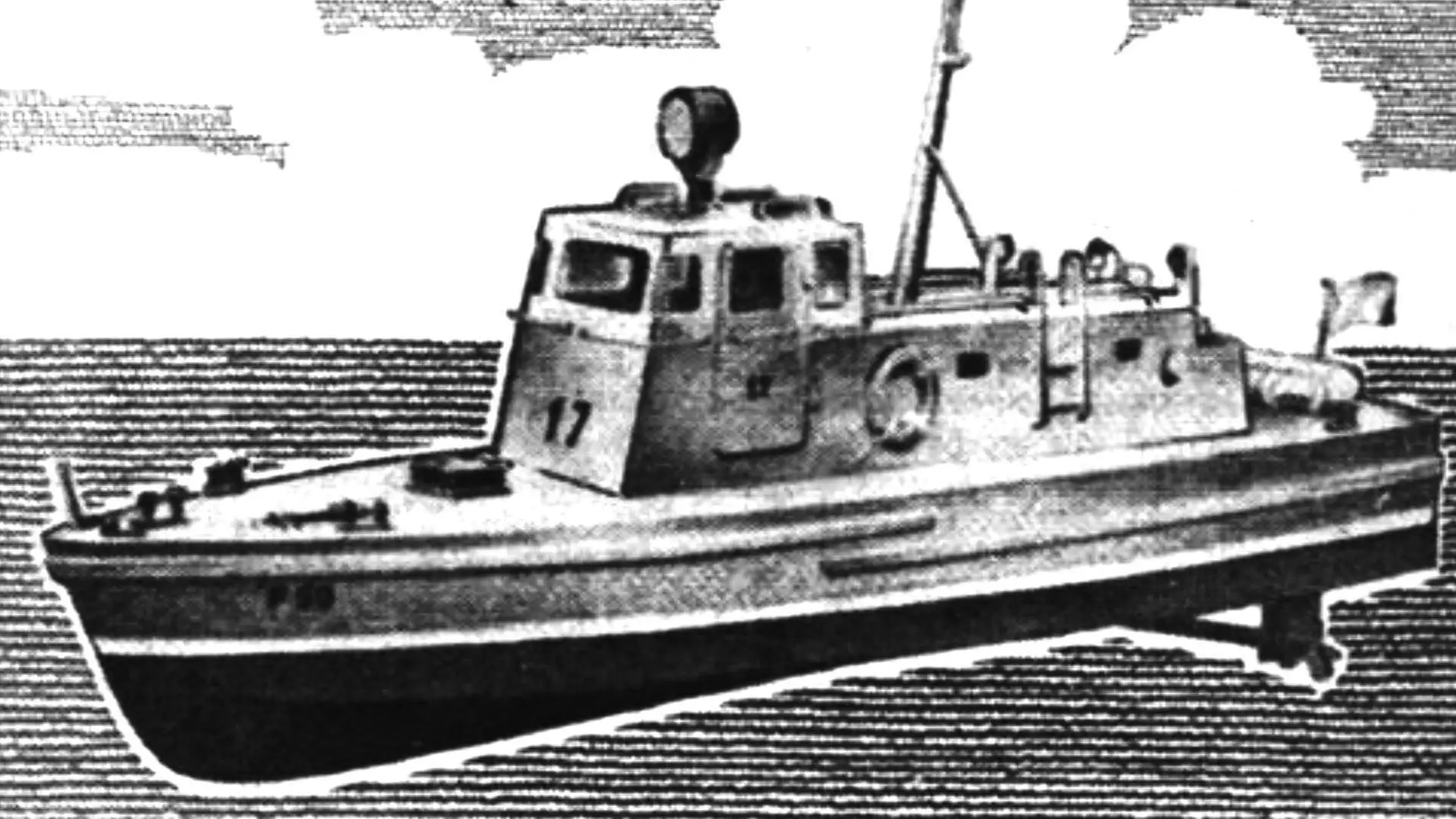
As a prototype for this model, a twin-engine boat of the British Air Force was chosen. During World War II, such boats were used to search for and rescue pilots shot down over the sea, and also to perform guard duties.
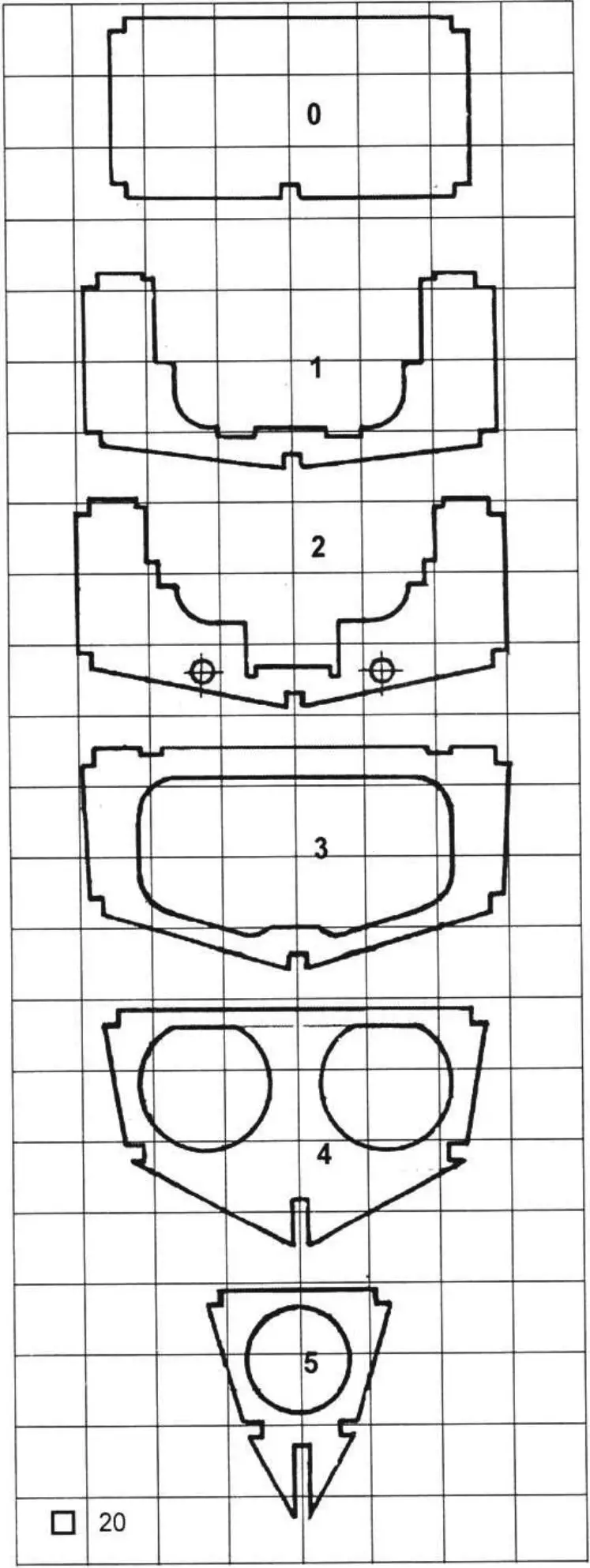
Work on making the model begins with drawing a full-size scale-copy plan. The plan view of this drawing will serve as a kind of building board: the drawing should be fixed to a flat board and protected with polyethylene film so that the frames do not stick to the board.
The model hull is assembled keel-up. The frames are cut from 4 mm plywood, and the bow tip is cut from the same material. On the building board the frames are fixed with pins, after which the bow tip and a keel made from a pine strip of 4×4 mm cross-section are joined to them. Assembly is done with epoxy glue. Finally, four pine stringers of 4×4 mm cross-section are fastened to the framework.
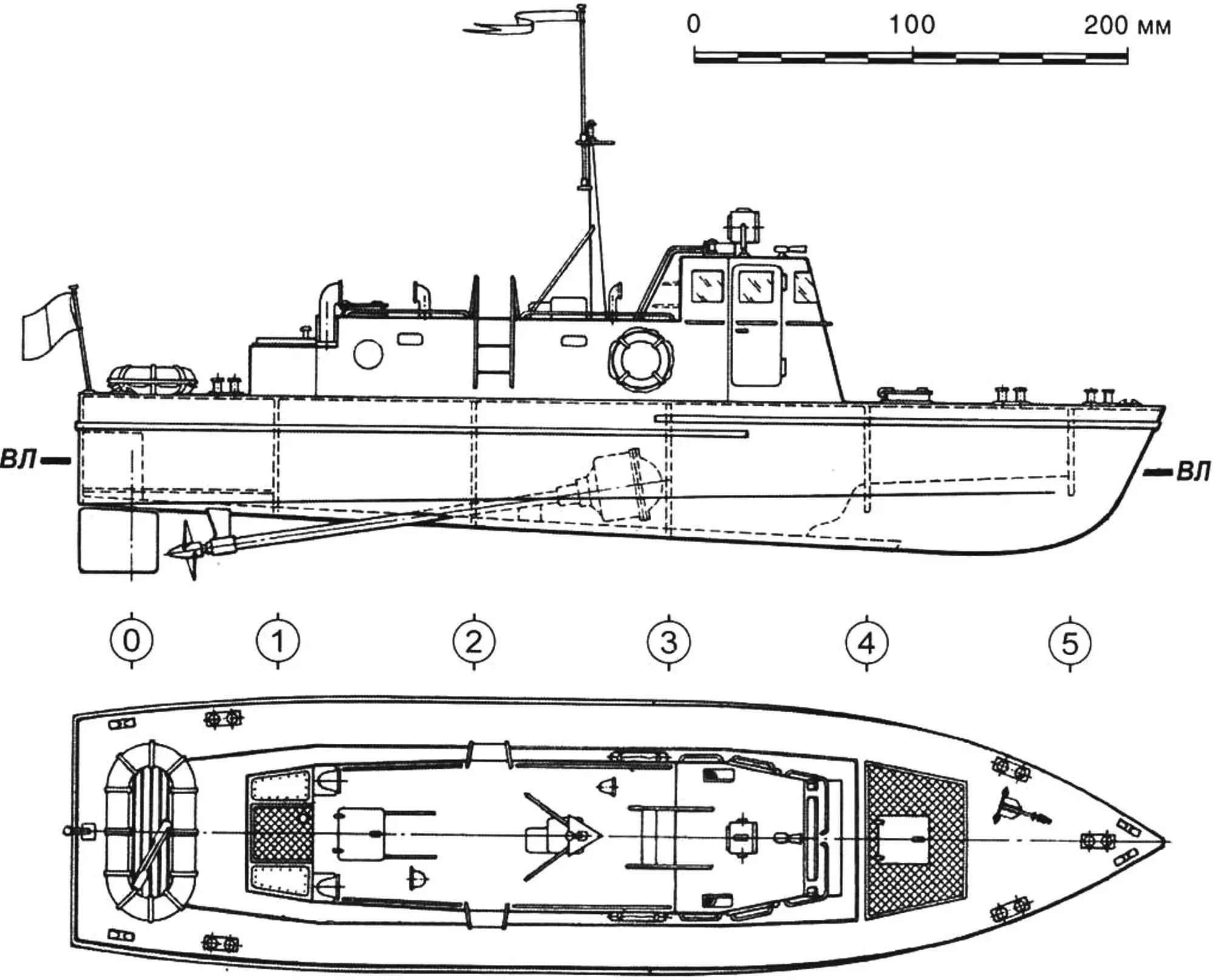
After the glue has cured, the framework is sanded with sandpaper glued to a small board and planked with 0.8 mm plywood. Since such thin plywood is practically impossible to obtain, one should take the more readily available 1.2 mm plywood and sand it down to the required thickness. Electrical cardboard (pressboard) or laminated drawing paper bonded with epoxy can also be used.
Planking is done with epoxy glue, and the blanks are fixed on the framework with a rubber bandage — first in the stern section, and then in the bow. If necessary, plywood or cardboard strips are placed under the bandage to ensure a reliable fit of the planking to the framework members.
After curing, the outer surfaces of the hull are sanded, then leveled with putty made from nitrocellulose lacquer and talc, sanded again, polished, and painted in two coats. Inside, the hull is coated in two layers with a two-component parquet varnish that ensures waterproofing. Next, rubbing strakes made from pine strips are glued to the hull sides according to the drawing.
The model’s power plant consists of a pair of engines with sterntube shafts and propellers. To install the engines, two openings are cut in the hull and sterntube pipes are mounted in them. After checking the shaft alignment — they must be parallel to the model’s plane of symmetry in plan view and also lie in the same plane in the side view — the joint between the sterntube and the hull is filled with putty (a mixture of epoxy resin and talc). From above, the hull is closed with a deck cut from a 1.2 mm plywood sheet. An opening is cut in it for installing and servicing the mechanisms and power batteries.
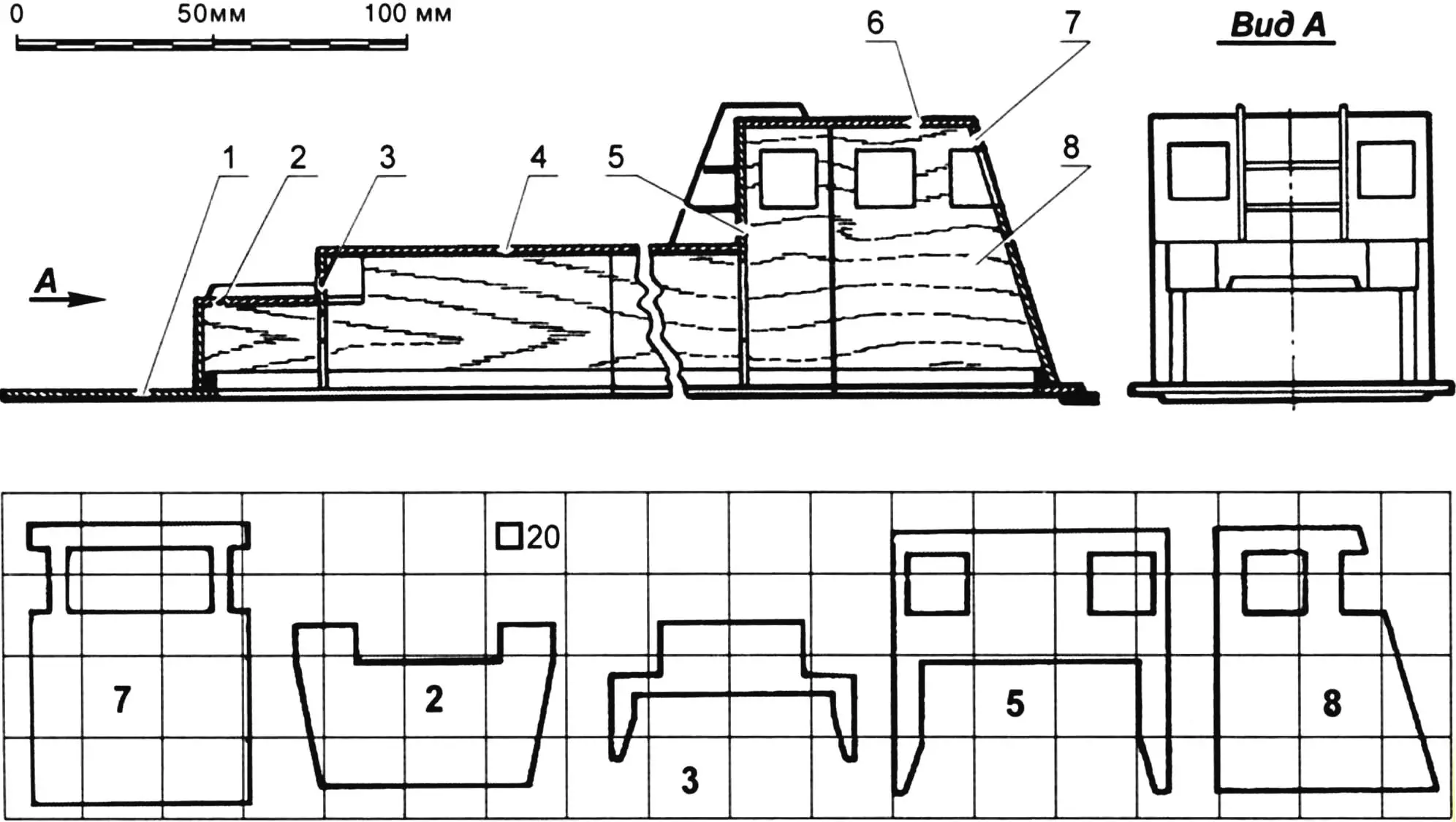
1 — deck cover; 2 — aft cover; 3 — bulkhead; 4 — cover; 5 — cabin aft wall; 6 — cabin roof; 7 — cabin forward wall; 8 — cabin side
The superstructure and cabin parts are cut from 1.2 mm plywood. During assembly, strips of 2×4 mm cross-section are fastened at the corners. The cabin portholes are lined from the inside with lavsan film that imitates glazing. Handrails, brackets, and ladders are bent and soldered from Ø1 mm copper wire. The superstructures are mounted on a plywood plate that serves as a cover for the underdeck space. The forward part of the cover is secured with a clip, and the aft part — with a screw threaded into a nut glued under the deck.
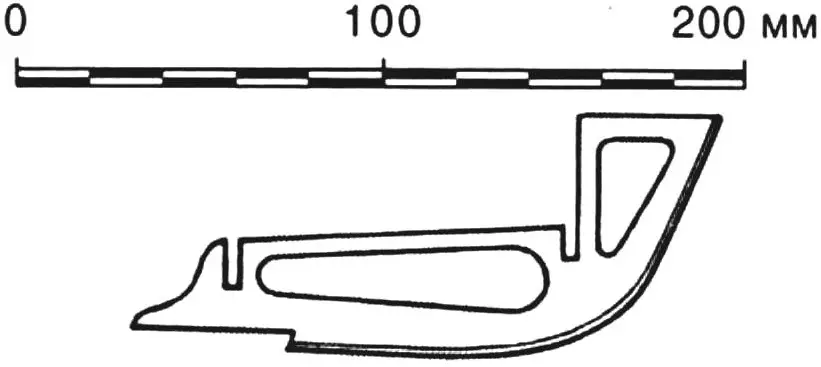
The rudder blade is made from 3 mm plywood. The rudder stock is a steel rod 2.5 mm in diameter, fixed in the blade with epoxy glue. At the upper end of the stock a tiller arm is mounted — a lever for setting the course. Fittings and other small parts are formed from thermoplastic (“Plastika” material or similar). Bollards are finished from aluminum rivets of a suitable diameter; the searchlight is made from a tube-cap.
The starboard and port engines are connected to each other in parallel.
Tuning the model on the water consists of eliminating trim (by moving the power batteries forward or aft) and correcting (by rudder deflection) the straight-line running of the copy.
«Modelist-Konstruktor» No. 9’2025, Ya. VLADIS
Recommend to read
 FOR BUSINESS AND FUN
To transport various cargoes to their farm of Simonov from the village of Podsosenki Saratov region made the tractor chassis. The engine capacity of 40 HP with gearbox's used car... Bee house
Today we introduce readers to two such works, interesting above all because they address an area of home farming that is still only weakly covered by technical creativity: beekeeping. For...
