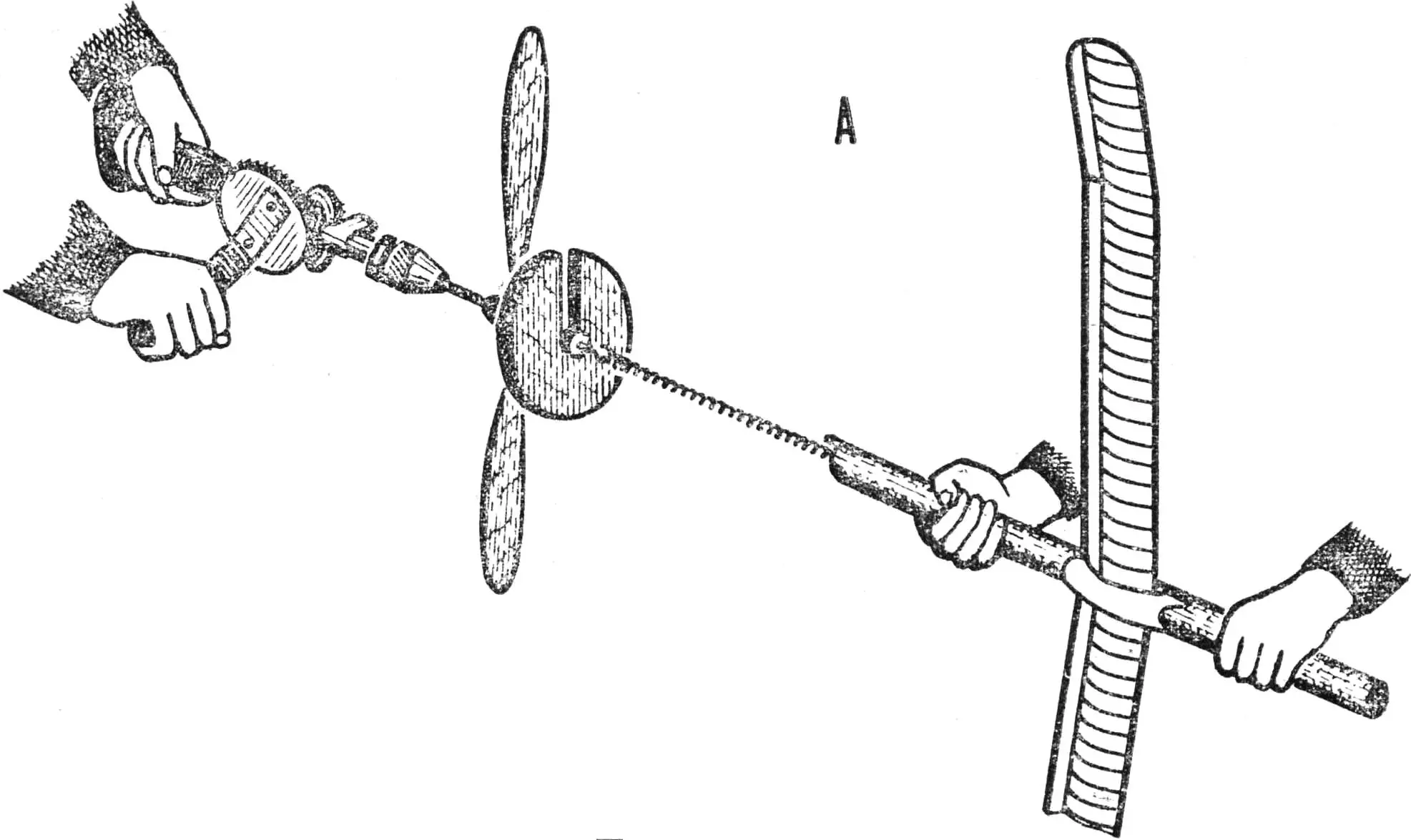
When preparing a rubber-powered aircraft model for launch, rubber breakage is not uncommon. As a rule, the secured strand, which has a lot of energy, then destroys the propeller and injures the modeler.
Recently, many people have been using a protective disc made of plastic, metal, or plywood, which is installed between the rubber motor and the propeller and is attached to the latter’s hub by means of various latches, springs, and the like. After the rubber motor has been wound, the disc must be removed quickly. This is required by how rapidly the situation at the start can change.
A — winding the rubber motor with a protective disc;
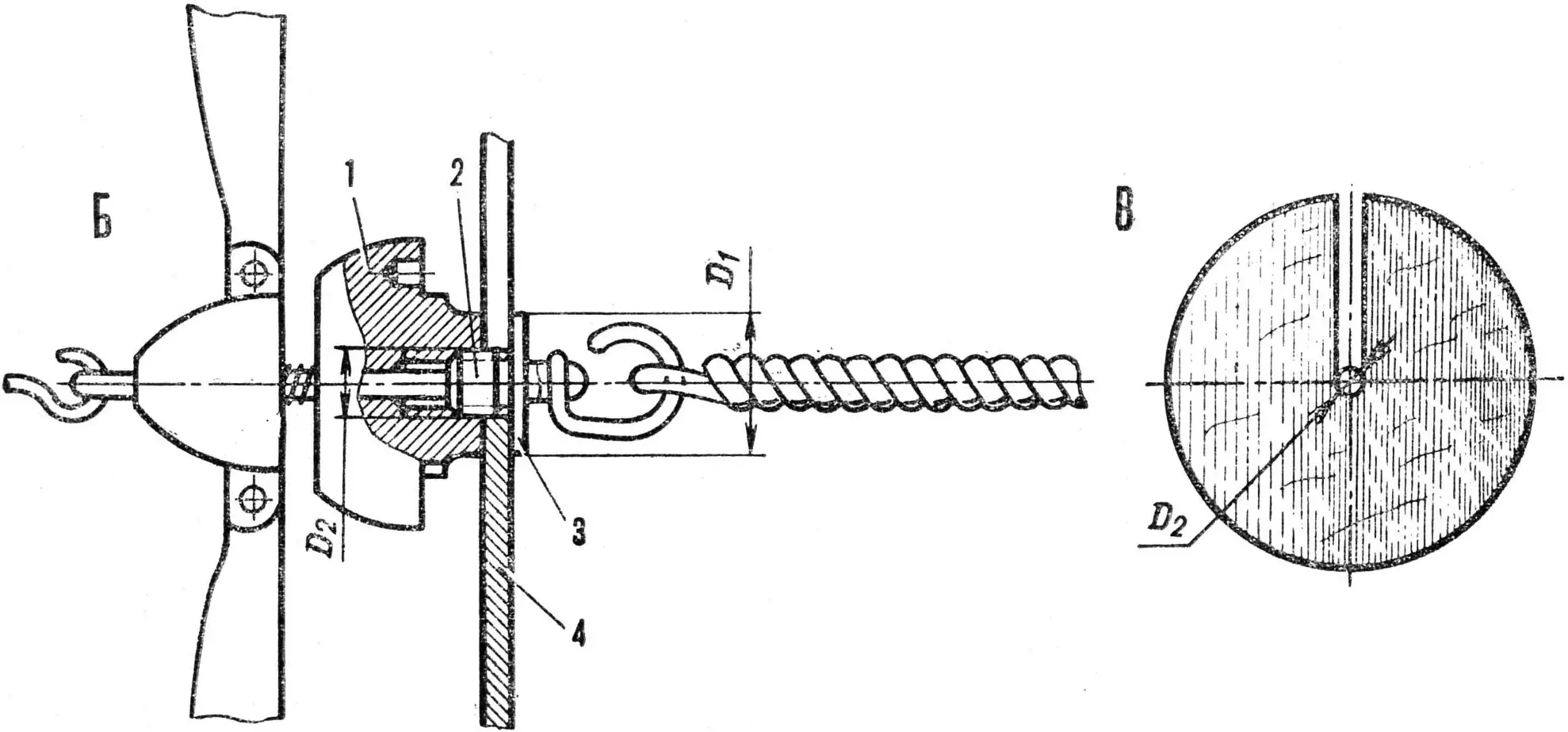
B — propeller design with a protective disc: 1 — boss, 2 — threaded part of the shaft, 3 — shoulder, 4 — protective disc;
C — protective disc.
For a number of years I have successfully used a protective disc that is secured on the hub by means of a threaded stop. The threaded part of the shaft ends, on the rubber-motor side, in a shoulder. Its diameter is larger than that of the shaft and equals the diameter of the hub boss. (Thread diameter — 6×1; shoulder — 9 mm.)
The protective disc is made from a D16T sheet 1—1.5 mm thick and has a Ø 6.2 hole in the center that is extended into a radial slot. Before the rubber motor is wound, the disc is inserted into the gap between the boss and the shaft shoulder and tightened, which securely holds it on the propeller hub. A light tap on the edge of the disc is enough for the boss to turn and move forward along the shaft. The disc slips out into the resulting clearance thanks to the radial slot, and the shaft is disconnected from the boss. Now all that remains is to insert it into the model.
“M-K” 10’79, O. LAGUTIN
Recommend to read
 MODEL CLASS F3B
The fuselage is laminated entirely of fiberglass, applying resin To Tina-153. The bow compartment to the first frame filled with foam PS-1, which cut the slots for placing the battery... “MULTILATERAL” HACKSAW
Definitely interesting clue is given in No. 2, 1982, in the article "Handsaw — a universal tool" to fix on one drank the landlord several Polota. Want to offer a design that allows to...
